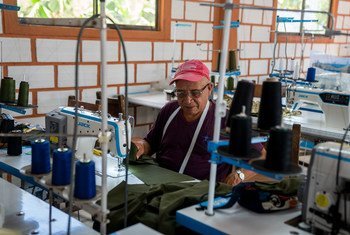
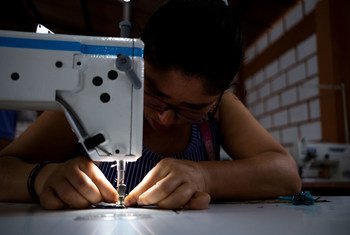
The COVID-19 pandemic has affected global food systems worldwide, causing food insecurity and malnutrition (ILO/Maxime Fossat)
Approximately three billion people, almost 40 per cent of the world’s population, cannot afford a healthy diet and another one billion people would join their ranks should further unpredictable events reduce incomes by one-third, the UN food agency said, launching a new report on Tuesday.
The report defines shocks as short-term events that have negative effects on a system, people’s well-being, assets, livelihoods, safety and ability to withstand future shocks.
More resilience
FAO stressed the need for countries to make their systems more resilient to sudden shocks, like the COVID-19 pandemic, which played a large part in the latest global hunger surge.
At the virtual launch event, FAO Director-General, QU Dongyu, said, “the pandemic highlighted both the resilience and the weakness of our agrifood systems”.
Agrifood systems – the web of activities involved in the production of food and non-food agricultural products and their storage, processing, transportation, distribution and consumption – produce 11 billion tonnes of food a year and employ billions of people, directly or indirectly.
The UN agency underscored the urgency of strengthening their capacity to endure shocks, including extreme weather events and surges in plant and animal diseases and pests.
While food production and supply chains have historically been vulnerable to climate extremes, armed conflicts or increases in global food prices, the frequency and severity of these shocks are on the rise.
Concrete action
Moreover, a disruption to critical transport links could push food prices up for some 845 million people.
The report includes country-level indicators in over one hundred Member States, by analyzing factors such as transport networks, trade flows and the availability of healthy and varied diets.
While low-income countries generally face much greater challenges, middle-income countries are also at risk.
In Brazil, for example, 60 per cent of the country’s export value comes from just one trading partner, narrowing its options should a shock hit that partner country.
Even high-income countries, such as Australia and Canada, are at risk because of the long distances involved in the distribution of food.
Recommendations
Based on the evidence in the report, FAO makes a series of recommendations.
The key is diversification – of actors, input sources, production, markets and supply chains – to create multiple pathways for absorbing shocks.
Supporting the development of small and medium agrifood enterprises and cooperatives would also help maintain diversity in domestic value chains.
Another key factor is connectivity. Well-connected networks overcome disruptions faster by shifting sources of supply and channels for transport, marketing, inputs and labour.
Finally, improving the resilience of vulnerable households is critical to ensure a world free from hunger. This can be done by improving access to assets, diversified income sources and social protection programmes.
CIAT/NeilPalmer
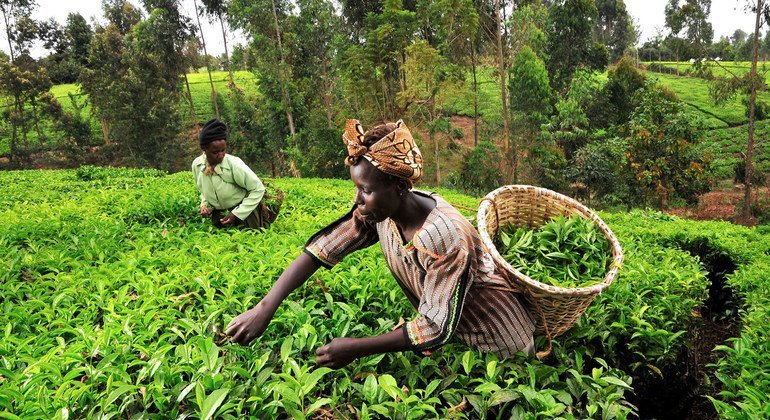
A number of tea pickers in Kenya are shifting to produce other crops as climate change threatens tea plantation in the country.
Governor Abudullahi Umar Ganduje of Kano State, Northwest Nigeria
Your Excellency, the Khadimul Islam I am prayerful that my letter reached you sound – and in still in the spirit of helping Kano state citizens to acquire good knowledge.
Your Excellency, my name is Muhammad Bashir and I am a citizen of Kano. I was born in Magashi Quarters of Gwale Local Government Kano, in the metropolis. I am a grandson to Late Malam Idi Kura, one of the rare gems that sacrificed their lives to educate people in Kano years ago.
My grandfather served as Primary Head at Kwankwaso – and I have equally taught for nearly six years at different schools in Kano, voluntarily.
Sir, may I seek your permission to remind you about Kano people’s belief in you – and their level of understanding that leading a ‘mighty’ state like Kano is not easy – because, Alhamdulillah, there’s a huge demand and expectations from the subjects on you.
We must also commend you for standing alone to get rid of illiteracy through introducing a “free and compulsory education” law in our state.
However, it is high time to call upon you to reconsider the appointment you have given Muhammad Sanusi Sa’idu Ƙiru, to serve us as education commissioner.
Your Excellency, it is luckless that Ƙiru has not been representing you, the driver of modern literate Kano, well.
Your Excellency, I do not want to inform you of what may dishearten you, but considering your commitment to make our state sound educationally, many schools across Kano are in a very sorry state – due Ƙiru’s reckless management.
Sir, I developed interest to draft and send you this letter when I read ‘serially’ about one “about to die” school at Tudun Maliki as well as many other public schools in the state.
To be honest, Your Excellency, Hon. Ƙiru has not only been unkind to to education in Kano, but also journalists – for he has pushed number of Kano journalists to the grieving wall because, Your Excellency, Ƙiru has never been a friend to pen holders like you are.
I may not wish it be happy to see Ƙiru ‘forcefully’ leaving his office, but it will make Kano citizens happy to have you address this situation and rescue the future of their wards through any possible means.
I am sending this, sir, because I am one of those ‘few’ citizens that still have positive hope in you – and want your administration to scale.
I am prayerful that my letter would be given sighting consideration.
The reintegration of former FARC combatants into civil society is being facilitated at a site in the small town of Llano Grande in Dabeiba, Colombia (UNMVC/Esteban Vanegas)
UN Secretary-General António Guterres is headed to Colombia this week to mark the fifth anniversary of the signing of the peace accords that ended 50 years of conflict in the country, and his activities will include travel to the village of Llano Grande, where the townspeople and former combatants are working together to secure a better future.
This small village is an example of how, through peace and reconciliation – and determination – a new ‘family’ can be forged from among old enemies.
UN News traveled to the region ahead of the Secretary General, who’s two-day visit will begin Tuesday 23 November.
Familia Llano Grande reads a mural at the entrance of this Colombian town where ex-combatants, locals, soldiers and police coexist. This would have been unthinkable just five years ago, before the peace deal was reached that brought an end to the conflict between the Colombian Government and the Revolutionary Armed Forces of Colombia, known as the FARC EP.
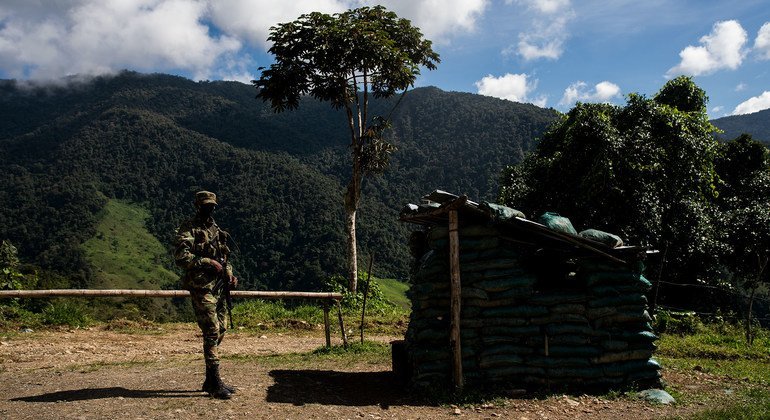
A soldier stands in a former FARC guerilla camp in Dabeiba, Colombia (UNMVC/Esteban Vanegas)
Family, of sorts
All sides consider themselves victims of a conflict that lasted too long. They are now a “family” of sorts. One that has had its ups and downs, and wounds that need healing, but which in this case, the United Nations is helping through what could be called ‘reconciliation therapy’.
Peace “has brought many benefits for the peasants, for the communities, for the public force. Mainly for the Llano Grande family. We take care of each other, we meet, we see how we can help each other,” says a member of the small contingent of the Army, stationed on the side of the mountain where Llano Grande is located, and who preferred not to give his name.
“Oh yes, now we are a family,” said 67-year-old Luzmila Segura, who remembered that during the, she woke up on many mornings filled with fear.
“You saw the armed people arriving. Oh, how scary! My God! We thought they were coming to kill us,” she recalled, adding that armed guerrillas attacked the mountainside village “many times” and even ransacked her small ranch in the countryside and burned everything in sight. She was forced to leave her farm and go to live to a nearby village.
But since the peace deal was signed, Ms. Segura said, smiling: “Now I feel very happy because they gave me the house. Now it’s very calm here. We all work together as a family. Peace has [held] and so far, everything is going well. All together. It has already taken away my fear.”
She now works at a new Arepas factory, started with the help of the UN Food and Agriculture Organization (FAO).
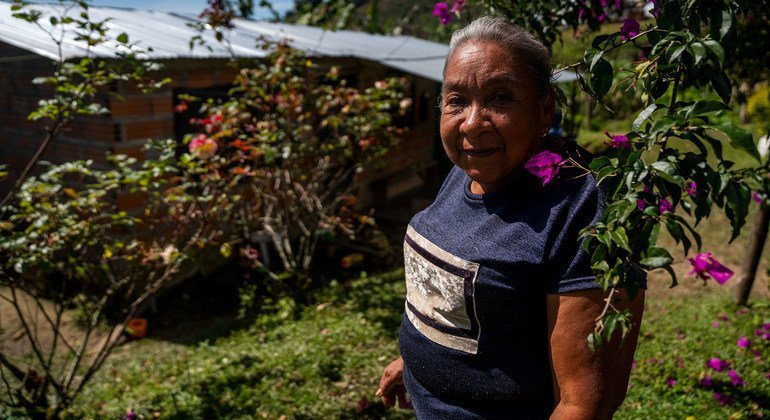
Farmer and conflict victim Lucila stands outside her house which was rebuilt after the peace process in Colombia (UNMVC/Esteban Vanegas)
We are all ‘working for peace’
Carmen Tulia Cardona Tuberque, who runs the Arepas factory where Ms. Segura works, says she prefers to talk about the present because the past too painful. She shies away from the details of her personal story that includes a husband who was killed in the conflict, a sad refrain echoed by many who stayed in Llano Grande, as well as those who fled.
“I believe this is a community that, despite so many difficulties that it has been through, today has everyone together working for the same cause, peace. You never thought this was going to happen,” she said, looking plaintively out at the horizon.
“The community contributes a grain of sand to the people. We, here as a community, support each other, because harmony depends a lot on that,” she continued, her face lighting up a bit as she added that many people displaced by the fight are returning to Llano Grande. “That is something that motivates you a lot.”
Similarly, Jairo Puerta Peña, a former combatant who joined the FARC when he was 14 years old, “around 45 years ago”, who now attends a training course in construction, said he also feels he is part of the Llano Grande family. “We all have the same goals: To live better, to work with peace of mind.”
After his morning training class wrapped up, Mr. Peña detailed how his life has changed in the past five years: “Life in war was always walking, knowing, talking to the population, studying and training the troops so we would not be killed when we had to face the enemy. After the Peace Accords, life has been calmer. There is peace of mind … being with family, sleeping, eating, working … The shots, the bombs and the helicopters loading troops are no longer heard.”
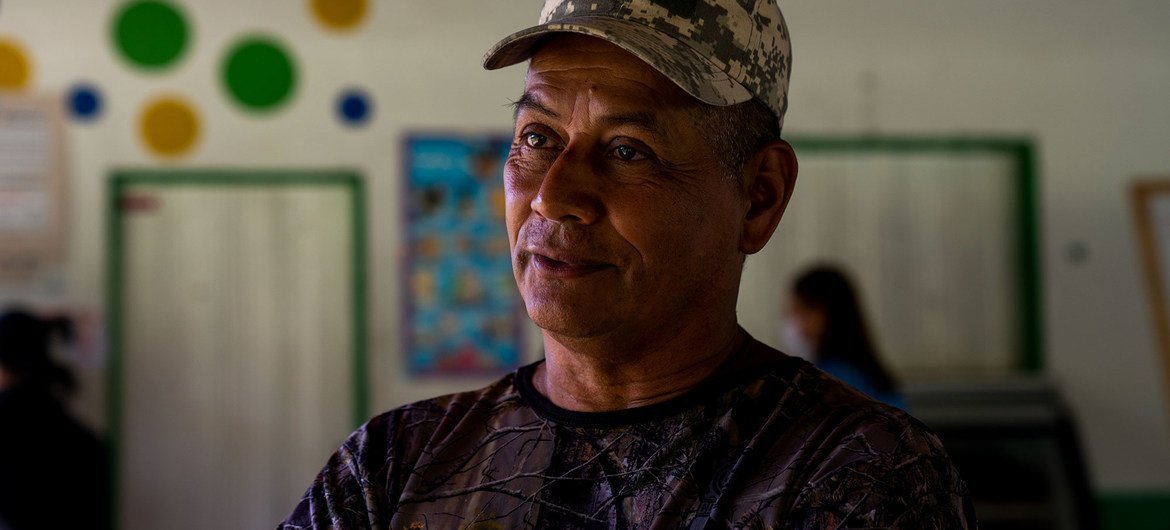
Ex-FARC combatant Jairo Puerta Peña attends class as part of a process to return to a life without conflict in Colombia (UNMVC/Esteban Vanegas)
An ex-combatant’s struggle for a ‘normal’ life
Mr. Peña’s friend and fellow ex-combatant, Efraím Zapata Jaramillo, who was 21 years old when he left his construction job in Medellín and “went up the mountain” with the FARC in the department of Caquetá, explained how he went from being in the mountains with a rifle to struggling to reintegrate into society “and have a normal standard of living, like any Colombian.”
Ex-FARC combatant Efrain Zapata Jaramillo works in a tailor shop as part of a process to return to a life without conflict in Colombia (UNMVC/Esteban Vanegas)
“All of us here, ex-combatants, non-combatants, the police and the Army, are a family fighting for peace to move forward and not take up arms again. The word should be our weapon; [and we should use it] to not only defend our rights but also those of the Colombian people. Especially the peasantry, who have been abandoned by the State,” he says, sitting in front of the sewing machine which he uses to make garments for the community, thanks to assistance from the UN Development Programme (UNDP).
Sitting next to him in the tailoring workshop is Monica Astrid Oquendo, a young peasant woman for whom the Peace Accords have brought not only peace of mind, but many opportunities to learn and train in ways that have benefited the community so much.
“We are like a family because we share ideas, we share work,” she says.
Former farmer Monica Astrid Oquendo works in a tailor shop as part of a process to return to a life without conflict in Colombia (UNMVC/Esteban Vanegas)
With a measuring tape hanging around her neck, Ms. Oquendo is excited about the handcrafted sweatshirts and polos she has made, and the windbreakers she is learning to construct. They will be sold in the valley and beyond, to protect motorcycle riders from the sun, rain and cold.
A village teacher helps build a family
When it was announced that 117 ex-combatants were going to be relocated to Llano Grande for their reintegration, Mariela López, a teacher at the town’s school, felt fear, but had few doubts about what she thought was best for Llano Grande and Colombia as a whole.
“That first day that I saw them again, I left. I went to town and down there, I sat down to cry. I said, how can I talk about peace if I have not forgiven? But if I do not forgive, then the one who is hurting is me. And I said to myself I don’t want any family in Colombia to live what I experienced, and from today I am going to contribute whatever it takes so the peace process can take place and so reconciliation can be experienced in Llano Grande,” she explained.
Later, when she met the ex-combatants, she changed his opinion of them: “We thought, and not only me, that ex-combatants were aggressive people because of what we had experienced, but when they arrived, then I thought they are not so bad and – I am going to apologize for what I am going to say – I think that many of them are also victims.”
The UN lends a hand
Located in the department of Antioquia, Llano Grande is a village of 150 inhabitants. It is also the site of one of the Territorial Spaces for Training and Reincorporation, which facilitate the reintegration of ex-combatants into civil society, while benefiting the surrounding communities.
It is located on a property that was bought and handed over to the ex-combatants in the municipality of Dabeiba. It is estimated that in Antioquia, 80 per cent of the population was caught up in Colombia’s armed conflict. Historically, the region served as a stronghold for numerous armed groups that were strengthened by illegal economies – illegal mining and illicit crop cultivation.
As all those who UN News spoke to for this article have shown us, peace – and family – are made up of many elements: trust, reconciliation, reintegration, forgiveness, and hard work.
Since the signing of the peace agreement, the UN Verification Mission in Colombia, alongside various UN agencies and Offices, has been accompanying the Llano Grande family on its journey, making it possible for the words in the accord to take root.
This support has been fundamental.
For Mr. Peña because “it has prevented the Colombian Government from doing whatever it wanted with the Accords”.
For Ms. Segura, because “the community has given me a new home”.
For Ms. Cardona because she has started work in her Arepas factory.
For Mr. Zapata and Ms. Oquendo because they are making hands-on decisions at their clothing workshop.
And for Ms. Lopez, because she has provided the music programmes, computers, and desks for the children at her school.
All in all, with the support of the UN, some 15 projects have been launched – ranging from soap manufacturing to fish farming, to education, clothes-making, livestock, and agriculture.
Former FARC guerilla camp Llano Grande in Dabeiba, Colombia (UNMVC/Esteban Vanegas)
Some promises not met
But like the winding paths that cut through the verdant, heavily forested mountains of Llano Grande, the road to peace has many twists and turns, and takes determination reach the desired destination.
Indeed, both Mr. Zapata Efraím and Mr. Peña point out that “some aims of the peace deal have been accomplished while others have not”. Both noted some key actions have yet to be taken by the Government in the areas of housing, land, and food.
At the same time, many projects in Llano Grande are stalled due to lack of funds or technical follow-up, and in some cases, even due to a lack of commitment from the ex-combatants. Moreover, since April 2021, there have been persistent delays and reductions in the food supply, causing unrest and doubts about the long-term sustainability of the local-level reintegration and reconciliation efforts.
Llano Grande and communities like it have made strides in the wake of the peace deal, but in other places, there is still much work to be done.
Not too far from Llano Grande is the municipality of Apartadó, where the Government will hold the ceremony to commemorate the fifth anniversary of the signing of the Peace Accords, which the UN Secretary-General will attend.
There, the Mayor’s Office has begun construction of a “fundamental highway to connect the rural areas (where the ex-combatants are) with the city”, but currently, there are no resources to finish the project.
And some members of the municipality have cautioned that although there is no conflict between ex-combatants, civilians, military and paramilitaries, there is no reconciliation either; rather, “each one does his own thing without messing with the other,” UN News was told.
In the same department of Antioquia, the Ombudsman’s Office has issued 31 alerts related to homicides, attacks, threats, displacement and stigmatization of former combatants. Since 2017, the department has registered 30 homicides and four disappearances, the vast majority of them men.
Finally, in other parts of Colombia, such as the department of Chocó, things are reportedly more serious, and the UN Human Rights Office (OHCHR) indicated this past Thursday that the situation is “alarming” and that “serious violations” are being committed.
Guterres in Colombia
During his visit, Secretary-General António Guterres will meet with Colombian President Iván Duque and other Government officials, as well as with leaders of the former FARC-EP guerilla movement.
He will attend commemorative events and observe peacebuilding and reconciliation efforts involving former combatants, communities, and authorities. Mr. Guterres is also expected to meet with heads of the transitional justice system, victims of the armed conflict, and leaders of Colombian civil society, including women, youth, indigenous and Afro-Colombian representatives, as well as human rights and climate activists.
Through his visit, the Secretary-General will take stock of the major achievements of the peace process, as well as the outstanding challenges. He plans to convey a strong message of encouragement for the continued implementation of this far-reaching and transformative Peace Agreement for the benefit of all Colombians.
Small arms and light weapons are collected and sorted for destruction at a facility in Serbia. (UNDP/SEESAC)
Small arms trafficking is a “defining factor in undermining peace and security”, the Director of the UN Institute for Disarmament Research (UNIDIR) told the Security Council on Monday during a ministerial debate.
Robin Geiss said that that diversion and trafficking of arms “destabilizes communities and exacerbates situations of insecurity, including by committing serious violations of international humanitarian law and human rights law, as well as violence against women and children in various contexts”.
The Council met under the chairmanship of Mexican Foreign Secretary Marcelo Ebrard as one of the signature events of Mexico’s November presidency.
Diversion and trafficking
As the unrestricted flow of weapons continues to fuel violence, it is a shared global responsibility to seek solutions, according to the concept note.
Throughout the lifecycle of arms and ammunition – from the production stages to their final use – moments exist when they can be diverted or trafficked to non-State armed groups, criminals and terrorist actors.
Mr. Geiss upheld that this “destabilizes communities and exacerbates situations of insecurity, including by committing serious violations of international humanitarian law and human rights law, as well as violence against women and children in various contexts”.
While direct effects include deaths, injuries, displacement, and psychological harm, there are also long-term socio-economic consequences, such as access to health and education, the delivery of humanitarian services, and the protection of civilians.
For Mr. Geisss, this illicit trade is also dynamic and multi-faceted.
“When loopholes and gaps are closed in one domain, vulnerabilities are exploited in another”, he said. “States affected by patterns of recurring armed violence, therefore, face many challenges to prevent the diversion and misuse of arms”.
Research-backed solutions
A UNIDIR review of 200 documented cases highlighted the importance of preventing diversion, not only from national stockpiles, but also from the country that manufactured and exported them.
“National ownership is fundamental” in this area, said Mr. Geiss, but “will not achieve success without international cooperation and assistance”.
Between 2015 and 2020 the UNIDIR supported 11 States in conducting assessments on weapons and ammunition management, known as WAM.
Today, the Institute’s chief said, the issue is increasingly recognized as a fundamental component of conflict and armed violence prevention.
Mr. Geiss described now as “an opportune moment” for an international dialogue to strengthen multilateral, regional, and national policies and practices.
“Advancing a United Nations strategic approach to WAM could further enhance multilateral efforts to deliver peace, security, stability, and development around the world”, he argued.
Civil society
Council Members also heard from María Pía Devoto, who represented Argentina’s Coalición Armas Bajo Control – a coalition of 150 civil society organizations created to implementat the Arms Trade Treaty.
She upheld that the “devastating impact” of this problem “is felt most acutely among communities in conflict-affected regions, where these weapons perpetuate a vicious cycle of violence and insecurity.”
Ms. Devoto also said that mandatory Security Council arms embargoes are being undermined by violations carried out by non-State actors and even UN members.
“The most egregious recent example is the Libyan embargo, which, in March this year, was described by the Panel of Experts as ‘totally ineffective’”, she recalled, urging Council Members to act, including through sanctions.
“Mr. President, you and your colleagues have at your disposal the tools, knowledge and experience to combat the illicit trafficking and diversion of small arms and light weapons. It’s about finding the political will to do it”, concluded Ms. Devoto.
Lai Mohammed, Nigeria's Minister of Information and Culture
Text Of The Press Conference Addressed By The Hon. Minister Of Information And Culture, Alhaji Lai Mohammed, In Abuja On Tuesday Nov. 23rd 2021 On The Report Of The Lagos State Judicial Panel Of Inquiry And Restitution To Investigate Cases Of Police Brutality And The Incident Of Oct. 20th 2020 At Lekki Toll Gate
Good morning gentlemen
2. It’s no longer news that the Lagos State Judicial Panel of Inquiry that investigated cases of police brutality as well as the incident of Oct. 20th, 2020, at Lekki Toll Gate in Lagos has submitted its report. The submission happened while I was out of the country on national assignment. Unlike many commentators and analysts, we took our time to read and digest the report, and we are now well placed to respond.
3. Without mincing words, let me say that never in the history of any Judicial Panel in this country has its report been riddled with so many errors, inconsistencies, discrepancies, speculations, innuendoes, omissions and conclusions that are not supported by evidence. What is circulating in public space is simply a rehash of the unverified fake news that has been playing on social media since the incident of Oct. 20th 2020. It is simply incredible that a Judicial Panel set up to investigate an incident has submitted a report laden with allegations, the same allegations it was set up to investigate in the first instance. Instead of sitting for all of one year, the panel could have just compiled social media ‘tales by the moonlight’ on the incident and submitted, saving taxpayers’ funds and everyone’s time. That report is nothing but the triumph of fake news and the intimidation of a silent majority by a vociferous lynch mob.
4. Gentlemen, we have read some critical analysis of the report by a courageous few. One commentator, a lawyer, said it raised more questions than answers. Another commentator, a journalist, called it a ‘disgraceful report by a disgraceful panel’, saying it reported allegations instead of investigating the allegations. Yet another wondered how a Judicial Panel could use the words ‘massacre in context’ and equate such to a massacre. All these and many more have raised valid questions on that report. We salute their courage and refusal to be cowed by the rampaging lynch mob that has been screaming blue murder since the report was released.
5. We do not intend to bore you by rehashing details of the discrepancies, innuendoes, inconsistencies and errors in that report. They are already in the public space. Let us, however, point out some key highlights of such discrepancies, errors, omissions, etc.
i) – The report threw away the testimony of ballistic experts who testified before it. The experts said, inter alia, in their testimony:
”The Team finds that from the medical data examined, including the timeline of arrival at medical facility and the nature of the injuries sustained by the Victims, who were taken to the 5 medical facilities, that no military grade live ammunition (high-velocity) was fired at the protesters at Lekki Tollgate on 20th October 2020, within the timeframe of reference (18.30- 20.34hrs). That the GSW (Gun Shot Wounds) injuries (4 in number between 19:05 and 19:45 hrs), which were examined by the Team, can be safely identified as being discharged by either low velocity caliber and/or artisanal/12-gauge firearms (artisanal firearms are locally-fabricated weapons). What is however certain is that had the military personnel deliberately fired military grade live ammunition directly at the protesters; there would have been significantly more fatalities and catastrophic injuries recorded. This was clearly not the case.’’
ii) – The same panel that said it deemed as credible the evidence of the Forensic Pathologist, Prof. John Obafunwa, that only three of the bodies on which post mortem were conducted were from Lekki and only one had gunshot injury went on to contradict itself by saying nine persons died of gunshot wounds at Lekki!
iii) – The man whose evidence (that he counted 11 bodies in a military van where he was left for dead before he escaped) was found to be crucial by the panel never testified in person. Rather, the video of his ‘testimony’ was played by someone else. It did not occur to the panel to query the veracity of the testimony of a man who said he was shot and presumed dead but still had time to count dead bodies inside a supposedly dark van at night!
iv) – The panel said trucks with brushes underneath were brought to the Lekki Toll Gate in the morning of Oct. 21 2020 to clean up bloodstains and other evidence, but still found bullet casings at the same site when it visited on Oct. 30th 2020. It said soldiers picked up bullet casings from Lekki Toll Gate on the night of Oct. 20th 2020, yet claimed that policemen came to the same spot to pick the same bullet casings on Oct. 21st 2020!
v) – The panel was silent on the family members of those reportedly killed, merely insinuating they were afraid to testify. Even goats have owners who will look for them if they do not return home, not to talk of human beings. Where are the family members of those who were reportedly killed at Lekki Toll Gate? If the panel is recommending compensation for the families, what are their identities and addresses? Who will receive the compensations when no family members have shown up to date?
vi) – How did a man who reported seeing the lifeless body of his brother himself ended up being on the list of the panel’s deceased persons?
vii) – How can a Judicial Panel convince anyone that the names of some casualties of the Lekki Toll Gate incident listed as numbers 3 (Jide), 42 (Tola) and 43 (Wisdom) are not fictitious names.
viii) – Why did the Judicial Panel feel compelled to concoct a ”massacre in context” as a euphemism for ”massacre”? A massacre is a What is ”massacre in context?”
ix) – The report never mentioned cases of police personnel who werebrutally murdered or the massive destruction of police stations,vehicles, e.t c during the Endsars protest. Does this mean that the panel didn’t consider policemen and women as human beings?
x) – The report didn’t make any recommendation on the innocent people whose businesses were attacked and destroyed during the protest in I think it was too busy looking for evidence to support its conclusion of ‘massacre in context’.
6. It is clear, from the ongoing, that the report of the panel in circulation cannot be relied upon because its authenticity is in doubt. Besides, the Lagos State Government, being the convening authority, has yet to release any official report to the public. Neither has the panel done so. The cowardly leakage of an unsigned report to the public is not enough. Assuming the report in circulation bears any iota of genuineness, it is basic knowledge that the report of such a panel is of no force until the convening authority issues a White Paper and Gazette on it. It is therefore too premature for any person or entity to seek to castigate the Federal Government and its agencies or officials based on such an unofficial and unvalidated report.
7. CNN AND OTHERS The CNN has been celebrating the leaked report of the Lagos State Judicial Panel of Inquiry. In its rush to claim vindication, CNN apparently didn’t even read the report before rolling out the drums in celebration. By that action, CNN has celebrated prematurely and has now committed a double faux pas: First, by relying on unverified social media stories and videos to carry out an investigation of the Oct. 20th 2020 incident at Lekki, where it did not have a correspondent on ground. CNN goofed in its report on the findings of the panel, which fell below the main standards of journalism. Secondly, CNN rushed to the air to celebrate an unsigned and unverified report that is riddled with inconsistencies, errors, discrepancies, innuendoes. That’s double faux pas by a news organization that is eager and willing to compromise standards just to claim vindication.
8. Sadly, a section of the Nigerian media has also joined the lynch mob. Honestly, in an attempt to vilify government at all costs, they have done themselves a great disservice. How can any news organization worth its salt write an Editorial validating this kind of report? Are they not seeing what others, including journalists and lawyers, are seeing? In a shocking twist, a Nigerian newspaper chose to hail what it calls ‘’detailed investigative report’’ by CNN, even when the news channel did not even cover the incident of Oct. 20th2020! It’s a classic case of cutting your nose to spite your face.
9 CONCLUSIONS i) – Gentlemen, there is absolutely nothing in the report that is circulating to make us change our stand that there was no massacre at Lekki on Oct. 20th 2020. For us to change our stand, a well-investigated report of the incident that meets all required standards and will withstand every scrutiny must be produced and presented to the public. The report in circulation does not meet those requirements. We also appeal to the families of those allegedly killed in Lekki to speak out. It’s untenable to say that some families did not come out because they are afraid. Any parent who is afraid to testify about the death of his or her child is not worth to be called a parent.
ii) – We reject the notion that our soldiers and policemen massacred innocent Nigerians at Lekki on Oct. 20th 2020. That conclusion is not supported by the weight of available evidence. Indictment for murder is a very serious issue that cannot be done on the basis of allegations and corroborations, as the panel did. Such allegations must be proved beyond a reasonable doubt. The report in circulation is calculated to embarrass the Federal Government and its agencies without fool proof evidence. The Federal Government has never condoned the abuse of the rights of Nigerians by security agencies under any guise, hence it disbanded SARS and encouraged states to set up the panels to investigate reports of human rights abuses allegedly committed by the disbanded SARS personnel
iii) – The 37 policemen and six soldiers who died across the country during the Endsars protest are also Nigerians and should not be forgotten.
iv) – Those who have engaged in premature celebration of the report in circulation should now go back and read it thoroughly and tell Nigerians whether it can pass any serious scrutiny.
v) – We are saddened that anyone died at all during the Endsars protest as the life of every Nigerian and indeed every human is sacrosanct. As we have disclosed many times, 57 civilians, 37 policemen and six soldiers were killed across the country during the protest, and we commiserate with their families.
10) Gentlemen, I thank you for your kind attention. I will now take your questions
In its last reports, Nigeria’s Debt Management Office (DMO) released debt profiles of all the 36 states and the federal capital territory (Abuja), with Borno emerging the state with lowest amount of debt nationwide.
According to the DMO report released at the end of June, 2021, Borno was followed by Taraba, Yobe and the FCT in owing the least amount of foreign debts.
Borno owes $16.70 million, Taraba- $20. 59 million, Yobe- $25.81 million and the FCT- $29.45 million, the DMO reports (see table below).
On the other hand, the report showed Lagos, Kaduna and Edo in that order, with the highest external debt profiles.
Lagos owes $1.38 billion, Kaduna- $559.50 million, and Edo-$ 281.47 million, Cross River- $184.60 million, Bauchi-$133.69 million, Enugu-$124.22 million and Adamawa- $116.49 million. Remaining states owe ranges of around $100m to $29 million each.
The DMO report indicated that Nigeria has an external debt stock of $33.46b equivalent to N13.8tr, where federal government owes $28.91b while the 36 states and the FCT owe a combine amount of $4.55b as external debt.
Borno Governor, Professor Babagana Umara Zulum was on Sunday conferred with Honorary Doctorate of Letters (LLD), honoris causa by Afe Babalola University in Ado Ekiti, capital of Ekiti State, South West Nigeria..
The University said Zulum was honoured for his “exceptional” performance since becoming Governor in 2019.
The conferment was done during the University’s ninth convocation ceremony attended by Governor Zulum in Ado-Ekiti.
Host Governor Kayode Fayemi attended the convocation.
Proprietor and chancellor of the University, Afe Babalola, SAN, paid tribute to Governor Zulum’s unwavering commitment and dedication in serving his people.
He said,m the award was in recognition of Zulum’s courage and resilience, as well as honesty in the face of daunting challenges facing his state.
The University’s Vice Chancellor, Prof. Smaranda Olarinde had at a press conference on Monday, November, 15, 2021 announced that Zulum was to be honoured for his “proven integrity, character and exceptional contributions to the development of the society”.
The VC also disclosed that The Ooni of Ife, Oba Enitan Ogunwusi, Emir of Ilorin, Alhaji Sulu Gambari and Ewi of Ado Ekiti, Oba Rufus Adeyemo Adejugbe were to be honoured as well with honourary doctorates to appreciate their services.
Governor Zulum was accompanied to Ado Ekoti by Senator Abubakar Kyari of Borno North, Senator Ali Ndume of Borno South, Deputy Speaker of Borno State Assembly, Engr Abdullahi Askira, Chief of Staff Prof. Isa Hussaini Marte, Commissioner for Higher Education, Dr Babagana Mallumbe Mustapha, and the Vice Chancellor of Borno state University, Prof. Kyari Sandabe.