Home Blog Page 537

Nigeria: 40-Year Old Man Dies In Tanker Accident Explosion

0

By Iliya Kure

In Kano state, northwest Nigeria, a 40-year-old driver with Julius Berger Construction Company, Aminu Dakatsalle, has been burnt to death following an accident involving his trailer and a petrol tanker.

Information from Kano State Fire Service says Mr. Dakatsalle, ran into a petrol tanker which broke down on the road, conveying about 60,000 litres of PMS from Zaria to Kano.

Public Relations Officer (PRO) of the Fire Service, Saminu Yusif Abdullahi, said the driver of Julius Berger truck [Dakatsalle] got trapped in the vehicle and all efforts to save him proved abortive as he was engulfed by fire.

“Our formation received a rescue call from Kura Fire Service Divisional Officer, Auwalu M. Sani, our fire fighting crew arrived at the scene at about 13:00,” he said.

He added that all the vehicles and victim were burnt beyond recognition, adding that the deceased has been handed over to Garun Malam Police Division Officer, Maisoro Usman.

Nigeria Introduces Toll-Free Number For Reporting GBV

0

By Sunday Elijah

Nigeria has introduced a 4-digit shortcode toll-free telephone line to encourage citizens to report cases of sexual and gender-based violence.

The shortcode number is 6472.

Executive Secretary of National Human Rights Commission (NHRC), Mr Tony Ojukwu, announced this in Abuja at a multi-agency task team meeting on the Sexual and Gender-Based Violence register.

According to him the number would make it easier for survivors to obtain, report, and activate support and urged the public to use the code properly to report GBV cases.

Also speaking, a Deputy Director from National Agency for the Prohibition of Trafficking in Persons (NAPTIP), Mr Titus Amariju, says of the 25 states that have passed the Violence Against Persons Prohibition, VAPP Act, 7 have so far joined the Sexual Offender Register platform.

Mr Amariju stated that Edo had 202 sexual offenders, Delta had 105, and Kano had 38.

Nigeria: Buhari Inaugurates $2.5bn Dangote Fertiliser Plant in Lagos

0
Dangote Fertiliser Plant, Lagos

President Muhammadu Buhari of Nigeria has flagged-off the Dangote Fertiliser Plant in Lagos, south-south of the country, estimated to have cost about $2.5 billion. The fertiliser complex occupies 500 hectares of land in Lekki Free Trade Zone, Lagos

The plant acclaimed as Africa’s largest granulated urea fertiliser is expected to reduce Nigeria’s reliance on importation and increase its foreign earnings.

“On behalf of the very very large community and millions of direct and indirect jobs that this complex will be providing, I want to thank Alhaji Aliko Dangote”, the Lagos State Governor, Babanide Sanwo-Olu said.

President, Dangote Group of Industries, Alhaji Aliko Dangote stated that the company was working with farmer associations, corporate farms, NPK blenders, development partners and state governments all over Nigeria, as well as governments across Africa and beyond who are looking for sustainable approach to improve soil and farm yields.

“Our goal is to make fertiliser available in sufficient quantities and quality for our teeming farmers, assuring greater agricultural outputs”, Alhaji Aliko said.

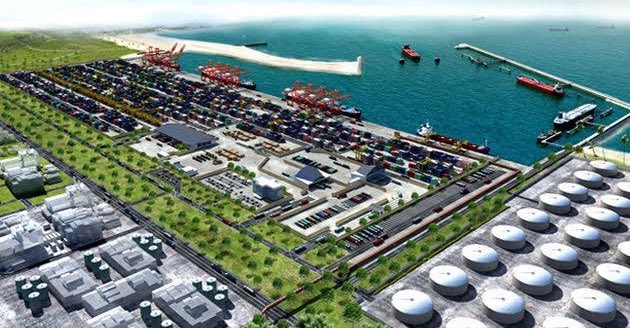
Similarly, President Buhari also inspected the ongoing construction work at the Lekki Deep Sea Port in Lagos.

Lekki Deep Sea Port in Lagos

The President who did a very brief inspection of the Port was accompanied by the APC leader, Asiwaju Bola Ahmed Tinubu, the Minister of Information and Culture, Alhaji Lai Muhammed amongst others.

Minister of Transportation, Rotimi Amaechi had earlier told journalists, that inviting the President had forced the contractors handling the project, China Construction Communication to speed up work.

Mr Amaechi noted that the project would be due for commissioning by September.

The Governor of Plateau State, Simon Lalong noted that the port would facilitate activities of the Jos Dry Port, being handled by the Nigerian Shippers Council.

Also, Managing Director of the Nigerian Ports Authority, Mohammed Bello Koko said the Lekki Deep Sea Port would be properly regulated, just like the Tin Can Island and Apapa Port, adding that the port would ensure speedy delivery and clearing of goods and cargoes.

”So what it means is that there will be a reduction in the traffic and the pressure on tincan and apapa port”, Mr Koko said.

The visit of President Muhammadu Buhari to the Lekki Deep Sea Port also had in attendance the Director General of NIMASA, Bashir Jamoh and major stakeholders in the maritime sector.

Construction of the Lekki Deep Sea Port, at Ibeju Lekki Lagos began in 2017 and is estimated to add $461 billion to the country’s GDP in 35 years.

The Lagos State Government injected ₦106 million into the project.

RN

Take Decisive Measures To Address Climate Change, Mapisa-Nqakula to World Parliaments

0
South Africa's National Assembly Speaker, Nosiviwe Mapisa-Nqakula (Credit: NCTV)

South Africa’s National Assembly Speaker, Nosiviwe Mapisa-Nqakula, has urged the heads of parliament around the world to take all necessary steps to deal with climate change.

This, Mapisa-Nqakula said, can be done through oversight and other interventions with the constitutional powers of the institutions they lead.

Mapisa-Nqakula is leading a multiparty delegation of senior members of the South African Parliament to the 144th Plenary Assembly of the Inter-Parliamentary Union (IPU), currently underway in Bali, Indonesia.

The IPU is a global organisation of national parliaments that facilitates parliamentary diplomacy, and empowers parliaments and parliamentarians to promote peace, democracy and sustainable development worldwide.

Addressing the delegates on Monday, Mapisa-Nqakula said the 144th session, themed ‘Getting to Zero, Mobilising Parliaments to Act on Climate Change’, enjoined the IPU to reflect on the question of ‘climate change’ and the need to mobilise parliaments to act swiftly in reducing its negative effects.

The Speaker said tackling climate change has far-reaching implications for socio-economic development, production and consumption patterns.

She said climate change remains a serious global threat to national and international development, and its impact has continued to exacerbate at a time when the world is also dealing with the aftermath of the COVID-19 pandemic.

“The poor and the most vulnerable, on the [one] hand, have borne the greatest brunt and suffered the most due to the impact of climate change. It is worth mentioning that the manner in which climate change affects us depends on where we are located on the global map,” Mapisa-Nqakula said.

As it could be expected, she said, the hardest hit population groups are poor people, who are in the main, inhabitants of developing countries and are predominantly farmers who depend on rain-fed and basic mechanisms for tilling the land and earning a livelihood.

She argued that the only way their conditions can change is through policy shifts.

“Critical to this is dedicated action on the part of policy-makers and the people who represent them, like legislators and Members of Parliament. Great changes throughout history have been born out of crisis − we should therefore not waste this moment,” Mapisa-Nqakula said.

The Speaker also confirmed South Africa’s appreciation of the outcome of the Glasgow Climate Change Conference, which called upon the international community to rally behind a shared objective to act with a greater sense of urgency, based on international equity and the latest available science.

She said South Africa’s main priorities remain focused on securing an ambitious and progressive finance and adaptation package to support the African region and other developing countries to alleviate the negative impact of climate change.

“In South Africa, we support the government’s view articulated by the President on the green recovery for our country. It is our view that the Rome COP 26 legislative prescripts can and must safeguard the planet’s ecosystems, reduce emissions of greenhouse gases, and limit global temperature increases.

“In this instance, we call on the high income countries to step up and take responsibility given the fact that they continue to benefit most from the use of fossil fuels. Tackling climate change had far-reaching implications for socio-economic development, production and consumption patterns,” she said.

The 144th Assembly of the IPU kicked off on Sunday, and scheduled to conclude on Thursday with the adoption of a wide range of resolutions.

The South African Parliament delegation to the 144th IPU includes Mapisa-Nqakula, National Council Of Provinces Deputy Chairperson Sylvia Lucas and National Assembly House Chairperson Cedric Frolick.

The delegates also include African National Congress (ANC) Deputy Chief Whip Doris Dlakude, ANC MP Fikile Masiko, Democratic Alliance MP Dr Annelie Lotriet, and Economic Freedom Front Chief Whip Floyd Shivambu.

SAnews.gov.za

Voter Education: IEC, Wits Target South African Youth in New Campaign

0
IEC Ballot Box (Credit: SABC)

A unique partnership to grow youth participation in electoral democracy as well as to encourage them to register to vote has been launched by the Electoral Commission (IEC) and the University of Witwatersrand.

The voter education campaign was launched on the steps of the Wits Great Hall at a ceremony attended by Wits students, Electoral Commission Chief Electoral Officer Sy Mamabolo, Wits Dean of Students Jerome September, and the leadership of the Wits Student Representative Council (SRC).

The campaign is designed to encourage students to be active, engaged and responsible citizens of South Africa’s democracy, as well as make it easier for university students to go online and register to vote.

Its objectives also include:

  • Enabling an understanding and exercising of youth’s civic and democratic rights and responsibilities.
  •  Growing an empowered electorate within the student population.
  • Cultivating a culture of democracy and active citizenry in the student community.
  • Increasing voter registration in the student population.
  • Enhanced voter participation in both SRC elections and national, provincial and local elections.

Mamabolo said the IEC was proud to launch the important partnership with Wits students during Human Rights month 2022.

“The primary aim of this campaign is to cultivate and instil a culture of electoral democracy and active citizenry among students in both the public and private institutions of higher learning and to enhance voter registration and voter participation in both SRC elections and in national, provincial and local government elections.

“It is our firm belief that engaging students’ views about democracy and elections through voter education based dialogue will enhance voter participation among this particular group of the electorate population,” Mamabolo said on Tuesday.

“This partnership between the IEC and Wits University is important because universities are spaces that shape society and shapes the future,” said September.

September added that by partnering with the IEC, the university is coming together in building “our nation and ensuring that young people who will be leaders in society going forward actively participate, register to vote in a way that shapes our future and builds our democracy.”

“Voting for me is the loudest decision I make in silence. It is young people and young people-led organisations that will lead to change in South Africa and the Africa continent. It is young people who have led us and will continue to lead us through generational revolutions as agent of progress and bridges to the communities,” said SRC Deputy President Lesego Louw.

SAnews.gov.za

Investing in South Africa Pays Off For Pharmaceutical Company

0
Pharmaceutical Company

By Nosihle Shelembe

Belief, determination and patience are the key ingredients that a pharmaceutical company invested in South Africa has consistently used over the years.

The recipe continues to work for B. Braun, which has found South Africa to be a profitable investment destination. The company, which is headquartered in Germany, has had a presence in South Africa since 1995.

“We believe in the future of South Africa. The main target is to produce products at the highest quality standards and to bring the cost down as much as possible merely through productivity and efficiency. This was the mission when we pursued this investment,” says B. Braun Managing Director for Southern Africa, Jens Papperitz.

His comments come ahead of the fourth South African Investment Conference (SAIC).

In 2019, B. Braun pledged to invest R300 million at the SAIC. This was to expand its capabilities, tripling its manufacturing volume, where a significant portion was to be produced for exports.

The investment was spent on the construction of a new state-of-the-art facility that has united the production of intravenous sterile products, dialysis concentrates and disinfectants.

Creating jobs

As a result, the company created employment for about 160 people at its integrated pharmaceutical plant, situated in the Longlake Business Park in Modderfontein, Johannesburg.

The construction of the plant saw the creation of between 500 and 1000 job opportunities.

The majority of the new employees, who live in the nearby township of Alexandra, were recruited through the Youth Employment Service (YES) programme.

YES is a business-led collaboration that seeks out ground breaking ways, through innovation and technological best practice, to reignite the economy and give youth a dignified first chance.

As a proud participant of the YES programme, the company has improved the lives of young people employed at its Johannesburg plant.

YES beneficiary Axubile Celenda who works as a filler and printer for large volume parenteral (LVP) bags, says he enjoys being independent as he can pay for his studies at  the University of South Africa (UNISA) where he’s pursuing a Bachelor of Commerce in Marketing Management qualification.

With ambitions to grow in the company, Celenda aspires to work in the company’s marketing department.

Another beneficiary, Mpho Mokoena, recalls how he jumped at the opportunity to explore a career at the pharmaceutical company.

“I enjoy my job because the products that we manufacture saves lives. I am proud of my job,” says Mokoena who previously worked in retail.

Working for a better society

With continuous investments, the company has become one of the leading providers of dialysis services in Southern Africa.

As a leading global player in medical devices and pharmaceuticals, the company, has in the last 20 years grown and reinvested its profits in South Africa – a country which boasts a business friendly environment. The country also offers excellent infrastructure, a wealth of natural resources as well as a large resource base of skilled, semi-skilled and unskilled labor.

Strategically located at the entry point of the continent, South Africa also offers access to a market of 1.3 billion people.

B. Braun Southern Africa employs about 920 people.

“When I started in my job about seven years ago, we had about 500 employees and now have close to 1 000 employees. We have created employment. South Africa is still one of the key investment destinations, as it offers infrastructure and a skill set that is still superior to other African regions,” Papperitz tells SAnews.

Commitment to development

According to B Braun’s Human Resource (HR) business partner and head of HR, Felicia Ntuli, the beneficiaries will get opportunities to grow in the organisation as some did courses post their school education.

Ntuli can attest to the company’s commitment to development as she was empowered through the company’s youth development programme.

“I started with the company five years ago as a HR and Imperial Officer. Through my hard work and dedication, I was recognised to represent the company as a business partner. The business partner role has been fascinating and challenging at the same time,” she says.

When the company built the plant, several recruitment drives targeting young people, were conducted in Alexandra. Upon employment, the young people received in-house training on all the procedures of working in a pharmaceutical plant.

The company prioritises locally manufactured products and limits imports to only equipment that is critical for the success of the factory or has superior efficiency over locally sourced products.

B. Braun’s piping and air-handling systems were manufactured locally.

Seizing opportunities

Papperitz says the country offers tremendous opportunities that require investors who are committed to the country.

“See the opportunity that this country and this continent offers. The opportunities are tremendous but Africa is not for the faint hearted. Think long-term; you cannot give up when you experience setbacks and invest in skills transfer with as much knowledge that you can and you will be rewarded,” says Papperitz.

The company intends to create more jobs on the continent as it has expanded its operations into Zimbabwe and Zambia.

“We are running a number of dialysis equipment in the country. The market for dialysis is going to grow, as there is a need for the aging population. Hopefully, we will treat more patients in South Africa and the neighbouring countries.

“We want to manufacture more products. We have a manufacturing site in Knysna and I am pushing hard to do more export manufacturing out of South Africa. My vision for the next five years is to produce what can be produced here and produce it for Africa and other continents,” he says.

As part of government’s efforts to create an attractive investment environment to help promote an inclusive economic growth and boost employment, the fourth SAIC will be held on 24 March 2022 at the Sandon Convention Centre in Johannesburg.

The conference is part of government’s investment drive to attract R1.2 trillion over five years. It attracts delegates from South Africa and across the world to discuss investment opportunities in the country.

Since the first investment conference in 2018, South Africa has attracted R770 billion in commitments across a wide range of economic sectors.

SAnews.gov.za

Bank for International Settlements Publishes Central Bank Digital Currencies Report

0
SARB
South African Reserve Bank Building

The Bank for International Settlements (BIS) Innovation Hub has announced the completion of prototypes for a common platform enabling international settlements using multiple central bank digital currencies (mCBDCs).

The BIS is comprised of the South African Reserve Bank (SARB), Reserve Bank of Australia, Bank Negara Malaysia, and the Monetary Authority of Singapore.

In a statement, the Hub said: “Led by the Innovation Hub’s Singapore Centre, Project Dunbar proved that financial institutions could use CBDCs issued by participating central banks to transact directly with each other on a shared platform. This has the potential to reduce reliance on intermediaries and, correspondingly, the costs and time taken to process cross-border transactions.”

The project was organised along three work streams: one focusing on high-level functional requirements and design, and two concurrent technical streams that developed prototypes on different technological platforms (Corda and Partior).

The BIS said the project identified three critical questions. These included the question of whether entities should be allowed to hold and transact with CBDCs issued on the platform. Among the other questions was how could the flow of cross-border payments be simplified while respecting regulatory differences across jurisdictions and what governance arrangements could give countries sufficient comfort to share critical national infrastructure such as a payments system.

The project proposed practical solutions for addressing these issues, which were validated through the development of prototypes that demonstrated the technical viability of shared multi-CBDC platforms for international settlements.

“A common platform is the most efficient model for payments connectivity but is also the most challenging to achieve. Project Dunbar demonstrated that key concerns of trust and shared control can be addressed through governance mechanisms enforced by robust technological means, laying the foundation for the development of future global and regional platforms,” said Andrew McCormack, Head of the BIS Innovation Hub Centre in Singapore.

The project’s findings also affirmed that any such arrangement should be subject to the governance deemed appropriate by central bank participants, including allowing them to retain control of the application of rules on a jurisdictional and currency level.

The details and conclusions of the project were published on Tuesday in a report that supports the efforts of the G20 roadmap for enhancing cross-border payments, particularly in exploring an international dimension of CBDC design.

“Even though multi-CBDC exploration is at its infancy, Project Dunbar highlights the possibilities of using multiple CBDCs issued on a shared platform for international settlement.

“While many unknowns remain, and a number of areas still require further investigation, it is only through our collective understanding and journeying together that we can meaningfully contribute to the G20 roadmap for enhancing cross-border payments. We are privileged to be part of this pioneering piece of work,” said Rashad Cassim, Deputy Governor of the South African Reserve Bank.

SAnews.gov.za

Why The Tigray People’s Liberation Front And Putin’s Russia Are Strikingly Similar, By Jon Abbink

2
Flag of Ethiopia blowing in the wind. Full page Ethiopian flying flag. (Credit: Istock)

The TPLF leaders, like Vladimir Putin, are seeking to return their iron grip on the country, reversing a nation’s democratic transition

For nearly a month the attention of much of the world has been on the Russian invasion of Ukraine. We have all watched in horror as an authoritarian regime invaded a democratic state — seemingly in an attempt to reverse the freedom and self-determination the people of Ukraine have held dear since the 1990s.

While this war has rightly drawn global attention, we should not forget that elsewhere others are still engaged in a struggle to secure their democracy, freedom and safety from former dictatorial regimes. In Ethiopia, the Tigray People’s Liberation Front (TPLF), which held the country in an authoritarian grip for nearly 30 years, continues a military operation against the democratically elected government of Ethiopia. TPLF forces are still present and fighting, shelling, kidnapping and killing locals in Afar and northern Amhara region along the entire border of Tigray.

This is even though the Ethiopian federal army has said, after it had pushed the TPLF forces back to the border of Tigray regional state in December 2021, that they will not enter and fight in Tigray. In fact, there has not been any ground fighting in Tigray since June 21, when the federal government offered a ceasefire and withdrew — a ceasefire the TPLF rejected.

Throughout this conflict we have also seen a mass propaganda exercise by the TPLF, designed to garner Western support for its insurgency. Even today TPLF propagandists are trying to present themselves as the equivalent of Ukraine in this conflict.

The TPLF is, in fact, analogous to Putin’s Russia. Like Russia, it is the TPLF that began this war. Like Russia, it is TPLF aggression that has kept the conflict going. Like Russia, the TPLF has been found to have committed vast human rights abuses; and like Vladimir Putin it is the TPLF leaders that are seeking to return their iron grip on the country, reversing a nation’s democratic transition. Attempts by the TPLF to establish “administrations” in the parts of Afar they have occupied are also akin to what is happening in Luhansk and Donetsk in Eastern Ukraine.

And there is a striking similarity between how the two wars have been presented to the world by those who started them. Claims of aggression and threats by democratic governments have been made by both Russia and the TPLF. Both Putin’s cheerleaders and TPLF mouthpieces have made unfounded claims of “genocide”. The only divergence is how successful such propaganda has been.

While Western media and political leaders have rightly rejected Russia’s baseless claims, sadly this has not been the case with Ethiopia. Too many have been and continue to be taken in by TPLF claims — up to and including elected officials in the US.

The Western world can be proud of the support it has given Ukraine in defending its democracy. To secure democracy, freedom and stability in Ethiopia similar support should be offered to its democratically elected government. The TPLF, like Putin’s cronies, must no longer find a safe haven in the US and elsewhere.

Throughout this conflict Ethiopia, its diaspora around the world and its allies have been on the side of democracy. This must continue. There is a clear common cause between Ethiopians and Ukrainians as they both strive to defend their homeland against tyranny. Friends of both nations and diasporas must make this case and ensure those who are on the side of democracy stand together.

Abbink is professor of politics & governance in Africa at Leiden University and chair of the Researchers’ Assembly of the African Studies Centre in Leiden.


Currency Exchange Rates

USD - United States Dollar
ZAR
0.06
EUR
1.17
CAD
0.73
ILS
0.31
INR
0.01
GBP
1.34
CNY
0.14
Enable Notifications OK No thanks