Home Blog Page 532

Nigeria: NIMASA DG Jamoh Commiserates With el-Rufa’i On Recent Attacks In Kaduna

0
Gov. El rufa'i


By Joseph Edegbo

The Director General, Nigerian Maritime Administration and Safety Agency, Dr. Bashir Jamoh has commiserated with the Kaduna State government on the recent attacks involving Abuja-Kaduna Train service and the invasion of the Kaduna Airport leading to deaths, injuries and abduction of unspecified number of passengers.

In a letter to Governor Nasir El-Rufai of Kaduna State, Jamoh, expressed shock over the incidents, while sending his condolences to the families of the deceased and the entire good people of Kaduna State.
“May Allah (SWT) be with you at this trying time and crown your efforts to bring peace, progress and prosperity to Kaduna State with immense success”, Jamoh wrote.

Dr. Jamoh urged the people of Kaduna to keep faith with both the State and Federal Governments in their quest to find a lasting solution to the security challenges facing the State.

“Good shall always prevail over evil. Let us all be vigilant as good citizens and inform relevant security agencies of suspicious activities in and around the State” he added.

Nigeria: Kaduna Gubernatorial Hopeful, Dattijo Condemns Recent Attacks,  Donates Funds to Victims

0


By Joseph Edegbo

One of the leading gubernatorial aspirants in the All Progressives Congress (APC) in Kaduna State, Muhammad Sani Abdullahi (Dattijo) says he has received with shock, the sad news on the Abuja Kaduna train-attack, including recent attacks in Kaura, Jema’a and Giwa by terrorists.

In a statement issued to the media and personally signed, Dattijo condemned the attacks while condoling with the victims and their families on the unfortunate attacks.

“I am truly devastated by the train attack by terrorists yesterday evening. My thoughts and prayers are with victims and their families over the sad incidences”.

Dattijo also condoles with H.E Governor Nasir Ahmad El-Rufai, families and loved ones of victims of the Kaduna train, Kaura/Jema’a and Giwa attacks and prayed for the repose of the souls of those killed in the dastard attacks and speedy recovery of the injured.

“I extend my heartfelt condolences to our father and leader, Malam Nasir El-Rufai, families and victims of the nefarious attacks.” Dattijo said.

Dattijo further commended security agencies on rescue operations efforts and then urged them to strengthen team work to justify the huge investment in the security sector by the El-Rufai led administration.

“The coordination of rescue operations is commendable but l urge for a sustained synergy between security agencies to complement the huge investments in security by Kaduna State Government to curb all acts of criminality” said Dattijo.

“In the meantime, all activities lined up in continuation of the LGA tour and consultation of the aspirant is suspended until further notice”.

The statement also announced donations of an undisclosed amount to the victims of the attacks.

2023: Terror On Transit? By Buba Mala Geidam

0
Boko Haram members (credit: Vanguard)

In the thick of the horse-trading and cabal power games heralding the regime-change transition politics, it is now inevitable that the routine schedules of governance, including the trumpeted focus on the interest of the people, will fade into the background of the attention of the political leaders.

The democratic deficit that turned the trademark practice of voting into a abominable recipe for “disunity” on the altar of consensus at the APC national convention is a pointer to the unfolding drift from destined directions.

While the politics of governance will continue to dominate the thought and attention of power-seeking politicians, even at the risk of things threatening to fall apart, the burden of sustaining the nation, against all odds, must be borne by security agencies, whose agenda supersedes the partisan and clannish motivations of politicians to access power. The constitutional subordination of the latter to the authority of the former, despite the proven hazards of such an arrangement and the exigency of remedial review, remains a disturbing dilemma confronting the battles against insecurity.

Even as the politicians pre-occupy themselves with the imminent transition of power in 2023, the need for unwavering attention and proactive initiatives on combating the scourge of insecurity, particularly on the insurgency and terrorism front, cannot be over-emphasized.

In his relentless efforts to enhance capacity for eternal vigilance and re-strategizing initiatives for more robust counter-insecurity operations, the DSS, DG, Yusuf Magaji Bichi introduced Zonal Quarterly Conference of State Directors of Security (SDES) to identify basic and contemporary threats confronting the regions and proffer counter-measures.

At the recent conference for the North Eastern States held in Maiduguri, the Chairman, Babagana Bulama, who is also Director DSS in Adamawa State, revealed that the Department of State Services (DSS) has intelligence on members of the Islamic State West Africa Province (ISWAP) training suicide bombers to carry out deadly attacks on security agencies and vulnerable communities.

He added that elements of the Islamic State in the Greater Sahara (ISGS) in the Lake Chad area who fled Mali following increased military pressure from Russian mercenaries have entered Nigeria’s territory to support ISWAP terrorist activities.

Forewarned by sheer proactive intelligence operations, the DSS has demonstrated its distinctive capability in the nation’s security architecture and there is room for optimism that the intended objective of creating zonal forum for exchange and consolidation of operational intelligence and strategies shall continue to manifest for the benefit of the nation. However, the implications of such exposure of the imminent escalation of insurgency and terrorism must override the distractions of electioneering in the national interest.

It is pertinent to point out that the veracity of the DSS intelligence on ISWAP training suicide bombers to carry out deadly attacks on security agencies and vulnerable communities is manifest in recent news reports. In the latest incident, the Operation Hadin Kai JTF in the North East on March 22 on routine checks at the Maimalari Cantonment gate arrested Sergeant Thaddeus Habila Abraham with various arms, ammunition and materials for making Improvised Explosive Devices(IED) in his travelling bag on his way to Kaduna without a valid pass.

Incidentally, Kaduna State has witnessed a new wave of bombings including an explosion, which occurred at Hayin Danmani community in Igabi local government area of Kaduna State and left at least two people injured after an Improvised Explosive Device (IED) planted on a motorcycle in the area exploded.

Police anti-bomb squad disabled a second device found at the scene.  A month earlier, suspected terrorists planted a bomb at a hotel located in Kabala West area also of Igabi local government area. Commissioner for Internal Security and Home Affairs, Samuel Aruwan, has warned residents to be vigilant in view of reports of terrorists plans to plant IEDs at schools, markets and worship places.

Another aspect of the DSS North East Zonal Conference briefing that is not only ominous but also raises an issue of concern is the revelation that elements of the Islamic State in the Greater Sahara (ISGS) in the Lake Chad area who fled Mali following increased military pressure from Russian mercenaries have entered Nigeria’s territory to support ISWAP terrorist activities.

This report validates the long-held belief that there is infiltration of foreign fighters in the escalation of insecurity and insurgency in the affected northern states with reference to the collapse of the Libyan state and the dispersal of various armed militia into of the ranks of other terrorist groups in central and West Africa.

The Islamic State in the Greater Sahara (ISGS)fighters in the Lake Chad area who entered Nigerian territory to support ISWAP terrorist activities were reportedly fleeing from increased military pressure by Russian WAGNER GROUP mercenaries operating in Mali.

This is an indication of the impact of the mercenaries on the terrorists’ activities after the military regime there sent the French troops who have been in Mali for years without any significant progress in defeating the terrorists packing.  Considering the similarly potent intervention of South African Executive Outcomes group in pushing Boko Haram insurgents out of Borno State and back to the fringes of Lake Chad in league with Nigerian troops to facilitate smooth conduct of 2015 general elections, it is worth reviewing the option of renewing their partnership, as endorsed by the Borno Governor Zullum.

It would be a very welcome development if the 2023 transition of political power could translate into a glorious termination of the seemingly unwinnable war against insurgency and all forms of violent crimes currently haunting the country with heavy toll in lives and economic adversity.

For this to be achieved, there needs to be a radical review of the battle plans and war policy focused on maximizing the demonstrable gains of innovative strategies and bold initiatives of the ever vigilant, willing and able defense and security agencies as the DSS has deployed in the context of inter-agency collaboration to restore lasting peace and security. Without eternal vigilance and robust defense, democracy is doomed.

Geidam writes from Maiduguri

The Agony Of Almajiri System In Northern Nigeria, By Bala Ibrahim

0
Almajiri Boys (Credit: Daily Trust)

Anyone with conscience, living in northern Nigeria, that says he or she is not troubled by the trending Almajiri adversity, is definitely living a life of dissimulation. Before going into the misery of the system, which always brings grief to the children, and most time extreme distress to those around them that have a moral sense, it may help if I do an overview on the history of the Almajiri system, as gathered partly from oral tradition.

For starters, its important to know that the Almajiri system is a non-formal system of education, that got its name from the Arabic word, “Al muhajirun”, or an emigrant. Al muhajirun refers to a person who migrates from his home to a popular teacher in search of Islamic knowledge. Muhajirun were the first converts to Islam and the fellow emigrants who fled with Prophet Muhammad (PBUH) during the Hijrah from Mecca to Medina.

This is the basis of the Almajiri system, which is on its way to becoming a big problem in northern Nigeria. A time bomb that is simply awaiting ignition.

Because the system is geared towards the acquisition of Islamic knowledge, the curriculum is derived from the Holy Qu’ran, with the hope that the children would master and easily memorize the Qu’ran. However, because the system is informal, there is no arranged accommodation or any form feeding plan for the children, hence, they are let loose, to roam about the streets begging for alms and food.

Where available, the children would render menial labour to whoever is ready to pay, the proceeds of which they bring to the teacher, commonly called, Malam in Hausa.

Depending on the temperament of the teacher, the Almajiri, being the child of the poor, who can’t afford the formal schooling system, can be faced by a number of challenges, including physical abuse, sexual exploitation, ritual killing, forced labour, and all manner of maltreatments.

And these challenges are the basis of this article.

A video clip is currently circulating in the social media, two people have since sent them to me, showing a small boy, looking less than 7 years, who presented himself as Muhammadu, an Almajiri in the school of one Malam Maaruf. Almajiri Muhammadu doesn’t know the ward or borough he is staying in. All he knows is that he was brought to the Malam from the village of Magumau, somewhere after Bauchi, in northern Nigeria.

From the interview, which apparently seems to have been conducted by a team of journalists, Muhammadu has been a victim of brutality in the hands of his Mallam. All over his body are marks or sores left on the skin, from wounds and burns, some even unhealed.

The scars are testimonies of savage and physical violence on him, occasioned by the great cruelty of Mallam Maaruf, for the simple reason that Almajiri Muhammadu, is not regular in bringing food and stipends to him.

Almajiri Muhammadu said he was picked somewhere on the bridge, I think its one of those bridges in the city of Kano, because I can guess the voice of the interviewer, to be that of the presenter of a popular programme on the Hausa service of the pioneer private radio station in Kano.

Impulsively, without any forethought, when asked if he wants to be taken home or returned to his Mallam, Muhammadu’s response is a vehement NO. He would rather remain with them there. Perhaps consoled by the comfort of the air-conditioned environment.

Such is the plight of countless number of similar Almajiris in northern Nigeria today, some in even more dangerous and difficult situations, and the society is compelled to live with it.

Indeed the Almajiri system has been an issue that is highly controversial, because of a number of factors, the least of which is the contentious perception of some of the Islamic teachers, who are inculcating a corrupt ideology in the minds of the public and the pupils.

Through a form of weekly fees called “kudin sati” in Hausa, these Malams keep encouraging the pupils to go begging, reassuring them that to beg is better than to steal. This ideological confusion is the biggest among the many agonies of the Almijiri system in northern Nigeria.

Those against the system are accusing the Malams of not subjecting their children to such cruelty, which is promoting youth poverty and delinquency, failing to teach young boys vocational skills, making them unequipped, and eventually radicalizing them and turning them to be perfect recruits for banditry and Boko Haram.

A UNICEF report has put the number of Almajiris in Nigeria at nearly 10 million, or almost 80 per cent of the country’s nearly 15 million out-of-school children.

Even by my estimate, as someone that is terribly bad in mathematics, I know with such a percentage of Almijiris roaming the streets, and the pupils and their Malams having no financial support, the temptation to join criminality is only a cheque away. Anyone with any form of incentive, would have no difficulty in luring them.

May Allah help the system. Ameen.

Nigeria: Kano Approves Bill to Establish Minerals Development Agency

0
Gov. Abdullahi Ganduje


By Joseph Edegbo

Kano state Executive Council has approved a bill seeking the establishment of the state Mineral development Agency (KASSOMIDA) to allow the state effectively supervise the development of solid mineral sector for economic development.

The State commissioner for information, Malam Muhammad Garba announced this while briefing newsmen on the outcome of the weekly council meeting held at Aminu Kano House, Asokoro, Abuja.

He said the council has directed that the approved bill be transmitted to the State House of Assembly for passage into law.

Malam Garba further explained that the creation of the agency would facilitate access to grants and development funds from the federal government which include but not limited to the Ecological Funds, Solid Minerals Funds.

The commissioner pointed out that the development would also ensure environmental management and protection by tackling illegal operation as the few employees of the federal government cannot cover the vast areas of land where such illegal activities are being conducted.

He also revealed that the council has approved the disarticulation of 1, 571 junior secondary schools (JSS) to the State Universal basic Education Board (SUBEB).

Malam Garba added that a total of 783 JSS are to be handed over to SUBEB with immediate effect under phase I of the exercise, while 788 others whose disarticulation is proposed to be implemented gradually, commences by stopping of admission of students with immediate effect from 2022/202e academic session.

The commissioner stated that approval has also been given by the council for the release of funds to facilitate the completion of Technical College Kumbotso in Kumbotso local government awarded in 2013.

He said the council adopted the reviewed bills of quantity of the contract awarded and augmentation of the sum of N22, 965, 415.74 million, to cover the current rate of some building materials, which brings the revised contract sum to the tune of 200, 941, 284.70 million.

Malam Garba also said that contract awarded at the sum of N34, 400, 149.13 million for the repairs/renovation of dilapidated structures at Giginyu Special Primary School has been completed and put to use.

The commissioner said the council has approved the release of N24, 780, 000.00 million for the training of 66 zonal directors and four key ministry officers on Enhancing and Strengthening Leadership and management Skills by the Administrative Staff College of Nigeria (ASCON) at Topo, Badagry, Lagos state.

He said the funds cover training fees, accommodation, return tickets, Duty Tour Allowance of the participants, saying that the choice of residential training at ASCON premises in Lagos was to ensure active participation, punctuality and concentration.

Malam Garba also announced that the council has been formally informed on the review of National Examination Council (NECO) and national Board for Arabic and Islamic Studies (NBAIS) registration fees and cost of examination materials.

Dire Impact From Floods In South Sudan As New Wet Season Looms

0
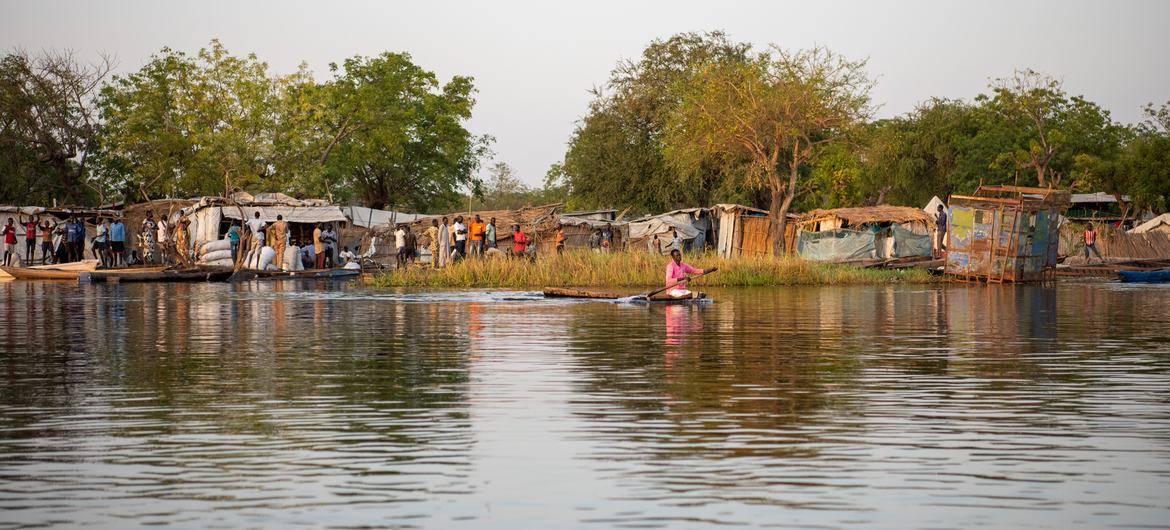
An ex-farmer displaced by flooding, paddles his canoe from his home in Old Fangak, South Sudan (UNHCR/Samuel Otieno)

Flooding and displacement in South Sudan are expected to worsen when the wet season begins in around a month, the UN refugee agency, UNHCR, warned on Tuesday.

“Urgent action is needed to protect already vulnerable populations from its worst impacts,” Andrew Harper, UNHCR Special Advisor on Climate Action, told a regular press briefing in Geneva.

Subsistence farming ‘decimated’

In 2021, the fragile country – struggling to overcome political and economic challenges since it gained independence in 2011 – had its worst recorded flooding ever, impacting more than 835,000 people, according to the UN humanitarian affairs office, OCHA.

Record rainfall in the past three years and overflowing rivers, have flooded thousands of hectares of farmland in eight states – preventing people from planting crops – and leading to the killing of nearly 800,000 livestock, without anything to feed them.

“This has decimated the subsistence farming that most communities depend upon to survive and substantially worsened food insecurity,” Mr. Harper said.

Water refuses to recede

Moreover, 33 out of 79 counties have been badly affected by the flood waters, which have not significantly subsided since the last wet season.

The impacts are especially harsh in Jonglei, Unity and Upper Nile states, where thousands of people have been displaced or marooned in dike-ringed compounds, holding back floodwaters with mud, sticks and plastic sheeting. 

Meanwhile, the approaching wet season threatens to swamp extremely remote communities where residents are already surrounded by floodwater.

“Such climate events will worsen in future, as extremes become the norm, not the exception,” the UNHCR spokesperson said. “Globally, floods and droughts are becoming more frequent and intense”.

Though contributing least to carbon emissions, developing countries like South Sudan are being disproportionately affected.

Canoes have become the only means of transport for residents of Old Fangak, South Sudan.
Canoes have become the only means of transport for residents of Old Fangak, South Sudan. (UNHCR/Samuel Otieno)
Hard to reach areas

During a five-day visit earlier this month, UNHCR Special Advisor Harper toured Old Fangak, Malakal, Jamjang and Bentiu where he saw first-hand the human impact of the flooding.

He recounted that poor road infrastructure, or the lack of any passable roads, make it hard for outside help to reach remote locations, such as Old Fangak in Jonglei state, where a former airstrip is completely submerged and currently unusable for landing.

“In Old Fangak, I met with a twice-displaced woman in her 70s, who spent her days deep in murky floodwaters, desperately plugging a porous earthen dike with sticks and mud, to prevent water swamping the small compound housing her family,” the UNHCR official said. “It is truly heart-breaking to see”. 

Ahead of the rains, marooned residents of Old Fangkak said they need water pumps to bail out their compounds.

“Heavy equipment is also needed to make sturdy flood barriers and build mounds to keep their livestock above water,” he continued.

“UNHCR has provided plastic sheets, hoes, spades, and sandbags to help strengthen their flood defences, and is supporting families displaced to Malakal and other towns”.

Avoiding ‘devastating’ repercussions

Visiting Yida refugee camp in Unity state, Mr. Harper witnessed a polar-opposite situation: a region in the grip of drought.

Access to the most vulnerable populations is a major impediment for humanitarian relief,” he said.

Despite multiple challenges, the climate action advisor observed that “residents have been extremely generous to those displaced by violence or hazardous weather events, often sharing the meagre resources they have.”

However, he maintained, they need “sustained support to avert devastating consequences”.

A case of survival 

The UNHCR spokesperson warned that if assistance is not stepped up for the people of South Sudan, “the climate crisis coupled with ongoing insecurity mean that resources will further shrink, leaving people with no means to survive.”

Accelerated action is required to avoid mounting losses, ensure better preparation, and secure a liveable, sustainable future.

“We know that if we do not act now, the cost will be high, with devastating human consequences,” he concluded.

UN News

DR Congo: UN Envoy Calls For Strategy To Address Root Causes Of Conflict

135
Peacekeepers escort a humanitarian convoy to the village of Pinga in North Kivu, Democratic Republic of the Congo. (UNICEF/Guy Hubbard)

Amid deteriorating security in the eastern part of the Democratic Republic of the Congo (DRC), the top UN envoy in the country has called for a comprehensive political strategy that includes measures to address the structural causes of the conflicts.

Bintou Keita, who heads the UN Stabilization Mission in the Democratic Republic of the Congo (MONUSCO), was briefing the Security Council on Tuesday, on recent developments there.

She said that only three months into this year, nearly 2,300 civilian deaths had been recorded in the country’s eastern provinces. “This is proof of the inherent limits of only having security operations to resolve conflicts,” she said.

Armed groups

Ms. Keita said the security situation in the country’s east has deteriorated despite the joint military operations against armed groups by the national security forces, known as the Armed Forces of the Democratic Republic of the Congo (FARDC), which was joined by the Ugandan People’s Defence Forces (UPDF).

She said civilian losses and displacement of populations have increased because of bloody reprisals by Allied Democratic Forces (ADF) militants.

In the past three months, there has been an alarming increase in activities by the M23 rebel movement in North Kivu. On Monday, M23 elements carried out horrific attacks, targeting civilians in communities near Rutshuru.

In North Kivu, the situation has worsened because of the use of improvised explosive devices by the ADF. On 11 March, its leadership renewed its allegiance to Da’esh. MONUSCO has also documented a 10 per cent increase in human rights violations and attacks, since last December.

Helicopter crash: Investigation launched

Earlier on Tuesday, the mission reported that a search and rescue operation was underway, after a Puma helicopter lost contact with MONUSCO and crashed in the restive North Kivu region.

Speaking at the regular noon briefing, UN Spokesperson, Stéphane Dujarric, said there had been eight people on board, including six crew members – all from the Pakistani military – and two military personnel – one from Russia, and another from Serbia.

They had been on a reconnaissance mission in the area of Tshanzu, south-east of Rutshuru – the scene of recent clashes between Congolese forces and M23.

An investigation is underway. We will update you as soon as more information becomes available”, Mr. Dujarric said.

Our thoughts are obviously with the families and friends of those onboard the helicopter, and all of our colleagues of the UN Mission of the Democratic Republic of the Congo.”


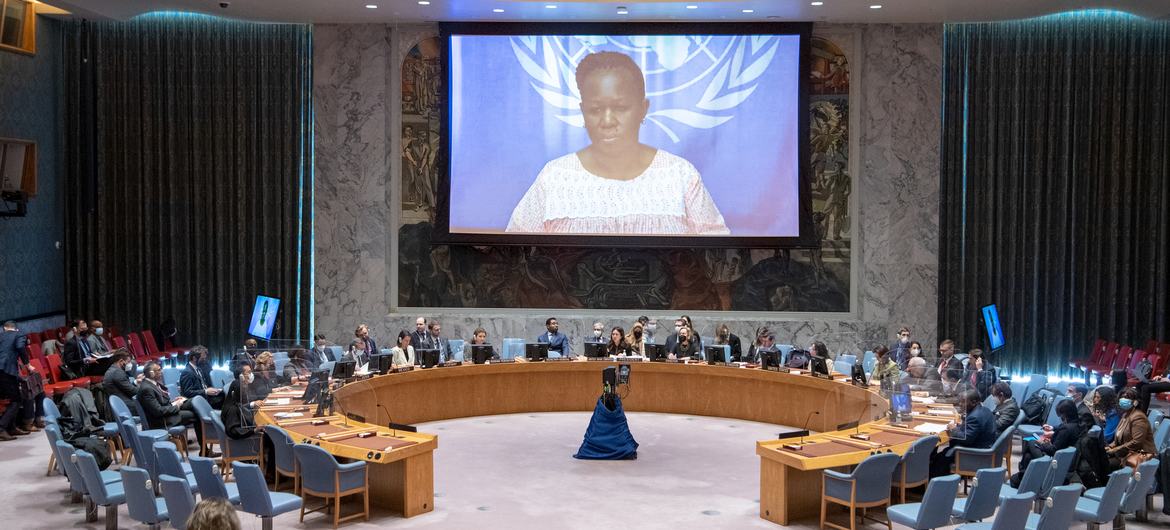
Bintou Keita (on screen), UN Special Representative in the Democratic Republic of the Congo and head of MONUSCO, briefs the Security Council meeting on the situation in the country.
Bintou Keita (on screen), UN Special Representative in the Democratic Republic of the Congo and head of MONUSCO, briefs the Security Council meeting on the situation in the country. (UN Photo/Eskinder Debebe)
Civilians increasingly vulnerable

Ms. Keita sounded the alarm in the Security Council over the considerable erosion of the protection of sites for displaced persons as well as frequent attacks against medical services and other civilian infrastructure.

In the face of these security changes, MONUSCO has redoubled its efforts to better protect civilians in Ituri, working jointly with FARDC/UPDF, deploying support units for FARDC to increase the deterrent effect against M23 in North Kivu.

The Mission is also pursuing mobile deployments to protect displaced persons in South Kivu, she said.

However, without a combined approach addressing both the causes and the symptoms, the efforts of both the United Nations and Congolese forces will remain insufficient, she emphasized, adding that in Tanganyika province, the Mission is closely monitoring the evolution of the security dynamics ahead of its scheduled withdrawal in June.

UN News

Nigeria’s 2023 Outlook and the Looming Danger, By Michael Owhoko

0
Dr. Michael Owhoko

I am neither a prophet nor a clairvoyant, but from the manifestation in my crystal ball, I see Nigeria in 2023 being shaped by upheaval fuelled by miseries and hopelessness. Agitation reminiscent of the ENDSARS protests will break out.

Primary triggers are the country’s pathetic economic indices, including growing unemployment, cynical gross domestic product (GDP), inflation and the undiversified weak mono-commodity economy, lacking leadership and managerial oxygen.

Secondary triggers are the dampened economic opportunities induced by nonchalance over worsening corruption, mounting debt burden, crude oil and foreign exchange manipulation, macroeconomic flux, insecurity, hunger, poor electricity supply, and lack of constitutionalism and rule of law.

Tertiary trigger is the unresolved national question pertaining to incompatibility of the country’s political system and its diverse ethnicities, which is negatively impacting on the country’s fundamentals.  Put differently, the country’s unitary system is antithetical to a multi-ethnic society like Nigeria, which undoubtedly, is the root cause of the country’s regression and despairs.

These concerns will transpire immediately after power transition in May 2023 with increased build-up towards the end of the year and beyond.  This unprecedented development will mark a watershed in the history of Nigeria.

Nigerians are fed up.  Suicide cases arising from hunger are on the increase. Over 82 million Nigerians now live on less than a $1 dollar a day.  At a conservative black-market rate of N580 to a dollar, the average Nigerian survives on less than N580 daily.  This amount cannot buy a standard loaf of bread of N600.  You now know why Nigerians are looking malnourished except those that have access to the country’s treasury, and the privileged few who are involved in under-the-table transactions, either in public or private sector.

Nigeria was ranked 103rd out of 116 countries by Global Hunger Index (GHI) as one of the hunger-plagued countries in the world, an indication of government’s failure over provision of welfare.  Even the World Bank recently affirmed in its 2022 Poverty Assessment Report that 4 out of every 10 Nigerians live below the national poverty line.

The report added further that only 17 percent of Nigerian working class earn wages that can lift them out of poverty while the wages of the remaining 83 percent are too meagre to guarantee exit from the poverty domain.

This is a mirror image of the depth of poverty in the country where some Nigerians go to bed hungry while majority are unable to afford two quality meals a day, resulting in discontent and frustration.  Yet, the country’s GDP is said to be growing, even as poverty capital of Africa and the World.

Can a growing band of unemployed and idle youths improve a country’s GDP?   Majority are not employed, implicitly, are not adding value to production of goods and services.  With no income earned, purchasing power is prostrate.  Rather than shrink, GDP is growing.  The Nigeria’s economy is a study in contradiction.

It is near impossible for a country’s GDP to grow in the face of a corresponding rise in unemployment, particularly among youths who constitute majority of the workforce.  Data for youth unemployment rate in Nigeria is in the region of 35 percent, about the highest in the world.  Obviously, this is exacerbated by lack of creative, determined and visible leadership efforts at addressing this precarious anomaly.

It is unhelpful that figures being published by the National Bureau of Statistics (NBS) do not inspire hope as they contradict market realities. The NBS had said Nigeria’s GDP grew by 3.98 percent (year-on-year) in real terms in the last quarter of 2021.  Though, an optimistic trajectory, it is a paradox when viewed against the background of alarming rate of youth unemployment whose input into GDP is paramount.

Look at the number of graduates coming out of universities and other institutions of higher learning yearly, coupled with the country’s skill-less educational curriculum, the rural-urban drift, and the astronomical rise in population, you will understand why all residential streets are busy with high presence of idle youths during working hours. This was not so in the past where the streets were empty and quiet during the day, indicative of people’s presence at work.  Not anymore!

Again, looking at the suffocating inflationary rate, you begin to wonder whether the data deployed by NBS are tested or are just for political show.  From the consumer price index (CPI), NBS had said inflation dropped to 15.60 percent (year-on-year) in January 2022 when compared to 16.47 percent recorded in January 2021, a reduction of 0.87 percent.  Really?  It is imperative NBS officials go to market or grocery shops for personal purchases as part of feedback mechanism to ascertain firsthand, the real inflation texture in the country.

These economic flaws and current dysfunctional unitary system of government which has held the country down, preventing states or regions from unleashing their optimum potential, remain a major threat to unity and peace in the country.

The powers that be have conceitedly subjugated as inconsequential, the contending questions.  Unfortunately, hitherto strategy of deceit, repression, oppression and domination aimed at diverting attention from the country’s many woes will not work, and will be disrupted in 2023.

Having failed in all fronts of its promises to fix security, economy and corruption, the exit of this administration in 2023, will mark a new era that will usher in renewed agitation for reposition of Nigeria’s polity for enduring peace and progress.

The gaps created by mismanagement of diversities and inability to convert opportunities into capital, including failure to take advantage of existing unifying catalysts to strengthen the country’s unity, will deepen inclination for self-determination in 2023.  This may lead to reshuffling of existing structure aimed at dousing and averting eruption of bottled-up tension next year.

The year 2023 will also mark a new consciousness among frustrated youths of the ineffectuality of internet fraud (yahoo, yahoo), betting, gambling, drugs and other pseudo-revenue generation mechanisms.  There will be a complete emotional shift based on new reality that these vices are not solution to their problems, and may elicit a resolve to take their destinies into their hands.

Indeed, the youths will be more concerned about their dimmed future, which they believe, has been sacrificed on the altar of greed by politicians and those in authorities.  Impaired vision of the country’s leadership and lack of capacity to design programmes and set priorities to lift the country from its current dark clouds are believed to be chiefly responsible for the deteriorating living conditions of Nigerians.

The reality is that no amount of rejigging of the country’s unitary constitution can make Nigeria work, except it is replaced with a federal structure characterized by fiscal autonomy, where every state or region can freely aspire in line with its capacity and resourcefulness.  The current system cannot unite and hold the various nationalities together.

What is fundamental is the real search for “solution to the disillusion”, to borrow from the great reggae artist, Peter Tosh.  It is not about elections and leadership change but about disillusion in the land.  The solution is total restructuring based on the 1963 Constitution.  This constitution had been tested, and it worked.

The current unitary structure breads corruption, ethnicism, nepotism and misery.  That corruption has become a way of life in Nigeria, permeating all strata of government and society, is a proof of the country’s chronic and irredeemable state of decay.  Undeniably, the current political structure cannot even pass the Rotary Four Way Test, if used to measure the sincerity of purpose.  Is it the truth? Is it fair to all concerned? Does it build goodwill and better friendship? Is it beneficial to all concerned?  The answer is a resonant NO.

This is also the reason why elections and national headcount are difficult to conduct in the country due to competing regional interests for national power, and fear of change to current balance of power and status quo by benefited sectional power blocs.

Until the country is restructured from the current unitary system to federalism, a game-changing disruption for the realization of a new Nigeria in 2023 is inevitable, and the 1999 Constitution will be the first port of call.

Dr. Owhoko, Lagos-based journalist and author also publish articles on www.mikeowhoko.com.

Currency Exchange Rates

USD - United States Dollar
ZAR
0.06
EUR
1.17
CAD
0.73
ILS
0.31
INR
0.01
GBP
1.34
CNY
0.14
Enable Notifications OK No thanks