Home Blog Page 529

Ending Nigeria’s Oil Dependency, By Nafi Chinery & Tengi George Ikoli

0
By Nafi Chinery & Tengi George Ikoli (Credit: Premiumtimes)

The issues of a “post-oil” period and economic diversification received considerable attention in Nigeria after the 2014 commodity price crash, again during the 2016 economic crisis, and more recently with the coronavirus pandemic influenced global crisis. Over the period, recognition of the dangers of Nigeria’s dependency on oil led to several initiatives aimed at securing changes in government policy to address the problem. Here we examine Nigeria’s oil dependency within the context of emerging global and national imperatives, to provide some initial recommendations to frame the Natural Resource Governance Institute’s (NRGI) newly constituted Nigeria programme, designed to focus on “Nigeria’s Oil Dependency: Imagining a Future Beyond Oil.”

Nigeria’s oil dependency through the years

Nigeria’s dependence on oil is deep-rooted. The country continues to suffer from the effects of the Dutch Disease, which began when oil was discovered in the 1960s, having focused its efforts predominantly on its oil resources, and the potential for greater returns from oil, making other sectors less attractive. But, decades later, little has changed in Nigeria. Although the oil sector continues to deliver returns, these have depreciated over the years, hindering the success of Nigeria’s development aspirations, such as Vision 20:20, and the Economic Recovery and Growth Plan (ERGP), which are often just out of reach as they continue to rely on the performance of the global oil market.

How dependent is Nigeria on oil?

Nigeria’s federal and state governments remain heavily dependent on oil revenues, relying on these to deliver public goods, to service debt and bolster the national currency. The oil sector, however, has not significantly improved the well-being of Nigerians. Non-oil sectors lead to vastly more employment opportunities than the oil sector and their economic activities contributed approximately 93 per cent of GDP in 2020.

At the federal level, Nigeria’s dependence on oil almost crippled her economy, catalysing a negative GDP growth of 1.8 per cent in 2020. The coronavirus pandemic highlighted the potential losses to the federation, due to the Federal Government’s more than 50 per cent revenue dependence on oil, as the shutdown of global economic activities at the onslaught of the pandemic and sharp declines in oil demand in 2020 left the government unable to meet its 2020 revenue projections. The Federal Government had to slash its budget by a more realistic 20 per cent, reducing its benchmark price and production projections from $57 per barrel to $30, and anticipated production volumes from 2.2 million barrels per day (mbpd) to 1.7 mbpd consecutively, to accommodate the new realities. Continued divestments by the international oil companies (the oil majors) and their refocus on cleaner energies, threaten Nigeria’s future ability to attain its revenue projections, if they remain pegged against oil productions. Nigeria’s debt stock in 2020 stood at 31 per cent of the GDP and continues to grow as it tries to bridge the shortfalls in oil revenues. Despite this stark reality, the 2022 Federal Government budget still reflects 31 per cent of expected Federal Government revenue generation from oil, even as oil exports continue to supply 90 per cent of Nigeria’s foreign exchange and half of the Federal Government’s revenues. Continued dependence on oil revenues threatens the lives and livelihoods of Nigerians and social cohesion in the country.

Nigeria currently is at a pivotal point in its history, in which decisions made now will weigh heavily on its economic survival. After previous financial crises — the halving of Nigeria’s Stock Exchange All Share Index in 2008 and the 70 per cent commodity price crash in 2014 — Nigeria’s economy eventually rebounded as oil demand and price recovered…. So, ahead of that eventuality, the government must make plans to replace the huge shares of government revenue and foreign exchange earnings for which it presently relies upon oil. 

Meanwhile, almost all of Nigeria’s states depend on the oil income, channeled from the Federation Account and Allocation Committee (FAAC), for more than 50 per cent of their fiscal needs. The most dependent are the oil-producing States, with Bayelsa and Akwa Ibom averaging 85 per cent of their fiscal dependence on oil revenues. Only Ogun State and Lagos State draw less than half of their revenues from the FAAC consistently. Oil-producing states risk being fiscally unviable without oil. These states must urgently find alternative sources of revenue beyond FAAC to build their fiscal resilience before oil demand dips. Those residing in those States must ask for the diversification of their states’ revenues, with greater focus on revenues generated internally beyond oil.

Ending dependency and preparing for a future beyond oil

Nigeria currently is at a pivotal point in its history, in which decisions made now will weigh heavily on its economic survival. After previous financial crises — the halving of Nigeria’s Stock Exchange All Share Index in 2008 and the 70 per cent commodity price crash in 2014 — Nigeria’s economy eventually rebounded as oil demand and price recovered. But this will no longer be the case if the Organisation of the Petroleum Exporting Countries (OPEC), the International Energy Agency (IEA) and others are correct when suggesting that we will soon reach peak demand for oil. So, ahead of that eventuality, the government must make plans to replace the huge shares of government revenue and foreign exchange earnings for which it presently relies upon oil.

The federal and state governments must make critical and strategic decisions carefully to position their economies for a future without oil. Oil will lose its value, so Nigeria must build its resilience in anticipation of that future, and take advantage of all the opportunities available in the African corridor, the growing green economy, technology, and non-sectors that speak to its unique advantages.

Looking more closely at the federal government’s short-term plans to maximise its oil and gas endowments, there are obvious challenges. First, investments in frontier explorations, as provided for in the Petroleum Industry Act (PIA), may pose some risks in locking in revenue that may not yield the desired returns. Gas as a ‘transition fuel’ requires significant capital investments and as a fossil fuel, it is likely to eventually lose out on investments to greener alternatives. Gas takes a long time to bring profit and if Nigeria is to transit using gas to industrialise and energise before attaining its COP 26 carbon neutrality plans by 2060, a clear plan and pathway for how it intends to transition to other energy options, with trackable milestones is required. In addition, if natural gas exports are expected to supplement foreign exchange earnings from oil in the short-term, lower longer-term investments may mean that those gains won’t last. Buffers need to be put in place to account for that or the growing investments made in cleaner fuels may put natural gas projects at risk of becoming “stranded assets” — with revenues sunk before realising any value. It is critical that the Federal Government makes strategic spending decisions as oil’s role in meeting global energy demands continually declines over time.

The Federal Ministry of Finance, Budget and National Planning should devise a comprehensive and inclusive plan, with concrete and measurable milestones, in collaboration with relevant ministries, departments and agencies that speak to Nigeria’s context, and accounts for both risks and opportunities to reduce oil dependence. That plan must then be implemented collaboratively. The opinions of Nigerians must be sought on the best approach to wean the country off its dependency on oil.

The executive’s branch’s plan to dig deeper into fossil fuel investments by committing $1.5 billion to refurbishing historically unprofitable refineries, proposed investments in Dangote refinery, frontier exploration and sustaining fuel subsidies, may put Nigeria’s future at risk if the alternative costs are not appropriately assessed. Even then, crude oil production to meet the government’s ambition to ramp up production is threatened, as majors like Shell, ExxonMobil, Chevron and Total rebrand as “green” to reflect investor appetite and the global energy transition. These international oil companies have been selling Nigerian assets, which will likely continue as the energy transition accelerates. Importers of Nigeria’s petroleum products are also seeking greener options. The top five export destinations for Nigeria’s petroleum products (IndiaSpain, NetherlandsUnited States and China) have committed to achieving carbon neutrality between 2030 and 2050. This puts further strain on Nigeria’s short-to-medium term capacity to generate and sustain its foreign exchange earnings, as oil demand falls. Oil producing regions will also be further strained as legacy environmental pollution and oil dependence-induced economic and social challenges will remain if a ‘just transition’ is not prioritised.

Beyond oil, the Federal Government should accelerate revenue diversification through trade and domestic production, leveraging other sources of foreign exchange. Attracting foreign exchange earnings could be done by backing enablers that add greater value to local products, while offering greater support to the manufacturing sector, developing Nigeria’s critical minerals in the mining sector to leverage the green economy, and boosting regional trade through the African Continental Free Trade Agreement (AfCFTA) 2020 are other ways to improve and leverage domestic production diversification for more jobs and economic growth, which are key goals of the Nigerian government.

The Federal Ministry of Finance, Budget and National Planning should devise a comprehensive and inclusive plan, with concrete and measurable milestones, in collaboration with relevant ministries, departments and agencies that speak to Nigeria’s context, and accounts for both risks and opportunities to reduce oil dependence. That plan must then be implemented collaboratively. The opinions of Nigerians must be sought on the best approach to wean the country off its dependency on oil. They must agree on a timeline and pace of reform, and identify priority areas of focus. During the upcoming 2023 electoral campaigns, presidential and gubernatorial candidates, especially from oil producing states, must be required by citizens to outline plans to build fiscal resilience away from oil dependence. Civil society, accountability actors and the public must sustain dialogue and make economic diversification a major theme in the 2023 elections — on the campaign trail, in the commitments of candidates and on party platforms.

Nafi Chinery is the West Africa (Anglophone) regional manager at the Natural Resource Governance Institute (NRGI). Tengi George Ikoli is a senior governance officer with NRGI’s Nigeria program.

Nigeria: Gawuna Now Acting Kano Governor as Ganduje Travels

0


By Joseph Edegbo

Governor Abdullahi Umar Ganduje of Kano state has handed over power to his deputy, Dr. Nasiru Yusuf Gawuna who will now be acting governor of the state.

The state commissioner for Information, Malam Muhammad Garba, who announced this in a statement on Wednesday, said Governor Ganduje has been away to the United Arab Emirate, where he will be attending an Investment Summit being facilitated by the Nigeria Governor’s Forum (NGF).

He said the deputy governor has been empowered to act in full acting capacity pending the return of Governor Ganduje.

The statement directed all commissioners, heads of extra-ministerial departments, top government functionaries, corporate and individuals to give the acting governor due recognition, support and cooperation.

It further indicated that issues seeking the attention of the governor should be communicated to the Office of the Acting Governor.


Ghana: Parliament Passes Controversial Tax Bill After Opposition Walkout

0
Ghanaian Parliament

By Sunday Elijah

Ghanaian Parliament on Tuesday passed the controversial electronic transaction tax bill, tagged E-levy bill, which the government says will assist in raising $900m in additional revenue.

“The Electronic Transfer Levy duly read today after the consideration stage has been passed,” Alban Bagbin, the speaker of parliament said.

However, before the bill was passed, the opposition legislators had staged a walkout, dismissing the new tax as unfair.

“The people have roundly rejected the e-levy and our constituents have told us to reject it, so why is the president imposing it on us?” said opposition NDC party parliamentarian Isaac Adongo.

“What is the crime of Ghanaians that now the government wants to use their pockets as collateral?”

When it becomes a law, it will introduce a 1.5 percent tax on electronic money transfers and transactions.

President Nana Akufo-Addo’s government said the move will help address problems from unemployment to Ghana’s high public debt.

Many Ghanaians see the new law as yet another burden since they are already struggling with high cost of living occasioned by rising fuel prices due to the Ukraine crisis.

Minister of Finance, Ken Ofori-Atta said government had already reduced the proposed tax from 1.75 percent to 1.5 percent after consultations, adding that it will bring in projected revenues of $927.5m.

President Nana Kufour and his cabinet members had recently cut their wages by 30 percent, along with other measures which they said will help generate $400m in savings for state coffers.

Why Africa Prints Money in Europe – DW

0
Only a handful of African countries print their own banknotes

Last July, a delegation from The Gambia visiting the Nigerian Central Bank asked if the Gambian dalasi could be ordered from its West African neighbor.

The Gambia’s central bank governor, Buah Saidy, said the country was running low on its national currency.

The tiny West African country had to redesign its currency after the defeat of former President Yahya Jammeh, who ruled The Gambia from 1994 until he was forced into exile after refusing to accept defeat in the 2016 elections.

Jammeh, who is accused of human rights violations and killings of political opponents during his 22-year reign, had images of himself on the nation’s banknotes.

After his ouster, the Gambian Central Bank set about destroying those images.

Now, the dalasi notes have images of a fisherman pushing his canoe out to sea, a farmer tending to his rice paddy, and a spattering of colorful, indigenous birds.

Outsourcing the cash

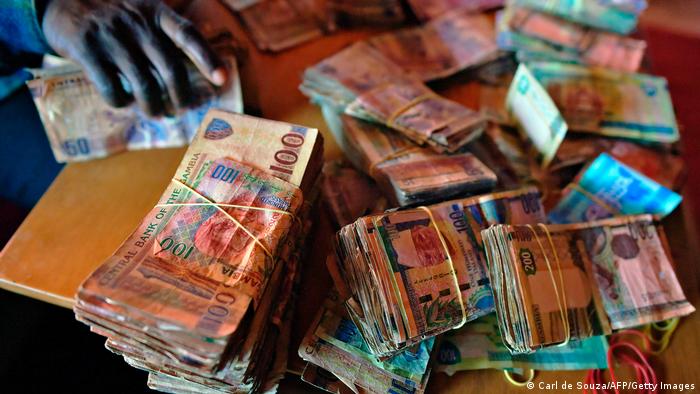
Bundles of Dalasi banknotes
 After the ouster of former strongman Yahya Jammeh, The Gambia’s central bank destroyed Dalasi notes containing his image


One issue remains, however: The Gambia doesn’t print its own currency. It places orders with UK companies, resulting in a shortage of liquid money.

And The Gambia is not alone in having its money printed in another country.

More than two-thirds of Africa’s 54 countries print their money overseas, mostly in Europe and in North America. It comes at a time when the African Union is trying to usher in a golden, made-in-Africa age that should see Africa beef up production and enjoy greater profits.

Among the top firms that African central banks partner with are British banknote printing giant De La Rue, Sweden-based Crane, and Germany’s Giesecke+Devrient.

How transparent is the process?

It is perhaps surprising that almost all African countries import their currencies. The practice could even raise questions of national pride and national security.

For richer countries, like Angola and Ghana, there’s also the issue of real autonomy and economic sufficiency.

Most countries are tight-lipped about their currency-printing processes — likely for security reasons. The printing firms are even less transparent.

None of the firms DW contacted responded to requests for a list of African countries that print with them.

Counting the cost

Ethiopia, Libya and Angola — along with 14 other countries — place orders from De La Rue, writes Ilyes Zouari, who studies African countries.

Six or seven other nations including South Sudan, Tanzania and Mauritania are said to print theirs in Germany, while most French-speaking African countries are known to print their money with France’s central bank and with the French printing company Oberthur Fiduciaire.

It’s not clear how much it costs to print African currencies like the dalasi, although the US dollar costs between 6 and 14 cents.

But it is likely that the cost of printing for over 40 African currencies is significant.

In 2018, a central bank official in Ghana complained to local journalists that the country spends huge amounts for its UK orders of the Ghanaian cedi.

And since countries usually order millions of notes to be carted in containers, they usually have to pay hefty shipping fees. In The Gambia’s case, officials say shipping costs rack up a bill of £70,000 (€84,000, $92,000).

High demand

Still, while it may sound odd, analysts say that African countries printing much of their currency abroad is not unusual.

Many countries around the world do it. For example, Finland and Denmark outsource their money-making, as do hundreds of central banks around the world.

Just a handful of countries, like the US and India, produce their own currencies.

Mma Amara Ekeruche from the African Center for Economics Research told DW that when a country’s currency is not in high demand — and not used globally like the US dollar or the British pound — it makes little financial sense to print it at home due to the high cost involved.

Money printing machines usually churn out millions of notes at a time. Countries with smaller populations, like The Gambia or Somaliland, would have more money than they needed if they printed their own.

“If a country prints one banknote for €10 at home and sees that it can print it for about €8 abroad, then why would they incur more costs to do that? It won’t make sense,” Ekeruche explained.

Some countries — like Liberia — don’t attempt to print their own money because they don’t even have a printing press — it is costly to set up and requires special technical capabilities.

Only a handful of African countries, like Nigeria, Morocco, and Kenya have enough resources to print their own currencies or mint their own coins, and even they sometimes supplement production with imports.

Is third-party printing secure?

Ekeruche said some individual countries attempting to produce their own currencies could fall victim to corrupt officials or hackers who might attempt to forge or manipulate them. In many cases, outsourcing is more secure.

Even with importing, there can be challenges. Containers of Liberian dollars shipped from Sweden disappeared in 2018, although the government later accounted for it.

Meanwhile, firms like De La Rue have existed for hundreds of years, mass-producing for central banks across the world.

They have the tools and experience to keep up to date with currency innovations, such as polymer which is considered cleaner, more durable and more secure than paper, with the plastic material allowing the inclusion of more sophisticated features to protect against counterfeits.

But outsourcing is not without disadvantages. Some countries could find themselves on the receiving end of economic sanctions. In 2011, for example, the UK withheld orders for Libya’s dinar from De La Rue, after the UN sanctioned the late leader, Moammar Gadhafi.

Why not print the notes in Africa?

African countries have been formulating plans to boost intra-African trade. There is currently more trade with Western and Eastern countries than there is within the continent.

Printing banknotes in Africa would boost profits on the continent and, at least theoretically, African countries could choose those with printing capabilities since there’s likely some idle capacity.

But that is not happening in practice. “That’s due to trust issues between the countries,” said Emmanuel Asiedu-Mante, a former deputy chief with the Ghanian central bank, and because many have been printing with overseas firms for years.

And there’s the complicated case of Francophone Africa — the countries using the Central African CFA franc and the West African CFA franc. The currencies are tightly pegged to the euro because of colonial relations and are produced in France.

Still, there’s hope that change could be on the horizon. With The Gambia’s central bank, officials proposing a possible partnership with Nigeria, countries could start to look inwards for their currency orders. If that happens at scale, it could cut shipping costs drastically.

Edited by: Keith Walker

Four Tree Species Added To List Of Protected Trees In South Africa

0

Agency Report

The South African Department of Forestry, Fisheries and Environment has added four tree species to the list of protected trees in South Africa.

Forestry, Fisheries and Environment Minister, Barbara Creecy, has updated the annual list of all tree species, which added the Red and Pink Ivory (Berchemia zeyheri), the Jackal Berry (Diospyros mespiliformis), Manketti (Schinziophyton rautanenii) and the Umtiza (Umtiza listeriana) on the list of protected trees.

The updated annual list of all tree species which are protected in terms of the National Forests Act was published by Creecy in Government Gazette 46094 (Notice No. 1935).

Department spokesperson, Albi Modise, said the consequence of declaring a tree, species of trees or a particular group of trees or woodland, means that no person may cut, disturb, damage or destroy any protected tree.

It also means that no person may possess, collect, remove, transport, export, purchase, sell, donate or in any other manner acquire or dispose of any protected tree, or any forest product derived from a protected tree.

“Except under a licence granted by the Minister, or in terms of an exemption from the provisions if approved by the Minister on the advice of the Council,” Modise said.

Modise warned that a person who contravenes the prohibitions is considered to have committed a first category offence, and “may be convicted and sentenced to three years imprisonment, or imprisonment and a fine to be determined by the court”. – SAnews.gov.za

Nigeria: Kogi Govt Warns Glo, Airtel Against Tax Evasion as KGIRS Refutes Rumoured Illegal Taxation

0


By Joseph Edegbo

Kogi State Internal Revenue Service (KGIRS) on Wednesday refuted allegations of illegal taxation on telecom giants operating in the state.

This came as the state government warned both GLOBACOM and AIRTEL to pay their taxes and desist from damaging media campaign against the state government.

Acting Executive Chairman, KGIRS, Alhaji Sule Salihu Enehe, while reacting to the allegation made against the organisation by Globacom, noted that KGIRS had tremendous respect for the rule of law and that his action against the two companies was based on court order, adding that the state “will not take any action that infringes on the rights of individuals and corporate organisations.”

He spoke while addressing journalists at the Revenue House, in Lokoja.

Enehe stated, “We maintain a cordial relationship with organisations to complement the efforts of government at making Kogi State the investment haven of Nigeria. KGIRS was in a tax default battle with three major telecom giants including MTN Nigeria Communication, a situation in which MTN Nigeria Communication responded to responsibility by immediately clearing their tax liabilities of N60 million but GLO and AIRTEL refused to clear their abilities

“It should be noted that KGIRS deals with Telecom companies individually and not with an Association of Telecom Providers. Also, the court issues highlighted in the petition was the case of business premises, whether the telecommunication mast can be regarded as Business Premises by virtue of Section 2 of Kogi State Business Premises Law 2017. The matter was decided by the Federal High Court Lokoja in favour of the Telecom Association against the Registrar of Business Premises, Kogi State, and four others of which the state filed a notice of appeal thereto and is now before the Court of Appeal, Abuja.”

He said several demand notices had been sent to the two defaulting telecom companies (Glo and Airtel) but that they refused to oblige, stressing that the said liabilities included Globacom Nigeria defaulting at N300 million unremitted tax liabilities, “both corporate and individual, and Social Service Contribution Levy from 2017 through 2021, Also Airtel Network Limited defaults at over N60 million both corporate and individual tax liabilities.”

“All these payments are to be paid by virtue of the law of the Kogi State House of Assembly duly passed, which allows KGIRS to collect the levies and fees on these premises. While MTN Nigeria Communications has come to settle their tax liabilities, we expect the remaining two – GLO, AIRTEL to do the same,” he added.

Meanwhile, the state government, in a statement issued by the Commissioner for Information and Communications, Kingsley Fanwo, has thrown its weight behind the Internal Revenue Service, stressing that the Telecommunications giant “cannot choose which law to obey nor take Kogi for a ride.”

Noting that the telecom giants had not been fair to Kogi State, Fanwo said, “The Kogi State Internal Revenue Service has our full backing in its efforts at ensuring both GLOBACOM and AIRTEL pay their taxes. As a government, we shall continue to provide the necessary services to the people and maintain a good relationship with corporate organisations.

“However, we will not accept a situation where a corporate organisation will refuse to pay taxes due to the state and instead of facing the reality, resort to damaging media campaign against the state government.”

Recent Terrorist Attacks in Israel Undermine ‘Prospects for Peace’: Guterres

0
Time lapse photo of Tel Aviv District, Israel. (Credit: Unsplash/Igal Ness)

Secretary-General António Guterres on Tuesday night condemned recent terrorist attacks in Israel that have claimed the lives of at least 11 Israeli citizens.

“Such acts of violence can never be justified and must be condemned by all,” he said in a statement issued through his Spokesperson.

Tuesday’s terrorist assault on the street in Bnei Brak, a small ultra-Orthodox city on the eastern outskirts of Tel Aviv, was the third such attack in Israel in a week.

Five people were reportedly shot dead in the suburban attack, three Israelis, and two Ukrainian citizens.

Broad condemnation

Amateur video broadcast on Israeli TV stations showed a man dressed in black brandishing a rifle. According to news reports, the Palestinian gunman was a resident of Ya’bad, in the northern West Bank, who was believed to have been working at a local building site.

He was later shot dead by Israeli police, but not before fatally wounding one of the officers who confronted him.

Israeli prime minister, Naftali Bennett, said the country was facing a new wave of terrorism. Palestinian President Mahmoud Abbas, also condemned the attack.

Spate of attacks

The attack marked one of the bloodiest weeks in Israel in recent years, ahead of the Muslim holy month of Ramadan, beginning next weekend.

Two previous attacks just days earlier, saw an Israeli Arab drive his car into a cyclist, killing him. The attacker, who reportedly had planned to join terrorist group ISIL – then stabbed three people to death outside a shopping centre.

Five days later, two Israeli Arabs killed two police officers in Hadera, after opening fire on them at a bus stop. ISIL reportedly said that it was behind the assault.

In the spirit of the upcoming religious holy days, the Secretary-General calls for an immediate end to violence, which only serves to undermine the prospects for peace,” the Spokesperson’s statement said.

The UN chief also extended his “heartfelt condolences” to the families of the victims and wishes a prompt recovery to those injured.


Nigerian Singer, Dimma Releases Another Hit Song Titled Oti Ngbodo Ngbo

0
Nigerian Gospel musician and songwriter, Chidimma Doris Onuoha

Chidimma Doris Onuoha known professionally as ‘Dimma’ is a Nigerian Gospel musician, songwriter, Motivational speaker, and Project Cost Engineer has no apology in giving her fans and other music lovers an undiluted joy.


By all definitions, she is intelligent, talented and humble to a fault.
Started singing at a very young age in her local church, she has grown beyond leaps and bounds. And still willing to learn and relearn for the benefit of her fans both home and abroad.


She composed and recorded ‘Diversity’ Anthem titeled “At a time like this” for her company in 2006.
Dimma emerged the 1st runner up at a talent show organised by her company in 2017; performing a South African song titled ‘Vulindlela’ to the admiration of all.

As an international start that she has evolved into, the artist performed at the Hawaian end of the year thanksgiving in October, 2019 at San Francisco, USA.


Born October 3rd, 1982 in Imo State, she studied at the University of Nigeria Nsukka, where she got her first degree having been satisfied in learning and character.

Curled from The Sun

Currency Exchange Rates

USD - United States Dollar
ZAR
0.06
EUR
1.17
CAD
0.73
ILS
0.31
INR
0.01
GBP
1.34
CNY
0.14
Enable Notifications OK No thanks