Home Blog Page 524

Nigeria: KDSG Receives Belongings of Passengers On Attacked Train.

0
Gov. Nasir-El-Rufai of Kaduna State, Nigeria


By Joseph Edegbo-

The Kaduna State Government says it has received luggage, valuables and other belongings of some passengers who were on the Abuja-Kaduna train AK9 which was attacked by terrorists on 28th March.

The Commissioner of Internal Security and Home Affairs, Mr. Samuel Aruwan announced this in a statement

The items , the statement said , were handed over to the Kaduna State Government by the Military authorities, who had gathered the items from within and around the train during search operations after the attack.

“Governor Nasir El-Rufa’i expressed his thanks to the Military authorities and commended them for their careful handling and documentation of the items, comprising over 100 pieces of luggage, valuables, gadgets and personal effects.

“Nine persons had already collected their items after presenting proof at the point of recovery by the military.

“The remaining belongings, received with a detailed inventory, will be carefully stored. A system for the receipt of claims will be communicated to the public subsequently”, it concludes.

ASUU Struggles: Propaganda And Counter-Narratives, By Andrew A. Erakhrumen

0

“An army marches on its stomach

We have come full circle, again! It is no more news, unfortunately, that after efforts by members of Academic Staff Union of Universities (ASUU) at preventing industrial dispute with government were frustrated, they reluctantly activated their suspended strike, with a four-week roll-over strike, on the 14th of February, 2022 after ASUU-National Executive Council (NEC) Meeting of 12th to 13th of February, 2022, held at University of Lagos, Lagos.

In line with the nomenclature for, and modus operandi of, the disruptive roll-over strike, it has been extended (not unexpected) on the 14th of March, 2022, for another eight weeks, after ASUU’s Emergency NEC Meeting of 13th of March, 2022 at University of Abuja, Abuja.

Regrettably, this ongoing eight-week roll-over strike – according to the Union – is total and comprehensive! The earlier-mentioned ASUU-NEC, both at Lagos and Abuja, came after mobilisation congresses/press briefings were held from 31st of January to 9th of February, 2022, by all ASUU branches.

The congresses and press briefings served as follow-up to another round of ASUU’s Zonal Press Conferences that ended on the 15th of December, 2021.

These actions resulted from the expiration – on the 5th of December, 2021 – of ASUU’s three-week ultimatum given to the Federal Government of Nigeria (FGN).

The earlier-mentioned ultimatum was issued after ASUU-NEC Meeting of 13th to 14th of November, 2021 held at University of Abuja, Abuja.

The ultimatum was to give FGN more ‘undeserved’ time to fulfil its part of the Memoranda of Understanding/Action signed by both parties before and on the 23rd of December, 2020.

Therefore, it is very important for those who blindly parrot the clownish opinion, that ASUU applies strike as the ONLY means of ventilating its discontentment, to know that other efforts were exerted (several letters were written, meetings, parleys, interviews, press statements, published articles, interventions, among others) to avoid this industrial dispute, but as always, those benefiting from deliberately-troubled waters in Nigeria’s public universities have ‘successfully’ brought us here, again.

What is/are the issue(s) this time? Relaying the same old story will answer this question as ASUU’s demands have not changed concerning revitalisation funding for public universities, non-payment of earned academic allowances (EAA), non-implementation of renegotiated 2009 ASUU/FGN agreement, non-payment of promotion arrears, inconsistency in payments by the fraud-ridden Integrated Payroll Personnel Information System (IPPIS) and non-deployment of University Transparency Accountability Solution as a reliable replacement for IPPIS that is mainly competent in fraudulence!

Therefore, since we have found ourselves at this point, again, what is next? It should be clear by now, as we have stated severally, that these industrial crises in Nigeria’s public higher academic institutions are always contrived by those benefiting from them!

We are convinced, beyond doubt, that this is partly the reason behind governments’ refusal to implement almost all collectively-bargained agreements reached with ASUU!

Well, ASUU is back in the trenches against a class of voraciously extractive political elite represented by predatory governments! Clearly, there are no two elephants fighting here!

Rather, this is a fight between a deliberately-made disadvantaged ASUU and a big monster trampling on all! Struggle – for things already taken for granted in many other climes – is still part of life for Nigerian academics!

These are scholars expected to concentrate on knowledge generation but have been methodically constrained, slyly by the system, to be struggling with issues of basic survival! We are talking about someone whose take-home pay (if paid) cannot take home!

This is someone always battling, monthly, to ensure that part of his/her scandalously meagre take-home pay accompany him/her home! We are referring, here, to someone who is gravely distracted by the vagaries of economic challenges!

This is a university lecturer whose pay has remained what he/she has been earning since 2009 in the federal universities and far worse in others!

Definitely, we are talking about lecturers that are more of perennial borrowers from cooperative societies and moneylenders!

We are, unambiguously, referring to lecturers whose “fairly used” (expired) vehicles imported from the northern hemisphere (for those who have one) compel them to visit auto-mechanic workshops, regularly! It is marvelling how they have been able to cope with their demeaning paupers’ pay without cutting corners, considering the sense in the above-quoted words attributed, in instances, to both Frederick the Great (1712–1786) and Napoleon Bonaparte (1769–1821).

We salute lecturers who have been soldiering on in these universities with their sweat and blood! However, we must acknowledge that thinking deeply about research in this kind of a caustic and discouraging clime is burdensome!

Consequently, we will always kick against a system that aims at killing the willing horse. Things must change for the better – for lecturers – in Nigeria! Certainly, we are not oblivious of some “bad eggs” – as also found in all other professions – who do not have business being in the university system as lecturers!

These unscrupulous elements are very embarrassing to ladies and gentlemen of complete integrity within the university system! We have, earlier, written about them and will surely still do, extensively, in future interventions. Moving forward, we want to emphasise that it is long overdue for serious attention to be paid to the emoluments of lecturers in public universities.
.
We will be stating the obvious to say that many lecturers have been successfully deliberately impoverished, pummelled psychologically and captured by the state! This may sound unbelievable to some but it is a fact!

There has been a long time surreptitiously systematised plan – by the Nigerian political class in collaboration with ‘willing hands’ within the university system – aimed at incapacitating intellectualism and intellectuals, particularly those referred to as ‘radical scholars’, in order to cow, silence and enshackle them!

We dare say that many of those currently in government (as well as the corridors and bedroom of power) are, sadly, the dregs of society.

We strongly believe that these dregs of society are those being referred to by Wole Soyinka in this quote: “Books and all forms of writing are terror to those who wish to suppress the truth”.

This pauperisation and eventual state-capture are the reasons behind the transient ‘success’ of governments’ strategy of tokenism (renamed here as ‘peanutism’) in dealing with public university workers.

For instance, ASUU struggles in the last ten years, or so, have always been deliberately reduced – by governments and their ‘megaphones’ – to agitations for the peanut known as EAA, and lecturers appear to be falling, always, for this scam!

The EAA is what governments and their agents do hype, loudly, during industrial disputes and lecturers seem unable or are reluctant to shoot this propaganda down!

Enemies of public universities have always been deriding ASUU struggles using well-nourished propaganda efficiently tied to this EAA!

Members of ASUU must counter these carefully strategised damning evil narratives attached to EAA that do not free them from financial enslavement!

The EAA has not been, and is still not, the solution to their pecuniary challenges! Sadly, salary too, is not! Nonetheless, the 2009 ASUU/FGN agreement has been renegotiated in 2021.

The 2009 version, with its salary component that is far less than the African average as at then, was to be renegotiated every three years starting from 2012. However, this was not achieved, thereby keeping lecturers in public universities on the same ‘salaries’ to date! Lecturers’ salaries and allowances, unlike political office holders’, are not hidden.

For example, assuming there are no tax deductions, a full professor earns between N381,695.75 (US$915.14) and N501,680.25 (US$1,202.81) monthly!

After subtracting obnoxious taxes and other deductions, a professor “at the bar” (who must have spent ten years as a professor) goes home, monthly, with something around N416,000! Many public universities are not paying this ‘peanut’ while there are others owing months of unpaid ‘salaries’! What offence have lecturers in Nigerian public universities really committed to warrant this shabby treatment?

This is the ‘peanut’ that governments (disputants in industrial disputes) shamelessly shout “no work, no pay” about every time they and their minions enable industrial disputes in public universities! It is – now – time for lecturers to resolutely insist that the draft 2021-renegotiated 2009 ASUU/FGN agreement be signed and implemented forthwith! There is nothing to be ashamed of in renegotiating for a salary increment for the first time since 2009! This slave wage must give way to a proposed better one already well bitten into by the burgeoning economic inflation!

Experience has shown that Nigerian governments are at home with the disgraceful pittance they call ‘salary’ for poor workers. Thus, lecturers should ceaselessly demand for their right to live as humans! If they do not, no one will do it for them!

As we always say, strike is something ASUU members very much love to hate. However, since we are here, now, it will be better to not fall for the regular fake promises and timelines that are observed in the breach by governments.

The Union, irrespective of government propaganda, should ensure that its demands are met, concretely, before suspending the prevailing roll-over strike, to avoid its resumption any time soon!

Dr. Erakhrumen currently teaches at the Department of Forest Resources and Wildlife Management

Conversations With My European Friends, By Owei Lakemfa

103
Owei Lakemfa

I have been engaged in countless conversations with my European friends across continents, groups and social media about current world events and whether their leaders are right in pursuing a solitary military solution.

Were they right in the 1990s in just being interested in winning the ideological battle by encouraging the atomisation of Europe? Could the wars that have devastated that continent, especially from the 1990s, have been prevented?

With the seeming end of the Cold War, was it in the interest of humanity for European powers to have been primarily interested in expanding their military wings, rather than investing in a more inclusive world? When last week European countries met in Brussels with their North American allies, all the talks were about increasing defence spending, massing more troops in their continent, increasing arms supplies to Ukraine and more sanctions on Russia.

There was little or no plan on how to reduce tension, strive for a ceasefire or pursue a negotiated settlement in the war in Ukraine. Yet, the two armies involved in the war, the lives being taken or destroyed, are European; so are the damaged towns and cities.

The 10 million displaced peoples are European, so are the four million who have become refugees. Almost all the countries bearing the weight of these refugees are European. So, why are there no concerted efforts by European leaders to broker peace? Do they hope Ukraine would militarily defeat Russia and thereby solve what they consider their headache? Are they waiting to see both European countries exhaust themselves militarily?

Is Ukraine, to these European leaders, an expendable shell? In response to my writings, an European friend asked: “Do you view the Baltic countries and Poland’s right to security from Russia irrelevant? Are these smaller countries’ right to exist unimportant?” My simple response is that all countries have a right to security, including the Baltic countries and Russia.

As such, we need an understanding in the world where the security of one would not constitute the insecurity of the other. On the fall of the Soviet Union, I had argued that it might not have been in the long term interest of Europe to have encouraged or allowed it to splinter into 15 different countries.

For instance, would it have been possible for the three nations on the Baltic Sea – Latvia, Estonia and Lithuania – to have coalesced into a united state, rather than exist as atomistic entities?

Yugoslavia, so great and promising, was under Marshall Broz Tito a respected country that led what was known as the Non-Aligned Movement; countries that sought a balance between the two superpowers.

Was its quite bloody division into seven separate countries, with its horrific loss of lives and massive destruction of a part of Europe, inevitable, or most of Europe was simply excited that the Eastern Bloc was collapsing? What was the benefit of using foreign military muscle to produce a fingerling like Kosovo? Could negotiated diplomacy have helped? Was the post-communist ‘Velvet Divorce’ in Czechoslovakia which, on January 1, 1993, split that wonderful country into Czech and Slovakia, necessary? To these kinds of thoughts, a close friend with whom I am an admin on a respected international platform responded: “Many were separate countries until Stalin took them over during WW2, Ukraine included. Stalin got a bilateral treaty signed with each one. Czechoslovakia, Poland, Hungary had widespread dissent during different years. Yugoslavia with Tito remained fairly independent.

Chechenya became Islamic and fought with the Soviets until 1958 when they were taken over. Kazakhstan and some others were part of the Soviet Union before the war. After WW2 they declared themselves independent. These are very individual countries with their own language, culture and history.” I thought about her response but could not agree with her conclusion that seems to give the impression that these countries have the basis to establish separate states because: “These are very individual countries with their own language, culture and history.”

All countries are artificial. In perhaps all cases, they are created by individual countries and nationalities, each with its own language, culture and history. This cannot be the basis of separatism. For instance, the United Kingdom (UK) has a minimum of four countries – England, Scotland, Wales and Northern Ireland – under a single state structure. Their cultural, linguistic and historical differences should not be enough to break it into separate entities.

The same with Spain, which has different nationalities with distinct histories and cultures like the Castilians, Galicians, Valencians, Basques and Catalans. Even Belgium, the headquarters of the European Union, has diverse nationalities like the Flemish, Wallon, Italian and the Moroccans which, with each election, merely manage to form a government.

One very unique country which ought to be a model to us all is Switzerland, which is composed of the Swiss, German, Italian, Portuguese, French, Kosovo, Turkish and smaller nationalities.

To give the people a sense of belonging, the country has four official languages: German, French, Italian and Romanish, excluding English, which is widely spoken in a place like Geneva. So, having national, linguistic, cultural, geographical and historical differences should be no primary reason to split countries.

There is a German friend based in Nigeria who seems displeased with my pointing out the fact that 77 years after arriving in Germany, as conquerors or liberators, foreign troops remain in that country. He asked me: “You do understand the difference between occupation and international agreements, right?” If it were a simple case of international agreements, then the basic concept of reciprocity in international relations should apply.


So, why hasn’t Germany had similar military bases in those countries? Personally, I love and respect Germany partly because that country provided four of my main mentors in life and about who I continue to study and draw inspiration. Karl Marx and Friedrich Engels opened my eyes and mind to dialectics, political economy, materialist thought and social relations.

The writings of Roxa Luxemburg helped me to distinguish between feminism and women’s liberation. My most beloved writer, whose style I wish I can imbibe, is Bertolt Brecht. On my first visit to Berlin, I went looking for his grave and found it!

The world used to be run on a tripod: North Atlantic Treaty Organisation (NATO), Warsaw and the Non-Aligned Movement.

The last two are dead, while NATO has expanded under the thumb of a superpower. I do not think it is safe for the world to walk and run on one leg called NATO. With the United Nations (UN) immobilised by the veto, it is necessary to revive the Non-Aligned Movement, which at its peak had 120-member countries, including from Europe, Asia, Africa, Latin America, the Gulf and cutting across faith, race, cultural and ideological diversities. This is my case for a universal rebirth and a new world order.

Lakemfa, a former secretary general of African workers, is a human rights activist, journalist and author. 

Investment Of Technology In Third World Countries, By Fom Gyem

0
Fom Gyem
As technology has shown a critical role in the development of the Western world and its economic growth, developing countries are still suffering to integrate advanced technologies into their systems today. With globalisation and cooperation from developed countries, advanced technologies can be invested in Third World countries.
The lack of investment in science and technology has undermined Africa’s economic transformation at both the structural and sectoral levels (the growth of productivity within sectors).
In many Third World countries, the unemployment rate is found to be very high. Driving technology can decrease the unemployment rate by creating more job opportunities in those countries, for example here in Nigeria we have the Bolt, Rida, Uber and many other driving technology platforms that has help reduce the rate of unemployment .
As technology continues to advance, this is creating a highly technological environment in different types of organisations, where almost every job today requires a certain degree of advanced IT skills.
Today, mobile phones and other computer software make services accessible to everyone online. Third World countries can benefit from those provided services through advanced technologies in different fields such as agriculture, healthcare, and education.
One of the main reasons to infuse technology in the Third World countries is that existing technologies developed by other nations can be used; the Third World countries just need to learn how to integrate and operate them.  And, consequently with all integrated technological advantages.
One of the most common challenges that developing countries face when integrating technology is the lack of infrastructure that might interfere with technology. It is crucial, prior to infusing technology into  developing countries to develop a sustainable infrastructure plan that could support advanced technologies. While integrating technology in Third World Countries is well thought out for economic development and growth, it is also as important in improving education.
As a matter of fact, education is a priority that Third World Countries need today to take them to the next level and even lead them to the status of developed countries, also in order to infuse technology into Third World countries it is significant to take social, economic, and political factors into account.
Technology will bridge Third World countries with the rest of the world and make them more approachable. A sustainable technology development will offer better opportunities and raise the standard of living of the people in Third World countries. It is essential in bridging the skills deficiency gap in science, technology, and innovation, which are vital to unlocking Africa’s potential and accelerating economic growth and prosperity.
The best-trained, most talented researchers gravitate to environments where their work is leveraged by modern equipment, reliable utilities, and sufficient funding for supplies and, perhaps most critically, where they can benefit from the presence of other talented people and we Africans are proven to be very talented and smart people if given the chance to explore.
Nigeria has a powerful entrepreneurial climate, with innovative ventures such as Jumia, Inter-switch,  and Andela as the outcomes. These ventures cut across education, fintech, agriculture, healthcare, logistics, and travel. Nigeria was Africa’s leading startup investment destination in 2018, recording nearly $95 million in deals. Lagos’ Yaba neighbourhood has even earned the nickname “Yabacon Valley.”
The relative affordability of Nigeria’s internet is key; The Economist ranks it first in affordability in the region. The government’s National Identity Management Commission has been carrying out massive registration across the country on the mandatory National Identity Number (NIN) scheme.
A unique identity system is essential in developing countries, where the vast majority have few other ways to prove who they are and thereby get access to public services or the financial system, usually through a mobile phone. Policies to facilitate digitisation must adapt to many challenges, which, themselves, must be addressed over time.
It is therefore heart-warming when the Minister of Communications and Digital Economy, Isa Pantami recently challenged startups and innovators in the Nigeria ecosystem to take ownership of existing policies to further consolidate and enhance the success of the ecosystem.
During his meeting with indigenous innovators in Lagos, Pantami urged them to explore avenues of developing the ecosystem to further drive the digital economy agenda.
Beyond the call, the Federal Government should also ensure its policies are practicable for the enabling environment.
Fom Gyem writes from Wuye District, Abuja.

As Bandits/Terrorists Tighten The Noose Around Our Necks, By Jibrin Ibrahim

0
Jibrin Ibrahim

For the past few years, armed men – terrorists, insurgents, militants, bandits, jihadists and so on – have been on the war path against the Nigerian people. Each year, thousands of people are killed, kidnapped for ransom, sexually assaulted, their homes burnt, and their food taken, while millions have had to flee as internally displaced persons or refugees. We are in a state of anomie and there are no moral values or standards holding the society together anymore. We have entered the era of self-help and, increasingly, Nigerians are buying guns to defend themselves or to rob and kill others. The state, which has the responsibility to provide security to Nigerians, is absent. When armed bandits took over the Abuja-Kaduna road, the Generals, Police commissioners, ministers and director-generals of our governing class followed us civilians to go by train or fly between the two locations. They did not think about their responsibility to solve the problem, because they had an alternative.

The situation has changed dramatically over the past week. The bandit-terrorists who had been attacking numerous targets, including military establishments, led an assault against the Kaduna airport and stopped flights. Then they attacked the Abuja-Kaduna train, derailed it and broke into the first-class wagons occupied by members of the governing class and their families, killing some and kidnapping others. Meanwhile, these outlaws have had ownership of the Abuja-Kaduna road for years and they attack, kill and kidnap victims at will. In other words, after years of killing and maiming ordinary Nigerians, especially in rural Nigeria, without much notice by those in charge of the state, they are now making a direct beeline for members of the governing class and their families. This is the moment that we would know whether the governing class would all move out of the country to the beautiful houses they have already purchased in Dubai and other parts of the world or whether they would stay and fight, not for the masses, but for their lives and their families.

As it is the case with a lot of Nigerians, I was particularly struck by the case of Dr Chinelo Nwando Megafu, a dental surgeon, who died from the wounds she sustained in the deadly attack on the Abuja-Kaduna train on Monday night. Shortly after the attack, Chinelo posted on her Twitter handle that she was shot in the train, while calling for prayers from her followers. In a sane country that claims to be very religious, people would have responded with prayers.

Yes, many of them have stolen enough money to be comfortable abroad for the rest of their lives but it would be a miserable life, as they escape with their nuclear families and abandon their brothers, cousins, school mates and the congregations they worshipped with to be massacred. I know they don’t have much of a conscience but what a miserable life they would be living in a foreign country, where no one knows them, they have no roots and no one is even impressed with their wealth. If they have any brains, the time for them to develop a sense of self-preservation is now. Money, as they obviously don’t know, can buy goods but cannot buy happiness.

Every single Nigerian who has been killed, maimed, assaulted or hurt in any way since this crisis started 12-years ago tells a painful narrative and it is a major tragedy. As it is the case with a lot of Nigerians, I was particularly struck by the case of Dr Chinelo Nwando Megafu, a dental surgeon, who died from the wounds she sustained in the deadly attack on the Abuja-Kaduna train on Monday night. Shortly after the attack, Chinelo posted on her Twitter handle that she was shot in the train, while calling for prayers from her followers. In a sane country that claims to be very religious, people would have responded with prayers. Many did not even believe she was telling a true story because we live in a world of cynical disbelief. In pure wickedness, others were asking her whether she was not yet dead. The young doctor died. We often say that our leaders have no empathy and we are right. The problem is that too many of us have also lost our empathy. When a society is in anomie, everyone gets affected.

In its lead story yesterday, Daily Trust reported that senior security officials confided in the newspaper about the existence of many intelligence reports warning of a planned operation by the criminal groups, with one senior official describing the incident as “totally avoidable”. They added that they had learnt that the Kaduna State Security Council and the leadership of the 1st Division, Nigerian Army headquarters had also separately requested the Nigeria Railways Corporation (NRC) to suspend the late-hour shuttle between the two cities – an advisory that was however ignored. The managing director of the NRC, Engineer Fidet Okhiria has confirmed that the NRC was written to stop the evening train: “They wrote to us that they suspected that they wanted to attack the train but that was in December/January. But we looked at it and said if there is something like that, they should find a solution to it and stopping the train is not the solution.”

At the level of the president, his usual response is to issue directives to security operatives to address the problem. He has been issuing these directives for seven years and the situation has been getting worse. It was in this context that the Council of Imams and Ulama of Kaduna State has said that they have had enough of the talking and demanded action from President Muhammadu Buhari over the series of attacks against the people.

The Kaduna State governor was also clear in his comments that the security agencies know the bandit/terrorists, monitor their phone conversations and know their plans. They also know where they live and could eliminate them if they undertake a serious bombing campaign. Unfortunately, in spite of all the available intelligence, they have not taken the necessary actions to stop these heinous attacks and massacres of Nigerians. At the level of the president, his usual response is to issue directives to security operatives to address the problem. He has been issuing these directives for seven years and the situation has been getting worse. It was in this context that the Council of Imams and Ulama of Kaduna State has said that they have had enough of the talking and demanded action from President Muhammadu Buhari over the series of attacks against the people. They concluded on the note that the government must be held responsible for every single soul that has been lost in the attacks:

“The hideout of the bandits is well known to security agencies in Nigeria, yet the bandits operate without hindrance. Government’s lackadaisical attitude toward protecting the life of Nigeria is enough”.

The worsening problems of insecurity in Nigeria, therefore, can be clearly attributed to the criminal liability of government and its security agencies that have not done the needful to address the crisis. As more of the members of the governing class fall victim to attacks and terrorists, as bandits and insurgents deliberately target them, has the moment arrived when they will show more commitment and action in addressing the rising insecurity in the country? Let’s hope that the noose tightening around their necks and ours will awaken their enlightened self-interest. This is not because they really care about what happens to the people. The hope is that they might at least care about their own lives and those of their families.

A professor of Political Science and development consultant/expert, Jibrin Ibrahim is a Senior Fellow of the Centre for Democracy and Development, and Chair of the Editorial Board of PREMIUM TIMES.

False! Akufo-Addo Gov’t Hasn’t Constructed Over 10,000km Of New Roads Since 2017

0
President Nana Akufo-Addo

Claim: Akufo-Addo government has constructed some 10,875 kilometers of new roads in the last five years

Verdict: False. The government has constructed just about 5,000 kilometers of new roads since 2017.


Full text: President Nana Addo Dankwa Akufo-Addo while delivering the 2022 State of the Nation Address on Wednesday, March 30, 2022, said his government has delivered the most kilometers of new roads compared to all other governments in the fourth republic. He further described it as “unprecedented.”

“Some ten thousand, eight hundred and seventy-five (10,875) kilometres of new roads have been constructed in these five (5) years. Let me mention that yesterday, it was my honour and great pleasure to have commissioned the Tamale Interchange, the first such interchange in the northern sector of our country, which the people of Tamale celebrated. I considered it to be a most satisfying birthday present,” he said.

But his claim has been challenged widely by some political opponents.

The Ranking Member on the Transport Committee of Parliament, Governs Kwame Agbodza said the claim was false and also claimed that the government can only boast of 68 kilometers of new roads constructed.

“The only thing that you claim has been done is 68.5km and the asphaltic overlays that are ongoing can easily be 1,500 km,” he said.

Several media houses including Starr FM and Joy FM have amplified the president’s claim, which continues to generate controversy.

Verification:

There is no centralized national database that details the progress of road constructions across the country, covering the tenures of all presidents in the fourth republic.

The Ministry of Roads and Highways, the agency responsible for monitoring and evaluating road infrastructure and financing, construction and maintenance activities in the sector, has provided a series of reports that highlight its work in the sector since the Akufo-Addo government assumed office in 2017.

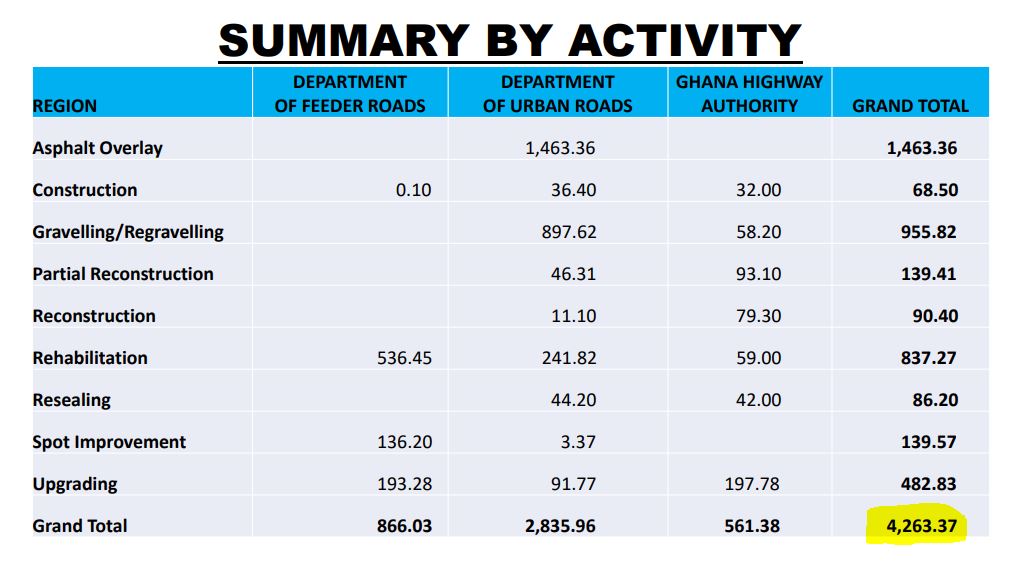
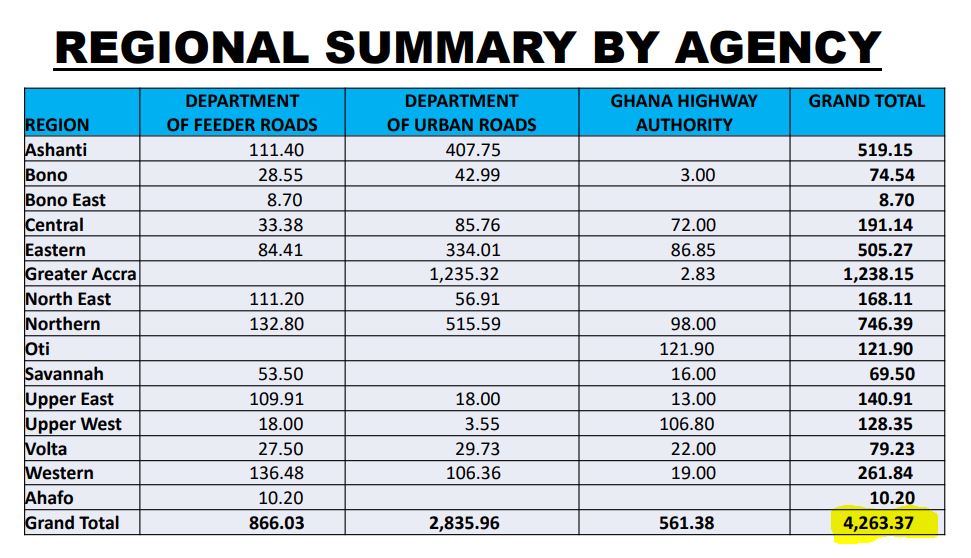
The ministry, in a report on its website highlighting developments in the roads sector between January 2017 and February 2022, indicated that the total length of new road constructions, asphaltic overlays, reconstructions, and all other road development projects were 4,263.37 kilometers.

Source: Ministry of Roads and Highways

The date above clearly contradicts the claim made by President Akufo-Addo during the delivery of the 2022 State of the Nation Address.

Further checks were done on the Ministry of Finance’s website. Its Medium Term Expenditure Framework (MTEF) documents between 2016 and 2021 confirm that at the start of the Akufo-Addo administration, the total length of Ghana’s roads was 78,401 kilometers.

The Roads Ministry in a statement to justify Preisdent Akufo-Addo’s claim, said “any activity on a road amounts to construction.”

This however will amount to gross misrepresentation of facts as the ministry will be suggesting that activities such as spot improvement, grading, gravelling and regravelling of unpaved roads adds to the count of new constructions.

It will be statistically improper to say the gravelling and regravelling of the same 5 kilometer road amounts to 10 kilometers of new roads constructed.

The ministry’s explanation is therefore untenable and rather goes to buttress the point that the ‘10,875 kilometers of new roads’ were NOT constructed within five years as claimed by President Akufo-Addo.

City Newsroom

Mental Stress Dilemma Among African Breast Cancer Survivors, By Abisayo Fakiyesi

0
Abisayo Fakiyesi

Cancer has remained a dominant terminal disease in the world. Anyone who hears the word, cancer, dreads it. Most individuals in the world still see cancer as a death sentence despite advancements in technology in treating the disease.

According to medical news today, cancer is described as a disease that results when cellular changes cause the uncontrolled growth and division of cells. In essence, the cells are supposed to grow and die for new cells to form again. In a situation when cells grow and don’t die and grow uncontrollably, it becomes a problem. There are several types of cancer including brain, mouth, breast, cervical, lung cancer amongst others. The leading cause of cancer in women all over the world, especially in black women, is breast cancer. Breast cancer is majorly aggressive in black women.

In recent studies and observations, more African women are being diagnosed with the dreaded disease. Africa being a third world country with a high increase in poverty and an ever-increasing gap between the rich and the poor has the most breast cancer patients globally. African women diagnosed with breast cancer sell their belongings and also borrow to get treated.

Most African women don’t have access to health insurance and the few who have this access do not get fully covered during treatment by the insurance companies. When an African woman successfully goes through the harsh treatment of breast cancer, she is faced with the financial burden of reintegrating back into society; most times, families and friends turn their backs on providing her with the necessary support after treatment. For instance, a young and well-educated lady like me, who defeated breast cancer twice, started from scratch with barely little or no support from friends and families who were there during treatment. One is expected to magically bounce back to normal life. Hence, I was faced with the mental stress of reintegrating back into society.

According to Lazarus & Folkman, 1984, mental stress is a form of stress that occurs because of how an event in one’s external or internal environment is perceived, resulting in the psychological experience of distress and anxiety. In other words, an event either internal or external can affect the behaviour and psychology of an individual. Amidst stigmatisation, side effects and pain faced by African women, they are still challenged with financial mental stress.

There has been a jamboree of breast cancer awareness among African women but most organisations like some NGOs are silent about life after breast cancer treatment. That’s why you see a lot of breast cancer survivors being depressed after breast cancer treatment. African women are stereotyped to be silent about their problems; hence, the slogan “e go better” is the anthem for survival.

This article is clamouring for a shift in the aims and objectives of stakeholders in breast cancer survivorship in Africa to also put priority on how African women can find their feet again to move past the disease. African women who survived breast cancer should be empowered with skills and provided financial support to reintegrate back into society. The government should embark on programs that will alleviate the poverty level of the women concerned. Philanthropists should not only focus on the sick but also on survivors who recovered from a terminal disease. Above all families and friends should continually support these women even beyond cancer treatment.

In conclusion, mental stress is more pronounced on African women after breast cancer treatment, which can lead to their breakdown and eventually lead to heart attack or suicide attempt. If all stakeholders including the media who play a role in creating breast cancer awareness in Africa can also put a priority on ways to empower these women after treatment, the end result would lead to more women coming out to give hope to those still undergoing treatment.

Breast cancer is not won by one; it is won by a community.

Fakiyesi is a two-time breast cancer survivor based in Lagos

Nigeria: Awak Sworn-in As Substantive Chief Judge Of Gombe State

0
Justice Joseph Awak takes oath of office 1st April, 2022

By Iliya Kure

Governor Muhammadu Inuwa Yahaya of Gombe State, northeast Nigeria, has sworn-in Justice Joseph Awak as substantive Chief Judge of the state.

“Following the recommendation of the Judicial Service Commission on the March 16, 2022, as required by the Constitution, I approved the appointment of Justice Joseph A. Awak as the substantive Head of the State High Court of Justice as ratified by the Honourable members of the Gombe State House of Assembly,” the Governor announced while performing the ceremony in Gombe.

Justice Awak is the third substantive Chief Judge of the State following the steps of Justice Zainab Bulkachuwa and Justice Hakila Heman, who served in the same capacity since creation of the state in 1996.

Justice Awak took over as acting chief Judge on January 2, 2022, when the former acting Chief Judge, Mua’zu Pindiga retired on attainment of statutory age of service.

Gov. Yahaya, said his administration would continue to support the Judiciary and Legislature in discharging their statutory responsibilities effectively for the overall benefit of the people of Gombe State.

“To facilitate the proper functioning of the judicial arm of government, our administration has placed emphasis on having a harmonious working relationship with the judiciary,” he said.

While restating his commitment to continue supporting the independence of the judiciary in Gombe State for the enhancement of service delivery and speedy administration of justice, Governor Inuwa assured the entire members of the judiciary that he would continue to make available all necessary facilities and funding for the discharge of the statutory responsibilities of the arm.

“The myriad of challenges facing our dear nation cannot be tamed without ensuring swift, sure, and fair administration of justice. It, therefore, goes without saying that we require an incorruptible judiciary where justice shall be dispensed to all manner of people in the state without discrimination, fear or favour.”

He congratulated the new judiciary helmsman for being found worthy to superintend over the important arm of government.

“First and foremost, our gratitude goes to Allah for giving us the opportunity to witness this important occasion of the swearing-in of the substantive Chief Judge of Gombe State.  It is, indeed, a joyful and historic moment seeing you cheerfully taking the Oath of Office. Constitutionally, you are now the head of the judiciary arm of government in the state.”

He described Justice Awak as a man well known for his sterling qualities befitting of a top-ranking judicial officer, whose appointment as the Chief Judge of the state was a culmination of many years of meritorious and selfless service to the judicial arm of government, not just in Gombe State, but also the federation as a whole.

Yahaya said, “I have no doubt in my mind that Justice Awak will discharge his duties in this new role with utmost commitment and integrity as he has always done for the benefit of our dear state.

“The importance of having judicial officers with high levels of experience and moral rectitude at this moment of our history cannot be over emphasised. It is undeniable that unbridled corruption, violent crimes and numerous other forms of criminal behaviours have bedevilled our nation, making it extremely difficult, if not completely impossible, to meet our developmental aspirations and consolidate our constitutional democracy.”

In his acceptance speech, Chief Judge Awak, lauded the governor for the confidence reposed in him, assuring that both arms would enjoy improved relationship.

Currency Exchange Rates

USD - United States Dollar
ZAR
0.06
EUR
1.17
CAD
0.73
ILS
0.31
INR
0.01
GBP
1.34
CNY
0.14
Enable Notifications OK No thanks