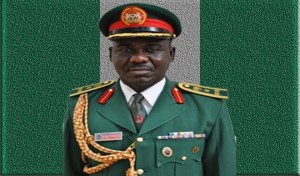
The attention of the Nigerian Army has been drawn to a publication by Premium Times online news medium titled “EXCLUSIVE: Nigeria raises troops for Gambia, ready to remove Yahya Jammeh”. This is not true.
Consequently, Nigerian Army wishes to disassociate itself from such false information that exists only in the figment of the imagination of the medium. There was no time or place Nigerian Army disclosed such information to the medium. If there is any, we challenge them to name the officer or soldier that gave them such information and when.
For the avoidance of doubt, Nigerian Army is not planning to attack any country. It should be noted that such reckless and unprofessional conduct is not expected of any reputable and responsible news medium as it is inimical to national security.
The publication apart from being false in its entirety, it is unethical and capable of endangering the lives of Nigerians in diaspora.
The medium is please requested to always clarify such matters affecting national security and diplomatic issues that may endanger the safety and security of Nigerians abroad to avoid such misleading and embarrassing publication.
By Winifred Bulus Kaduna (Nigeria) — Kaduna state government says it has inaugurated the National Education Management Information System (NEMIS) data base in all its 23 local government areas.
Commissioner for Education, Science and Technology, Professor Andrew Nok explained that the project was to address the challenge of generating reliable data due to centralised nature of data collection in the state.
He said the programme supported by Education Sector Support Programme in Nigeria (ESSPIN) would ensure more reliable data in the state Annual School Census (ASC), for planning, monitoring and evaluation in a bid to move the education system forward.
“This objective can only be achieved through cost effective and reliable data collection, collation, entry and analysis,”
Also speaking, Director of Planning, Research and Statistic, Yakubu Salisu said, “This effort would address the hitherto cumbersome and unreliable data collection process in the state”
He added that NEMIS policy was approved by the National Council of Education in 2007 to ensure accuracy, quality and reliability of data collection in schools.
Chairman, Association of Local Government Employees (ALGON) Ben Kure commended the state government for the effort and promised maximum support of all the council chairmen in the state for the success of the programme.
Kaduna (Nigeria) – The Haemophilia Foundation of Nigeria (HFN) has sought for the support of Nigerians in raising the sum of N100, 000, 000 to purchase six mobile laboratory vans (worth N9.5 million each) to be use for diagnoses to identify people living with Haemophilia in rural areas of Nigeria.
Executive director of the Foundation Mrs. Megan Adediran sought for the support while speaking during its first quarterly media forum in Kaduna, North-west Nigeria.
According to her, majority of the persons living with Haemophilia (PLWH) identified are from urban centers, hence the need to carry the sensitization campaign to rural areas to save lives that could be lost as a result of bleeding.
She said with Nigeria’s population of about 180 billion, the number of persons living with this disorder should be around 17,000 or 18,000, explaining that, one (1) in every 10,000 person is born with Haemophilia – such people do not bleed faster than others but longer because they lack clotting factor (protein) in the blood which helps to control bleeding.
Mrs. Adediran added that, “In January 2016, we had about 181 patients but as of December 2016; we had about 304 patients of which all are from urban centers. We also discovered that there is zero identification in rural areas.
“Our target is to identify 500 patients in 2017; we want to achieve that by taking diagnoses to the people because we found out that people finds it difficult to go to hospital where the diagnoses is very expensive ranging from N90, 000 to about N140, 000; Some can’t even afford the transportation from their localities to teaching hospitals where some of this facilities could be access.”
She further noted that, the Foundation wants to provide such diagnoses for free, where patients can benefit from factors (injection infused into the blood stream to stop bleeding) supplied from the World Federation of Haemophilia.
“If we can get 200,000 people that can donate N500 within the 90 days of our fund raising challenge/campaign starting from 18th January to 17th April, 2017, we can raise N100 million to buy the vans, reagents for test, employ drivers and do other things,” she emphasized.
While noting that each of the geo-political zones would have one van with a team of medical experts to commence work by May, she also called on the media to collaborate with the Foundation to identify more patients.
Earlier in her opening remark, HFN program officer, Nkechi Lawson, said the Foundation’s aim is to improve the quality of life for people living with bleeding disorder.
She however noted low level of awareness even among health workers and identification of the over 17,000 patients as their major challenge.
Lawson further pointed out that, Haemophilia is a bleeding disorder where an individual lacks the ability to form a clot after an injury (internal or external); saying the common types are; Haemophilia A – caused by low level of factor VIII in a person (it affects 1 in 10,000 persons); and Haemophilia B – caused by low level of factor IX which affects 1 in 30, 000 person.
Though Haemophilia cannot be totally cured but it can be managed by injecting the missing factor into the blood stream whenever there is a cut to stop bleeding, she added.
It symptoms include; bleeding for long after a cut, removing a tooth, circumcision, after surgery, big bruises; sudden bleeding inside the body for no clear reason; bleeding into the muscles and joints especially knees, elbows and ankles.
… after Extremists Calls for Boycott of Christmas Celebration
Christian worshipers in a Sudan Church
Sudanese Minister of religious affairs on Wednesday condemned hatred campaigns by extremists Islamists groups calling to boycott Christmas celebrations and other Christian events, while reiterating his support to religious coexistence in the east African nation.
During the celebrations of Christmas by the Sudanese Catholic and Coptic Churches, Sudan Tribune reported that, radical Islamists plastered the walls of several churches with flyers calling on Muslim to boycott the celebrations and to not pay visits or to congratulate them.
In a statement released Wednesday, the Minister of (religious) Guidance and Waqf Amar Mirghani Hussein said he had received complaints from Christian religious leaders and clerics about flyers plastered on the wall of their churches, calling on Muslims to boycott their festivals.
“Islam does not forbid congratulating non-Muslims, especially Christians, on their religious occasions,” Hussein said pointing to “the multiple fatwas (Islamic ruling) on this respect that stress the need to communicate with all religions, sects and groups” he added according to the statement.
The minister further called to promote peaceful coexistence, emphasizing that such hatred posters should not be allowed to stir up divisions and drive a wedge between Sudanese Christians and their fellow citizens.
The Nigerian Army has raised an army battalion that would be deployed in troubled Gambia to forcefully remove President Yahya Jammeh from power if he fails to step down on January 19, PREMIUM TIMES can authoritatively report today.
The battalion, christened ECOMOG NIBATT 1, was drawn from the Army’s 19th Battalion based in Okitipupa, Ondo State, military insiders have told PREMIUM TIMES.
Personnel were also drawn from other formations and units across the country due to shortage of men at 19 Battalion which has a significant chunk of its troops deployed for internal security task force, Operation Delta Safe.
This newspaper learnt that the Army Headquarters has instructed the nominated officers and men, put at over 800, to immediately report at the Nigerian Army School of Infantry, Jaji, for a crashed course on counter terrorism and counter insurgency.
Our sources said Army Headquarters has also instructed the Army directorates of policy and plans; finance; and logistics to ready funds, arms, ammunition and other logistics for the operation.
The Armoured Corps is also working hard to ready armoured vehicles needed for the task, officials said.
There were suggestions by some of our sources that the Nigerian Air Force and the Navy might deploy men and equipment for the operation as well.
Top military officers said the Nigerian Battalion would be deployed in The Gambia anytime after January 19 if President Jammeh makes real his threat not to step down after the expiration of his tenure.
“This is an emergency operation, but we are ready,” one officer said. “The Nigerian Army is a strong, professional fighting force battle ready at anytime. We are so well structured that we can deploy at the touch of a button.
“We did it in Liberian, Sierra Leone and elsewhere. And Jammeh should know that we are not a joking force. Once we get the all clear from ECOWAS, the AU and the UN to move in, we can pick him up.”
The regional bloc, the Economic Community of West African States (ECOWAS), had on December 23 put standby military forces on alert.
The ECOWAS Commission President, Marcel de Souza, said Senegal, The Gambia’s only territorial neighbour, would lead any military operation in the country.
Other West African countries will be mandated to provide troops as well, Mr. De Souza reportedly said.
Mr. Jammeh lost the December 1 2016 Gambia presidential election to opposition candidate, Adama Barrow.
He initially accepted defeat and congratulated Mr. Barrow but changed his mind and decided to challenge the outcome of the election.
He also vowed not to hand over to the winner as expected on January 19.
On Thursday, Mr. Jammeh said he would not step down before a Supreme Court decision on the disputed election, the BBC reported.
The President, the report said, insisted his cabinet and the National Assembly would remain in place until the Supreme Court rules on his party’s petition.
There is currently shortage of judges in the country to sit on the matter.
The case can only be heard in May if Nigeria agrees to supply judges to the Supreme Court.
West African leaders, led by President Muhammadu Buhari, the chief mediator, are travelling to Gambia on Friday to persuade Mr. Jammeh to accept an “honorable exit plan”.
Nigeria’s Department of State Service (DSS) has arrested four suspected members of the Boko Haram group who fled to Lagos from North-eastern Nigeria.
Spokesperson of the Service, Tony Opuiyo, in a statement pointed out that, the suspects “fled to the state (Lagos) to evade arrest in the ongoing military offensive in the North-east.”
According to Opuiyo, the four suspects were arrested on January 10 in the Oko Oba area of Lagos state, and are identified as Fanayi Bukar Hassan, Butame Hassan, Kologoni Bukar, and Amina Abubakar.
He further revealed that, the service also arrested a leader of the sect in Okene town, Kogi state, Identified as Abdullahi Mohammed, who has been responsible for the coordination of Boko Haram activities in Okene axis of the state.
Two fleeing Boko Haram members were also arrested on January 1st, at Mutum Biyu in Gassol local government area of Taraba state in a mosque after they had fled Marte, Bornu state. They are; Bale Grema and Kolomi ADBA-AJI, the statement added.
Kaduna (Nigeria) – Nigeria has criticized media reports on increased import duties, explaining that the 2016 Fiscal Policy Measures (FPM) tariffs for those items remained at their 2015 levels, while duties for some other items were actually reduced.
Recent media reports suggested that Nigerian government had increased charges on luxury goods imported into the country, including automobiles and pharmaceutical drugs.
A statement by Director Information in the Ministry of Finance, Salisu Na’inna Dambatta regretted how the media misrepresented the information.
“The Federal Ministry of Finance wishes to categorically state that the correct position is that, the 2016 FPM did not involve any upward review of tariff on the affected food items and luxury goods. On the contrary, tariffs for those items remained at their 2015 levels, while duties for some other items were actually reduced,” it says
Read below the statement by the Nigerian Government.
Press Release
The attention of the Federal Ministry of Finance has been drawn to recent publications in the media, regarding the 2016 Fiscal Policy Measures (FPM), to the effect that the Federal Government has raised import duties on food items and luxury goods.
The Federal Ministry of Finance wishes to categorically state that the correct position is that, the 2016 FPM did not involve any upward review of tariff on the affected food items and luxury goods. On the contrary, tariffs for those items remained at their 2015 levels, while duties for some other items were actually reduced. A comparison of the 2015 Fiscal Policy Measures Circular dated 20th March, 2015 and the 2016 Fiscal Policy Measures dated 29th November, 2016 will affirm this position.
With regards to the 20 per cent duty on pharmaceutical products in the 2016 Fiscal Policy Measures, it should be noted that pharmaceutical products were already in the import prohibition list.
This is in support of Government’s intention give further encouragement and desirable protection to local manufacturers of Pharmaceutical products and ensure that those who, despite the prohibition, import such products under special permission, pay the required duties.
This clarification is aimed at providing the Nigerian media and other stakeholders with the correct information on such sensitive matters and to urge all interested parties to cross-check information with relevant authorities for accuracy. This is especially necessary at these challenging times when the Federal Government is putting extra efforts to encourage our local industries and manufacturers.
The accompanying documents, which could also be accessed on the website of the Federal Ministry of Finance, contain the details of the 2015 and 2016 Fiscal Policy Measures for the records.
Kaduna (Nigeria) – Nigeria has commenced construction of 65 boreholes in 28 states, in hope of providing nationwide access to portable water. This according to the Ministry of Water Resources is under the 2016 Appropriation Act “targeting the Internally Displaced Person Camps (IDPs), Disaster Challenged Areas and Public Areas.”
Minister of Water Resources, Suleiman H. Adamu, told successful contractors in Abuja that the project is under the Partnership for Expanded Water Supply, Sanitation and Hygiene (PEWASH) launched recently by Vice President Yemi Osinbajo.
“These borehole projects are very important to us as they are meant to provide sustainable water supply to the Internally Displaced Persons, Disaster Challenged Areas and some Public Areas nationwide,” he said.
He urged the contractors to stick to specifications of the construction of the boreholes, as well as the local communities taking ownership of the projects.
In a remark, Michael Ale, who represented the contractors, promised to work towards the success of the project in line with the requirements.