Cairo (Egypt) – As part of the national program for early breast cancer checks, 180,000 women older than 40 have been examined for free since October 2007, the Health Ministry declared.
Advisor to the Health Minister, Abeer al-Maghawry, said the program began with four mobile clinics providing digital mammograms, which then increased to 12 mobile clinics, in addition to other units across other governorates.
As of January 2017, the number of cases diagnosed with tumors is 2,993.
Women diagnosed with breast cancer were referred to Qasr al-Aini, Ain Shams University hospitals, National Cancer Institute (NCI) and tumor centers across other governorates.
The checkup and treatment is offered for free. All workers in the program are women, Maghawry said, adding that three ultrasound devices were obtained as a grant from the UN High Commission for Refugee Affairs.
Egypt is the first country in Africa and the Arab world to obtain such devices, she said, indicating the total costs of all the devices reach LE8 million.
Maghawry highlighted Egypt’s experience in the program during a conference held at the previous Arab Hospitals Federation, attended by Arab health ministers.
She also urged women above the age of 40 to visit the nearest checkup vehicles, citing some locations: next to the Finance Ministry, at Haram Hospital, at the Health Department in Borg al-Arab, at Luxor International Hospital, at Qosiya Hospital in Assiut, next to the National Council of Women in Banha city and at the main headquarters next to NCI
Cairo (Egypt) – The Ministry of Antiquities is gearing up to complete the remainder of the excavation of the Ramses II statue using newer and safer techniques, informed sources in the ministry said.
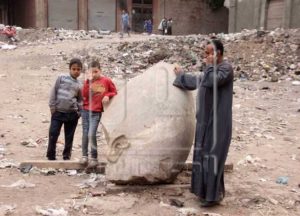
This move comes following sharp criticism about the poor method by which the head was extracted on Thursday; it was also left aside without proper precautions against residents in the area tampering with it.
The eight-meter statue was found submerged in ground water in the Matariya area in Ain Shams district by a joint German-Egyptian archaeological mission operating in Matareya area at the site of King Ramses II Temple which he built at in Oan City in Ancient Egypt.
The discovery included parts from two statues of two kings, one of which is likely King Ramses II, belonging to the 19th Dynasty.
Rumors that same day alleged that the use of heavy machinery and diggers in the site has led to the destruction of the statue, claims that the German-Egyptian mission have denied.
Mahmoud Afify, head of the Egyptian Antiquities Sector, said only the head of the statue was lifted with a crane due to its excessively heavy weight.
Antiquities Minister Khaled al-Anany said the discovery is one of the most important recent archaeological discoveries, as it demonstrates the greatness of the temple in ancient times in terms of the magnitude of the building and the statues that were adorned by fine, precise patterns and inscriptions.
The police in Kaduna on Sunday denied being responsible for the arrest and incarceration of Audu Maikori, CEO of Chocolate City Entertainment, who has been at loggerheads with the Kaduna State government for alleged incitement to violence.
“We’re not aware of his arrest,” Kaduna police spokesperson, Aliyu Usman, told PREMIUM TIMES on Sunday afternoon.
The disclosure, which was made after two days of repeated enquiries from this newspaper, marked the first public statement by the police since Mr. Maikori was arrested on Friday morning for the second time in a month.
It came hours after Mr. Maikori’s lawyer told PREMIUM TIMES that the Kaduna State government had concluded plans to arraign him before a court on Monday morning.
PREMIUM TIMES had reported how the label executive was arrested by the police and subsequently taken to Kaduna, based on information provided by his lawyers.
“I am aware that the police in Abuja are taking Audu to Kaduna,” Mark Jacobs, Mr. Maikori’s lawyer, told PREMIUM TIMES Friday afternoon.
Reports over the weekend, including tweets by the National Human Rights Commission, said police in Kaduna were holding Mr. Maikori at the State Criminal Investigation Department.
To be arraigned Monday— Lawyers
Similarly, John Danfulani, an associate of Mr. Maikori who is also standing in as one of his legal representatives, said he met the embattled label executive in a police facility along Ibrahim Taiwo Road, Kaduna.
“I was with Audu on Friday night. Left him at 8:30 p.m. in Ibrahim Taiwo Road cell,” Mr. Danfulani said.
Mr. Danfulani, a former lecturer at the Kaduna State University who is facing separate charges of incitement also brought against him by the Kaduna State government, said his friend will be arraigned on Monday.
“He will appear in court tomorrow,” Mr. Danfulani said.
Although the police vehemently denied playing any role in detaining Mr. Maikori, a highly-placed source within the organisation said other law enforcement agencies, especially the State Security Service, might be responsible.
“Other government agencies, like the SSS, might have arrested him and placed him in a police cell,” the source told PREMIUM TIMES in Abuja on Sunday.
PREMIUM TIMES could not independently confirm that SSS executed Mr. Maikori’s arrest. The agency’s refusal to appoint a spokesperson running close to two years made it impossible to get clarification.
Threats of prosecution
Mr. Maikori’s latest ordeal comes about a week after Governor Nasir El-Rufai pledged to ensure his thorough prosecution for allegedly circulating inflammatory materials capable of exacerbating the deadly conflict in Southern Kaduna.
“What he posted may have led to killings and we are trying to link the dates of the posting to attacks that may have happened the next day on Fulanis and if we are able to establish that causation, as lawyers, we know what it means,”Mr.El-Rufai said in Lagos March 4. “It is totally irresponsible to do that.”
The governor’s spokesperson, Samuel Aruwan, did not pick or return calls seeking to clarify if the governor ordered Mr. Maikori’s latest arrest.
Mr. Maikori, 41, was first arrested in Lagos in the afternoon of February 17 for allegedly trying to “incite” the public. He was subsequently transferred to Force Headquarters in Abuja for interrogations.
Mr. Jacobs said the arrest was in connection with a series of tweets posted by Mr. Maikori about seven weeks ago in which he alleged the killing of some Southern Kaduna students by Fulani herdsmen.
But details of the tweets, which Mr. Maikori said were obtained from his driver, turned out to be false, earning him vicious social media backlash.
Mr. Maikori later retracted and apologised for the false information.
A magistrate in Kaduna issued a warrant for his arrest, his lawyer said.
He was released on bail February 18, but the police said he “will be charged to court promptly.”
Police spokesman, Jimoh Moshood, told PREMIUM TIMES investigations were underway and Mr. Maikori will be arraigned after preliminary findings.
“You know investigation is a scientific approach —to actually tell the court that ‘this is the person that committed so, so and so offence’. So there’s no timeline for conclusion of investigation,” he said at the time.
On Sunday, Mr. Jacobs told PREMIUM TIMES that his client was released because the police “found nothing substantial to warrant prosecution.”
Over 200 have been killed and thousands more displaced in the latest violence between Fulani herdsmen and southern Kaduna residents, according to official estimates.
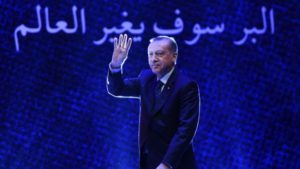
Turkish President Recep Tayyip Erdogan has warned the Netherlands it will “pay the price” for harming ties after two of his ministers were barred.
The two ministers were blocked from addressing Turkish expatriates in Rotterdam on Saturday, with one of them escorted to the German border.
The Dutch government said such rallies would stoke tensions days before the Netherlands’ general election.
Turkey’s ties with several EU countries have become strained over the rallies.
The rallies aim to increase support among expatriate voters for a referendum on expanding Turkish presidential powers.
Fatma Betul Sayan Kaya, Turkey’s family minister, had arrived in Rotterdam by road on Saturday, but was denied entry to the consulate and taken to the German border by Dutch police.
Foreign Minister Mevlut Cavusoglu tried to fly in but was refused entry.
‘Capital of fascism’
Several EU countries have been drawn into the row over the rallies:
Mr Cavusoglu called the Netherlands the “capital of fascism” after he was refused entry
Mr Erdogan accused Germany of “Nazi practices” after similar rallies there were cancelled – words Chancellor Angela Merkel described as “unacceptable”
Denmark’s Prime Minister Lars Lokke Rasmussen postponed a planned meeting with Turkey’s prime minister, saying he was concerned that “democratic principles are under great pressure” in Turkey
Local French officials have allowed a Turkish rally in Metz, saying it does not pose a public order threat – while France’s foreign ministry has urged Turkey to avoid provocations
Mr Erdogan accused countries in the West of “Islamophobia” and demanded international organisations impose sanctions on the Netherlands.
“I have said that I had thought that Nazism was over, but that I was wrong. Nazism is alive in the West,” he said.
He thanked France for allowing Mr Cavusoglu to travel to Metz to address a rally.
The Netherlands’ Prime Minister Mark Rutte has demanded Mr Erdogan apologise for likening the Dutch to “Nazi fascists”.
“This country was bombed during the Second World War by Nazis. It’s totally unacceptable to talk in this way.”
Mr Erdogan’s comments were “completely unacceptable”, and the Netherlands would have to consider its response if Turkey continued on its current path, he added.
The Dutch government is facing a severe electoral challenge from the anti-Islam party of Geert Wilders in its election on Wednesday.
Reports say the owner of a venue in the Swedish capital, Stockholm, has also cancelled a pro-Erdogan rally on Sunday that was to have been attended by Turkey’s agriculture minister.
Sweden’s foreign ministry said it was not involved in the decision and that the event could take place elsewhere.
What is the row about?
Turkey is holding a referendum on 16 April on whether to turn from a parliamentary to a presidential republic, more akin to the United States.
If successful, it would give sweeping new powers to the president, allowing him or her to appoint ministers, prepare the budget, choose the majority of senior judges and enact certain laws by decree.
What’s more, the president alone would be able to announce a state of emergency and dismiss parliament.
There are 5.5 million Turks living outside the country, with 1.4 million eligible voters in Germany alone – and the Yes campaign is keen to get them on side.
So a number of rallies have been planned for countries with large numbers of expat voters, including Germany, Austria and the Netherlands.
Why are countries trying to prevent the rallies?
Many of the countries, including Germany, have cited security concerns as the official reason.
Austrian Foreign Minister Sebastian Kurz said Mr Erdogan was not welcome to hold rallies as this could increase friction and hinder integration.
Many European nations have also expressed deep disquiet about Turkey’s response to the July coup attempt and the country’s perceived slide towards authoritarianism under President Erdogan.
Germany in particular has been critical of the mass arrests and purges that followed – with nearly 100,000 civil servants removed from their posts.
In Malawi’s newspapers, there is much talk of the need to tackle vigilante and mob justice. But the stories Peter Walker found suggest change is some way off.
In the dusty city of Mzuzu in northern Malawi, things seem to work. Mums, babies and squawking chickens pile on to a fragile network of tin-frame minibuses. Trade is thriving in the market. Here, merchants yell out the prices of rice, beans and eggs, engulfed by the odours of fresh fish and cheap rum.
But behind this facade is the constant presence of death.
Thanks to the scourges of drink driving, mob justice and endemic disease, there is a pungent smell of mortality. And with it, a police force seemingly oblivious, and apparently, ready to sweep murder under the carpet.
I already knew Malawi’s judicial system needed an overhaul. But only after I spent one sun-drenched Saturday in the city’s Zolozolo neighbourhood, did I realise how urgently.
Fifty-two-year-old Raymond N’goma lives in a home that is nothing more than brick walls and mounds of rubble. No roof. No doors.
Raymond, who earns 90p ($1.40) per day as a bicycle taxi driver, wears a black-and-white striped basketball vest, a neat moustache and a sad frown. His five children are dressed in clothes that are threadbare, outgrown and caked in dust. Their empty eyes are fixed on mine.
Raymond recalls how his second wife, who has now abandoned them, may have fatally poisoned his 18-year-old son from a previous marriage. She was held in police custody in 2011, but was returned to Raymond after four months. There was no trial and no conviction.
“I can’t believe she poisoned him. I’m undecided. It was only doctors who checked the body and I’ve just left it in the past,” he says, deadpan.
Sitting on the edge of a brick well, he hesitates, gazing wearily at nothing, when I ask him whether he killed his son. I laugh quietly at the absurdity of my own question. “I’m innocent. I can’t poison my own son. It’s complex,” he answers.
In another case, 35-year-old Fiskani Chipeta, a market stallholder, was found unconscious outside a primary school in January. Two unknown men dumped her at the hospital. The same day, her house was burgled.
Fiskani’s mother, Orlean, speaks some English, and weighs her words with tired concentration.
“I don’t know who killed her, we can’t know,” she tells me. “But the death from killing, it’s too much in Mzuzu. We are crying out for a miracle.”
Fiskani’s parents-in-law didn’t involve the police because they thought it a waste of time. Orlean’s brother, Tennyson, adds: “My niece was left on the side of the road like a dead dog but there were no clues. If we went to the police they would just say: ‘How do we find the suspect if there’s no information?'”
Along Zolozolo’s dusty main road, a woman swivels on her wooden chair, and points nervously to a nearby bungalow. “It happened here,” she says.
Her friend Angelina Mkandawile, was beaten to death here last month. Extraordinarily, the suspect – her husband, Nogzani Hara – was kept in custody for just 48 hours. He was bailed after Angelina’s burial.
As we speak, he is in the Protestant church next door. “Everyone is complaining the police have done nothing,” I’m told.
In a room dimly lit by the setting sun, village chief South Mfune tells me the story of friend and church volunteer Sarah Zgambo. Last month, Sarah’s husband discovered her affair of four years. He beat her to death with a metal bar and threw her body into the botanical gardens.
A friend of his allegedly attacked Sarah’s lover. Two suspects are in custody.
In this case at least, it seems the police did their job. But with tangible frustration, his clenched fists shaking, South tells me that his community are scared.
He says police fail to uphold confidentiality for victims and witnesses. And he tells me criminals will only be detained for one or two days. “People fear they will come back for them and kill them,” he says.
As dusk settles, we meet five of Sarah’s seven children. The eldest, 19-year-old Ruth, is composed, as her infant sister tugs on her ankle-length skirt. It’s a typical African printed-cloth wrap, or chitenji, in vibrant yellows and blues.
It doesn’t match her bleak state of mourning and even bleaker future. “When my mum is dead and my dad is in prison: it’s very hard,” she says.
Ruth was the day’s most heart-rending example of someone on the receiving end of a failing judicial system. One that needs complete reform. Only then can my new friends feel safe in Mzuzu, the city where everything else seems to work.
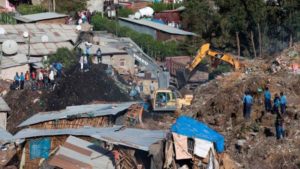
At least 48 people have been killed in a landslide at a vast rubbish dump on the outskirts of Ethiopia’s capital Addis Ababa, officials say.
They say dozens of people are still missing since the landslide on Saturday night at the Koshe landfill. A resident said 150 people were there at the time.
A number of makeshift houses are now buried under tonnes of waste.
The area has been a dumping ground for Addis Ababa’s rubbish for more than five decades.
A city spokeswoman told AP news agency that many children were among the dead.
There are fears the death toll could rise further.
Local resident Musa Suleiman Abdulah told AFP he heard “a big sound” and saw “something like a tornado… rushing to us” when the landslide occurred.
Tebeju Asres said that the family’s house had been swallowed by the landslide.
“My mother and three of my sisters were there when the landslide happened. Now I don’t know the fate of all of them,” he told AP.
Hundreds of people attempt to make a living by scavenging at the landfill site, sifting through the rubbish for items they can sell, the BBC’s Emmanuel Igunza in Addis Ababa reports.
Some people even resided at the rubbish dump permanently.
The authorities have been building Africa’s first waste-to-energy plant near the landfill.
They plan to burn rubbish generated by the capital’s estimated four million people and convert it into electricity.
Katsina (Nigerai) – Katsina State Government in northern Nigeria is reopening nomadic schools having loss two academic terms to activities of cattle rustlers, who took over the school buildings.
The region has suffered several attacks, and “you dare not go there before. But today, we entered here without any escort,” said Chairman, Katsina State Universal Basic Education Board, Lawal Buhari Daura.
The chairman added, “We thank Almighty Allah that peace has returned to the land and the Nation as a whole with the current set of leaders we have at the helm of affairs. The government are on their toes to tackle insecurity and ensure that day and night Nigerians are secured,”
Four of the reopened schools include, Kyabbo Nomadic primary school in Jibia Local government and Hamada Nomadic Primary School in Sabuwa Local Government, Ginginyu Nomadic Primary school and Garin Liman Nomadic Primary school in Batsari Local government area.
Daura called on the nomads to allow their wards to go to school to acquire western education, “we are not saying you should not send your children to farm, rear animals or send them to Islamic school, but what we are saying is, also send them to go to school,” he said.
The Chairman also tasked the nomads to encourage girl-child education in their communities to produce female doctors among others who will in turn play vital roles in the society and where necessary while also urging them to also enroll in adult education.
“You are not left out, you can engage in adult education and with that you can read because some Quran are written in English. Fight ignorance because ignorance is the root cause of the killings,” Daura stated.
Similarly, the Executive Secretary of SUBEB in Jibia, Dr. Salisu Mamman said he was forced to close down the school due to the high level of insecurity adding that the school was turned into a hideout for cattle rustlers.
He said five cattle rustlers including a teacher, who was involved in the activities of the rustlers were killed by soldiers who raided and liberated the area.
Head teacher of Kyabbo Nomadic primary school in Jibya Local government area, Abubakar Mohammed expressed delight to government for renovating and reopening the school.
The cattle rustlers were beleived to have come from northern states of Kaduna, Kano, Bauchi, and Niger states.
United Nation’s Humanitarian Chief, Stephen O’Brien, has revealed that the world is presently facing its worst humanitarian crises since 1945.
He explained that about 20 million people in Nigeria, Yemen, Somalia and South Sudan were suffering from starvation and hunger.
Mr. O’Brien therefore requested the UN Security Council in New York to help fight starvation faced by the countries affected.
“The situation for people in each country is dire and without a major international response, the situation will get worse. All four countries have one thing in common: conflict.
“It is all preventable. It is possible to avert this crisis, to avert these famines, to avert these looming human catastrophes,” he said.
He added that 18.8 million people in Yemen have been affected by the hunger and starvation, stressing that the region had been affected by war waged by Iran and Iraq and have continued to suffer.
According to him, South Sudan had been at war since 2013 and its government has blocked humanitarian aid from coming into its territory to help victims.
He observed, “At least, 75,000 children are facing starvation in Nigeria as a result of Boko Haram terrorist attacks that have displaced many in the country.
“Somalia on the other hand had lost nearly 260,000 people in the last famine about six years ago.”

 Cairo (Egypt) – As part of the national program for early breast cancer checks, 180,000 women older than 40 have been examined for free since October 2007, the Health Ministry declared.