Home Blog Page 1572

Nigerian Government Half-Hearted, Biased To Finding Peace In Southern Kaduna – SOKAD

0
Map of Nigeria Showing Kaduna State

 By Amos Tauna

Southern Kaduna in the Diaspora, SOKAD, has observed with dismay that the state and federal governments’ actions have clearly demonstrated a half-hearted and biased commitment to finding peace in Southern Kaduna.

In an open letter to Governor Nasiru Ahmed El’Rufai of Kaduna state, made available to newsmen in Kaduna on Thursday, the forum noted that in several instances, their (Government) actions have continued to undermine the ability of the people to defend themselves.

The letter signed by Freeman Kamuru, Danlami Ngboze and Daidu John, President, Secretary and Financial Secretary respectively, explained that, “Such actions amount to crimes that are prosecutable. Their offices are termed limited and the actions or inaction of those in power, who have sworn to protect and defend the constitution of the Republic and to comply with internal agreement on basic universal human rights will be called to order and tried in due time.

“Southern Kaduna Diaspora ( SOKAD) continues to be troubled by your handling of the genocide in Southern Kaduna.  We have expressed our concerns about this on several occasions, specific to the intimidation of your critics, with the hope that the state will modify its approach, but to no avail. 

“While the Kaduna State government has made pronouncements on its desire to secure a lasting peace in Southern Kaduna, its actions, so far, have directly contradicted its pronouncements.

“One important step in the process of securing peace in any community is to dialogue with legitimate representatives of the people of the community. However, when the state arrogates to itself the sole power to decide who it will dialogue with, and ignores the people’s choice, it shows that the state call for peace is not genuine.

“A case in point is your attitude toward Southern Kaduna Peoples Union (SOKAPU). SOKAPU is the legitimate representative of the ethnic groups in Southern Kaduna. For the Governor of Kaduna State to refuse to dialogue with this respected group and to refer to its officers as bigots, is unfortunate and unacceptable. 

“Your statement on National Television that you will not meet with SOKAPU to discuss strategies for achieving peace in Southern Kaduna raises serious questions about your commitment to peace in the area. SOKAPU is a nationally and internationally respected group, led by learned professionals in different fields of human endeavors, who are well equipped to offer useful advice to the Governor and others in leadership who are truly concerned about the ethnic and religious cleansing going on in Southern Kaduna.

“The recent Operation Harbin Kunama in Southern Kaduna, was initially seen as a positive step toward achieving lasting peace in the area; it was hoped that perpetrators of the genocide-the armed Fulani herdsmen, would be disarmed. Many people in southern Kaduna were leery and skeptical of the effort, just as they were of the establishment of a permanent military presence in the area.  Those fears are now confirmed as the Operation Harbin Kunama entered its second phase a couple of weeks ago. 

“As it turned out, it is innocent and helpless people of Southern Kaduna who are having their hunting tools and rifles confiscated and soldiers are reported to be going house to house disarming them.  The state has failed these citizens by not protecting them and now it is taking away any chance of resistance against the terrorist that are wiping them out. 

“The state is therefore aiding and abating the ongoing genocide.  This is wrong and therefore unacceptable.  From available reports, no terrorist has been disarmed or arrested. The Fulani herdsmen are still armed and keeping their weapons. While some elected Southern Kaduna politicians, such as Senator Danjuma Leah have had their legally obtained guns confiscated, the Emirate in Kafanchan which is widely believed to be a repository of illegally obtained weapons, has not been searched.

“SOKAD is also troubled that Kaduna State is deliberately undermining the education of Southern Kaduna. Under the pretext of security, you and your Commissioner for Education, have closed the only two tertiary Institutions in Southern Kaduna and have no plan to reopen them.

“SOKAD will continue to contribute its quota to ending the genocide in Southern Kaduna. We are committed to being a watchdog for accountable leadership from those elected to serve the people.

“The people of southern Kaduna have had little cause to shout for joy under your regime as the liberty and freedom that you promised as a candidate continues to elude us.  Instead, unspeakable tyranny has been visited on us under your watch more than at any time in living memory.”

Nigeria: Media Development Organization Plans Training Programs For Journalists

0
AMDF Logo

By Longtong Ibrahim

Africa Media Development Foundation (AMDF), a Kaduna based media development organization is planning series of training programs for journalists in Kaduna State among which include Media clinic and the Kaduna Social media Engagement Day. These programs are aimed at enhancing the capacity of journalists.

Briefing newsmen on Wednesday in Kaduna – northwest Nigeria, AMDF Coordinator, Mrs. Sekyen Dadik, said the Kaduna Social media Engagement Day would come up next week’s Thursday 18th May, 2017; explaining that, the training would highlight the importance of social media especially in the dissemination of information to a large audience.

According to her, the activity will feature two paper presentations and a panel discussion on how the media professionals and Civil society organizations (CSOs) have been using the social media effectively – with a view to improving their impact. She added that, the program targets Managers from mainstream media, Online publishers, Reporters, program producers, program presenters; CSOs, Government agencies, and Private sector businesses using social media for communications activities.

“The place of social media in the society today cannot be ignored – while journalism is known as the fourth estate of the realm, today world over, the social media is termed the fifth estate of the realm,” Mrs. Dadik pointed out.

While noting that AMDF had the opportunity to train journalists in online journalism, Peace Journalism, Development Journalism, among other training, the Coordinator said, the Media Clinic program is an annual event which brings together Media Executives, Media Practitioners, and Development Partners to discuss issues that affect the media and proffer possible solutions.

“AMDF had sought partnership from organizations with interest in social media and they are forthcoming.

“We recognize you, the media also as our partners and major stakeholders in achieving our desired outcomes for the Social media engagement, and we will continue to count on your support to succeed,” she added.

AMDF is a nonprofit, nonpolitical organization that supports journalists, media development and promotes freedom of the press. It activities includes; Training, advocacy, research, coordination and information sharing.

Nigeria’s First Lady Conducts Health Screening Exercise For IDPs

0
Aisha-Buhari

Wife of Nigeria’s President, Mrs. Aisha Buhari has stressed the need for women to be conscious of their health, as a precondition for a successful livelihood.

A statement by the first Lady’s Director of Information, Suleiman Haruna, noted that Mrs. Buhari stated this during a health screening exercise at the Durumi Camp for internally displaced persons (IDPs) in the Federal Capital Territory, a program organized by her office in collaboration with Cry for Help Foundation.

She emphasized the need for women to know their blood pressure and blood sugar, as well as to check themselves for malaria, sickle cell anaemia, hepatitis, cervical and breast cancers.

She said, “I call on all women to be conscious of their health status; it is through this consciousness that a woman can live a healthy, and therefore a productive life.”

Represented at the occasion by the National Coordinator, Future Assured Programme, Dr. Kamal Muhammad Abdurrahman added that, they have conducted health screening exercises in five of the six geopolitical zones of the country and commissioned two mobile clinics for easier access to remote areas.

“We will visit the sixth geo-political zone, which is North Central, very soon, and begin subsequent rounds to more states across the country.”

In his remarks, the Secretary General of Cry for Help Foundation, Alfred Sanni, said hundreds of the IDPs and residents of neighboring communities benefited from the screening exercises, while their children were checked for eye as well as Ear Nose and Throat (ENT) infections.

She however commended Mrs. Buhari for the concern she has on the health of women and children.

Nigerian Gov. El-Rufai ln Kaduna Court, Testifies In Libel Suit Against Newspaper

0
Gov. El-Rufai
Gov. Nasir El-Rufai of Kaduna State, Nigeria

By Amos Tauna

Governor Nasiru Ahmed El-Rufai of Kaduna state, northwest Nigeria, Wednesday appeared before a Kaduna High Court to testify in the libel suit he filed against The Union Newspaper in 2015, over an alleged news report on his (El-Rufai) asset declaration.

El-Rufai in July, 2015 sued The Union Newspaper for allegedly reporting that he declared assets worth N90 billion before the Code of Conduct Bureau.

The matter between the Governor against Union Publishing Company and one other came up before High Court 4 of the Kaduna State High Court of Justice for continuation of hearing wherein the plaintiff himself, El-Rufai testified as plaintiff witness 5.

During his testimony, several documents were sought to be tendered among which was the Code of Conduct Bureau Assets Declaration Form.

The counsel to the defendant, Barrister Abuul Hiifan Andrew, consisted to the misbility of all other documents sought to be tendered except the Code of Conduct Bureau Assets Declaration Form of the plaintiff on the ground that the document sought to be tendered was entirely different from the copy frontloaded before the Court, stressing that the document sought to be tendered is certification of the Code of Conduct Bureau stamp and the date of certification which is the first date of August, 2016 contrary to the document that was frontloaded which did not contained any certification from the Code of Conduct Bureau.

Counsel to the plaintiff,  A. U. Mustapha, SAN, in his submission to the objection raised to the defendant counsel argued that the objection was misconception as the document sought to be tendered was relevant and same was frontloaded.

Counsel to the defendant while arguing his case,  said, “Also apparent of the document as shown on the date of the certification shows that the document was certified by the  Code of Conduct Bureau during the pendency of this case as this suit was commenced in the year 2015 and the document certified in 2016 which clearly shows that as at the time of commencement of this action, the document sought to be tendered was not frontloaded.

“However, the honourable Court admitted the document on the basis that same is relevant to the case and the trail continues as the witness was cross examined and the plaintiff at the end of the proceeding closed their case.”

The case was adjourned to 15th June, 2017 for the defendant to open their defense.

Rule of Law: Why ECOWAS Must Apply The Gambia Experience On Nigeria

0

By Abdallah el-Kurebe

There is no doubt that the fundamental rights of all Nigerian citizens are guaranteed by the 1999 constitution of the country, which provisions the President of the Federal Republic, Muhammadu Buhari swore to uphold.

Described and seen as a disciplinarian; one who was believed to have impressive qualities of leadership paraphernalia, President Buhari has rather failed to portray that particular quality of leading Nigerians in accordance with the rule of law. This is especially as it relates to contravention of court orders in issues of fundamental human rights of Nigerian citizens.

In these matters, especially that affects former National Security Adviser (NSA), Sambo Dasuki, Buhari has subsumed himself to be, not only the President that he was elected to be, but also the head of the judiciary that he is not. This is so much that most judges’ rulings, especially those in which cases he has vested interest, are subject to Buhari’s assent – like laws passed by the National Assembly.

Mr. President’s fight against corruption is regarded by both national and international communities as ‘incomplete’ without committed respect for the rule of law. The rule of law is a veritable ingredient of democratic rule without which it is not coherent. The theory of coherentism in democracy is such that the practical leadership qualities should be seen to cohere with the principles of democracy, the leading pilar of which is the rule of law.

Vendetta?

Shouldn’t Buhari’s failure to be bound by the orders of four courts, including that of the ECOWAS confirm Nigerians apprehensions that he is out to take a revenge against the former NSA who was alleged to have held him captive during the Abacha coup? Does Mr. President believe in our judiciary, which swore him to office? Why did Buhari take Dasuki to court in which he did not believe? Should we amend Nigeria’s constitution so that the President could, as well, be the judge in our courts? What has the President against Dasuki that the courts would grant him bail but he would overrule the courts, including the ECOWAS court? These are fundamental questions that should address issues of fundamental rights that are being abused by the President.

The Kanu example

If the gravity of alleged offenses upon which one is standing trial in court is what should determine whether he be granted bail or not, Nnamdi Kanu is a good basis for Dasuki to be released on bail. One of the five sustained charges against Kanu, the court having struck out six, is treasonable felony – a declaration of war against the state. Nigerian constitution describes treason as a gross offense punishable by death.

If Kanu could be granted bail and be released by Buhari, why should Dasuki whose alleged offense is less in gravity be denied to enjoy bail granted to him by four courts of competent jurisdiction? Is it because no one is making noise in favour of Dasuki as many did in favour of Kanu?

ECOWAS’ intervention

 The Economic Countries of West African States (ECOWAS) of which Nigeria is a member, recently made giant moves in the African sub-region to ensure the providence of the rule of law in the Gambia. The body’s assertiveness made defeated former Gambian dictator flee the country to allow the will of the people prevail. That was a first good step taken to check the excesses of African leaders, especially those of the sub-region, who feel they could, at will, hold on to power even where they lost in free and fair elections.

Aside from ensuring that winners in elections take over power from those who lost out, ECOWAS has a duty to ensure that rule of law, which is the backbone of any sustainable democracy, takes precedence no matter who is involved.

It is no longer news that former National Security Adviser (NSA) to former president Jonathan, Col. Sambo Dasuki has remained incarcerated on the allegedly misappropriating funds given to his office by the Central Bank of Nigeria, among others, since after Jonathan lost the 2015 presidential election to Muhammadu Buhari. It is not also news that the Federal government of Nigeria and Dasuki have been in courts over the allegations.

In September, 2015 a Federal High Court in Abuja presided by Justice Adeniyi Ademola, granted bail to Dasuki on self-recognition after he pleaded not guilty to a one count charge of illegal possession of firearms. It was argued that the offense was bailable based on section 158 (1) (2) (3) of the new Administration of Justice Act and Sections 35 and 36 of the 1999 Constitution. He was to deposit his international passport with the Court, as a measure to ensure he does not jump bail.

It is to be believed that no matter the enormity of any offence committed by any individual, once the Courts pronounce him fit to enjoy bail, so shall it be. Bail is a fundamental right of all Nigerians as guaranteed by section 35 of the Constitution. Though charged with illegal possession of firearms at the Federal High Court and money laundering offences at the High Court of the Federal Capital Territory, notwithstanding the gravity of the charges, Col. Dasuki was admitted to bail by three trial courts. And, having fulfilled the bail conditions on December 29 and the Kuje prison authorities, having released Dasuki, the Department of State Security immediately rearrested him.

In December, 2015 a High Court in Federal Capital Territory, FCT, Abuja presided by Justice Husseini Baba Yusuf also granted bail to Dasuki and four others standing trial for money laundering. The third bail was granted by Justice Peter Affem of FCT High Court. Conditions of all bails were met by Dasuki.

Compelled by the circumstances of his denial to bail, Dasuki approach ECOWAS Court to secure the enforcement of his human rights to personal liberty guaranteed by article 6 of the African Charter on Human and Peoples Rights. Although the federal government challenged the competence of the ECOWAS Court to hear and determine the suit, the preliminary objection was dismissed. It held that the detention of Dasuki without a court order was not justifiable under the Nigerian Constitution and the African Charter on Human and Peoples Rights. As a consequence, the court ordered Dasuki’s release and damages to him to the tune of N15 million as reparation for infringing his human rights.

The ECOWAS Court through Justice Friday Chijioike Nwoke ordered immediate release of Dasuki from detention, holding that the Federal government had violated both national and international laws on the right of persons and citizens to freedom of liberty. It imposed a fine of N15,000,000 against Nigeria as compensatory damages to Dasuki for the deprivation of his freedom to liberty and the deprivation of his properties. Justice Nwoke held that even if the applicant had committed a crime the law still had it that due process of the law must be observed in his trial.

ECOWAS COURT JUDGEMENT: 

“Having perused the case before us, we have come to the conclusion that the re-arrest and detention of the applicant after he had been granted bail by three courts since last year make mockery of the rule of law. Executive arm should not interfere with the judiciary. “Even if the applicant has committed crimes of whatever nature, the principle of innocence must be respected and the fact that he has been charged to court does not disentitled him to freedom of liberty… Court must rise to their responsibilities and prevent executive lawlessness. It is the applicant today; it could be anybody tomorrow. There is no legal basis for the re-arrest of the applicant other than to circumvent the bails granted by courts. We have no difficulty in coming to the conclusion that the purported search warrant claimed to have been obtained by the Nigerian government was an afterthought aimed at perverting the cost of justice because the so-called search warrant was not certified and to worsen the case the defendant claimed that it could not serve the same search warrant on the applicant. For the avoidance of doubt, anybody who commits crimes must be put on trial before an appropriate court but in doing so, the state must respect local and international laws in the prosecution of such persons.”

In spite of these courts orders for bail, it could be seen that president Buhari has treated these orders with contempt. Viewing that Buhari has always proclaimed his obedience to the rule of law, one only wonders whether within the rule of law, there are laws that are exceptional and therefore not worthy of his obedience as a President.

It should be recalled that Buhari it was that spearheaded the operations of ECOWAS in the Gambia. Nigeria also intervened for the release of Niger Republic’s ex-President Tanja Mammadou in line with the order of the ECOWAS Court. Why then should Buhari not direct the DSS to comply with the Court order to release Dasuki on bail?

Yet, at a resumed sitting on fire-arms charges, Justice Ahmed Rahmat Mohammed of the Federal High Court, Abuja in an amended charges, affirmed the bail granted to Dasuki in 2015.

That Dasuki could not be allowed to enjoy bails admitted by Justices Adeniyi Ademola, Peter Affen, Husseini Baba-Yusuf of the FCT High Court and the ECOWAS Court, is an outright display of non-respect for the rule of law by the Federal government.

Through a Presidential Media Chat in December 2015, it was to be known that President Muhammadu Buhari was behind Dasuki’s continued detention in spite of courts orders for his release on bail.

This development therefore calls for ECOWAS’ intervention to enforce compliance by the Federal government to obey the rule of law. Like it started by ensuring the enthronement of democracy in The Gambia, ECOWAS should continue in the same light because rule of law, as it is, MUST be seen as the backbone of all democracies. Otherwise, we would be operating a ‘Militro-Democratic’ government.

el-Kurebe, who coordinates the Media Forum for Development, writes in from Sokoto.


Rainfall: Teenager Drowns In Kaduna, Northern Nigeria

0
Map of Nigeria Showing Kaduna State

By Amos Tauna

A 13-year old, Chinedu Ogechukwu ThankGod, has on Monday drowned in a gutter, during a heavy downpour in Sabon Tasha, area of Kaduna, northern Nigeria.

Her whereabouts remain unknown, as search parties are yet to find her, or her remains.

The situation is raising concerns among friends, relatives and neighbours, who have thronged the family residence, which is the location where she was last seen.

People also thronged the spot that caved in before she was swept away; amazed that a gutter can sweep away a teenager.

AFRICA PRIME NEWS visited the area, it was painted with sad and gloomy faces, who expressed worry that over 12 hours after she was swept away by the flood, they still remained clueless on where to find her.

The place where eyewitnesses said they have seen her swept by the raging water became an instant attraction as people wondered how a gutter could sweep away a teenager.

The gutter that swept her was constructed by the Nigeria Railway Corporation, flows from Sabon Tasha from where it connects to Gbagyi Villa before emptying into a River at Karatudu, Romi.

As at the time of the visit, her father was said to be out with one of the search parties and was not available for comments.

Mrs. Ifeoma Eze, mother of the victim was traumatized by the unfortunate incident and could barely utter a word, but after much persuasion from relatives, she painstakingly gave out the age of her daughter and a recent photograph.

“The incident happened at about past 5pm Monday when the rain was falling,” she informed.

Mrs. Eze said Ogechukwu was born on July 17, 2004 and was a JSS 3 student.

The mother of the girl, who is a business woman, appealed for help from all over in ensuring that her daughter was found.

On how the girl fell into the gutter, some neighbours around the vicinity who did not disclose their identities said, Ogechukwu went out to empty refuse into the drainage when the rains  were falling, so that they can be washed away.

“She emptied the first one, went back and came back to empty the second one before she was swept into the water. A boy that was around there was said to have attempted to to grab her hand and pull her out but the current of the water was too strong,” a source informed.

When the Police Public Relations Officer (PPRO) Kaduna State, ASP Aliyu was contacted for comments, he directed our correspondent to the DPO Sabon Tasha Division.

The Midwife Who Saved Intersex Babies

0

By Helen Grady and Anne Soy

Five years ago a midwife in Kenya delivered a child with male and female sexual organs. The father told her to kill it, but instead she hid it and raised it as her own. Two years later, the same thing happened again – and before long she was forced to flee to save the children’s lives.

Zainab was used to delivering babies. As a traditional birth attendant in rural western Kenya, she’d delivered dozens over the years. But none like the one in front of her now.

It had been a tricky birth, but nothing Zainab couldn’t handle. The umbilical cord had got twisted around the baby’s head and she’d had to think quickly, using a wooden spoon to untangle it.

After clearing the baby’s airway, she washed the child and cut and tied the umbilical cord. It was then that Zainab saw something she’d never seen before.

“When I looked to see if it was a boy or a girl, I saw two things protruding – this baby had male and female parts,” she says.

Instead of saying what she usually said at this point – “It’s a boy!” or “It’s a girl!” – Zainab handed the baby to its mother and simply told her, “Here is your baby.”

When the exhausted mother saw that her child’s sex was unclear, she was stunned. But when her husband arrived, he was in no doubt about what should happen next.

“He told me, ‘We can’t take this baby home. We want this baby to be killed.’ I told him that the child was God’s creation and must not be killed. But he insisted. So eventually I told him, ‘Leave the baby with me, I’ll kill it for you.’ But I did not kill the baby. I kept it.”

The father came back several times to check that Zainab had done what she’d promised. She hid the baby and insisted she had killed it. But this would not work forever.

“A year later, the parents somehow heard that their baby was alive and came to see me,” Zainab says. “They told me I must never reveal that the baby was theirs. I agreed and since then I’ve been raising the child as my own.”

It was an extraordinary – and risky – choice.

In Zainab’s community, and in many others in Kenya, an intersex baby is seen as a bad omen, bringing a curse upon its family and neighbours. By adopting the child, Zainab flouted traditional beliefs and risked being blamed for any misfortune.

That was in 2012. But two years later Zainab was amazed to deliver a second intersex baby.

Although there are no reliable statistics on how many Kenyans are intersex, doctors believe the rate is the same as in other countries – about 1.7% of the population.

“This time, the parents didn’t ask me to kill the child. The mother was alone and she just fled and left me with the baby,” Zainab says.

Once again, she took the baby into her home and raised it as part of her family. But her husband – a fisherman on Lake Victoria – was not happy.

“When he went out to the lake to fish and had a bad catch, he blamed the children,” says Zainab.

“He said it was because they had brought a curse on us. He suggested I hand the children over to him so he could drown them in the lake. But I refused. I told him I would never allow that to happen. He became violent and we started fighting all the time.”

Zainab became so worried by her husband’s behaviour that she decided to leave him and take the children with her.

“It was a difficult choice for me because financially I had a comfortable life with my husband and we had grown-up children together and even grandchildren. But you can’t live in such an environment – with threats and fighting. I was forced to flee.”

Childbirth is changing in Kenya. Increasingly, mothers are giving birth in hospitals, rather than in the village. But not so long ago the use of traditional birth attendants was the norm, and there was a tacit assumption about how to deal with intersex babies.

“They used to kill them,” explains Seline Okiki, chairperson of the Ten Beloved Sisters, a group of traditional birth attendants, also from western Kenya.

“If an intersex baby was born, automatically it was seen as a curse and that baby was not allowed to live. It was expected that the traditional birth attendant would kill the child and tell the mother her baby was stillborn.”

In the Luo language, there was even a euphemism for how the baby was killed. Traditional birth attendants would say that they had “broken the sweet potato”. This meant they had used a hard sweet potato to damage the baby’s delicate skull.

“The parents did not get any say in the matter,” says the group secretary Anjeline Naloh. “The expectation was that the baby should not even live long enough to cry.”

These days, the Ten Beloved Sisters leave delivering babies to hospital midwives. Instead, they support expectant and new mothers and raise awareness about HIV transmission. But in more remote areas, where hospitals are hard to reach, traditional birth attendants still deliver babies the old-fashioned way and the Ten Beloved Sisters believe infanticide still happens.

“It is hidden. Not open as it was before,” says Anjeline Naloh.

“Those things still happen, but they are secrets now,” agrees Seline Okiki.

“People bathe openly and if you see something that is a little different, that’s where they go speak: ‘Oh, did you see something, eh?’ [laughter]. You compare. That’s normal!”

Georgina Adhiambo, executive director of the charity Voices of Women in Western Kenya, which is making efforts to reduce the stigma that surrounds intersex people in western Kenya, says the subject is still taboo.

“We’ve come across parents who’ve tried to hide their intersex child or even locked them up – some because they were ashamed, others because they were afraid that others might try to harm their child,” she says.

“We’re explaining who intersex people really are. This is a very religious society, so we explain that intersex children are also created by God.”

But paediatric endocrinologist Joyce Mbogo – one of a new generation of doctors trained specifically to deal with what they call Disorders of Sex Development, or DSDs – says attitudes to intersex people are starting to change.

“We have a new set of parents who are willing to seek help,” she says. “The internet is accessible even in the rural areas, so when they realise there’s something wrong they’re able to look and see what could this possibly be.”

Treatment options vary. Some patients require no treatment, many need medication or hormone therapy and others need corrective surgery – though often this is delayed until after puberty so the children can decide for themselves who they want to be.

For Zainab’s adoptive children, such decisions are a long way off. They are healthy and happy and when she talks about them her face lights up. She’s visibly proud of them and the new life she’s built for herself. She still delivers babies when she’s needed, but makes her living mostly by buying and selling clothes and sandals.

“We all eat well and I can see that they are normal children. We talk, the older one helps with the household chores and my son thinks of them both as his siblings. They are all my family. It’s a miracle from God.”

When asked if she’s ever regretted her decision, Zainab laughs as if it’s a ridiculous question. “Should I throw them out? No, I’m their mum! They’re human beings and I have to take care of God’s creation.”

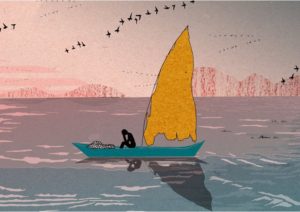
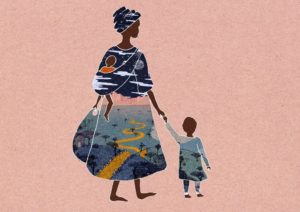
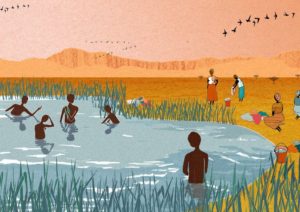
Illustrations by Charlotte Edey

Curled from the bbc.com

Nigeria: Fulani Group Decries Rising Incidence Of Cattle Rustling In Three LGAs Of Kaduna

0

By Longtong Ibrahim

A group of Fulani herdsmen under the umbrella body of Gam-Allah Fulani Development Association, Kaduna State Chapter, have decried the rising incidences of cattle rustling in three Local Government Areas (LGAs) of Kaduna state – Chikun, Kajuru and Kachia, saying, they are been deprived of cattle rearing which is a major source of their livelihood.

Briefing newsmen in Kaduna – northwest Nigeria, Chairman of the group, Idris Gundari, on Monday said over 10,000 cows have been taken away from them by gun men, whom according to him are their fellow Fulani brothers trained, armed and sponsored by wealthy individuals in the state.

He noted that, the cattle rustlers while carrying out their nefarious attacks are always well armed with AK47, making them helpless of their situations.

On steps taken to address the situation, the chairman said, they have written to the police twice and the Secretary to the State Government but have not received any response yet; adding that the recent attack happened over the weekend around prison yards in kujama area and kankoma.

Corroborating what the chairman said, Secretary of the group, Ardo Bature Danji, noted that, in 2017, a total of 11,571 cows were stolen from them; with some of their houses set ablaze and money either stolen or collected as ransomed of kidnappings.

He however called on the Kaduna state government to intensify security measures in the aforementioned areas just as they did in Birnin gwari and Igabi Local Government Area of the state to put an end to cattle rustling and reduce tension among their people in the state.

Narrating his experience from some of the attacks, a member of the group, Isa Usman, said he now lived in town while his children goes to streets to beg for alms. He pointed out that, over 200 of his family cows were taken away by rustlers; at some point in time paid ransomed when two of his children were kidnapped and his house set ablaze; forcing him to relocate with his family including the seven children of his brother who was killed in one of the attacks.

Currency Exchange Rates

USD - United States Dollar
ZAR
0.06
EUR
1.17
CAD
0.73
ILS
0.31
INR
0.01
GBP
1.34
CNY
0.14
Enable Notifications OK No thanks