Home Blog Page 1558

Kaduna Airport Lying Fallow After N2bn Facelift — Guardian

0

By Wole Oyebade

• Insecurity Working Against Kaduna – NASI Chair
• FAAN Cannot Force Airlines To Go To Any Airport – Yakubu

Kaduna Airport was recently upgraded to international status to drive traffic in the wake of repair works at the Nnamdi Azikiwe International Airport, Abuja. But few weeks down the line, the aerodrome has returned to its sleepy state amidst huge investment that might just have been a waste. WOLE OYEBADE reports.

Except for Murtala Muhammed International Airport (MMIA), Lagos and the Nnamdi Azikiwe International Airport (NAIA), Abuja, Airports nationwide are perpetually dormant. While some are blessed with one or two flights operations per day, several others rarely see landing or takeoff in weeks. And at nightfall when most airports around the world are at the peak, their counterparts in Nigeria are getting closed for the day.

Indeed, it is not due to fault of officials or commercial airlines. Most of the 26 airports lack good airfield lighting. Hence, any attempt to operate after 6:30pm is just a disaster waiting to happen.

Kaduna Airport used to be like that until recently. Apparently to the taste of the ever busy MMIA and NAIA, it was upgraded to international status in February and March for 24-hours flights operations.

It is not of magnanimity that the Federal Government transformed the airport, spending about two billion naira. Rather, for exigency of the moment to avail an alternative airport since Abuja airport, the second busiest in the country, was closing down for overdue rehabilitation exercise.

Billions worth of investment met purpose and Kaduna International Airport came alive. Given a newly installed Instrument Landing System (ILS), Category 9 upgrade of facilities, expanded runway, fire cover and new passenger terminal; it was with delight that the airport opened with Ethiopian Airline’s (ET) 787 dream-liner landed safely last March.

With asphalt been laid on Abuja airport’s sole runway, over 100 local flights were taking turns per day at Kaduna. Official records have it that over 3,533 aircraft flights and 170,150 passengers were recorded within the six weeks period.

Today, with the airport already back in bed due to low activities, there are worries over the investment deployed into its upgrade.It will be recalled that the Kaduna International Airport was picked ahead of Minna Airport, notwithstanding infrastructural constraint at the airport and insecurity in the state. Infrastructure was addressed and security well managed.

The Guardian learnt that the investment was quite strategic in the bid to open up the northern part of the country to other international flight operations besides seasonal Hajj operations.

Out of the 19 states within the northern geopolitical zone, 13 of them are nearer to Kaduna, while the remaining six are nearer to Abuja. “Getting it right with Kaduna is to further open up the north for international operations, without first going to Kano, Lagos or Abuja. And it was a success. It was also expected that Kaduna international Airport will continue to be a beehive of activities of flights even when Abuja reopened. Seeing everything gone cold was a surprise,” a top source at the airport said.

Amidst the concern of what becomes of the airport after the reopening of NAIA on April 19, aviation officials were enthusiastic that another international aerodrome of high traffic for the north has just opened. Even the airlines were quick to promise continuous patronage on the route, with some pledging two or three flights a-day. It was a pledge informed more by loyalty than business-concern.

Barely days after the NAIA reopening, passengers that had been booked for the Kaduna route post reopening at Abuja were left stranded at KIA as their airlines failed to show up!

As at the last check on Thursday, only three out of the eight operating airlines run the Lagos-Kaduna or route. Hence, an average of two or three commercial flights uses the international airport a day. Azman and Med-View consistently run a Lagos-Kaduna flight daily, while Arik Air does one frequency five days a week.

Spokesperson of one of the most popular carrier in the country, said; “we ordinarily don’t go to Kaduna, if not for the diversion.””The capacity is not just for us. More so, we don’t want to start competing with another airline on that route, when there are more lucrative destinations to connect.”

The Guardian learnt that except towards weekends, most airlines fly about 50 per cent seat-capacity on the route, which is not business-wise for airlines battling to stay afloat.

President of the National Association of Nigeria Travel Agencies (NANTA), Bernard Bankole, said the KIA experience has shown that there is more to improving the air travel sector than infrastructure upgrade, as intended in the plan to concession all the airports.

Bankole said whereas there is nothing wrong with infrastructure development, there is need to complement same with good strategy and policy to ensure that travellers are drawn to use the facilities for maximal return.

Going forward, he advised the government to give operating airlines incentives to go to Kaduna. “It is obviously a low traffic route for air travel, but does not mean that northerners don’t want to fly. Why not encourage them to make appreciable use of the facility?”

At least two basic factors drive airport utilisation and they are the economy and tourism, says the Chairman, Governing Council of the Nigeria Aviation Safety Initiative (NASI), Capt. Dung Rwang Pam.Pam told The Guardian that neither of the factors has helped the course of “good initiative” in developing the infrastructure, coupled with the state government’s drive to attract investors.He noted that the entire country is in a state of economic recession and depression, which has not worked in favour of Kaduna, amidst insecurity that also do not mix with tourism.

According to Pam, “If it had been like 40 years ago, it would have been fantastic because Kaduna was more or less the economic, administrative and education centre of northern Nigeria. It has still got some charms to it though. The government has done a lot to encourage investment intimating the rest of the world about its rich deposit in gold. But we have to wait a bit to see the result.

“There is problem with its tourism because no matter how much you tried to advertise, tourism will not thrive where you have much insecurity. That is working against Kaduna at the moment, with foreign airlines, except ET deciding not to fly there. Government is also doing something in that area but needed to do more to curtail the Islamic Movement in Nigeria, led by El-Zakzaki and also activities of herdsmen in the Southern part of state as well.

“If the government can tackle these two security threats, they will be able to attract tourists and investors into the state. The sad thing about Kaduna is that it is almost mid-way between Abuja and Kano. These two have international airports that Kaduna has to compete with as one of the factors affecting the traffic they could have had.

“If they can look seriously and continue on their aim to make Kaduna a destination of choice for investors as well as they improve on security threats in Kaduna State, they will be able to improve the utilisation of Kaduna airport and make the investment that government made in KIA worthwhile,” Pam said.Chief Executive Officer Cita Aviation Fueling Company, Dr. Thomas Olaleye Ogungbangbe, added that the low uptake at KIA was symptomatic of the lack of cooperation among operators and growth in the aviation sector.

Ogungbangbe said the fact is that air traffic is abysmally low in Nigeria given that only 15 per cent (eight per cent) of the country’s over 170 million fly.Meanwhile, the airlines are still not making the most of the available traffic, to be opportune to develop seemingly less viable routes like Kaduna.

He said despite their marketing abilities, the industry has been unable to grow, expand and be strong enough to attract more Nigerians to travel by air, and this has contributed to excess capacity or performance below capacity that leads to huge economic losses in terms of potential turnover of air travellers not captured as passengers by the airlines.

According to him, “Why are our airlines operating at cross purposes and in competition instead of cooperating? Why not interline instead of one airline running seven frequencies with about 50 per cent capacity? Fact is that 40 per cent capacity covers fuel alone, which means nothing is left.

“Besides, the airlines are selling tickets at cheap prices when Boeing has said that no flight of about an hour should be less than $100. These are some of the problems that improved partnership would have addressed, save the airlines from high mortality rate and also endear the passengers to effective and efficient air travel,” he said.

Spokesperson of the Federal Airports Authority of Nigeria (FAAN), Henrietta Yakubu, said though there is no comparing what the KIA was like in March and April to what it is now, but the airport has seen significant improvement in traffic as more flights operations are taking place at the airport.

Yakubu said: “It is not as if the airport has shut down after NAIA reopened. No! What we should realise is that the airport cannot continue to maintain the full capacity like it did during the diversion. We have been going there before the diversion and have continued after the reopening of Abuja airport.”I’m aware that Ethiopian Airlines is considering direct flight from KIA to Addis Ababa. So, definitely, investment of the Federal Government will not go to waste just like that. Airlines will continue to fly into the airport. You know that they do Hajj operations there too. So, the airport is bound to still be running, though may not be at capacity.”

Commenting on the sharp drop from over 100 flights to about two or three a-day, she said: “FAAN cannot force airlines to go to any airport they don’t want to go. The airport is always open to any airlines that cans to go,” adding that the subject of incentive is exclusively a policy decision of the government.

Curled from guardian.ng

Synagogue Church Going To Israel: What Residents, Neighbours Say

0
T.B. Joshua

• ‘It Is Because Of T. B. Joshua’s Presence We Are Enjoying Constant Electricity Here’

News that The Synagogue Church of All Nations (SCOAN) in Ikotun–Egbe, Lagos, is relocating to Israel is everywhere. Since it broke, not only followers of the church have expressed concern, but also those who do business around the church, as well as those benefitting in one way or another from Prophet Joshua Temitope Balogun, the General Overseer of the church. It has also stirred controversy as to why the man, popularly known as T. B. Joshua would want to relocate to far away Israel. The Guardian wanted a confirmation from the man of God himself, but at the time of this publication, he was yet to be reached because of the water-tight bureaucracy/security around him.However, The Guardian decided to feel the pulse of Nigerians, especially those living in Ikotun-Egbe axis, where the church is located.

CHIEF Felix Ergwemen is a retired police officer, and the owner of O.J Guest House, located opposite the church. He knew Prophet T. B. Joshua as far back as 1990, when, according to him, the area was not as popular as it is today. Ergwemen had been away from Lagos and just returned from Benin. He was surprised to hear the church was moving to Israel.

He said: “It is strange to me. Prophet T. B. Joshua is my man and the one that is controlling this place; we are very close. I built this house in 1990, while he came in 1992. Sometimes, he would come to my place here and that was when I was the Crime Officer at Zone D, Mushin Police station. One of my sisters, now late, was a member of the church. In fact, it was through her that I got to know Prophet. If he decides to relocate, the impact on us will be too much. The man is trying for Nigeria. If we have two or three pastors like him in Nigeria, it will be marvellous. We will pray to God to make him change his heart, if the news is true. I am not surprised though, as even Jesus Christ was never honoured in His own country.

“Concerning business, in fact, we are going to lose. It was his advice that made me open this place in 2013, when he appeared to me in a dream, where he told me ‘my friend, why should you allow your building to be deteriorating? A time will come, when this area will be like Israel, where people will be coming to worship God. Go and open the place.’

After that dream, I came here and gave all the tenants quit notice. And since 2013, we’ve maintained a cordial relationship. My customers are mainly from his church. For instance, this lady you are seeing here is a Liberian. I have more than 30 customers patronising this place weekly. Some of them left and will return on Friday. This place is more or less T. B. Joshua’s house.

“Our prayer is that it’s not going to happen. He can be going and coming, because he belongs to this country. We don’t even want him to appoint a deputy. He can send his deputy to Israel, because we want to have him here. He is the god we know and can see physically before the Supreme God. We pass through him to God. If he is planning such a thing in his heart, we pray he has a rethink. He is our spiritual father and brother. Before I came here, you can’t stay at the junction, where his church is, up to 9pm. A lot of evil things were happening then. Sometimes you would see all manner of sacrifices by herbalists, juju men and women at the junction, but since this man came to this environment, he has sanitised the place. He has empowered many of the villagers, and given scholarships to many.

“Those I know that are being fed by him are more than a million. He is a man who doesn’t think of himself, but only of others. If we have 15 pastors doing what he is doing, Nigeria would have improved. He is a philanthropist to the core. After praying for people and they get what they want, he would tell them they are free to return to the church they came from. He would say, ‘I am not forcing you to worship with us.” He is not like other pastors that will insist you must attend their church. We will continue to pray, so that he doesn’t leave us. T. B. Joshua is like a mortar, which doesn’t move. Rather, people take their yam to where the mortar is and pound it there. That is what he is.

This house is not a brothel. We have about 18 rooms here, and we charge between N2, 500 and N3, 000 per night. But in some hotels, people pay N15, 000 per night. It is mainly for our church members, who come on Friday and stay till Sunday. By Monday morning, they are gone until the following week.”

CAROLINE Swen, a Liberian in the guesthouse is visiting Nigeria for the first time. She explained that she was in the country to see the man of God concerning her health. So, what is her opinion about the church moving to Israel? Caroline, who has spent a week in the country, said: “I think it’s not going to be easy, especially for the poor ones, because it’s not everybody that can travel to Israel to see the man of God over there. While there are some that can afford to travel to Israel, this place is like Israel for many. It’s because of this man that a lot of people are coming in and out of Nigeria. News about this man of God is everywhere, which is why many people are watching Immanuel Television, just to see him and listen to his sermon. After watching him, you get prepared and then come to Nigeria.

“I came here purposely for healing. I was booked for a surgery, but for the fact that I saw the man of God on television healing people with diverse problems, putting people’s kidney together and making people to see, I decided to come. This is the only man I’ve seen doing what Jesus Christ did, which is why I am here to get my touch and as I came, I have received my touch and I’m well again.”

JOHNSON Nwerem, a Catholic, who has a drug store close to the church, told The Guardian many Nigerians would be disappointed, if T.B. Joshua is allowed to relocate his church to Israel. He said the presence of Synagogue Church has made Ikotun very attractive, so moving it to Israel would cause pain in the hearts of people because a lot of businesses would collapse.

He said: “I first saw what you are telling me on the Internet a couple of days ago. I think Synagogue makes this place look attractive in terms of business, so it will not be advisable to move it, because many people will be affected. Many people come here to see the man of God, and there is an improvement in our sales whenever they are around. For example, they come here on Saturdays to patronise us ahead of the Sunday service. We’ve been benefiting from them. I am not a member, I am a Catholic.”

He advised the Federal Government to do everything possible to ensure they prevent the church from being relocated. “It will negatively affect not just the people in Ikotun, but Nigerians as a whole. People who come from different parts of the country are getting answers to what they come for and we are also benefiting from it.”

STANLEY Oghian, who lives at No. 6, Nick-Chuks Street, said he used to worship with the church. “If this church relocates to Israel as we are hearing, of course, it will affect many businesses, including hotels and foodsellers around the church. If you move away the church and Alibert Company from Ikotun, the place is finished. This company and the church are the lifeline of Ikotun people and any attempt to remove them from here would make life meaningless.

“For instance, this three-storey building on Nick-Chuks Street is a hotel. Do you know how much the owner has spent to erect that building? If Synagogue goes away from Ikotun, who will lodge there? It will be a waste, if Synagogue is no longer here.

“I will feel very bad, as it will affect businesses, welfare and the social life of people. This is because whenever the church is having its programme, the whole of this place is agog with visitors and the impact of that on businesses is huge. As for transporters such as Okada, Keke drivers and taxi/cabs, they carry these visitors to their various hotels, and very often they charge them extra money.

“Behind Nick-Chuks Street, there is a lodging there, and visitors pay N3, 500 per night. These are things that will affect us here, if the man leaves. Things will become difficult and electricity supply will dwindle. It is because of T. B. Joshua’s presence we are enjoying constant electricity here. The news of his going away will affect my spiritual life, as well as other members. His church members like the man so much. When the building collapsed, I remember vividly how members in my compound stood up to defend him. You dare not speak ill of the man, when they are around. They are so dedicated to him.”

Oghian said it would be bad for Nigerians, the government, as well as tourism if Synagogue is allowed to go.“Many Nigerians are working in the church and they are paid N3, 000 per day. If the church goes away from here, the workers will be affected. The choir members receive as much as N150, 000 monthly. There was a period they had a special programme and visitors were begging for accommodation. Then, a room was N3, 000 per night. This storey-building opposite us, the tenants converted their rooms for lodging overnight and they were collecting N3, 000 per night, because hotels in the area were fully occupied and some of the foreigners wanted accommodation very close to the church. That is why I said it would be very difficult, because businesses will crumble and electricity will reduce.

“Even the agberos/areas boys benefit from the church’s presence, as they help to coordinate traffic, whenever there is gridlock in the area. It will be like taking food out of their mouth. Some of the worshippers who come with their cars are ready to pay N1, 000 to these boys to secure their cars, until service is over. Another set of people that benefits from the church are God Is God Motors and other transporters. Every time service is over, you hear them calling for passengers going to Benin, Asaba, Onitsha, etc. and I hear they charge N4, 000 per commuter. Some of these foreigners come on Thursday and would lodge till Monday. A plate of food in some of these hotels is between N500 and N1, 500.”

ALOYSIOUS Ekoro, 65, sells beer, soft drinks and other items very close to the main road. He told The Guardian the economy would suffer, if government should allow the Prophet to move his church to Israel. Disturbed Ekoro queried: “Is it not the same thing as those who go to Jerusalem and Mecca for pilgrimage? Is it not our money they spend over there, but here foreigners are coming on their own to see this man of God, and we don’t value it. If you don’t value what you have, outsiders will help you to value it. If the Federal Government allows this man to leave this country, they don’t know what they are doing.

“Whenever our government officials travel out, what do they go there for? Jamboree! But this one that God gave to them, they are not maintaining it. They are busy peddling different kinds of allegation against the man. I am not a member of Synagogue Church, but I don’t like the way government is treating the man. Go to Calabar and see what the governor is doing to attract foreigners. If the church goes to Israel, is it not the same Nigerians that will go there and spend our money? It is not because of my business. I have spent 30 years in this area. The government should create an enabling environment to attract foreigners and not to send them away.”

GRACE Solomon, a resident believes that the church’s planned relocation to Israel is the perfect will of God. Grace, who calls the man of God, her father, said: “Nobody can change God’s will and it is not because of the collapsed guesthouse, that issue has been resolved. If he wants to go, government cannot stop him. He can only go and come back. The man of God is not closing this church. If he is going to Israel, do you think the church will be busy adding new structures? Look over there, there are additional structures going on in the premises. In fact, that is even enough to convince anybody that the church is not moving away from here. And he is not going to appoint a deputy to run the church, while he is away.

“Let me tell you, no other person can control this church. He is the one doing everything, so the information is not true. He only goes to Israel on a visit. For instance, as we are talking today being Monday, he is not available. We only enjoy him on Sundays. He goes to Israel every week. They’ve given him a piece of land over there in Israel, but he is not going to close down the church here in Nigeria. This is his fatherland. How many people do you think can go to Israel to see him?

“He can go to Israel today and by Sunday morning, he is back and he would go straight to the church. In fact, we are seeing more foreigners now than before. He once told us that God told him to have land in Israel. He said if it were the will of God, he would gladly take it. And when Israel offered him a place in their land, he told us he had taken the offer. He told us that God has instructed him to take the offer, but that he would not be there permanently. Rather, he would go and come back and that is exactly what he is doing now. Other people can enjoy him from Monday to Saturday, but we are sure to enjoy him every Sunday.”

ANNE Mannah is another foreigner from Sierra Leone and a regular face in Nigeria, but she has a different view. “I want him to go to Israel because Nigerians don’t appreciate this church, they don’t like what the man is doing and they don’t know that the glory is here in Nigeria. If the man moves his church to Israel, Nigerians will lose a lot. In fact, this place will be like a village, where nobody will like to visit. So, what they have to do is to appreciate the man of God and what he is doing. What they are saying about the man is not good. If Nigerians really appreciate what the man is doing, he will not want to move his ministry to Israel.

“Most of the people that are coming here are foreigners and when foreigners come into a country, you know what that means— they bring in so much money. I am a member of the church from Sierra Leone and I have been here for four months. I am lodging in one of the hotels around. We have been benefitting a lot, which is why some of us are here to see him. If the people here do not appreciate the man of God, we appreciate him. If Nigerians do not appreciate their own, and he relocates to Israel, of course, we will go there to see him and who is losing?”

Curled from guardian.ng

Recession Hits Sokoto, Hinders Governor From Delivering Good

0
Aminu Tambuwal
Governor Aminu Tambuwal of Sokoto State, Nigeria.

A governor in northern Nigeria, Aminu Tambuwal of Sokoto State said the recession in the country has kept him from delivering goods to his people.

“We came with the zeal to work, but the unfortunate situation we found ourselves, has slowed us down,” Tambuwal said on Sunday at the quarterly meeting of his party All Progressives Congress (APC).

Recession has hit the African oil giant, when the country fail to manage its income properly and due to corruption.

Present government is also blamed for not forming government on time and without clear economic direction, until six months in office.

Despite the stance, Tambuwal bragged, “Yet, we have been promptly paying salaries and other workers’ entitlements, as well as pensions and gratuities.

“We have also completed most of the inherited projects; some are ongoing, while we have initiated additional projects. The present administration will not abandon any projects, which would be evenly spread across the state,” he said.

He called on his party members to offer prayers for President Muhammadu Buhari to recover from his illness and return safely to the country

The Chairman of the party in the state, Suleiman Danmadamin-Isa, said that the meeting was to provide opportunity for party members to strategise on issues affecting the party.

Anti-Igbo Threat: All Southerners At risk Of Almajiris’ Attacks – Afenifere

0
Nigeria
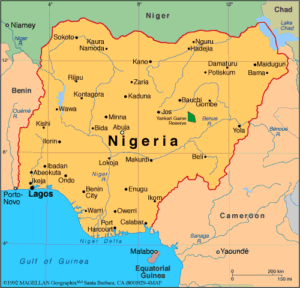
Map of Nigeria

By Adelani Adepegba, Abuja

As Nigeria marks the 24th anniversary of the June 12, 1993 election on Monday, the Afenifere has restated its call for the implementation of the last national conference as a way out of the challenges facing the country.

It noted that the nation has been wobbling and pretending that its unity was settled since the annulment of the June 12 elections believed to have been won by Chief Moshood Abiola.

The group in a statement on Sunday by its National Publicity Secretary, Yinka Odumakin pointed out that all southerners are at the risk of attacks by Almajiris and mujaheedins in the north following the quit order issued to Ndigbo by some northern youths.

It argued that the refusal of the security agencies to arrest the groups that asked the Igbo leave the north within three months, indicated that the Arewa youths were merely voicing the position of the northern political establishment.

Odumakin said, “We now mark another June 12 amidst an October 1 quit order to Ndigbo by Arewa youths who have also secured endorsement from the Northern Elders Forum, with the Arewa Consultative Forum conceding what they called “the frustrations of the youth” with Ndigbo.

“While the primary targets of the Arewa youths’ quit order are the Ndigbo residents in the North, we are not deceived that when the rubber hits the road, the Almajiris and the Mujaheedin would pick and choose among all southerners in the north for the baying of blood.”

Curled from Punch

Child Spacing Can Avert Maternal Death In Gombe

0
Map of Nigeria showing Gombe State

By Auwal Ahmad

A renowned Nigerian obstetrician and gynecologist, Prof. Emmanuel Otolorin has said that several issues and occurrences in Nigeria underline the importance of family planning.

Prof. Otolorin during a Media Round-table on Family Planning and Maternal Health organized by MamaYe-Evidence for Action in Abuja in October 2016, that the most important, however, is that as many as 18,000 of the 40,000 women who die of pregnancy-related causes each year can be saved with the availability of family planning, says.

He said due to a complex mix of cultural, religious, economic and social factors, maternal and child deaths were common occurrences in Nigeria.

Also, experts say however that access to family planning (FP) can reduce the risk of death from pregnancy, and indirectly contribute to averting many child and infant deaths and ailments.

Speaking to our Correspondent in Gombe, Community Mobilization and Mark Officer with Marie-Stopes International Organisation Nigeria (MSION), Gombe State, Mr. Ibrahim Yusuf, said that increased access to Family Planning services could prevent about 1.6 million unintended pregnancies in Nigeria every year.

Mr. Yusuf said Family Planning could help save the lives of women and children by reducing unplanned pregnancies and promoting healthy child spacing.

“Evidence has shown that the high death rate is mostly due to unintended high risk pregnancies due to low use of Family Planning services. Increased uptake of Family Planning can avert up to 44 per cent of maternal deaths and 23 per cent of child deaths”, he said. He added that Family Planning is an essential component of reproductive health and key to safe motherhood. Its potential to contribute to maternal and newborn mortality and morbidity reduction is therefore enormous.

Mr. Yusuf explained that the Family Planning uptake in Gombe was hindered by a myriad of factors, ranging from lack of education, poverty and religious barriers, as well as poor access to services and commodities, traditional beliefs favouring high fertility, misconceptions, worries about side effects, lack of male involvement and poor coordination of health programmes, among others.

According to the 2013 edition of the National Demographic and Health Survey (NDHS), the current contraceptive prevalence rate (CPR) of Nigeria, i.e. the proportion of women using Family Planning, both traditional and modern methods, is 15 per cent, out of which modern CPR is 10 percent.

During the London Family Planning Summit in 2012, Nigeria announced a plan to increase its CPR to 36 percent by 2018. Once achieved, the authorities said 400,000 infants and 700,000 child deaths would be averted in the country by then.

Gombe State, in north-eastern region of Nigeria has a projected population of 3,022,590, and maternal mortality ratio that is one of the highest among the states of the federation. The NDHS 2013 survey pegs the maternal deaths in the North East at 1,549 per 100,000 live births. This means that for every 100,000 live deliveries, an estimated 1,549 women lose their lives. The ratio in Gombe State is 800 per 100,000 live births.

The current CPR of Gombe State is 3.8 percent, according to NDHS 2013, while unmet need for Family Planning, i.e. the proportion of women who want to use Family Planning services but do not have access, is 19.4 per cent. According to the 2014 National Family Planning Blueprint, which set targets for states to attain by 2018, 7.5 percent CPR is being targeted.

With a total of 615 health facilities comprising 592 primary health care centres, 22 secondary health facilities, and one tertiary health facility, Gombe State would seem to have the structure to deploy to achieve its CPR target. However, only 349 of the health facilities provide Family Planning services. There are also other factors that militate against the achievement of the Family Planning goal: The number of health care workers in the public sector is just 4,081. Majority of the 1,209 are community health extension workers (CHEWS), who are not qualified to administer the most effective and most demanded Family Planning methods, the so-called LARCs—long-acting reversible contraceptives. Doctors number 163; nurses/midwives 1,150; community health officers 114; and junior community health workers 605; Environmental Health Officer, Environmental Health Technical, Environmental Health Assistance 560 and village health workers over 1,000.

Also, only 150 health workers are trained to provide Family Planning services. In spite of that fact, contraceptive commodities are available through the federal government supply chain as the Government of Nigeria introduced free commodity policy in 2011. Curiously, the free commodities have not translated into better access, as only about 4 per cent of women of reproductive age in the state access Family Planning services. One major reason is that at the average Family Planning clinic, there are charges for consumables like hand gloves, syringe and needle, detergent needed to administer the services on the women.
To make Family Planning service really free, consumables should ordinarily be provided by the state government.

The arrangement is that the Federal Government will provide Family Planning commodities like condoms, pills, IUDs, and injectables, while the state government should provide consumables. But a number of states, Gombe inclusive, have failed to provide those consumables. Analysts say the state government needs to create a budget line, like other states are beginning to do, to provide the effective implementation of Family Planning, an effective and proven way of reducing maternal deaths.

To address its challenges, the Gombe State Ministry of Health developed a policy called the Gombe State Framework for the Implementation of Expanded Access to Family Planning Services – 2013 – 2018, which provides the state with a road map, even though it needs review for current approach.

The Framework has an estimated cost of 1.019 billion Naira over a 6-year implementation period, with four goals, objectives, targets and activities. The goal is to improve access to and uptake of Family Planning methods in Gombe State such that the contraceptive prevalence rate (CPR) increases to 7.5 percent by 2018.

A cardinal objective of the policy is to build the capacity of all CHEWs, doctors, nurses and midwives working in reproductive health (RH) and Family Planning to provide cadre-appropriate Family Planning services in the state by 2018. It will also expand the availability of Family Planning commodities offered by cadre-appropriate providers in the wards, primary health centres, as well as secondary and tertiary facilities. Increased use of Family Planning methods among men, women and young persons of reproductive age in Gombe State by 2018 is the ultimate goal.

Investigations revealed that out of the four objectives only the first was attempted. Forty-eight nurse-midwives and community health officers have been trained by United Nations Population Fund (UNFPA) and Association for Reproductive and Family Health (ARFH) to serve as master trainers.

Marie Stopes has trained 120 nurses and midwives while UNFPA and ARFH have trained another set of 172 community environmental health workers in Gombe, Yamaltu/Deba, and Shongom local government areas of the state. The state government is supposed to train the remaining health workers, but there is no indication that anything has been done in that regard.

Speaking to our correspondent, Ms. Rabi Umar, a stakeholder in the health sector, confirmed that the uptake of Family Planning is low in the state because of a combination of factors, particularly lack of a budget line for Family Planning; insufficiency of trained Family Planning personnel; shortage of consumables; non-involvement of men in the support for Family Planning programme activities; and lack of data tools.

Ms. Usman said the way forward is the creation of an Family Planning budget line, prompt release of the money budgeted, procurement of consumables by the state government, sensitisation of all men groups and training of nurses and midwives in each of the local government areas. She also spoke of the need for communication activities through radio and television programmes to dispel rumours and correct misconceptions related to Family Planning

May To Form ‘Government Of Certainty’ With DUP Backing

0

Theresa May has said she will put together a government with the support of the Democratic Unionists to guide the UK through crucial Brexit talks.

Speaking after visiting Buckingham Palace, she said only her party had the “legitimacy” to govern, despite falling eight seats short of a majority.

Later, she said she “obviously wanted a different result” and felt “sorry” for colleagues who lost their seats.

But Labour said they were the “real winners”.

The Lib Dems said Mrs May should be “ashamed” of carrying on.

The Tories needed 326 seats to win another majority but they fell short and must rely on the DUP to continue to rule.

In a short statement outside Downing Street after an audience with the Queen, Mrs May said she would join with her DUP “friends” to “get to work” on Brexit.

Referring to the “strong relationship” she had with the DUP but giving little detail of how their arrangement might work, she said she intended to form a government which could “provide certainty and lead Britain forward at this critical time for our country”.

“Our two parties have enjoyed a strong relationship over many years,” she said.

“And this gives me the confidence to believe that we will be able to work together in the interests of the whole United Kingdom.”

It is thought Mrs May will seek some kind of informal arrangement with the DUP that could see it “lend” its support to the Tories on a vote-by-vote basis, known as “confidence and supply”.

Later, she told reporters that she had “wanted to achieve a larger majority but that was not the result”.

“I’m sorry for all those candidates… who weren’t successful, and also particularly sorry for MPs and ministers who’d contributed so much to our country, and who lost their seats and didn’t deserve to lose their seats.

“As I reflect on the results, I will reflect on what I need to do in the future to take the party forward.”

DUP leader Arlene Foster confirmed that she had spoken to Mrs May and that they would speak further to “explore how it may be possible to bring stability to this nation at this time of great challenge”.

While always striving for the “best deal” for Northern Ireland and its people, she said her party would always have the best interests of the UK at heart.

Scottish Conservative leader Ruth Davidson has since sought assurances from Mrs May that any deal with the DUP will not affect LGBTI rights across the UK. Northern Ireland is the only part of the UK where same-sex marriage is not legal.

A source close to Ms Davidson, who is gay, told the BBC: “The PM needs to remember there are more Scottish Conservatives than DUP MPs.”

Who are the DUP?

The DUP are pro-union (not Europe but UK), pro-Brexit and socially conservative.

The party, which returned 10 MPs to Westminster, has garnered a reputation for its strong, sometimes controversial views.

It opposes same-sex marriage and is anti-abortion – abortion remains illegal in Northern Ireland, except in specific medical cases.

One MP is a devout climate change denier, while a former MP once called for creationism – the belief that human life did not evolve over millions of years but was created by God – to be taught alongside evolution in science classes.

During the election campaign, the DUP’s Emma Little-Pengelly was endorsed by the three biggest loyalist paramilitary organisations.

Curled from bbc.com

SOKAPU Disassociates Self From Ultimatum Issued Igbos To Vacate Northern Nigeria

0
Southern Kaduna People Union (SOKAPU) Logo

Southern Kaduna Peoples Union (SOKAPU) has dissociated itself from the ultimatum issued to Igbos to vacate northern Nigeria within three months.

Recently a coalition of northern Nigeria youth groups has asked the Igbos in the northern part of the country to vacate the region within three months, asking northerners in the igbo land to return to the north within the same period.

A statement by SOKAPU National Public Relations Officer, Yakubu Kuzamani says “The “Arewa Youths” that spoke lack the mandate to speak for all the people of the north, and, certainly, not for Southern Kaduna people,” adding that “The lgbos did not in anyway offend Southern Kaduna People.”

The statement condemned the Group, saying the nigerian constitution has given the every Nigerian the right to live in any part of the country.


The Statement Reads

On June 6, 2017, a coalition of groups describing themselves as “Northern Youths” came together and issued what they called ‘The Kaduna Declaration’. They issued a three-month ultimatum to all Igbos to leave the north while asking all northerners to also leave the South-East. The coalition served the Igbos its intention to “reclaim, assume and assert sole ownership and control of … landed” properties and assets owned by Igbos in Northern Nigeria. Interestingly and by implication, the group claimed to be speaking for the 19 Northern States of Nigeria. The alleged crime of the Igbos was their quest for secession.

We in SOKAPU held back for a while to carefully study the national implication of that declaration, but we can say now without doubt that Section 41, Sub-section 1 of the Constitution of the Federal Republic of Nigeria very explicitly safeguards the rights of all Nigerians to reside in any part of the country with no hindrance whatsoever. The “Arewa Youths” that spoke lack the mandate to speak for all the people of the north, and, certainly, not for Southern Kaduna people. We insist that all Nigerians have the right to live and carry out legitimate affairs in all parts of the Country.

We unequivocally disassociate ourselves from the toxic fumes of hate and bigotry belched out against the Igbos without provocation by the so-called Arewa Youths for the following reasons:

  1. The lgbos did not in anyway offend Southern Kaduna People. We are a hospitable and accommodating people. We assure the Igbos that their property and assets (movable or immovable) in Southern Kaduna are secured, assured and guaranteed. The security of all Igbos in Southern Kaduna is guaranteed. We will continue to accommodate the Igbos and all persons of goodwill towards us irrespective of their primordial, ethnic or religious cleavages.
  2. The expressed desire of the Igbos to have a separate country of their own is an inalienable right which has not in any way, in our opinion, translated into a crime or provocation to us in Southern Kaduna, the North or the Nigerian State
  3. The lgbos have so far in our estimation merely exercised their rights to gather and to protest peacefully. They exercised their constitutional rights to acquire property in the nooks and crannies of this country. These are not criminal actions.
  4. We were not consulted by the so-called Arewa groups before issuing the Kaduna Declaration despite the fact that Southern Kaduna is in the North West. The declarants, it appears clearly, do not see us as part of the North. None of the 53 ethnic nationalities of Southern Kaduna were consulted. Neither was SOKAPU the umbrella body of the 53 ethnic nationalities of Southern Kaduna consulted. They have, it appears, excised us from the North. They have shown utter contempt and disregard for us as a people. They did not speak for us. Those making such calls threatening fire and brimstone on the Igbos have only served to poignantly demonstrate their bizarre nature. They should be arrested and prosecuted by the Nigerian State immediately. To threaten bona fide Nigerians with eviction and confiscation of their properties is to beat war drums. It is incitement against the Igbos. We condemn the Declaration without reservations.

We ask the “Northern Youths” to look carefully inward into the north and they would find that other bigger problems facing the north’s existence, unity and cohesion has been festering without any comments from them. They should work towards strengthening the fragile trust that exists between and amongst all northerners with other ethnic groups than resorting to hate statements and incendiary ultimatum to bonafide Nigerians. These issues should be of immediate concern to them and not the Igbos.

Thank You.

Signed: Mr Yakubu Kuzamani

National Public Relation Officer


Nigeria: CSOs Strategise On Proposed Kaduna Health Insurance Scheme

0
Kaduna Map
Kaduna Map

By Amos Tauna

There are strong indications that the public hearing on the proposed Kaduna State Health Insurance Bill currently before the State House of Assembly, will receive quality inputs from civil society and community based organisations in the state.

Already, CSOs in the state are holding series of meetings, perfecting plans on relevant and effective contributions to make during the public hearing on the proposed bill.

At one of the meetings in Kaduna held Thursday, Chairperson of Maternal and Child Health Civil Society Partnership, Dorcas M. Adeyemi, noted that there were issues in meeting the health of people in the state, stressing that a bill is before the State House of Assembly to help address that challenge.

She said the State Assembly would soon call for a public hearing on the proposed bill, hence the meeting by CSOs to sensitise their members, as well as other community members on the health insurance scheme and how to make meaningful contributions during the public hearing.

“We are trying to get issues that are relevant to the bill for the overall benefits of the people of Kaduna State and enhanced medical treatment and welfare in the state,” she explained.

Shehu Usman Mohammed, Chairman, Family Health Advocates in Nigeria Initiative (FHANI), observed that the meeting was a preparatory ground for participants to exchange ideas on the proposed bill establishing health management organization dealing with health insurance.

He added that health insurance provides for an alternative funding of health services, ensuring that the vulnerable in the state are provided medical attention at a minimal cost.

“The meeting is on how to galvanise efforts and ideas on health insurance and arrive at meaningful inputs for the public hearing, as ways to move the state forward health wise.”

Kaduna State Coordinator, National Health Insurance Scheme, Hassan Dan-Zaria, said, the proposed bill if properly implemented, would be a step forward towards ensuring a better healthcare system in the state.

He called on relevant stakeholders in the state to see the public hearing as an opportunity given to the people to make meaningful contributions in order to ensure the state benefits from the health insurance scheme.

The meeting was attended by representatives of CSOs, Religious groups, Traditional institutions and professional bodies, among others.

Currency Exchange Rates

USD - United States Dollar
ZAR
0.06
EUR
1.17
CAD
0.73
ILS
0.31
INR
0.01
GBP
1.34
CNY
0.14
Enable Notifications OK No thanks