As part of effort to fight child killer diseases, Kaduna state government says it is set to tackle Diarrhea and pneumonia which are among the five childhood child killer diseases.
The commissioner for health, Dr Paul Dogo While speaking with Nagarta radio, said, there is specific intervention in place.
Gombe (Nigeria) — Gombe State Government in northeast Nigeria says it has spent N2.7 billion for the procurement of 20,000 metric tonnes of fertilizer for the 2017 farming season to be distributed to farmers in the state.
State Commissioner of Agriculture, Dahiru Buba Biri who announced this Sunday while speaking with journalists in Gombe, said that 3000 metric tonnes of NPK and 10, 000 metric tonnes of Urea have been stored for onward distribution to farmers in the state.
Biri said that it has become necessary to inform the public against the backdrop of allegations that government failed to put in place any arrangement to distribute fertilizer to farmers with the cropping season already underway.
“Government has made adequate arrangements as you can see from the fertilizers in our stores that would be distributed to farmers immediately,” he said.
He explained that the state government is facing challenges in the supply of particularly NPK from the federal government through 11 blending fertilizers across the country.
The commissioner explained further that so far only 3000 out of the 10, 000 metric tonnes of NPK have been supplied, with approval to lift additional 6 metric tonnes.
“We have already in stock the earmarked 10 metric tonnes of Urea but we have to delay the distribution until we have 60 percent of the required NPK,” he said.
He allayed the fears of farmers in the state that government would commence the distribution of the commodity immediately.
He explained further that government will subsidize fertilizer to farmers in the state following approval from Governor Ibrahim Hassan Dankwambo.
Gombe (Nigeria) — Education has been part of the human society from the very beginning. Human societies throughout the ages have had stakes in education. The importance of education cannot be overemphasized. In fact, it will not be an exaggeration to say that without education, most societies will die. Philosophy of Education is a term that can be used to refer to the academic field that involves applied philosophy. It can also be used to describe philosophies that promote certain visions of education, examining the goals, meaning and other aspects.
While most societies will agree or acknowledge the importance of education, a large number of them fail to channel sufficient resources that can be used to promote and support educational institutions and activities. It is clear to everyone that, children, who are born innumerate and illiterate, quickly learn the culture and norms of the community they are born into, with the help of those around them and professional teachers. Within a short time, the children are able to read, write and act in an appropriate way. The skills improve as the child grows, and with time, they would have learnt enough to enable them to operate in the society without constant guidance.
Education today can serve as a mechanism for social-sorting. People have different learning skills with some exhibiting more facility than others. Education plays a major role on the economic fate of every individual. Education helps to equip individuals with the knowledge and skills that allow them to be able to define and pursue their individual goals. It also allows people to participate in the community, playing their part to improve their conditions and the condition of the society.
While many may view education in a very individualistic way, it is important to look at the societal perspective. The more educated individuals, there are in the society, the more developed that society becomes. Unfortunately, most societies today are embracing the narrow view that encourages people to get an education as a way to enhance their own individual needs. This has led to a few individuals holding the view that they are autonomous. In the end, this same individuals end up living very unfulfilled lives. Education should be able to create individuals who are assets to the society at large. Formal education provided by the state, is an acknowledgement of the importance of Philosophy of Education for survival of the society.
Formal education provided by the state, is an acknowledgement of the importance of Philosophy of Education for survival of the society. Making education a necessity helps to ensure that the society can continue to grow. One obvious sign of the great impact Educational Philosophy makes is that every time there is a crisis in society, there is inevitably a breakdown in the education system. Lack of education causes instability, and leads to a rise in poverty, ignorance and disease.
Nigeria’s Northeast is for long faced with utmost challenges, especially in the education sector. The region takes the large chunk of the number of out of school children and the problem of girls education, where most of the girls have no access to education, as a result of lack of Government commitments and interventions to create opportunities for the people of the region to be educationally developed. The result is poverty, child abuse and act of terrorism.
In this sense, Governor Dankwambo has made education his first, second and third priority to cater for the high need of quality education in Gombe State and the North in general. To him also, Education is the most important investment and he made it most precious assets to the people of Gombe State.
The administration of Ibrahim Hassan Dankwambo has focused its attention on spreading education to all nooks and crannies of the State by investing billions of Naira in the sector.
Within the six years of his two tenures, Governor Dankwambo constructed new Central model Schools in Gombe, Dukku, Funakaye, Akko, Billiri, Kaltungo and Deba Local Government Areas and renovated over 502 classrooms in both primary and Secondary Schools across the State. He built up to 51 laboratories to improve the standard of Science and technology education in the State and Constructed new secondary and Primary Schools at Gabukka, Herwagana, Abubakar Umar Memorial and Kurjale. Others are Auwaru, Futuk in Akko LGA, Lalaipido in Shongom LGA and Awak in Kaltungo LGA.
In order to provide a conducive learning atmosphere to pupils in Schools, Governor Dankwambo has Decongested the classes of 100 or more to 40 students per class in all schools across the state and constructed and renovated the hostels, toilet facilities and supplied beds and mattresses in boarding schools across the state.
His administration also showed its commitment in providing high teaching standards in the State by recruiting over 2,000 university graduates and over 1,000 NCE graduates, to make up for the shortage of teachers in both primary and secondary schools across the state, with additional recruitment of another 762 graduates recently.
The administration also purchased of over 4,000 (three in one) desks for Secondary schools, reading and writing materials to Primary, junior and senior secondary schools across the state, Purchased of over 2,570 double decker beds and over 636 tables and chairs for students in boarding schools and principals and teachers respectively. It also fabricated and supplied 13,183 sets of pupils furniture and 1, 200 sets of teachers furniture for the schools, Purchased and supplied instructional materials and lecture’s aids in primary schools, Constructed staff quarters and 68 VIP toilets in Schools across the state.
To also ensure more quality teaching and learning in schools, the Dankwambo administration has also created a quality Assurance Department, trained about 5, 000 teachers as part of professional development and 3,918 teachers consisting of 888 junior secondary and 3,030 primary teachers.
In his effort to control the number of Amajiris on the streets of Gombe State, Governor Dankwambo has constructed Tsangaya Primary Schools in Nafada, Kwami and Wuro Ladde with facilities.
So far, 2,000 students have been enrolled for remedial programme with the University of Maiduguri in which 55% have gained admission in to the University and Purchased and distributed JAMB/UTME forms to them and send 20 Students for overseas maritime degree programme. To also make the payment of Students scholarship easy, he introduced the E-Payment of Scholarship allowances and computerization of the Scholarship Board.
His commitment to give the best in higher education within the six years of his two tenures has become imperative as he constructed and established five Tertiary institutions, which include the School of Basic and Remedial Studies in Kumo and Daban-Fulani, Conventional College of Education Billiri, College of Nursing and Midwifery Dukku (under construction), State Polytechnic Bajoga, School of Legal and Islamic Studies Nafada, the Gombe State University College of Medical Sciences (under construction), as well as the procurement and installation of laboratory equipment for the College And Faculty Of Pharmaceutical Science, Gombe State University.
The Governor has recently received a committee report on the establishment of five additional tertiary institutions, which are the State University of Science and Technology, College of Agriculture and Animal Husbandry, College of Accountancy, Institute of Journalism, and the Institute of Sports.
Participants of a 2-day stakeholders meeting for the Regulators’ Monitoring Programme, REMOP, for basic education and electricity have expressed concern on potential development disaster, if regulation and performance continue to slide in the two sectors.
The meeting is coming ahead of the 2017 Wole Soyinka Media Lecture Series to examine the nexus between basic education and electricity.
A statement issued by the Coordinator of Wole Soyinka Centre for Investigative Journalism (WSCIJ), Motunrayo Alaka, says the stakeholders, comprising representatives of government, pressure groups, non-governmental organisations, private sector and international development partners, lamented that faulty regulatory system, official secrecy, corruption, poor media coverage and paucity of data, are some of the challenges plaguing quality basic education and electricity supply in the country.
The Centre Coordinator had explained the vision behind REMOP to the participants, emphasising that, “The change we seek is the change we need, therefore, it is important that all concerned put pressure on the current government to deliver on its promise.”
Regarding basic education, the participants were worried that the sector was grappling with a myriad of challenges, including the 8.7million children who are out of school, based on the UNESCO Institute of Statistics reports.
“Haruna Danjuma, President, National Parent Teachers Association of Nigeria (NAPTAN), highlighted the fact that the figure is one of the highest globally.
“Corroborating the sad state of basic education in Nigeria, Olusegun Ajiboye, Registrar, Teachers Registration Council of Nigeria (TRCN), stated that there is a need to pay attention to the quality of teachers who instruct students at this level,” the statement observes.
It adds that Abosede Adelaja, Secretary to the State Universal Basic Education Board (SUBEB) Lagos, who represented the Deputy Governor of the state, Idiat Adebule and the Chairman of SUBEB, Ganiyu Sopeyin, said Lagos State continues to lead the rest in ensuring standard education.
“Despite the huge investments on basic education, especially through the Universal Basic Education Commission’s (UBEC), Olatunde Adekola of the World Bank, who was represented by Solomon Adebayo, bewailed the fact that the sector is yet to make significant improvement in the drive to offer quality education to the 44 percent of its population who fall under the age of 15, which incidentally covers the age bracket for the basic education programme. How are we spending the little we have? How are we prioritising targets?” Adekola queried.
The participants observed that the consensus on the availability of electric power supply, on the other hand, was that, although the regulatory framework for the Nigerian Electricity Regulatory Commission, NERC, makes the body very powerful, the system was yet to work, as it should.
According to Frank Jacobs, President of the Manufacturers Association of Nigeria, MAN, the challenges bedeviling NERC had thus far made electricity more expensive for manufacturers who now spend 40 percent of their cost of production on power supply as against their counterparts in Ghana who deploy about 20 percent and those in China and Europe who use less than 10 percent.
Joy Ogaji, Executive Secretary, Association of Power Generation Companies (APGC), particularly blamed the inconsistencies in the sector on the clear lack of coordination.
He lamented that various government authorities were compromising the independence of NERC.
Tomi Akingbogun, Chairman, Network of Electricity Consumers Advocacy of Nigeria (NECAN), in his contribution, noted the damage the challenges with power supply had inflicted on the Nigerian people with huge cost of tariff despite the unavailability of electricity.
Chief Executive Officer, Association of Nigerian Electricity Distributors, ANED, Azu Obiaya, asked the gathering to reflect on the humongous cost of investment that could guarantee electric power supply.
“Risk is assigned where it is best borne. The consistency we hope to achieve in the sector will cost money. Someone has to pay.” Obiaya emphasised. “There is a need for Nigeria to decide whether it wants to keep electricity as a social service or fully privatise it,” he added.
“The Stakeholders’ meeting on basic education and electricity is a major part of the REMOP initiative supported by the MacArthur Foundation, which seeks to foster proactive disclosure of information, transparency and accountability among regulatory institutions in Nigeria through the active engagement of the media and other actors.
“The WSCIJ intends to continue the conversation at the public annual lecture scheduled for 10am at the Yar’Adua Centre, Abuja on Thursday 13 July, which would be Wole Soyinka’s 83rd birthday,” it explains.
World Population Day is celebrated annually on 11th of July to increase awareness of the people towards population issues.
Resolution 45/216 of December 1990, of the United Nations General Assembly affirmed the decision to continue observing World Population Day to enhance awareness of population issues, and how they relate environment and development.
The Governing Council of the United Nations Development Programme (UNDP) in 1989 recommended that every 11th of July should be observed globally and celebrated as the World Population Day to raise awareness among public, with a view to finding solutions to population challenges.
This followed the interest generated when the world population hit five billion on 11th July 1987.
The attention of the World was drawn to “Universal Access to Reproductive Health Services.” This started by the theme of 2012th World Population Day, when the world population was approximately 7,025,071,966.
Since then, the campaign of the World Population Day every year increases the knowledge and skills of the people worldwide towards their reproductive health and family planning/child spacing.
The theme for this year (2017) is ‘Family Planning: Empowering People, Developing Nations’
It is estimated that about 225 million women want to space their child birth delivery, but are not using safe and effective child spacing methods, for reasons ranging from lack of access to information, or services to lack of support from their partners or communities.
Most of these women with an unmet demand for contraceptives live in 69 of the poorest countries on earth.
Some of the objectives of celebrating the world population day are mentioned below:
It is celebrated to protect and empower youths of both gender like girls and boys.
To offer them detail knowledge about the sexuality and delay marriages till they become able to understand their responsibilities.
Educate youths to avoid unwanted pregnancies by using reasonable and youth friendly measures.
Educate people to remove the gender stereotypes from society.
Educate them about the pregnancy related illnesses to raise the public awareness about dangers of early childbirth.
Educate them about STD (sexually transmitted diseases) to get prevented from various infections.
Demand for some effective laws and policies implementation in order to protect girl child rights.
Make sure about the access of equal primary education to both girls and boys.
Make sure the easy access of reproductive health services everywhere as part the basic primary health for each couple.
Through the celebration, people are encouraged to take part in discussing population issues like importance of family planning/child spacing, population management, maternal and child health, poverty, human rights, right to health, sexuality education, reproductive health, adolescent pregnancy, girl child education, child marriage, and sexually transmitted infections, among others.
It is important that countries identify with the objective towards making life on planet earth more comfortable and conducive as planned by the almighty creator. This could be achieved by adhering strictly to the methods adopted towards ensuring better development of the family, community and the society at large.
World Population Day is celebrated through variety of activities and events like seminars, discussions, educational competitions, educational information sessions, essay writing competition, public contests on various topics, poster distribution, songs, sports activity, speeches, poems, artwork, slogans, themes and messages distribution, workshops, lectures, debates, round table discussions, news distribution through press conferences, TV channels and news channels, relay of population related programmes on radio and television and so many.
This year’s Day has coincided with the London Family Planning Summit, which aims at expanding access to voluntary child spacing to over 120 million additional women around the world by year 2020.
Nigerian government need to take concrete steps towards promoting issues like child spacing through provision strengthening of health facilities – this would go a long way in addressing high maternal and infant deaths in the country.
Traditional and religious leaders should be involved in the campaign for better understanding of child spacing and its benefit.
It is only when steps are taken in the right direction that population management will be understood in Nigeria, especially in line with the dream and vision of the annual celebration of World Population Day.
Nigeria Police have debunked rumours making round that the millionaire kidnapper, Chukwudi Onuamadike, a.k.a Evans has escaped from police custody.
A statement by Police spokesman, CSP JIMOH MOSHOOD says, “Evans is intact in Police Custody, investigation into all the crimes he has committed which include several kidnappings; armed robbery and murder are ongoing.
According to the statement, Police have made significant progress in the investigations of these crimes.
“The public should disregard and discountenance all media reports in the social and print media that he has vanished or released and all criminal charges against him dropped as UNTRUE and ABSOLUTE FALSEHOOD,” The statement says.
The Spokesman says, on completion of investigations, Evans and other members of his gang would be arraigned in court.
Evans, was arrested in 2006 for armed robbery where seven members of his gang died during sharing of their loot in Lagos State.
The story says after robbing a bank the gang went to a hideout to share the loot, but a disagreement ensured, leading members of the gang to start shooting at each other, leading to the death of seven members.
Evans has co-ordinated bank robberies in southern Nigeria including Oyo, Port Harcourt and Abia, as well as numerous high-profile abductions where ransoms collected amounted to hundreds of millions of naira.
Less than a month before to his arrest, in June, the police had announced a thirty-million-naira bounty in return for information leading to his arrest.
About 3000 women and children less than 5 years die daily from preventable disease in Nigeria despite efforts by government and other stakeholders.
Executive Director of National Primary Health Care Development Agency (NPHCDA), Faisal Shuaib, stated this at the inauguration of a 21-member special committee to organise a national submit on Primary Health Care (PHC) to revamp the PHC system and mobilize needed resources for strengthening of the sector.
A statement by the Agency’s Spokesman, Saadu Salahu, says, the two day summit would also serve as a platform for cross fertilization of ideas arising from relevant stakeholders with responsibility for promoting primary health care in Nigeria.
The Executive Director identified significant gaps in technical coordination, system planning and integrated approach to policy implementation as some of the challenges facing the Agency and its partners in the achievement of its mandate on PHC.
He therefore charged all stakeholders on Primary Health Care to support the Committee for the success of their assignment.
In a remark, Deputy Chairman, House of Representatives Committee on Health, Mohammed Usman assured the agency of the support of the National Assembly to the success of the summit, stressing that the House committee had been involved in advocacy to improve PHC.
Also speaking, the Executive Secretary FCT primary health care board Mathew Ashikeni expressed great delight in the agency`s commitment to convening the National Summit on PHC at such a crucial time and pledged the support of all state primary health Boards to the success of the summit.
The 21-member committee for the national PHC Summit is headed by Oladimeji Olayinka, the Director Primary Health Care System Development in the Agency.
Members were drawn from NPHCDA, WHO, World Bank, BMGF, UNICEF, MAMAYE Evidence for Action, Preston Health Care Consulting, NGF, Association of Public Health Physicians, Nigeria Medical Association, National Association of Nurses and Midwives, National Association of Community Health Practitioners in Nigeria, Private Sector Health Alliance and other partners.
Hundreds of thousands of people have been displaced by the conflict between Boko Haram and the Nigerian armed forces in the northeast of the country. Some of them have already lived for years in temporary homes. Others are on the move from one place to another. All of them recount a life full of hardships in search of a glimmer of hope. These are some of their stories in the towns of Pulka and Banisheikh, Borno state, Nigeria.
“By the time we left, we had suffered a lot; we were very scared. It took us two days to get here by foot, after we slept overnight in the bush. Some of the people we travelled with passed away on the journey. Some of our children died of thirst as we didn’t have any water.” Falmata is a 35 year-old woman from Shetimari, in the northeastern Nigerian state of Borno. She recalls the beginning of the trip that took her away from her village. That was four years ago, in the midst of a conflict between the Nigerian armed forces and Boko Haram, which today has left nearly two million people displaced across the country and several hundred thousand refugees settled in neighbouring countries around the Lake Chad region, including Niger, Cameroon and Chad.
Falmata is one of those who has lost almost everything. The journey brought her to the town of Banisheikh, about 90 minutes by car to the west of the state’s capital, Maiduguri. “We settled here because we thought it was a safer place.” A lot of people were killed in her village, including three of her relatives. Boko Haram members would come on motorbikes and rob their belongings; some women were subjected to forced marriages, and other girls disappeared. “We don’t think it is safe enough to go back there yet.”
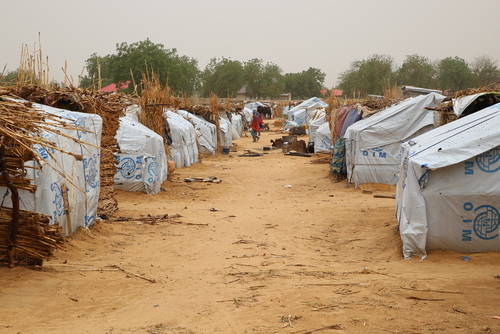
Falmata has moved from one camp to another in Banisheikh with her husband and seven children. The displaced community has grown and most now live in five settlements, sheltered only by flimsy plastic sheeting, supported with pieces of wood and stalk. These tiny spaces, in which they cook, sleep and spend most of their time, become terribly hot during Borno’s summer; when it rains, the plastic shelter leaks, and strong winds can rip holes in it. Sometimes the timber becomes infested with termites, damaging the frames, and causing the shelter to collapse.
MSF/Igor Barbero Camp for internally displaced people in the town of Banisheikh, state of Borno.
Unlike many roads across Borno, where movements can only be made with military escorts, traffic along the road from Banisheikh to Maiduguri has long been re-established. Numerous checkpoints serve a reminder of the volatility of a place that is a recurrent crossing point for insurgents coming from the Sambisa forest in the southern part of Borno state, heading north to Niger.
Over the past few months, following the escalation of the fighting, the Nigerian army has taken control of some towns in Borno. The clashes between the army and Boko Haram are forcing people to be displaced in all directions on a constant basis. People often have no choice but to leave their villages in the rural areas, sometimes separating from their relatives, and move to bigger towns where humanitarian agencies are concentrated. Aid is not reaching some inaccessible areas, and little information is emerging from these places. Pulka, close to the border with Cameroon, currently has around 60,000 to 70,000 people, but has seen its population increase considerably since the beginning of the year. New arrivals occur daily or weekly, to such an extent that humanitarian organisations now fear that the place is not fit to host many more people, particularly due to shortages of drinking water and insufficient shelter.
“When people arrive, they have very few belongings. The vast majority are women and children, as well as some elderly people,” says Sabina Mutindi, medical programme manager of Médecins Sans Frontières (MSF) in Pulka. “The young generation of men is completely missing,” adds Mutindi. Some of them may have died in the conflict, others may have joined the ranks of Boko Haram. “We see every possible medical case. The patients are hypoglycaemic, exposed to a harsh environment, so they have respiratory tract infections, ulcers, high blood pressure”. Once in Pulka, the fight is for survival.
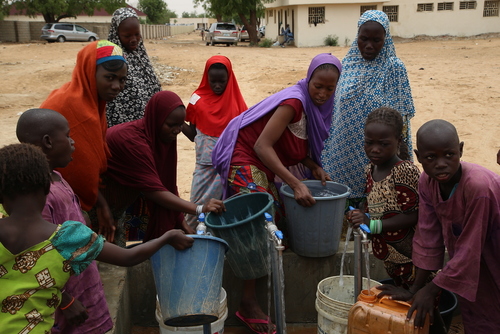
MSF/Igor Barbero Nigerian women and children displaced by the conflict between Boko Haram fetch water in the town of Banisheikh
Despite all the hurdles, for others, going to Pulka is a relief. Some had left the town when Boko Haram took over and have been in Cameroon for the last few years. Since May, the return of Nigerian refugees from Cameroon to Nigeria has intensified, with people leaving Cameroon because of the conditions in the camps where they were seeking refuge. However, they are also heading to places where services are limited. “We were told that we would be brought back to Nigeria, so we decided to come on our own. I decided to come to Pulka because it is my hometown,” says Adama, a 25 year-old woman and mother of four children, who had been living in Minawao camp in Cameroon for the last two years, until early May.
However, the return to Nigeria was not easy; during the journey, she had to cross a river and some people died when the canoe they were using capsized. “In Minawao, life was not easy. The information we received was that things in Pulka were better.” Upon her arrival, Adama found out that the food reservoirs and cattle stock she had left in the house she was renting in Pulka had disappeared, as well as all her other belongings. As a result, she moved into a health centre compound where MSF is running a hospital, and which is currently hosting around 2,000 displaced people and returnees who have not been given tents. “People need to assist us with aid,” says Adama.


 Gombe (Nigeria) — Gombe State Government in northeast Nigeria says it has spent N2.7 billion for the procurement of 20,000 metric tonnes of fertilizer for the 2017 farming season to be distributed to farmers in the state.