Image copyrightAFPImage caption Nigeria’s President Muhammadu Buhari returned to office in August after three months’ medical leave in the UK
A South African minister has criticised African leaders who seek medical treatment abroad.
Aaron Motsoaledi condemned “health tourism” while speaking in Zimbabwe.
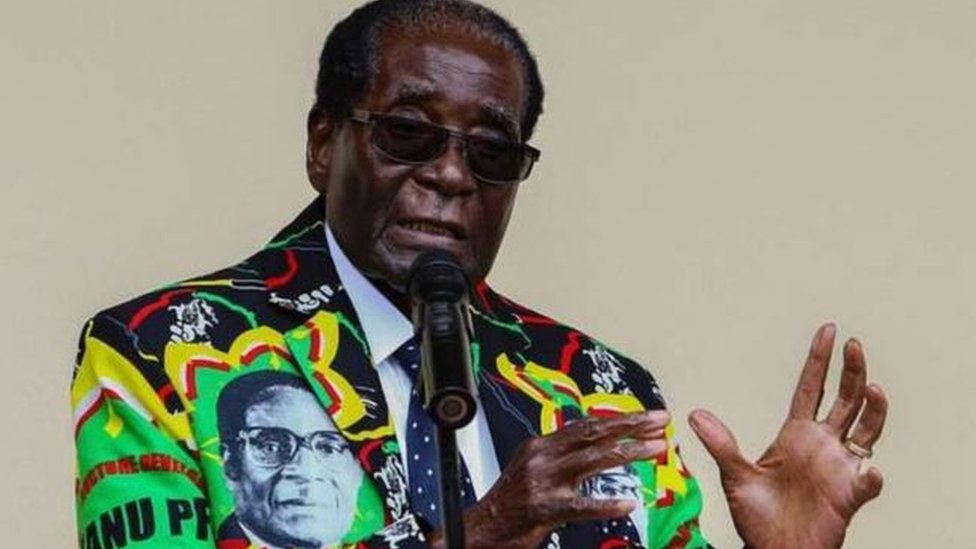
President Robert Mugabe, who frequently receives treatment in Singapore, had left the meeting of health ministers when Dr Motsoaledi made the comments.
Mr Mugabe’s spokesman has said that the president’s doctor “is not only Zimbabwean, he is actually black… He is very, very, very black”.
George Charamba made those comments to Zimbabwe’s state-run Herald newspaper in May, insisting that President Mugabe was not turning his back on Zimbabwean medical help.
Nigeria’s Muhammadu Buhari and Angola’s José Eduardo dos Santos have also been criticised for seeking medical treatment abroad this year.
At this week’s conference Dr Motsoaledi said:
“We are the only continent that has its leaders seeking medical services outside the continent, outside our territory. We must be ashamed of that.”
“This is called health tourism. We must promote our own,” he added.
Dr Motsoaledi also urged governments to increase funding to local facilities.
He has been praised by South Africans for using public hospitals instead of private facilities.
Analysis: Shingai Nyoka, BBC Victoria Falls, Zimbabwe
It was the elephant in the room as over 30 of Africa’s health ministers met to discuss strategies to tackle the continent’s public health problems.
The list of African heads of state who have recently sought medical treatment abroad includes President Muhammadu Buhari, Angola’s outgoing President José Eduardo dos Santos, Zimbabwe’s 93-year-old President Robert Mugabe, Benin’s President Patrice Talon and 80-year-old Algerian President Abdelaziz Bouteflika.
When Dr Motsoale made the comments in a plenary session, his remarks were met with silence from the other member states represented.
Dr Motsoaledi admitted his position is a controversial one, but added that it needed to be said.
Mugabe’s medical leave in 2017
17 Jan: President Robert Mugabe leaves Zimbabwe on an official trip then, according to the Standard, takes a detour to Singapore for routine checks
8 May: State media report that Mr Mugabe has left for Singapore on another routine medical check-up
9 July: Mr Mugabe leaves again for Singapore – a youth rally is postponed as a result and the main opposition accuse him of “ruling from a hospital bed”
This story is auto-generated from ‘BBC News’ syndicated feed and has not been edited by Africa Prime News staff.
United Nations Secretary-General António Guterres Tuesday announced the appointment of Alain Noudéhou of Benin Republic, as his Deputy Special Representative in the United Nations Mission in South Sudan (UNMISS). He will also serve as United Nations Resident Coordinator, Humanitarian Coordinator and Resident Representative of the United Nations Development Programme (UNDP).
Mr. Noudéhou succeeds Eugene Owusu of Ghana, who completed his assignment in July.
A statement from the UN says, the Secretary-General is grateful for Mr. Owusu’s dedicated service with the United Nations in South Sudan.
Currently, Chief of Staff and Director of the Executive Office of UNDP in New York, Mr. Noudéhou brings to the position extensive experience in international development and humanitarian affairs (since 2016).
He previously served as the UN Resident Coordinator and UNDP Resident Representative in the People’s Republic of China (2014-2016) and UN Resident Coordinator, Humanitarian Coordinator and UNDP Resident Representative in Zimbabwe (2010-2014).
He became UNDP Country Director in Tanzania in 2007 and served as UNDP Deputy Resident Representative in Rwanda in 2004.
Before joining United Nations, Mr. Noudéhou worked in senior positions from 1996 to 2002 for then CHF International Inc., an international non-governmental organization, currently named Global Communities, Partners for Good.
Mr. Noudéhou holds a Master’s Degree in Public Policy and Management from Carnegie Mellon University, USA.
He completed his undergraduate degree at Tsinghua University in China in 1990 and speaks English, Chinese, French, and Fon.
Nigeria is moving a strong position for the realisation of the green economy by carving a niche for sustainable wealth and development. Odimegwu Onwumere investigates in this report that the country is also head bent in grabbing the opportunity evolving around its marine, therefore using the paradigm shift to provide jobs and social reimbursements and also, not eschewing the protection of fundamental natural possessions, and making use of natural resources and ecosystem services
“If you want to address poverty in a sustainable manner, you cannot ignore the oceans. And if you must explore the seas and oceans in a sustainable manner, green house gas emission must be taken seriously,” said Dr. Dakuku Peterside at the experts’ round-table of MARPOL Annex VI, a treaty of the International Maritime Organisation for deterrence of air pollution from ships, held in Lagos, recently.
Peterside is the Director-General of Nigerian Maritime Administrative and Safety Agency (NIMASA). He has been working round the clock to improve water economy in the areas of green economy, sustainability and creating opportunities for development. He has also been into measures that would create job opportunities as part of sustainable ways to tap into development opportunities of the green economy. Peterside saw that the exact combination of policy, encouragement, competence development and informational tools, were keys in the sustainability of the green economy.
“We are conscripting 1,000 saving persons to safeguard our water ways,” Peterside told newsmen in April 2017, adding, “The regional Search and Rescue committee, which is made up of nine member countries – namely, Nigeria, Benin, Cameroon, Congo, Democratic Republic of Congo, Equatorial Guinea, Gabon, Sao Tome & Principe and Togo, was dormant. For almost a decade, they never met to discuss modalities of collaboration.”
This highlight was hinged on the fact that Nigeria was pursuing strapping situation for the nuance of the green economy in making sure that she carved a cubbyhole for sustainable wealth and development in Africa.
“NIMASA will soon take delivery of the 5th largest modular floating dockyard on the African continent. This dockyard will earn the Nigerian government, at least, $100 million annually in direct savings from the dry-docking of vessels operating in Nigeria, which is mostly done outside the country at the moment. It is our desire to partner the private sector to run the dockyard,” Peterside added.
Peterside observed that the Africa’s Seas and Oceans announced by the African Union (AU) starting from 2015 to 2025 was a waft in the ways things were done, recognising that the seas and oceans were the basement of economic infrastructure on the continent and it behooved on all to join hands and protect the seas. He noted that this was in line with the largely goals of Africa’s Agenda 2063.
Green Economy On Seas
In keeping the green economy sustainably, the Ministry of Environment and the Ministry of Finance, on 12th of January 2017, instated a Public Private Advisory Group assembly on the Green Bonds, to affirm stakeholders’ session, held in late 2016.
“It is a well-known fact that Africa’s seas and oceans are usually overlooked when it comes to issues of sustainable development in Africa, to the extent that Africa is considered to be sea blind,” said Peterside, adding, “Sea blind, because there is low level awareness of the potentials for wealth creation which abounds in the seas and oceans.”
He therefore bemoaned that Nigerians eyes were increasingly being opened “to the reality that our seas and oceans possess huge source of economic resources that can take the continent to the next level.”
What this meant was that the country had seen that diversification of the economy would aid investors and especially, the teeming young social entrepreneurs, but most importantly, in the green bond market, while structuring a countrywide climate finance aptitude.
“Investing in green sectors, including the water sector, more jobs and greater prosperity can be created. Arguably, these opportunities are strongest in areas where people still do not have access to clean water and adequate sanitation services,” as according to a national data of the UNICEF.
The international group went further, “Early investment in the provision of these services appears to be a precondition for progress. Once made, the rate of progress will be faster and more sustainable, thus making transition to a green economy possible.”
Sovereign Green Bonds
It’s no longer news that the green economy has become the keyword in all facets of businesses of countries on the Sub-Saharan Africa and Nigeria, was not left behind.
This oil rich country in West Africa with a growing population that was predicted to surpass that of the United States by 2030, held the first ever Green Bonds Conference, which was organised by the Federal Ministry of Environment in partnership with Federal Ministry of Finance and Debt Management Office.
At the event hypothetically held on Thursday, 23rd of February 2016 at the Nigerian Stock Exchange, Lagos, and christened “Green Bonds: Investing in Nigeria’s Sustainable Development”, the then Acting President, Professor Yemi Osinbajo delivered a keynote presentation.
The Federal Government (FG), however, expressed tremendous interest in the Sovereign Green Bonds project and some key international and local groups like the Nigerian Stock Exchange, CITI Bank, Chapel Hill Denham and Climate Bonds, the World Bank, DFID and EY were sponsors and collaborators to the FG, in order to carve a niche to augment the bond.
Explaining this, Oscar N. Onyema, CEO Nigerian Stock Exchange, said, “A sovereign green bond represents a new stage in development of Nigerian capital markets and opens the way for further corporate issuance and international investment.
“The NSE is playing a key role to help develop this enormous opportunity for Nigeria and fulfill one of our key objectives as a member of the UN Sustainable Stock Exchange Initiative.”
It was pragmatic that the Green Bonds was aimed to compel Nigeria and her citizens to spigot into the increasing universal market for green bonds. According to some opinions like the Climate Bonds Initiative, London, as of the end of 2016 the bonds encompassed of $576bn of uncategorized climate- supported bonds and $118bn of labeled green bonds.
This Green Bonds initiative by Nigeria was to make sure that the sustainable development opportunities of the green economy abound in the country. It was believed that the insurance approach to realising the green economy would add importance and appeal to the country’s funding decisions and gives the majority of Nigerians a new lease to the economy.
Nigeria’s Waterways
The NIMASA boss expressed confidence, saying that opportunities would accrue from proper water management in the areas of social and economical development and green economy. He added that protecting freshwater ecosystems was an issue that must be tackled with positive energy, given that water maintains a great role in biodiversity and ecosystem services.
Nigeria nonetheless was head bent in grabbing the opportunity evolving around green economy. Also, she was using the paradigm shift to provide jobs and social reimbursements by also, not eschewing the protection of fundamental natural possessions and making use of natural resources and ecosystem services.
This was even as Peterside unveiled that ships doing business in Nigerian waterways now flag Nigerian flag, unlike before. According to him, “It may also interest you to know that before 2003, less than 3 per cent of vessels operating in our waters were flagged Nigerian. However, today, we have over 60 per cent vessels doing business in Nigerian waters flying the Nigerian flag.”
He harangued that the Nigerian flag has also enjoyed noteworthy growth over the months. “While 262 vessels with a total tonnage of slightly over 232,000 gross registered tonnage (GRT) were registered in 2015, the figures almost doubled in 2016 as 370 vessels with a total tonnage of almost 420,000grt were registered within the past 12 months,” he added.
Those who know better were of the view that the earlier the green economy policies and actions were pursued with the attention it needed, the more the Sub-Saharan Africa would meet up with her developing strands.
This would also cut across investments in renewable energy development, they said, adding, renewable would bolster the electricity generation from renewable. They whispered that technology was one means to augment the green economy to especially, advance in the agricultural and industrial yield, while energy and water scarcity in the rural and urban areas would be sent on errand.
Odimegwu Onwumere is a Media Consultant based in Rivers State. Tel: +2348032552855. He contributed this piece via: apoet_25@yahoo.com
United States Agency for International Development (USAID), through the U.S. government’s Feed the Future Initiative, has launched the National Seed Trade Association of Ghana (NASTAG), in collaboration with the Ministry of Food and Agriculture and other development partners.
NASTAG is a partnership between producers, traders, government institutions and processors in the seed industry. The Association aims to spur private sector investment and promote the use of high-quality certified seed.
In attendance were, USAID/Ghana Agriculture Team Leader Jenna Tajchman and Deputy Minister of Agriculture Sagre Bambangi, who highlighted the importance of growing Ghana’s seed industry to build a food secure future
At the event, seven new Executive Council Members of the Association were inducted into office to grow the competitiveness of Ghana’s seed industry.
The Executive Council will work to strengthen the business and technical skills of its members, promote collaboration between seed value chain actors, and advocate on regulations, standardization and the provision of general seed information to all stakeholders.
The Government of Ghana has prioritized seed as a pillar in its flagship agriculture program, “Planting for Food and Jobs,” and NASTAG will play a leading role in its implementation. In Ghana, promoting the growth of the seed industry and ensuring access to quality certified seed has the potential to boost agricultural productivity, as well as enhance food and nutrition security in the country.
“We believe improving the seed sector is critical to Ghana’s economic growth. Developing Ghana’s seed sector is a top priority for USAID and its partners, and today’s launch is a milestone for the sector’s growth,” remarked Mrs. Tajchman. “NASTAG is a critical and necessary organization to develop Ghana’s seed sector.”
USAID and its Feed the Future partners support NASTAG with strategic planning, technical assistance, and increasing access to quality seeds for Ghanaian farmers. In Ghana, Feed the Future works to enhance agricultural productivity, links farmers to market and trade opportunities, and boost the nutrition of the most vulnerable population.
United Nations Mission in South Sudan has expressed sympathy to the family and friends of journalist Christopher Allen, killed during fighting in the town of Kaya, near the border with Uganda, in circumstances that remain unclear.
“We would like to pass on our deepest condolences to the family, colleagues, and friends of Christopher Allen for their loss. His death while reporting on the conflict in South Sudan is a tragedy,” said the Head of UNMISS and Special Representative of the Secretary-General, David Shearer.
“Christopher Allen is the tenth journalist to have been killed in South Sudan since 2012. UNMISS has repeatedly stated that any attacks on journalists are unacceptable and it calls on all parties to the ongoing conflict in South Sudan to respect the freedom of the press.”
Before moving to South Sudan, Allen had covered the war in Ukraine.
What is the fighting for?
The South Sudanese Civil War is a conflict between government forces and opposition forces.
In December 2013, President Salva Kiir had accused his former Deputy Riek Machar and ten others of attempting a coup d’état. Machar denied the accusation, and publicly criticised Mr Kiir for his inability to tackle corruption, adding that he would challenge him for the SPLM’s leadership. Things fell apart, he then fled to lead the Sudan People’s Liberation Movement – In Opposition (SPLM-IO).
Fight broke out between President Kiir’s SPLM and the SPLM-IO, igniting the civil war.
Ugandan troops were deployed to fight alongside the South Sudanese government.
The United Nations has peacekeeping force in the country as part of the United Nations Mission in South Sudan (UNMISS).
In January 2014 the first ceasefire agreement was reached, but since then, fighting has continued.
Thousands have been killed and hundreds of thousands have fled the Ugandan border area since the conflict broke out in 2014.
Media captionDays of destruction: The story so far
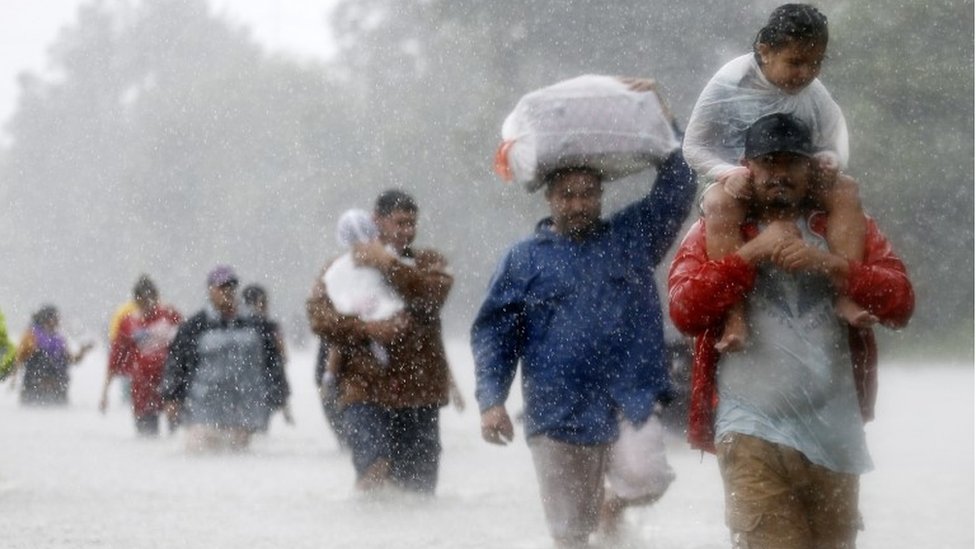
“Catastrophic” flooding in the US state of Texas is only expected to worsen in coming days as waters rise following a storm of historic proportions.
A record 30in of rain (75cm) has already fallen on the city of Houston in the wake of Hurricane Harvey, turning roads into rivers.
But forecasters say the total rainfall could nearly double later this week.
US President Donald Trump has promised swift action to help those affected. He is due to visit Texas on Tuesday.
“Recovery will be a long and difficult road and the federal government stands ready, willing and able to support that effort,” he said.
He said he was dealing with Congress on funding, warning “it’s going to be a very expensive situation”.
Mr Trump has also approved an emergency declaration for neighbouring Louisiana.
Harvey made landfall as a category-four hurricane late on Friday, bringing flooding described by officials as unprecedented. It was later downgraded to a tropical storm.
Media playback is unsupported on your device
Media caption‘I just have what’s in my car’ – flood-hit residents of La Grange
More than 3,000 people have been rescued in and around Houston, the fourth-largest city in the US, where about 6.6m people live in the metropolitan area. Helicopters have plucked victims from rooftops.
At least nine people are reported to have died in incidents related to the storm, Texan officials say.
Six members of the same family died trying to flee rising floodwaters, relatives told US media, but the incident has not been confirmed.
Image copyrightGetty ImagesImage caption With the storm continuing, thousands more people are expected to need to evacuate their homes
Governor Greg Abbott has activated the entire Texas National Guard – some 12,000 so-called “civilian soldiers” – to assist national forces in search and rescue operations.
The area is expected to have received a year’s rainfall within a week.
“Additional rainfall accumulations of 15 to 25 inches are expected”.
Meanwhile, army engineers have begun releasing water from two dams controlling water flowing along a major river into the heart of Houston.
Officials said they were opening the Addicks and Barker dams to stop water spilling into neighbouring communities, but that this could cause further damage down the Buffalo Bayou.
The National Weather Service (NWS) said the worst of floods were expected on Wednesday and Thursday, Reuters reports, although there is still uncertainty about the storm’s path.
Media playback is unsupported on your device
Media caption‘The biggest problem with Tropical Storm Harvey is just how slow moving it has become’
Thousands of homes are without electricity.
Many schools are closed – as are Houston’s two main airports, with runways completely flooded.
The Texas Gulf Coast is a key centre of the US oil and gas industry, and some of the largest refineries in the country have halted operations.
A city in crisis
By James Cook, BBC North America correspondent, Houston
Entire suburbs are under water, shops and businesses are shut and, with the motorways around the city cut off and both airports closed, travel is all but impossible.
A marooned hospital has been evacuated while, above the city, engineers are starting an emergency release of water from two bulging dams.
They are warning families who live beside one of the dams to prepare for flooding within hours.
Some residents have been critical of the preparations for this storm, which intensified rapidly in the Gulf of Mexico last week.
In at least one neighbourhood facing severe flooding, people are angry that they were told to stay put only to realise, as night fell, that the waters were rising fast and they could not get out.
Similar levels of 15-25in of rain are predicted for south-western and central Louisiana.
The state suffered huge destruction following Hurricane Katrina in 2005.
Observers have drawn comparisons with the disastrous evacuation of homes in New Orleans ahead of Katrina, which left thousands of people stranded in squalid conditions at that city’s stadium.
Tens of thousands of people have been ordered to leave parts of Fort Bend County, about 35 miles south-west of Houston, where a river is set to crest this week.
Dallas, 240 miles north of Houston, will set up a “mega shelter” at its convention centre to house 5,000 evacuees, city officials said.
But Houston authorities have not issued a mass evacuation order.
Mayor Sylvester Turner on Sunday defended the decision by citing the “crazy” logistics of planning an evacuation of 2.3 million people.
Meanwhile, Police Chief Art Acevedo said officers were focused on protecting the city from looters, with four people arrested on Monday.
Are you affected by Tropical Storm Harvey? Let us know about your experiences. Email haveyoursay@bbc.co.uk with your stories.
Please include a contact number if you are willing to speak to a BBC journalist. You can also contact us in the following ways:
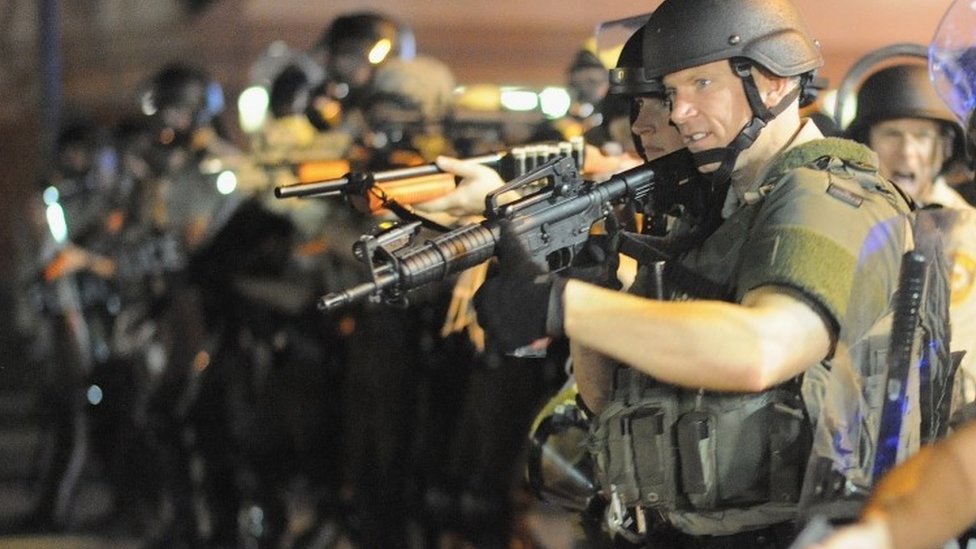
The ban followed criticism that police were too heavy handed in dealing with the protests that followed the killing of an unarmed black teenager by a white police officer in 2014.
The former US president was concerned about public reaction to images of heavily militarised police on the streets, saying it was important that police were perceived to be part of the community than being seen as an occupying force.
‘We have your back’
But Mr Sessions argued that Mr Obama’s restrictions went “too far”.
“We will not put superficial concerns above public safety,” he told a meeting of police officers.
Image copyrightAFPImage caption Mr Obama argued that it was important police were not seen to be occupying powers
“The executive order… will ensure that you can get the lifesaving gear that you need to do your job and send a strong message that we will not allow criminal activity, violence, and lawlessness to become the new normal.
“We have your back and you have our thanks,” he told the police convention.
Under the terms of the executive order, government agencies are compelled to take prompt action to reverse President Obama’s rules.
But the order has been criticised by civil rights groups and some Republicans in Congress.
“It is one thing for federal officials to work with local authorities to reduce or solve crime, but it is another for them to subsidise militarisation,” Senator Rand Paul said in a statement.
Mr Paul said that he would work to introduce legislation to ensure there was transparency in relation to such transfers so that law enforcement agencies do not to gain possession of equipment which remains prohibited.
This story is auto-generated from ‘BBC News’ feed and has not been edited by Africa Prime News staff.
Girl-child education has been identified as one of the key strategies for reducing maternal and child mortality as well as a tool for encouraging economic growth.
“Women who are educated are likely to attend ante natal and take care of their children because of their educational exposure, thereby reducing the risks associated with pregnancy, childbirth, and complications,” the Kaduna State Program Officer of Christian Aid Nigeria, Mercy Okeke, said.
Mrs. Okeke stated this Monday in Kaduna, while presenting a paper on “Girl-Child Education in Nigeria: Trends, practices, attitudes, and related barriers” at a three day training for Journalists on Collective Action for Adolescent Girls Initiative (CAAGI) and Voice to the People (V2P), organized by Christian Aid in Collaboration with Development Communications Network in Kaduna, northwest Nigeria.
According to her, “educated women are less likely to die in childbirth; they are more likely to have healthy and well nourished children – research has shown that a child born to a literate woman is 50percent more likely to survive pass the age of five.
“In Nigeria, 66 percent of mothers with secondary school education give birth in a health facility, compared to 11 percent with no education (British council 2012).
“The children of educated women are likely to go to school as well as raises schooling level for the next generation. They also have employment opportunities with higher pay after attaining good level of education.”
Mrs. Okeke however noted that poverty, gender norms and traditional practices, early marriage and access to school for people living in rural areas where long distance have to be covered before reaching a school are some barriers to girl child education in the country.
Earlier in his remarks, Governance Manager for Christian Aid, Temitope Fashola, explained that the essence of the workshop is to strengthen the capacities of Journalists in reporting issues around development at grassroots level and improving opportunities for the adolescent girls in the society.
He pointed out that the projects (V2P, CAAGI) are implemented in northeastern states and Kaduna, which aims at promoting accountability and address issues of development issues by empowering citizens to influence decision making around service delivery and to hold leaders accountable for improve public service for all.
Fashola also emphasized that there is poor level of service delivery in different sectors of the society, hence the need for empowering citizens so as to drive good governance and accountability.
“CAAGI project aims to improve the choices and opportunities available for girl-child in Kaduna state to live productive and meaningful lives through building active citizenship enhancing the voice and representation of women and other social excluded groups and establishing platforms for engagement between citizens and the state” he added.