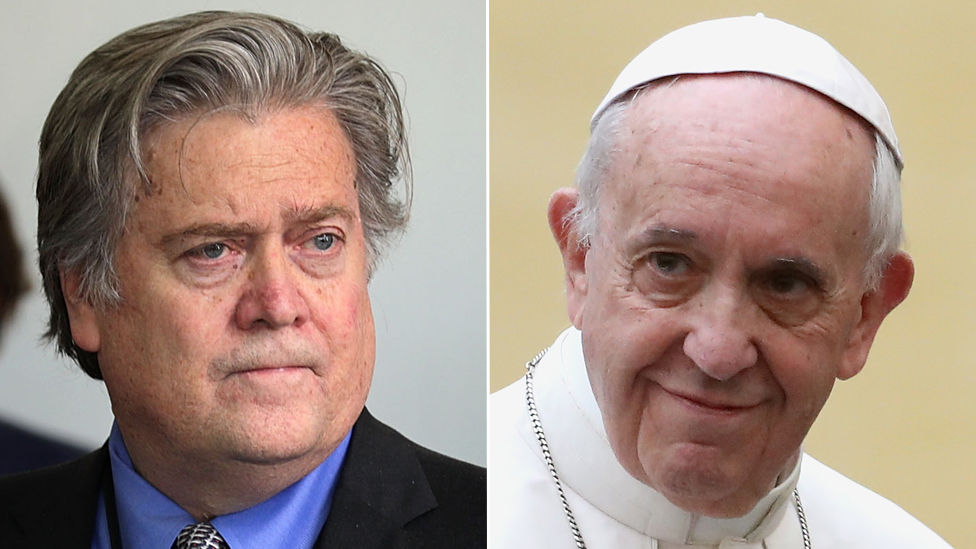
Steve Bannon’s remarks on the Catholic Church backing a US immigration scheme because immigrants fill the pews are “insulting”, a US cardinal has said.
New York-based Cardinal Timothy Dolan fired back after the ex-White House chief strategist said Catholics had an “economic interest” in US immigration.
He was referring to the Deferred Action for Childhood Arrivals (Daca), which President Donald Trump ended this week.
The Obama-era policy offers protections to young, undocumented immigrants.
Cardinal Dolan, the Pope-appointed Archbishop of New York who supported the programme, said on Thursday he was “befuddled” by Mr Bannon’s comments.
“I don’t really care to go into what I think is a preposterous and rather insulting statement, that the only reason we bishops care for immigrants is for the economic because we want to fill our churches and get more money,” he told Sirius XM’s Catholic Channel.
“That’s insulting and that’s just so ridiculous that it doesn’t merit a comment.”
Daca, which was introduced by former President Barack Obama in 2012, allowed some 800,000 so-called “Dreamers” to apply for work and study permits under a policy which, critics said, amounted to an amnesty for illegal immigrants.
Media caption‘We won’t go back into the shadows’, says this undocumented immigrant
In an interview with CBS News’ 60 Minutes programme, Mr Bannon defended Mr Trump’s decision and said the Catholic Church had “been terrible” on the issue.
“They need illegal aliens to fill the churches,” he said in the interview, set to air on Sunday. “They have an economic interest in unlimited immigration.”
Mr Bannon added that he respected Cardinal Dolan and the Catholic Church, but that immigration was “not about doctrine” and rather “about the sovereignty of a nation”.
“In that regard, they’re just another guy with an opinion”, he said.
Media playback is unsupported on your device
Media captionWhere do America’s undocumented immigrants live?
Mr Dolan shot back, saying it was not an issue of Catholic doctrine but a Biblical one.
“The Bible is so clear, so clear, that to treat the immigrant with dignity and respect, to make sure that society is just in its treatment of the immigrant is Biblical mandate.”
This story is auto-generated from ‘BBC News’ feed and has not been edited by Africa Prime News staff.
The Academic Staff Union of Polytechnics, ASUP, Kaduna Polytechnic, has resumed an indefinite industrial action, shutting down all academic activities in the institution.
A statement by the Publicity Secretary of the union, Abbas Muhammad, explained that the return to an earlier suspended strike by the union last Tuesday became inevitable following a unanimous Congress decision by the academic staff of the institution demanding the management of the institution to immediately address their demands.
The statement added that the teachers’ latest agitation followed the failure of the school’s management to resolve the many contentious issues for which an earlier strike was suspended on 18th July, 2017.
Some of the issues in contention, according to the statement include, poor working conditions, irregular academic calendar and routine lack of consumables for laboratory practical, even when such is a component of the students school fees.
Others are, inadequate amenities and conveniences, lack of recreational facilities, inadequate offices and furniture and the perennial lack of transparency in withholding of funds related to staff allowances.
The latest face-off between the academic Union and the Kaduna Polytechnic management is coming on the heels of an emergency Congress which was presided over by the body’s General Secretary who is holding forth as Acting Chairman, Talatu Raiya Umar, from which members of the body resolved to suspend all academic activities, with a passionate call on the government, general public and all stakeholders to prevail on the management to do the needful so as to ensure a timely resolution of the problems.
Virgin Atlantic boss Craig Kreeger on how the airline has been joining efforts to help those hit by Hurricane Irma. Disclaimer: This story is auto-generated from a syndicated feed and has not been edited by Africa Prime News staff.
Governor Nasiru Ahmed El-Rufai of Kaduna State, northern Nigeria has appointed Most Reverend Dr. Josiah Idowu-Fearon to head the Kaduna State Peace Commission.
A statement by Samuel Aruwan, spokesman to the governor said, El-Rufai has forwarded the names of four persons to constitute the leadership of the Peace Commission to the State of Assembly, explaining that the law establishing the commission was recently passed by the State House of Assembly.
It said governor Nasir El-Rufai nominated the Most Reverend Josiah Idowu-Fearon as Chairman and Priscilla Yachat Ankut as Executive Vice-Chairman/Chief Executive, Dr. Saleh Bashayi Momale and Hajiya Khadijah Hawzja Gambo are nominated as permanent commissioners.
“Dr. Josiah Idowu-Fearon is the Secretary-General of the Worldwide Anglican Communion, based in the United Kingdom. He is the immediate past Archbishop of the Kaduna Archdiocese of the Anglican Church, and also a former Bishop of Sokoto. Idowu-Fearon is a household name in peace advocacy and inter-religious harmony in Nigeria.
“He established the Kaduna Center for the Study of Christian-Muslim Relations. He holds degrees in theology, sociology, Arabic and Islamic studies from universities in Nigeria, the United Kingdom and the Kingdom of Jordan.
“Ankut is an expert in democratic governance, with specific experience in human rights, inclusive political processes, justice sector reform, conflict prevention and peace building.
“Her country experience spans South Africa, Gambia, Rwanda, Malawi and Nigeria where she has supported democratization processes in various capacities. Ankut worked with the United Nations Development Programme (UNDP) in Malawi as the Technical Specialist in Democratic Accountability where she supported the government of Malawi to develop a robust democratic governance sector strategy as part of its reform agenda.
“In Nigeria, she works with the Nigeria Stability and Reconciliation Programme (NSRP), DFID’s largest peace-building support programme, where she has successfully facilitated dialogue and reconciliation in communities affected by violent conflict across the country. She holds an LL.M from the University of Pretoria, South Africa. She studied law at the Ahmadu Bello University, Zaria.
“Dr. Momale is a development Geographer at the Centre for Dryland Agriculture, Bayero University, Kano. He holds a doctorate degree in Geography. He is a former Executive Director of The Pastoral Resolve, a non-governmental organization working in the areas of pastoralists’ education, conflict management and pastoral resource development in Nigeria.
“Hajiya Gambo is a gender rights activist, social entrepreneur and conflict resolution expert active in Plateau and neighboring states. She has been involved in several peace initiatives facilitated by the Geneva-based Center for Humanitarian Dialogue (HD),” the statement explained.
Nigeria’s Minister of Information and Culture, Lai Mohammed, has inaugurated Broadcasting building by Bayero University, Kano, praising elevation of Mass Communication to a level of a faculty through the provision of the necessary infrastructure.
“They (BUK) have elevated Mass Communication to a level of a Faculty but they did not just do so by pronouncement. They have done so by providing the necessary infrastructure that will make it possible,” he said.
Speaking while inaugurating some projects at the new site of the University, the minister commended the authorities of the Bayero University, Kano for elevating the instruction’s Mass Communication department to a faculty.
“I think what is clear now is that the BUK is actually committed and they want to be the foremost in Nigeria and even in Africa in the area of Mass Communication,” he said.
Lai Mohammed observed that the projects that were inaugurated demonstrated the commitment and readiness of BUK to raise the crop of professionals who would understand the dynamics of Mass Communication.
“We have seen the various studios, we have seen the Performing Theatre, we have seen the Academic Offices, we have seen the provision for the Post Graduate Students. So what BUK is actually telling us is that Mass Communication is too big to be a department and they are blazing the trail in making it a Faculty,” he noted.
The projects inaugurated by the Minister are the complex of the Faculty of Mass Communication, which has 50 offices, and the Broadcasting Complex, which houses the audio-visual studios, a computer laboratory and other facilities.
Mohammed also accompanied the former Minister of Petroleum, Prof. Jibril Aminu, to commission the 150-seat performing Arts Theatre also at the new site of the university.
“We have given politics a substantial impact on the direction of our lives. No wonder it’s so important to so many people!” shouted Aaron Ross Powell and Trevor Burrus, research fellows at Cato Institute, an American libertarian think tank headquartered in Washington, D.C, USA.
Powell and Burrus’s insight on politics in their discourse of September 14, 2012, with the designate – Politics Makes Us Worse – was the aftermath of my fears about politics in the 80s. They appended that political choices matter greatly to those most affected and the interest in political parties manufacture problems that never existed.
I came to understand what that meant: Our mentalities have been injured as a result of political choices. Buttressing this point, they enthused that for those who do pay attention, politics consistently leads in newspapers and on TV news and gets discussed, or shouted about, everywhere people gather; politics can weigh heavily in forging friendships, choosing enemies, and coloring who we respect.
Politics As A Dicey Affair
At our aboard in Oyigbo, Rivers State, Papa had told my younger brother, Henry, and I that there is an axiom that guides politicians: In politics, no permanent enemy or friend, but permanent interest. Incessantly, he shouted it into our ears that politics is a dicey affair.
Not minding, Henry showed interest in politics, but I never did. I hated politics following history accounts of how people kill and have been killed for politics and its offices. I detested killing and my bother never liked it, either, but he wanted to be a politician.
Powell and Burrus were worried why politics plays a major role in people’s lives with decisions by politicians determining what the people should do and should not, what the people’s children should learn in school and what they should be taught, how the people should eat and socialize, how they should even marry the people they love and sundry.
The highlight of that buttressed my worst fears which were on December 31, 1983 when many lives were lost to a coup for group mentalities, for political choices. The democratically elected government of Alhaji Shehu Shagari was overthrown by Major General Muhammadu Buhari in a military coup.
The same was applicable on August 27, 1985, when General Ibrahim Badamasi Babangida overthrew Major General Buhari in a coup, and stayed in power until August 27, 1993.
In that coup, many lives were lost, too. As a maximum ruler, people wailed and were bullied for wailing, because of group mentalities, political choices.
Hence, there was a long struggle to attain democracy with the help of international community. When democracy was gotten in 1999, we thought that democracy would help us when a retired Army General, Chief Olusegun Obasanjo was elected President Federal Republic of Nigeria in 1999.
But like the military regimes, I noticed the government sending out the Nigerian military on a largely Ijaw town of Odi in Bayelsa State, on November 20, 1999 and they massacred a people in a circumstance over indigenous rights to oil resources and environmental fortification.
Nigeria experienced a lot of politically motivated killings from that year to 2007. Dissenters to the views of the government were hounded and in 2016, democracy has not helped the people, either. All boils down to group mentalities, political choices.
Imprint Of Politics On People
Later, Papa told us of how politics of Nazism hypnotized Germany in the 20th Century. We read in the newspapers of how democracy and politics have made India to be on the index as the world’s largest population of poor people; oh! South Africa was ruined by apartheid of decades which was a sorry tale.
Across Asia and Africa, politics has imprint of woes in diverse places. Papa had told us that from 1974 when autocratic regimes gave way to democracy in Greece, to Spain in 1975, to Argentina in 1983, to Brazil in 1985, to Chile in 1989 and a host of others, politics has traumatized the people.
Soviet Union with a people living harmoniously was disintegrated by the politics in central Europe. My phobia heightened on noting that monarchical government was fad in the 19th Century and people fought against each other for dukedoms.
While peoples all over the world were fighting and hoped to gain in democracy, yet, nascent democracies collapsed in Germany, Spain and Italy in the first half of the 20th Century.
Politics Connects People With Woes
More than 70 million military personnel, including 60 million Europeans, were mobilized in one of the largest wars in history known as First World War, or the Great War, that originated in Europe and lasted from 28 July 1914 to 11 November 1918.
Over 9 million combatants and 7 million civilians died in that politically motivated war. This number excluded victims of a number of genocides. Because of politics, came Second World War that lasted from 1939 to 1945.
It was regarded as the most widespread war in history, directly involving more than 100 million people from over 30 countries. There was the Holocaust (in which roughly 11 million people were killed).
An estimated 50 million to 85 million fatalities were recorded in the atomic bombings of Hiroshima and Nagasaki. There was the Third World War where countries in extensive divergences indirectly showed their grievances.
This was christened Cold War or the War on Terror leading to the formation of the United Nations (UN). Psychotherapists observed, ‘United Nations’ was first coined and used by the then United States President Franklin D. Roosevelt in the Declaration by United Nations of 1 January 1942, during the Second World War, when representatives of 26 nations pledged their governments to continue fighting together against the Axis Powers.
Whichever, I could not have believed much in Powell and Burrus’s pose – on how badly politics can make a people worse or influence them in a democracy till the government of General Muhammadu Buhari of Nigeria came on board on May 29 2015, now as a democratically elected president.
Sharing Baked Breath In Politics
In Nigeria, the members of the two political parties – All Progressives Congress (APC), and the Peoples Democratic Party (PDP) – have shared baked breath under Buhari government except a few persons ‘sharing’ the largesse of the government.
Nigerians at large are crying wolf since the inception of this government and I will tell you how. Politics like this has made a lot of people not to vote across the countries of the world.
For instance, many young people in America do not vote during an election. This does not mean that they do not want to be heard, but, because of how the older ones have made them to feel and see a tooting gap between them.
In 1992, Mr. T.B, then a 19 year old student, refused watching the 1992 Presidential Debates because he didn’t see how that responded to the many isolations he was facing in school.
I could remember a Chris Weinkopf, associate editor of National Review, saying, “I think both of them are really just paying lip service to young people in the way they address issues.”
Weinkopf said this “when speaking about how Bill Clinton and Bob Dole are talking to young voters.” Many people believed that democracy would be the most political idea when the idea started in the 20th Century, but politics has posited itself to be afar from the people, even though that people play the politics.
In February 2014, I was astonished of how Ukraine politics was overturned by protesters, all, in a quest that there should be closer relations with the European Union (EU). The much solicited for by the protesters was for the closer relations to end Russian interference in Ukraine’s politics.
The world saw a people that took a stand against what they knew and termed “corrupt, abusive and autocratic government” of President Viktor Yanukovych. Powell and Burrus sniveled, saying that even if we try to ignore politics, it influences much of our world.
Nigeria Politics
My brother is today in politics, but I’m yet to see any change that the people have made with politics, or politics has made in the people.
Just in June 2016, the Committee for the Defence of Human Rights, (CDHR) cried out, saying that the All Progressives Congress, APC-led government has failed Nigerians who voted for them.
Both Buhari, who was once a military dictator and his party, the APC, have been said that they displaced signs of incompetence during electioneering campaign of 2015.
I read from a source, saying, “The APC presented Nigerians with a glimpse of Eldorado even when they were aware that they lack no the capacity or intellectual ability to fulfill even 10% of their promise. To mask their disability, they shielded General Buhari and Prof Yemi Osinbajo (his deputy) from every form of political debate. Instead, they resorted to prepare speech-making in Chatham House, London(UK), and padi-padi town hall meeting where participants, who are their party sympathizers and paid agents would discuss pre-arranged questions.”
This is my phobia about politics and the people. People hide under politics to perpetrate heinous things against the people. It is saddening that many people are committed to their different political parties for politics than they are committed to the general public. This is what psychologists have forewarned: People will grasp group mentalities for politics and will be antagonistic.
Odimegwu Onwumere writes from Rivers State. Tel: +2348032552855. Email: apoet_25@yahoo.com
The decision by Governor Nasiru Ahmed El-Rufai of Kaduna State in northern Nigeria to reopen tertiary institutions in Southern Kaduna closed down since last year has been described as a welcome development.
Sunday Marshall Katung, member House of Representatives representing Zangon Kataf/Jaba federal Constituency in a statement said the closure has been the subject of many interpretations, explanations and litigation, stressing that the reopening would provide relieve to both students and parents not forgetting traders who offer services at those institutions.
“The students in particular will be delighted to resume the pursuit of their academic activities.
“Notwithstanding the unjustifiable circumstances that led to the long closure of the tertiary institutions while secondary and primary schools were still open for academic activities, I want to sincerely appreciate all those who contributed in diverse ways towards the reopening of the schools.
“The Southern Kaduna Peoples’ Union, SOKAPU, which coordinated the peaceful agitation for the reopening deserved special commendation. The Centrum Initiative For Development And Fundamental Rights Advocacy, CEDRA, the Southern Kaduna Lawyers who selflessly deployed their resources and expertise towards a judicial settlement for the reopening are patriots.
“Southern Kaduna Youth and Students Forum, SKYSFOM, who went about pleading for the reopening, including holding press conferences, protests and collation of signatures in order to be allowed to resume school are also appreciated.
“Our traditional rulers, religious leaders, lawmakers, the youths of Southern Kaduna, members of the media, and so many others both within and outside the state who spoke on the media, and other platforms for the sake of calling for the reopening of these schools are acknowledged.
“You stood on the side of fairness to ensure the enthronement of justice through peaceful means and posterity shall not forget your efforts.
“I call on all people from Southern Kaduna in particular and the entire state to continue to live peacefully with one another irrespective of ethnic or religious differences, because our strength lies in our unity. This is imperative because the only way we can benefit from the dividends of democracy is in an atmosphere of peace,” he stressed.