Aminu Saidu of Zaria Golf Club has emerged winner of the Nigerian Breweries 2017 Jaji Golf Championship Tournament.
Saidu played in the men’s category 0-14 emerged Best Nett 18 holes with 64 points, Barrister Babanja’E of Ola Sa’ad Golf Club with 71 points emerging second runner up.
Sergeant Abubakar also of Ola Sa’ad Golf club with 77 point emerged third runner up while Abdullahi Mamman and Alhassan of Ola Sa’ad Golf club with 74 and 78points emerged Best Gross 18 Holes and Runner Up Gross 18 Holes respectively.
Speaking at the presentation of awards the Brewery Manager, Kakuri Branch, Kaduna, Mr.Abbey Ajayi, said, “through our corporate social responsibility (CSR) platform, we are not relenting in our continuous sponsorship of the Jaji Golf championship which we hold dear to our heart owing to the relationship that we have nurtured for over 36 years.
“What we are witnessing today, is the result of that partnership that we have enjoyed with the Armed Forces over the years, we have once again shown our commitment through our sports sponsorship. The Golf tournament itself has continued to witness positive transformation as it keeps getting bigger and better every year.
“This tournament offers us a unique opportunity to exercise, bond and enjoy good time together.
Our participation this year has added a new dimension as was done in previous editions, by introducing a coaching clinic this year, we aim to encourage new golfers into the game of golfing, by encouraging new people into this exciting sport.”
On Nigeria’s Unity, he observed that sports remain a strong unifying force the world over and by the sponsorship of golfing events, there is friendship, and the spirit of togetherness associated with it.
“Our company, in no small way, appreciates the huge efforts of the Nigerian Military in defending our sovereignty and the protection of lives and properties in this great country, especially at this challenging period. We salute you the Armed Forces Command Staff College, AFCSC, for training the very best in our country and Africa’s best,” he added.
Earlier at the Golf Clinic, the Commandant Nigerian Army School of Infantry, Brigadier General Jamiu Saram, commended Nigerian Breweries Plc for the laudable initiative of Golf clinic, stressing that the sport of Golf was very important for Nigerian military and would keep the military personnel fit all the times.
Also speaking the Captain of Ola Sa’ad Golf club, Colonel Nicholas Ashinze said, the company “has been a major supporter of golf in Ola Sa’ad Golf Club, this year’s sponsorship is different with the introduction of Golf Clinic, for us this is very strategic hence it means a future for Golf.”
The Golf Clinic had in attendance hundreds of Golfers from Nigerian Defense Academy, Bankers, Brewery staff, and Business men, among others who trooped the Ola Sa’ad Golf Club for learning.
Following the recent pronouncement that Nigeria is out of recession, – citizens have expressed reservations on the exit of the country from recession considering the high cost of goods in the market.
The National Bureau of Statistics (NBS), last week said, Nigeria exited its worst economic recession in more than two decades, notching up growth of 0.55 per cent in the second quarter of 2017.
The report showed how the economic recovery was driven by improved performance of oil, agriculture, manufacturing and trade sectors of the economy.
But in a reaction, former presidential candidate, Chief Martin Onovo, faulted the NBS for coming up with a verdict that Nigeria is out of economic recession.
Onovo, who contested the 2015 presidential elections on the platform of the National Conscience Party (NCP), argue that Nigeria was in a season of stagnation rather than being in a recession according to Vanguard online.
While reacting to the pronouncement of the country’s exit from economic recession, Governor Ayo Fayose of Ekiti State said, Nigeria coming out of recession was false news.
While baring his mind to journalists, he said many Nigerians were still suffering and dying in reality.
In April, a London-based organisation, World Economics, had announced that the country was gradually moving out of recession woods, a situation that negatively affected many business, especially by the dollar restriction policy.
The organisation on its website says, “April Sales Managers’ Index (SMI) data suggests that the Nigerian economy is continuing to grow out of the recession which saw 10 months of consecutive contraction in 2016.
There are speculations that the national development revenue has increased, suggesting a bright outlook for the economy.
The government is drumming that Nigerians must remain productive and sustain their economic activities to ensure a total defeat on the economic monster (recession).
A resident of Kaduna, Bright Sunday, who accepted the news with scepticism said, “questions that Nigerians are asking include, when would prices of food items come down? what policy, or strategy will the government introduce to ensure that the country does not go back to economic recession?”
A fabric seller in Kaduna Central Market, who wants to remain anonymous, said, “despite the announcement, prices of items have remained high in the market. We want to see price reduction on items, to identify with the new status,” she said.
President Muhammadu Buhari of Nigeria, himself believes that what the NBS said was not making sense to ordinary citizens, no wonder when he said, the real impact of coming out of recession will be better felt when ordinary Nigerians experience a change in their living conditions.
“Until coming out of recession translates into meaningful improvement in peoples’ lives, our work cannot be said to be done,” Buhari said.
Nigerian government needs put in place measures to consolidate efforts of individuals in the agricultural sector, oil and foreign direct investment, because they are the major factors currently boosting the economy.
Some opine that the federal government need invest more on things that would strengthen the country, not just the interest of leaders.
In the 21st century, Nigeria still does not have a good understanding (talk less of practice) of basic politics. Basic politics has to do with the true concern, focus and carrying out of ideas that will ensure the good of all the people in a defined political society. The good of all is the same thing as public or common good: the good that everyone has access to and is capable of being replenished always to elevate the living standards of its consumers. Consequently, politics must create and effectively distribute common good to all. Political philosophers were of the view that common good should be available to the highest number of the people than few. I am of the view that common good should be available to all. That is what I consider as one of the basics of politics. However, politics in Nigeria has never been about its basics, rather it is about fighting and arguing for the elites who control everything including the minds of the people. The way Nigeria is ruled, if the country is restructured and it remains one or not, who benefits most? It is the ruling elite class. If Nigeria remains united as it is today, who benefits most? It is still the ruling elites. I therefore wonder why non-elites are vehemently arguing their voices croaked, insulting, fighting and killing themselves over restructuring or not restructuring Nigeria.
The Nigerian commoners who argue for restructuring cite examples of some factors which have caused imbalances and tensions in the polity by querying some critical issues about the country. They ask the following questions which bear their source of rage against the so-called united Nigeria. Why should the South-East geo-political zone (out of the six zones) have five states while the rest zones have six states each? Why is it that the former Northern region would always have more population census figures than the Western, Eastern and Mid-Western regions combined? Why is it that in appointment into top government positions, the Northerners would always have more appointees than the rest of the country? Why is it that Kano State benefits more than Lagos State in sharing of the value added tax (VAT) revenue from the federation account, when the latter is the chief source of VAT revenue to the federal government? Why are most strategic military installations located in the Northern part of Nigeria? Why is it that the North recorded more heads-of-state and commanders-in-chief than all other parts of Nigeria put together? Why are the Fulani herdsmen killing Nigerians across the country and the federal government appears not to be serious in stopping them? Why is the federal government so powerful at the expense of the true development of the rest tiers of governance? They strongly argue that these issues make it always easy for the North to have more advantages and better access to the resources of the country than any other part. Therefore, Nigeria must the restructured to address these queries.
The restructuring argument also is about “who gets what” from the ruling crude oil resource. Crude oil is produced in the Niger Delta in the South-South zone. The argument is that the Niger Delta despite contributing about 80% of Nigeria’s foreign exchange revenue, has remained very poor and underdeveloped because the federal government and oil companies are not paying adequate attention to the needs of the peoples of the Niger Delta. Hence, the Niger Delta people are demanding for resource control through restructuring of Nigeria so that states or regions or zones should take over resources beneath their soil and contribute an agreed percentage to the federal government to take care of its federal services. It is in support of this argument that the Lagos State government argues that it is unfair to have allocated to it less revenue from VAT revenue chiefly derived from the state.
Besides, there is an important element of ethnicity or tribalism in the restructure argument. The argument is that ethnicity or tribalism led to the domination and marginalization of one ethnic group over another. The major outcome of the ethnic factor is the fear of marginalization expressed by both the majority and minority ethnic groups (more by the minority ethnic groups) which has engendered the lack of trust amongst all the ethnic groups. The fear of marginalization was indeed first raised by the late Premier of the then Northern Nigeria, Sir Ahmadu Bello, in 1953 when late Pa Anthony Enahoro moved the motion for Nigeria’s independence in 1956. Bello feared that Southern Nigeria will dominate the federal and regional civil services because the South were more educated than the North and therefore they objected to independence in 1956. This actually delayed Nigeria’s independence till 1960. The Igbos feel marginalized because they have not help the office of the President since after the civil war and that this accounts for the unacceptable level of their underdevelopment. Yet they refused to demand for good governance from all the Igbos who have been Vice President of Nigeria, Ministers, members of the Senate and House of Representatives, Governors and local government Chairmen from Igboland. The little resources that were made available to the Igbo through these appointments, how well were they utilized for the true development of Igboland? This is the question that needs to be addressed and not demand for Biafra or restructuring of Nigeria. However, the Igbo deserves six states like other political zones in the country. Also, the Igbo deserves an unconditional apology from the Federal Government of Nigeria (FGN) for the civil war and that such will never happen again.
In the 1950s, ethnic minorities in the Northern region (Tiv, Idoma, Jukun, etc.), Eastern region (Ikwerre, Ijaw, Effik, Ibibio, Ogoni, Akalaka etc.) and Western region (Bini, Urhobo, Itshekiri, Isoko etc.) feared that in the event of independence in 1960, the larger regional ethnic groups of Hausa-Fulani, Igbo and Yoruba in the North, East and West respectively will dominate them. They demanded for their own regions: Middle-Belt Region from the North, Calabar-Ogoja-Rivers Region from the East and Mid-West Region from the West. Recall that it was the fear of the minorities that led to the establishment of the Willinks Commission of Inquiry into the Fears of the Minorities in 1957. Out of the three requests, only the West allowed for the creation of another region out of it and this was how the Mid-Western Region was born in May 1963. The rest requests were denied and this has remained a sore point in the ethnic politics in Nigeria, despite the creation of states and local governments in those areas.
On the other hand, those who do not support restructuring and prefers Nigeria to remain one indivisible political entity with heavy federal powers argue as follows: restructuring may lead to the splintering of Nigeria into national pieces, big size is better than small size especially in international politics, unity in diversity is better than diversity in unity (diversity in a large house is better than diversity in a small house), there will be difficulty in determining how to exactly dismember Nigeria (how many countries? who will be with who? or who will be in which country? who will lead who? etc.) and that it is better and simpler to say we are Nigerians. At this point, I need to make it clear that restructuring does not necessarily lead to the scattering of Nigeria. In fact it may make Nigeria stronger. The proponents of united Nigeria also failed to address the issue of how united Nigeria can ensure good governance.
Fundamentally, both sides of the argument are not sincere. The basic problem with Nigeria is bad political leadership and the two sides are never mentioning how to deal with it. Bad governance is championed by the political, social (traditional rulers and their cronies) and economic elites who always benefit more than the rest of the people whether structured, restructured or united or re-united Nigeria.
The aggregated issues involved in the arguments are mainly those of political entity and ownership of resources. Restructuring argues that all political units either as is or as will be, should have total control of their respective mineral and all other resources found in their places, use the resources and contribute a smaller percentage of their annual budget to the federal purse. They also argued that during the First Republic (1960-66), resources were shared 50:50 between the FGN and the four regions. The question to ask is: during this period, was the level of development commensurate with resources available (given the size of the population)? Was it not the same period when late Major Nzeogwu accused and labeled the political class the “10 per centers”? Except Western Nigeria, education was for the privileged class in the rest of the country. Even with the 50:50 resource/revenue allocation, the regions were not able to discover, exploit and earn well from mineral resources in the regions? With Agricultural goods like cocoa, palmoil and groundnut, the regions exported them raw to Europe, thus undermined the possibilities of establishing industries for the processing of these goods into commodities for higher revenue and improved standard of living. If they meant well, why should these raw Agricultural goods be exported unprocessed to Europe? This was the origin of the lack of diversification of the Nigerian economy which has also consigned crude oil into the same fate. How can Nigeria become developed as an exporter of primary goods? This was how Nigeria lost all the chain industries that would have been created for the processing and re-processing of palmoil, groundnut and cocoa. This was the reason late Prof. Claude Ake opined that an undiversified economy is a disarticulated one and cannot lead to genuine development. At the end of the day, it was still the elites that benefitted most from the 50 percent revenue derivation, which proponents of restructuring are now advocating for.
Consequently, it is the duty of the restructuring argument to prove that the relatives and cronies of the expanded elite class who have fed fat from groundnut, palmoil and cocoa exports and now feeding fatter from crude oil exports will not be the ones to benefit most under a restructured Nigeria. How does restructuring engender or guarantee good governance? Lagos State is the most hardworking, industrialized and rich state in Nigeria; to what extent has this richness consistently improved the living conditions of Lagosians?
Proponents of restructuring from the crude oil producing states in the Niger Delta insist on resource control. They have failed to prove how resource control can ensure good governance in the management of the 100% resource they want to have. My dissertation research in June 2017 had estimated that Akwa Ibom, Rivers, Delta and Bayelsa states in the Niger Delta have earned over N13.5 trillion (1999-2015). Specifically, Rivers State earned an average annual income of N240 billion mostly from the federation account, amounting to N3.842 trillion during this period. What can the people of Rivers State show for it in terms of industrialization, productivity, employment, improved living standards etc.? Since 1999, all we hear is road, road, and road! No public water supply, no increase in quality of education, no adequate feeder roads to support effective rural development, no regular and affordable electric power supply etc. Rather, the only major progress recorded in the state is that the state has been adequately infested of cultism which has led to loss of hundreds of thousands of lives, sacking of communities (including that of the writer) and several other atrocities unleashed on the people of Rivers State by cultism. Meaningful economic and social activities needed for the development of the people have long been shut down in Rivers State since 2003 due to cultism. How will restructuring change all of these anomalies?
It is bad political leadership which has denied the creation of common goods and effective redistribution of same in the present united Nigeria that has given rise to the agitation for restructuring and/or dismemberment. If Nigeria can achieve good governance which will meet the basic needs of the people, the clamor for restructuring or dismemberment will disappear. Good governance will ensure that the little funds that are accrued to the states are well utilized for meeting the basic needs and true development of the people. Good governance goes beyond restructuring and unity arguments. It is about meeting the needs of the people through its attributes of accountability, transparency, effective and efficient resource utilization, rule of law, inclusive governance, discipline and leadership by decent behaviors in leading the people.
If how to live together is the problem, lets us sincerely discuss it. Nigerians should better put in place determined and committed model of discussing how to live together as a united nation than being carried away with the meaningless idea of restructuring or unity of Nigeria. Nigerians must insist on good governance. If we are not sure of good governance, there is no need for unity or restructuring of Nigeria.
Consider this a hyperbole at your ignorance – Isn’t it your peril? – oh ye, Knowledge Advocate. Certainly, in this part of the world, Knowledge is right now at the abattoir, being slaughtered. Or, do you need any eye to see his blood forming a mighty tide there? No doubt, Knowledge is multi-faceted, multi-dimensional. But, Researcher’s chronicle here is by no means a feeble proof.
Researcher is at then-University-Main-Library-now-turned-Faculty-Library to continue with his data collection using national dailies, only to get his vigour and enthusiasm watered down by the padlocked gate. That is Wednesday 6 Sept., 2017. A workday. 12 o’ clock noon. The nationwide public holiday for the celebration of Eid-il-Fitr was over two days ago. Why the closure, then? Only three staff work here: one is an ASUU member, and you know what that means; the other two are on annual leave! My investigations found two versions, though; one, the second staff is on leave too; two, he isn’t on leave but just went to only-God-knows-where. Whatever, their colleagues at the Main Library assured Researcher that the ‘library’ isn’t going to be open until Monday, next week. Why or how could both staff be on whatever leave at the same time, or be absent for whatever reason? Or, why no staff at the Main Library is posted there? It’s sad that these remain answerless, though not rhetorical, questions.
Why not the Main Library? Worse. Researcher had, in vain, gone there several times looking for newspapers of 2016-17. The definitive explanation was that all 2016 and some of the 2017 papers have yet to be packed from the old library to the several-months-old new one. His galvanised efforts were disappointed when he was told that the key to the vacated library might be with the Security Office and even if you get the key and a volunteering staff, you can not access the papers because of DUST. It’s based on this that the concerned lady advised Researcher to go to the now closed ‘library’. Isn’t here worse then, and, now, is there any hope for Researcher who hopes to finish his task within the week?
Yes. Since the ivory tower has failed, National Library is his last resort, thought Researcher. They have almost all papers of the said period. But, alas, all reference materials, books, shelves, chairs, desks – everything – belonging to the National Library have been jam-packed in a room and, obviously, no library business does and can take place! Not even a lady-staff’s concern and efforts to uncover the sardined papers to make them accessible to Researcher yielded any fruit.
Why all this booboo? The National Library had been occupying the State Library building for years and the latter had been moved to a rented building. Meanwhile, the former has been, for years, constructing ‘a state of the art’ library elsewhere within the heart of the state capital. The arrangement was that the State Library would relocate to its original place when the National Library finishes its permanent site and moves there. Now, the dream seems a dream forever.
At the other side of the coin, the State Library has failed to pay its rent and the landlord has asked it to pack. To avoid being a vagabond, it has seized its original place from the National Library and resumed business. A kind and respectful younger sister, though, it has allowed its elder sister to put everything it has in a room, for the meantime. This means two libraries, State and Federal, operate in one building. Fine. Researcher, shift target. The Serial Officer looks dumfounded when Researcher makes his mission clear. We haven’t bought any paper 2016-date! She responds as-a-matter-of-factly.
Until now, Researcher thought there was any hope for Knowledge to be sought and research done. But, his experience assures him there isn’t. (This is putting aside the 16th-century-ness of the duo). Isn’t all this clear evidence that this climate has made Knowledge the last item on its scale of preference? And, to add foolishness to madness, a few months ago, the Government held a Reading Awareness Event in this library-less Sahara. Anyway, doesn’t this madness-foolishness combo represent in microcosm what is happening in the larger geography? Now, who is to rescue not just Researcher but Knowledge from the hungry blade that has penetrated its skin and is a millisecond away from its throat? I? S/he? You? They? We.
Abdulkadir Adamu, Department of English, Gombe State University. He can be reached through adamuone86@gmail.com
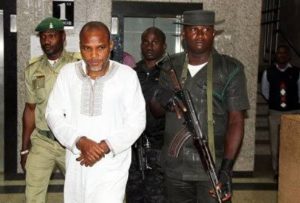
Nnamdi Kanu being led by prisons officers to an Abuja court
By Niran Adedokun
Has anyone noticed that rather than diminish, agitations for the restructuring Nigeria has grown in the aftermath of President Muhammadu Buhari’s crossing “our national red lines” speech penultimate Monday?
It started with a reaction from the Southern Leaders Forum, a congregation of groups from the three zones of Southern Nigeria.
The SLF, in insisting that Nigerians cannot be threatened out of their desire to renegotiate the country said: “We are of the view that leadership requires more than this at this crucial moment. We call on the President to realise that the country is in a very bad shape… This is the time to renegotiate Nigeria along federal lines negotiated by our founding fathers to stem the tide of separatist feelings and agitations.”
Ahead of this press conference, individual ethnic groups including Afenifere, representing the interest of the Yoruba; the Ijaw Youth Council; the Urhobo Progress Union and the Ohanaeze Ndigbo had condemned the President’s speech.
On its part, the Coalition of Northern Groups supported the President’s averment that Nigerians were free to live anywhere they desired. But they had a caveat that, “that does not extend to a people who by action and utterances say they are not Nigerians.” A suggestion the Ohanaeze Ndigbo would later describe as a blatant qualification of Buhari’s yellow card, one which went without reprimand.
On the larger part, northern groups including the Arewa Consultative Forum sided with the President. This seems a cogent testimony to the fact that ethnic warlords have refused to be beaten into the lines that Buhari hoped to draw by that early morning speech.
Incidentally, the Federal Government has unwittingly stoked the fire of these ethnic mumblings. Probably, to give bite to the President’s promise to deal with forces threatening the corporate survival of the country, the Attorney General of the Federation and Minister of Justice, Abubakar Malami, has approached the Federal High Court for the revocation of the bail granted the leader of Indigenous People of Biafra, Nnamdi Kanu, by Justice Binta Murtala Nyako of the same court, last April.
Two points need to be made here.
Although one can query the constitutionality of the bail conditions handed to the IPOB leader, there is no doubt that Kanu has flouted them. I cannot comprehend the legality of restricting the freedom of association and expression of a Nigerian, provided by the 1999 Constitution as amended. But even if these conditions were not totally legal, the man under trial accepted them and he should, if he really wants to remain a free man, live by them.
The second point is that the Federal Government, even though it is seeking to bring Kanu back into detention, has, this time, not resorted to self-help.
That the government has not decided to storm Kanu’s home with agents of the Department of State Services, and take him into custody is an indication that we are moving away from state terrorism that we were hitherto exposed to. Especially, as it concerns Kanu and a few others who have come into confrontation with the administration.
All said and done, the Buhari administration should at this point honestly ask itself what it stands to gain from having the IPOB leader arrested and clamped into jail. Would it prove the point that government is in control of the country or further the course of peace which the President, even without stating it explicitly, seems to desire?
In answering the question, the administration should re-assess the gains of having previously detained Kanu for about two years in spite of court orders for his bail. Did his incarceration suppress the idea of a new Biafra which he propagates or did it in any way discourage other parts of the country from speaking their minds about the structural imbalance in the country?
The truth is that the government and by extension, Nigeria lost more from Kanu’s detention than we gained. Before July 2015 for example, very little was known about Radio Biafra and its director. Although the frequency had been in the news on a few occasions, it did not appear that anyone paid much attention to it until the National Broadcasting Commission claimed to have successfully jammed its signals.
The Permanent Secretary at the Federal Ministry of Information at that time, Ms. Yemi-Esan, made the assertion just while leaving a meeting where she briefed President Buhari on the activities of her ministry.
Unfortunately, Radio Biafra continued with its programming hours after the claim by the Federal Government. And things never remained the same. The hitherto unknown radio gained global attention and more listenership in the eastern part of Nigeria where it daily spewed propaganda against the Buhari government. Announcing the attempt to stop Radio Biafra from broadcasting was the first misstep of the government in my opinion, as the failure of the attempt unwittingly validated the platform and Kanu.
Granted that Kanu, from reports, broadcast a lot of falsehood and bile about Nigeria, (which he allegedly referred to as a zoo) and its government, the Buhari administration made no attempt to attenuate the initial damage. And Kanu, a young man who might have desired nothing more than the attention that the Federal Government gave him by slamming him with charges bordering on terrorism and treason and holding him for months, while in detention, was having his time in the sun. Kanu and his mission have gained traction across the world, as governors, and political leaders visited him in prison. And by the time he would eventually be granted bail, he had become a tin god of some sorts. The administration simply provided free publicity services for him and the Biafra idea. His re-arrest will therefore make an icon out of him
But even more than that, rearresting Kanu is bound to heighten tension in the country. As soon as the AGF initiated legal proceedings to revoke Kanu’s bail, the President of Ohanaeze Ndigbo, Chief John Nwodo, took him to task on the legality of his action.
It got scary when he added the following primordial dimension: “A few hours ago under the watchful eyes of the Chairman of the Northern Governors Forum and in total defiance of the Head of State’s proclamation of the rights of a citizen of Nigeria to live anywhere in Nigeria and to do business anywhere in Nigeria, the Arewa youths, pretending to withdraw their quit notice, gave qualifications to the Head of State’s proclamation, issuing conditions for enjoyment of citizenship status.”
Predictably, the North responded before long. Chairman of the Northern Elders’ Forum, Mr. Paul Unongo, was quoted as criticising Nwodo and saying: “Leaders should be careful about what they support. This is the kind of thing that happened when our young men from the North, feeling cheated and angry with the old men from Kanu’s place for not cautioning Kanu, did what they did (ultimatum).”
If care is not taken, this emotive vituperation would escalate into physical confrontations and before we know it, there would be a conflagration that Nigeria does not need at this time.
So, why does a government desirous of an indivisible country want to, by its own action, propel distrust amongst its citizens? One understands the temptation to invoke the suppressive power of the state in stemming agitations but the administration should count the cost before embarking on such an expedition.
It is true that government should not be perceived as weak but there is no cost too high to pay to keep Nigeria one at the moment especially if it concerns giving every part of the country a sense of fairness and justice.
Media captionStrong winds and rain have been battering Florida
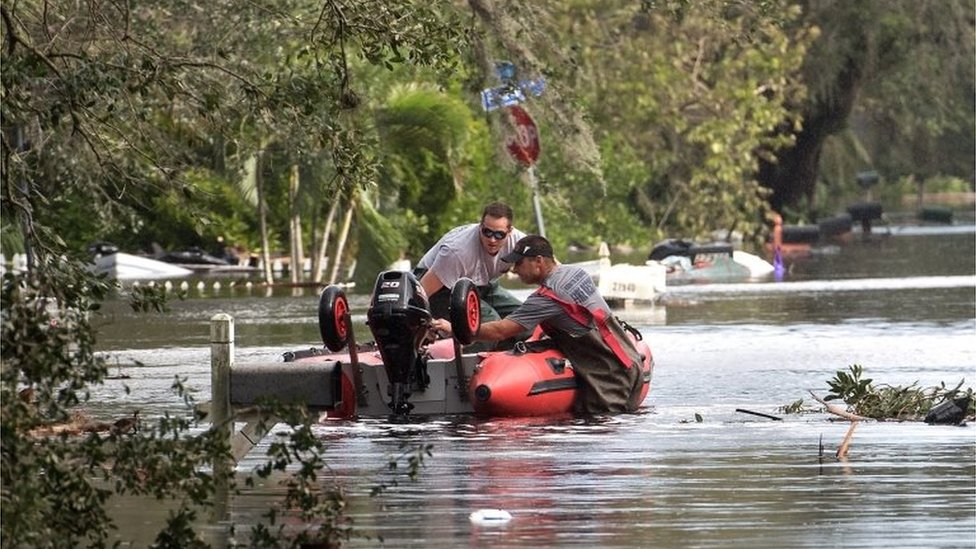
Relief operations are under way in Florida, as the extent of the damage from Hurricane Irma becomes clear.
More than 6.5m homes – two-thirds 62% of the state – are without power. Many parts of the state have been flooded
The islands of the Florida Keys and western parts of the state bore the brunt of Irma – which hit the state as a category four hurricane on Sunday before weakening to a tropical storm.
Media reports link at least four deaths to the storm in the Florida.
It cut a devastating track across Caribbean islands, killing at least 37 people there.
Florida Governor Rick Scott said it was “going to take some time” before people could return to their homes, the Miami Herald website reports.
Speaking as he went on an aerial tour of the Keys to survey the damage early on Monday, he said: “Power lines are down throughout the state. We’ve got roads that are impassable, so everybody’s got to be patient as we work through this.”
Image copyrightReutersImage caption Before and after in Brickell, Miami
All eyes on the Keys
By Jane O’Brien, BBC News, Miami
Miami dodged a bullet by and large. The eye of the storm did not hit the city but it did wallop the Florida Keys, of course, and that is where the concern is now.
Communications were pretty bad even on Friday. A number of people who had fled the Keys and checked into our hotel were struggling to keep in touch with relatives who had decided to stay behind.
Reports say that 10,000 people decided to ride out the storm. We do not know what state they are in now.
The first job rescue services will have to do is to test the integrity of the 42 bridges linking the Keys. If one of those is down, it could cause problems because it could strand any one of the islands.
The entire Keys are closed. There is no way of getting in there at the moment while the authorities assess the damage.
Media playback is unsupported on your device
Media captionHow badly did Irma hit the Florida Keys?
How big will the disaster response be?
Although Miami was spared the brunt of the storm, large parts of the city are under water. Winds have snapped power lines and 72% of homes there are without electricity, officials say.
On the west coast of Florida, drone footage from Naples, a town on the coast of the Gulf of Mexico about 125 miles (200km) to the north-west, shows rows of shattered suburban homes on streets under water.
President Donald Trump has released emergency federal aid for Florida, describing the hurricane as a “big monster”.
Funds will be needed to care for victims, clean up debris, restore power, and repair damage to homes and businesses.
Martin Senterfitt, emergency management director for Monroe County, said a huge airborne mission was in the works, the Miami Herald reports.
“Disaster mortuary teams”, he said on Sunday, would be dispatched to the Keys, which are part of Monroe.
Image copyrightReutersImage caption A number of fatal car crashes in Florida are being linked to the storm
Media captionAmateur footage shows flooding in central Miami
Which areas were hit before Florida?
Irma is the most powerful Atlantic storm in a decade, and caused widespread destruction on several Caribbean islands:
Cuba: at least 10 people were killed by the storm on the island, officials say. Electricity is out across the capital, Havana
Image copyrightAFPImage caption Parts of the Cuban capital Havana are under water
St Martin and St Barthelemy: Six out of 10 homes on St Martin, an island shared between France and the Netherlands, are now uninhabitable, French officials say. They said nine people had died and seven were missing in the French territories, while four are known to have died in Dutch Sint-Maarten
Turks and Caicos Islands: Widespread damage, although extent unclear
Barbuda: The small island is said to be “barely habitable”, with 95% of the buildings damaged. Antigua and Barbuda Prime Minister Gaston Browne estimates reconstruction will cost $100m (£80m). One death has been confirmed
Anguilla: Extensive damage with one person confirmed dead
Puerto Rico: More than 6,000 residents of the US territory are in shelters and many more without power. At least three people have died
US Virgin Islands: Damage to infrastructure was said to be widespread, with four deaths confirmed
Haiti and the Dominican Republic: Both battered by the storm, but neither had as much damage as initially feared
Media playback is unsupported on your device
Media captionIrma continues to affect Florida
Another hurricane, Jose, has been weakening over the western Atlantic, with swells due to affect parts of Hispaniola (the island split into Haiti and the Dominican Republic), the Bahamas, and the Turks and Caicos Islands, later this week.
Are you in the region? Are you a holidaymaker unable to get a flight home or a resident who has been preparing for Hurricane Irma? If it is safe for you to do so, share your experiences by emailing haveyoursay@bbc.co.uk.
Please include a contact number if you are willing to speak to a BBC journalist. You can also contact us in the following ways:
Nigeria’s Defense Headquarters have condemned a recent publication against the Nigerian Air Force operations in the northeast.
The report captioned “How Nigerian Air Force’s failings allegedly prolonged war against Boko Haram” was published in an online platform on September 7th, 2017.
According to a statement by the Director Defence Information, Major General John Enenche, the report is untrue and a deliberate misinformation of the public about the Nigerian Air Force in particular and the Armed Forces of Nigeria in general.
“The Armed Forces of Nigeria trained and have always operated jointly to achieve set objectives under a coordinated command and control centre which is the Defence Headquarters. Against this backdrop, it is not possible for a single service or component to frustrate or derail the aim of the Armed Forces of Nigeria.
“Therefore, the ill motivated publication against the Chief of Air Staff and the Nigerian Air Force should be disregarded. It is worthy to point out clearly that, the Nigerian Air Force has lived up to its expectation in the North East, alongside the Nigerian Army and Navy for the successes recorded against Boko Haram.
“The Air Force like the Army and Navy were not left out of the commendation given to the Chief of Defence Staff on the fight against Boko Haram by the United States of America secretary of state, on 22 March 2017 in New York.
“Consequently, Defence Headquarters hereby confirm to the general public that the Nigerian Air Force has never failed in its tasks against Boko Haram Terrorists in the North East. Collectively, the Armed Forces of Nigeria will continue to work relentlessly to make Boko Haram activities in the North East history in record time,” the statement noted.
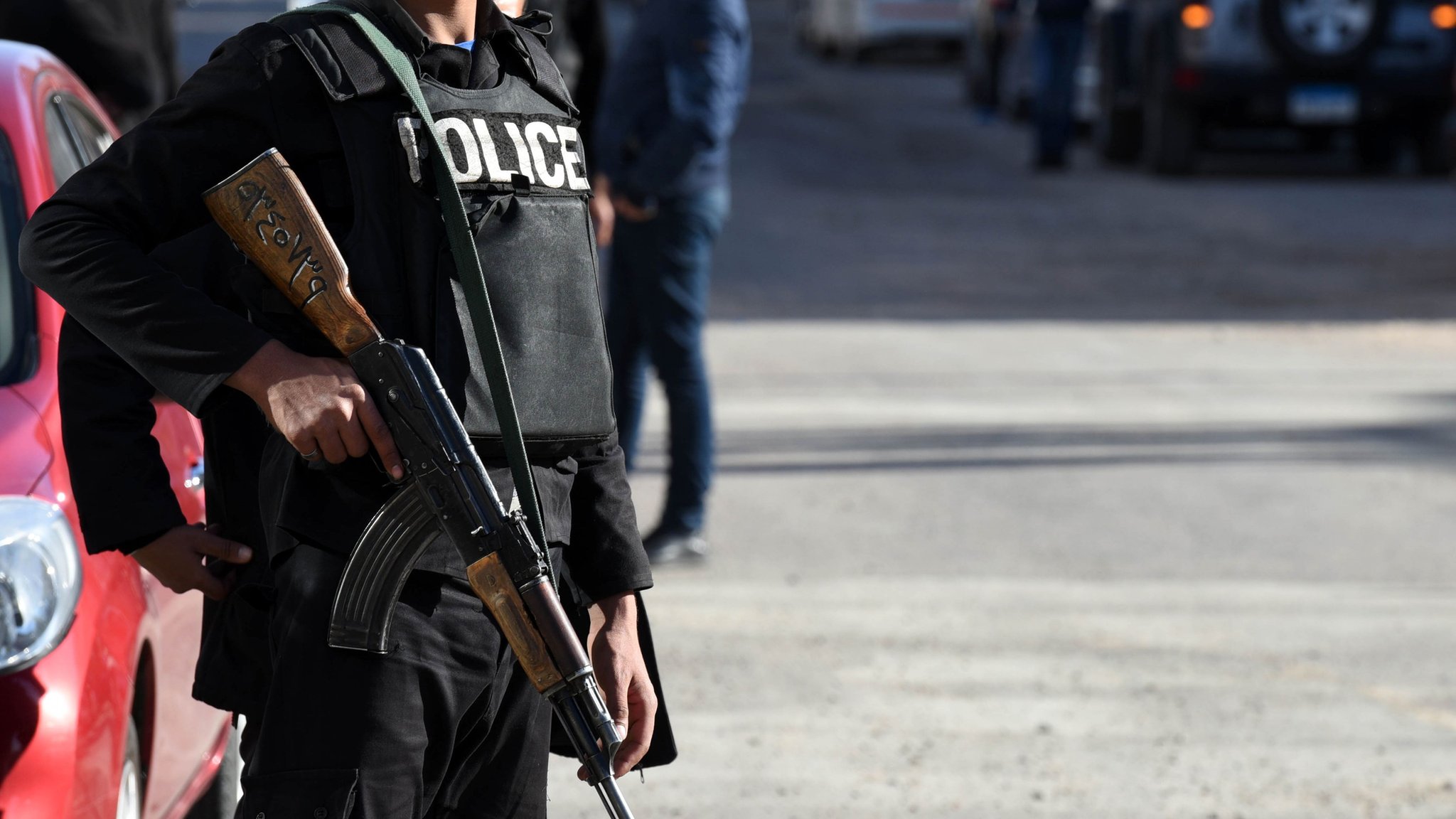
At least 18 policemen have been killed in an attack on a convoy in Egypt’s Sinai peninsula claimed by so-called Islamic State, security sources say.
Militants detonated a roadside bomb near the town of el-Arish, reportedly destroying three armoured vehicles and a fourth with signal-jamming equipment.
They then opened fire with machine guns at survivors of the blast.
The interior ministry confirmed there had been an attack and that several policemen had been killed or injured.
Hundreds of soldiers and police have been killed by militants affiliated to IS since 2013, when the Egyptian military overthrew Islamist President Mohammed Morsi.
The jihadists have also killed dozens of people in attacks targeting Egypt’s Coptic Christian minority elsewhere in the country, and claimed it planted the bomb that brought down a plane carrying tourists in Sinai in 2015, killing 224 people on board.
In Monday’s attack, the police convoy was travelling along the road between el-Arish and Qantara when a suspect vehicle tried to break through it, according to an interior ministry statement.
“When police forces dealt with the vehicle, it exploded and caused damages to the patrol’s vehicles,” it added. “This was followed by a shootout between the police officers and the terrorists, resulting in the death and injury of several policemen.”
It did not provide any casualty figures, but the attack appears to have been the deadliest on security forces in Sinai since July, when at least 23 soldiers were killed in a suicide car bombing that targeted a checkpoint near the Gaza border.
IS claimed it was behind the attack via its news agency Amaq.
It comes a day after the interior ministry said security forces had killed 10 suspected militants in a shootout during a raid on two apartments in Cairo.
Investigators had received information about militants travelling from northern Sinai to the capital to prepare for attacks on neighbouring provinces, it added.
This story is auto-generated from ‘BBC News’ syndicated feed and has not been edited by Africa Prime News staff.

 Aminu Saidu of Zaria Golf Club has emerged winner of the Nigerian Breweries 2017 Jaji Golf Championship Tournament.