Home Blog Page 1498

Africa’s Economic Giants Face Increasing Competition From Upcoming Kenya And Ethiopia

0
Africa Map
Africa Map

New Africa Risk-Reward Index provides investors with a synthesis of risks and opportunities across the African continent

Africa’s economic giants, Nigeria, South Africa and Egypt, have been stumbling recently. Rising security risks and political instability in Egypt, economic downturn and militancy in Nigeria and escalating political risks in South Africa led to doubts whether the balance between risks and opportunities in these markets is still favourable for businesses.

Despite recent recovery in Nigeria and South Africa, Kenya and Ethiopia might soon outshine these heavy-hitters in the competition for investment, according to the newly released Africa Risk-Reward Index developed by Control Risks (www.ControlRisks.com) and Oxford Economics. Key findings of the report:

·  Nigeria and its energy sector are too big to lose their appeal – the country’s reward score is 6.0 (out of 10), ahead of South Africa and Egypt. Nigeria’s charms, however, fade against a risk score of 7.3 (out of 10), as President Muhammadu Buhari’s government struggles through its first term. A fall in oil prices and lower production due to insurgent attacks in the Niger Delta have slashed growth from 6.3% in 2014 to 2.7% in 2015 followed by a sharp contraction of 1.6% last year. Economic indicators for this year are more favourable, but still the report forecasts a real GDP growth of only 1.1% in 2017.

·  South Africa’s risk score of 5.0 remains below the region’s average, but the reward score of 4.6 is also low. Whilst the country enjoys a deserved reputation as Africa’s pre-eminent constitutional democracy, several of its key institutions have gradually weakened over the past decade. Economic prospects are closely linked to the outcomes of the ANC’s national conference in December. The forecasted real GDP growth of 0.5% for 2017 is below population growth and certainly insufficient to reduce South Africa’s staggering 27.7% unemployment rate.

·  Egypt will test the most ardent optimist. President Abdul Fatah al-Sisi’s political position is stable, despite a series of economic and security challenges, reflected in the country’s risk score of 6.0. Socio-economic grievances, a government crackdown on opposition and Islamist groups and persistent militancy will continue to have an impact on the business environment. The tourism sector remains depressed. The country’s reward score of 5.5 reflects the measures the government has taken since mid-2016 to address its fiscal problems. Real GDP growth is expected to slow in 2017 (to 3.8%, from 4.3% in 2016) owing to a slowdown in government and private consumption.

·  Ethiopia outperforms every African peer with its high reward score of 8.0. Notably, it attracted $3.2bn of foreign direct investment in 2016 – more even than Nigeria, and double the figure for Morocco. The East African nation is one of Africa’s fastest growing economies and continues to offer strong prospects. Growth averaged 10% from 2010 to 2015 and although 2016 growth was slower at 6.5% the expansion remains impressive. However, the omnipresent role of government in the economy raises concerns relating to public sector efficiency and financial management. External debt is expected to increase to 38.7% of GDP by the end of this year, leading to a risk score of 5.8.

·  Kenya has achieved a period of strong GDP growth amid relative political stability: real GDP growth averaged at 6.0% in 2010-16. The 2017 growth forecast is at 5.4%. The country’s reward score is 6.7. A well-educated workforce and an innovative service sector, the government’s continued investments in upgrading critical national infrastructure, and deepening integration with its neighbours through the East African Community (EAC) all allow the country to act as a gateway into the larger East Africa region. Current fiscal concerns and a political system that remains closely tied to ethnic affiliation contribute to a risk score of 5.6 and reflects considerable room for improvements.

Paul Gabriel, Senior Analyst for Africa at Control Risks and lead-author of the report says, “Experienced investors – not only in Africa, but around the world – know that risk and reward are close companions. While no serious investor should overlook the economic giants of the continent, real competitive edge can only be achieved when investors manage to stay ahead of the pack in knowing what’s next. The Africa Risk-Reward Index helps investors to identify some of the more hidden investment opportunities in times where the heavy-hitters are struggling.”

Source: APO

Report On 2017 Morocco-Gabon Forum In Rabat [Video]

0

Moroccan and Gabonese economic players are attending the Morocco-Gabon Forum 2017 whose main purpose is to contribute to the consolidation of economic and trade exchanges between Libreville and Rabat. The meeting holds between 14th and 15th of September, in Rabat, Morocco,

Gabon shared its desire to see Morocco become a special business partner and establish their relationships as a model of South-South cooperation.

Gabon wishes to invest $21 billion in the years ahead to upgrade its infrastructures and support diverse poles of growth away from oil industry.

St Louis officer cleared in shooting of Anthony Lamar Smith

0
Jason StockleyImage copyright Reuters
Image caption Former officer Jason Stockley moved to Houston, Texas after resigning from St Louis police in 2013.

A white former Missouri policeman has been found not guilty of murdering a black man by shooting him five times after a car chase.

A judge acquitted Jason Stockley of first-degree murder over the 2011 shooting of 24-year-old Anthony Lamar Smith in the city of St Louis.

Mr Stockley, 36, was recorded during the pursuit saying: “Gonna kill this [expletive], don’t you know it.”

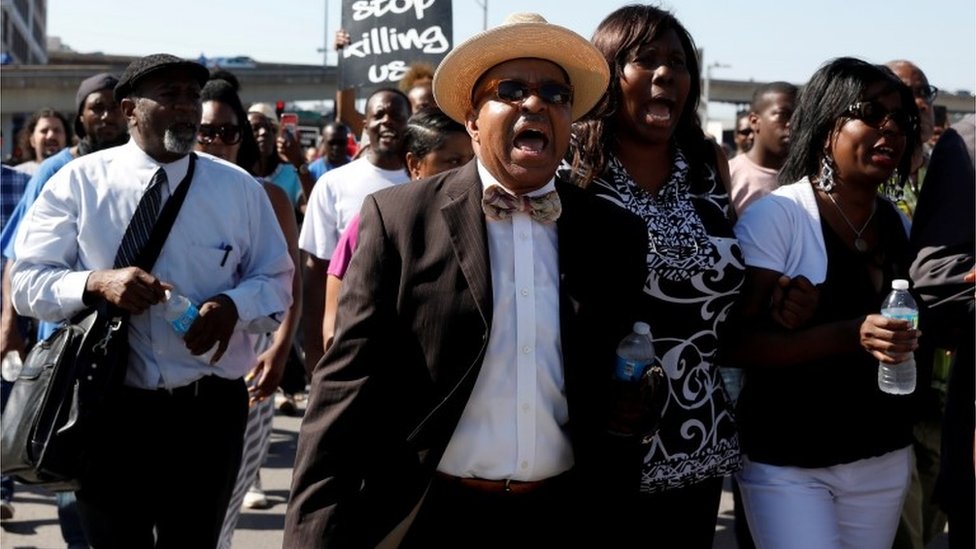
Demonstrators have taken to the streets following the verdict.

At least one protester has been arrested outside court, and several protesters were pepper sprayed after officers say they were attacked with thrown objects.

Missouri Governor Eric Greitens said earlier this week the state’s National Guard had been activated to safeguard city residents and property.

The Republican said the step was “a necessary precaution”.

Image copyright CBS
Image caption Lamar Smith had failed to follow police commands, the former officer’s attorney argued in court.

Mr Smith was a new father and engaged to be married when he was killed on 20 December 2011.

Mr Stockley and his partner said they believed they had observed Mr Smith engaged in a drug deal outside a fried chicken restaurant near central St Louis.

Police dashcam video and surveillance footage shows Mr Smith reversed his car into the police vehicle twice during his attempt to drive off.

After a three-minute high-speed car chase, Mr Stockley told his partner, who was in the driver’s seat, to ram Mr Smith’s car.

Mr Stockley then ran to Mr Smith’s window and fired five shots, hitting him each time.

Image copyright Getty Images
Image caption Police blocked protesters from entering the highway to disrupt traffic

The former police officer chose a bench trial rather than a jury.

St Louis Circuit Judge Timothy Wilson wrote in Friday’s ruling: “This Court, in conscience, cannot say that the State has proven every element of murder beyond a reasonable doubt, or that the State has proven beyond a reasonable doubt that the defendant did not act in self-defense.”

St Louis Circuit Attorney Kimberly Gardner said she was “disappointed” with the judge’s decision.

Prosecutors also accused Mr Stockley of planting a gun in Mr Smith’s car after shooting him.

The .38 calibre revolver recovered from the Buick had Mr Stockley’s DNA on it, but not Mr Smith’s.

Prosecutors questioned why Mr Stockley had rummaged through the boot of his police patrol car immediately after the shooting, before returning to Mr Smith’s car.

Image copyright Reuters
Image copyright Getty Images

Mr Stockley said he was retrieving some equipment to administer first aid.

Defence lawyers said Mr Stockley had acted “reasonably” in self-defence by killing a drug suspect he believed was reaching for a hidden handgun.

Only Mr Smith’s DNA was traced on a plastic bag of heroin that was also found in the car.

The St Louis Metropolitan Police Department initially deemed the killing justifiable.

But the investigation continued and Mr Stockley was charged last year after prosecutors cited unspecified new evidence.

He quit the force in 2013 and now lives in Houston, Texas.

The Board of Police Commissioners settled a wrongful death lawsuit in 2013 with Mr Smith’s family for $900,000 (£663,000).

Mr Smith’s fiancée has urged the community to avoid violence.

“However it goes, I ask for peace,” Christina Wilson told a news conference this week alongside the governor.

The case has inflamed racial tensions in St Louis, which has one of the highest murder rates in the US.

Rioting erupted in 2014 in nearby Ferguson, Missouri after the fatal police shooting of an unarmed black teenager, Michael Brown.

Note: This story is auto-generated from BBC syndicated feed and has not been edited by AFRICA PRIME NEWS

Special: Shortage of Child Spacing Commodities In Public Hospitals Hamper Uptake Of Services In Kaduna Communities

0
FP Commodities
Child Spacing Consumables

By Amos Tauna

No doubt, uptake of child spacing services has increased in Kaduna State, thanks to effort of organisations like the Nigerian Urban Reproductive Health Initiative (NURHI), which took upon itself the task of creating awareness and ensuring that people understand how the practice improves the chance of women to survive from pregnancy related deaths.

This has created demand in Kaduna state, leading to massive turn out, especially in the 73 facilities spread across 15 local government Areas of the state.

A recent visit by journalists to some of the Primary Healthcare Centres (PHCs), and General Hospitals reveals that there is shortage of commodities, i.e. pills, condoms, implants, IUDs, for women to access, in order to space their births.

The state government has provided N100 million naira in this year’s budget, but till date no item has been procured for the women who want to access the service.

At PHC Kafanchan, in Jema’a LGA, the demand of consumables for effective maintenance of child spacing has outweighed the supply – leaving the women to return home without accessing service.

The Family Planning service provider, Patience Nuhu Akapson, expressed delight that the family planning unit in the centre renovated by NURHI has further encouraged couples to embrace and ensure the maximum use of the facilities, stressing that the number of women coming for child spacing has increased.

AFRICA PRIME NEWS however discovered that in circumstances where there is shortfall of the consumables, patients have to go back home disappointed, or purchase same from a private vendor, while those who could not afford would remain unassisted.

At the Sir Patrick Ibrahim Yakowa Memorial General Hospital, Kafanchan, the Medical Director, Dr. Gyawiya Gajere, commended NURHI for equipping the family planning unit with all the necessary equipment.

“The coming of NURHI to the hospital has further enhanced our service delivery, especially with special attention to women in child spacing.

NURHI furnished the office given to them and all the necessary consumables required for full uptake.

“You can see for yourselves that a unique place was chosen for the family planning, so that women will not be distracted, but to ensure they have a free and conducive environment that will take care of their needs,” he explained.

The Family Planning service provider, Gunatu Kure, assured that the centre has capacity to offer all methods and handle complain from any woman as regards child spacing.

She explained that even before the coming of NURHI, couples have embraced child spacing, pointing out that since November last year when NURHI provided the necessary facilities to the hospital, there has been a massive number of women coming to the hospital on daily basis for all types of implants.

Shortage of commodities have continued to affect uptake of services in most facilities where child spacing services are rendered.

The Jema’a experience is the same as obtained in public health facilities in Soba, Giwa, Kaduna North, Kaduna South, and Chikun, among LGAs visited recently.

Communication Officer of Family Health Advocates in Nigeria Initiative (FHANI), Hauwa Saulawa, says, their NGO has been advocating for the timely release of N100 million provided in the 2017 Kaduna State budget for procurement of child spacing commodities and consumables, aimed at providing items for women to access the service.

She said women in the state have been coming to facilities for service, but they were made to pay between N300 – N500 to access service. This according to her has been discouraging them from going for the services.

“We have recently been conducting town hall meeting with NURHI to encourage more women to space their birth, to reduce the high rate of maternal deaths in the state,” she said.

In a chat with AFRICA PRIME NEWS, the Kaduna State Team Leader of NURHI, Kabir Abdullahi, said their model adopted working with religious and traditional rulers to generate demand.

“We have also supported the state government in training of service providers. We didn’t just renovate facilities, we made sure there are people capable of rendering service in all the facilities we are working with.

“Go to all the facilities where we have carried out intervention and trained workers, you will notice high volume of women coming for service. They are confident of the service providers to provide them with the service,” he said.

Kaduna state government must rise to the occasion of providing commodities and consumables for women in the state.

All child spacing commodities are supplied free of charge to the state government by the Federal Government and UNFPA for use, yet women have continued to purchase commodities and consumables to access service.

There is need for government to expedite action and procure needed items to save more women, especially in Kaduna state, where over 1,000 women die out of every 100,000 delivering children in the state.

Iliya Kure contributed to this report.

What is behind clashes in Ethiopia’s Oromia and Somali regions?

0
Image caption At least 30,000 people have fled their homes

Thousands of people have fled Ethiopia’s Somali region following deadly clashes in recent days between ethnic Somalis and Oromos. The BBC’s Kalkidan Yibeltal looks at the cause of the conflict and whether it can be stopped.

Dozens of people are reported to have died in clashes across Ethiopia’s Oromia and Somali regions in recent days.

According to Adisu Arega, Oromia government’s spokesperson, 18 people have been killed.

Twelve of those victims are ethnic Somalis, Mr Adisu told the BBC.

The figures are however disputed by the Somali regional government, which says that more than 30 ethnic Somalis have been killed in the Oromia town of Awaday.

The clashes have displaced at least 30,000 people, some of whom have taken refuge in makeshift camps at a stadium in the eastern city of Harar, whilst others are camping at police stations.

Local administrators have now asked aid agencies operating in the area to provide humanitarian assistance.

How serious is the trouble?

Following intense anti-government protests that plagued the Horn of Africa country during most of 2016, the government imposed a 10-month state of emergency, which was lifted in July.

While this heightened state of alert calmed most of the restive areas in the Oromia region, it did not stop cross-border clashes in the Oromia and Somali areas.

Image caption Ethiopia’s ethnic-based borders have been fuelling conflict between the two communities

In February and March, hundreds were reported to have been killed in the southern Oromia district of Negele Borena after an incursion by a paramilitary force called the Liyu Police, which is backed by the Somali region.

Ethnic Oromos allege that the Liyu Police, which has previously been accused by rights groups of human rights violations, of being behind the current attacks.

The Somali regional government has however rejected the allegations and charged that senior officials in the Oromia government were sympathisers of the Oromo Liberation Front, which is categorised as a terrorist organisation by the Ethiopian government.

While conflicts have been common between the two bordering communities, the public finger-pointing by top regional officials is unprecedented and could exacerbate the current conflict.

“We don’t believe this is expected from a responsible senior government official,” Communication Minister Negeri Lencho told the BBC.

Ethiopia’s political arrangement – federalism structured along ethno-linguistic lines – dictates that ethnic borders are also usually political ones.

Critics argue that this structure is a tinder box that allows minor conflicts to escalate.

What is behind the conflict?

Oromia and Somali are, respectively, the two largest regions in the country by area size, sharing a border of more than 1,400 km (870 miles).

While Somalis are mostly pastoralists, living from their animals, Oromos tend to be farmers, as well as pastoralists.

Both communities inhabit the areas around the regional border.

Historically, their relationship has been characterised by territorial competition which often leads to disputes and conflicts over resources, including wells and grazing land.

These conflicts can cause the displacement of tens of thousands of people.

In 2004, a referendum to decide on the fate of more than 420 kebeles – the country’s smallest administrative unit – gave 80% of them to Oromia.

Following the outcome, tens of thousands of ethnic Somalis reportedly fled the areas for fear of repercussions.

The decision has still not been implemented and this is one factor behind the current conflict.

Will the clashes spread further?

Since the two communities are largely pastoralist and cross borders in search for pasture for their animals, it is difficult to clearly demarcate their boundaries.

Image caption Thousands of people are living in makeshift shelters

Additionally, clashes that occur between the two communities can easily spread to neighbouring regions and countries because of shared ethnic ties.

The recent conflict has reportedly inspired the killing of two Ethiopians of Oromo origin in Hargeisa, capital of the self-declared republic of Somaliland.

People are reportedly trying to escape the violence by fleeing to the Kenyan town of Moyale, which also has a history of Oromo-Somali conflict.

Ethiopia’s communication minister told the BBC that the military and federal police forces had intervened to control the clashes.

But it is not clear whether this will be enough to prevent the conflict from spreading.

This story is auto-generated from ‘BBC News’ syndicated feed and has not been edited by Africa Prime News staff.

Nigeria: Presidential Committee Distributes Items To IDPs In Gombe

0
Executive Chairman of Gombe SEMA, Dr. Danlami Arabs Rukuje, Distributing the Items to IDP beneficiaries.

By Auwal Mohammad, Gombe

Executive Chairman of Gombe SEMA, Dr. Danlami Arabs Rukuje, Distributing the Items to IDP beneficiaries.

Nigeria’s Presidential Committee on Northeast Initiative (PCNI) has commenced distribution of food items to the 83 internally displaced persons in Gombe state with advise to beneficiaries to take the situation as an act of God and draw nearer to Him.

The Executive Secretary of the State Emergency Management Agency, Danlami Rukujei while presenting the items to the IDPs resident at Gona Community, in Akko local government area of the state urged beneficiaries not to sell the items, adding that about 1,000 persons would be benefitting from the items.

“Hopefully by Monday, the exercise will continue with people from Tumu/Pindiga axis until the materials we have is exhausted,” said the SEMA Executive Secretary.

The items distributed include 25kg bags of rice, millet, beans, sugar, vegetable oil, wax print, plates, mats, blankets, buckets, babies’ toiletries, and cartons of noodles.

Beneficiaries of PCNI Items to IDPs in Gona village, Akko LGA of Gombe State

Similarly the State Emergency Management Agency has distributed additional relief materials comprising food items and building materials to victims of recent floods and communal clashes that affected communities in Billiri Local Government Area.

Rukujei handed over items to the paramount ruler in the area, the Mai Tangale, Abdu Buba Maisharu II, for onward distribution to 15 households affected by communal clash in Kufai – Billiri LGA.

The brief ceremony took place on Friday at the palace of the traditional ruler.

He explained that the food items came from the state government while the building material was supplied by the Presidential Committee on North East Initiative (PCNI).

Biafra: Exercise Restrain For Peaceful Coexistence In Nigeria, JNI Warns Northerners Against Reprisal

0
Map of Nigeria
Map of Nigeria

By Amos Tauna

Jama’atul Nasril Islam (JNI) has warned Muslim youths and other Northerners against reprisal over the incident in Abia State, but to exercise restrain for the overall peaceful coexistence of the country.

JNI Secretary General, Khalid Abubakar Aliyu, in Kaduna, northwest Nigeria on Friday called on Juma’at Mosque Imams across the country, particularly in the North, to preach peace in their Friday sermon and understanding among Nigerians.

Aliyu who raised the issue while briefing newsmen, urged Southeast leaders to equally call on members of IPOB to preach peace, unity and understanding among Nigerians to stop attacking innocent people in their region.

He also urged security agents to ensure they arrest and bring the perpetrators of the attacks on Northerners to face the wrath of the law.

“Nigerians need to take lessons from crisis happenings in other countries of the world. Violence will never be a solution to any crisis. It’s also needless for any Nigeria to feel he is more Nigerian than other Nigerians.

“We must learn to live together in peace and harmony because we are bound by the Constitution of this country. JNI urged all juma’at Imams to preach peace in their sermons by calling for peace and to urge people not to retaliate, ” he said.

The JNI also described the attacks on Northerners in Abia state as pathetic, urging government and security agencies to restore peace in the state.

He also urged media practitioners to desist from reporting hate speech and biased reports capable of inciting people.

Angola’s ‘suitcase traders’

0

The entrepreneurial Angolan women travelling to Rio de Janerio and Sao Paulo in search of Brazilian clothes to bring home and sell. Note: This story is auto-generated from BBC syndicated feed and has not been edited by AFRICA PRIME NEWS

Currency Exchange Rates

USD - United States Dollar
ZAR
0.06
EUR
1.17
CAD
0.73
ILS
0.31
INR
0.01
GBP
1.34
CNY
0.14
Enable Notifications OK No thanks