A Coalition of Youth groups from Southern Kaduna senatorial zone in northern Nigeria has declared its support for the incumbent Senator, Danjuma La’ah, for a second term in office come 2019.
The coalition consisting of students, artisans and traders, observed that Senator La’ah, has laid a solid foundation for his constituency and needed to bring his laudable projects to completion beyond 2019.
Spokesman of the groups, Christopher Jatau, while briefing newsmen in Kaduna Thursday, noted the ground breaking achievements of the Senator as fundamental reasons for their unalloyed support.
He said, “Senator La’ah’s record breaking achievements are numerous. He has sponsored a bill seeking to upgrade College of Statistics, Manchok to a University which has passed first reading, awaiting second hearing before approval.
“He has secured licence to operate the National Open University programme in Kagoro. He has also secured approval for the building of Police Primary School in Kafanchan and Police Secondary School in Tum.
“He purchased and distributed pick-up-vans, motorcycles and sophisticated security gadgates in the eight local government areas amid security challenges. He purchased and distributed hospital equipment to boost rural healthcare in his senatorial district, and the purchased and distribution of over fifty transformers in the area.
“Given this background, the endorsement of Senator La’ah for a second term in office is necessitated by his various achievements, as such, he needs our support to continue the good works he has started.
“If we must grow politically, experience of the candidate and his achievements are supposed to be our collective basis for assessing a candidate rather than intangible and political considerations like ethnic, religious and party affiliation.”
With the ongoing agitations and clamoring for nationhood by different factions in Nigeria, Nigerians have been called upon to kindle the spirit of nationalism and patrotism for a united country.
“Our differences are not insurmountable, in our core we are all the same,” said President of Zamani Foundation, Philomena Talatu Henry, at a One-Day Workshop in Kaduna on effects of crisis/war.
She lamented that many people know that war is bad but they do not know how bad the reality is. “It is said that over 2 million people died in the Nigerian civil war. The result of war is always death and destruction,” she explained.
The Counsellor to governor El-Rufai of Kaduna State on Information and Communication, Saidu Adamu, said Nigerians should not allow their personal interest be a stumbling block to the general interest of the public. “It is time we start thinking of what will move us forward for the peace, unity and development of Nigeria, ” he added.
He lamented that war has become part of man because of greed. “We are so self centered in dealing with one another leading to war. Nigeria problem has been the issue of marginalization. Our elders always keep quiet until it is too late and we allow war to start because of our own gains.”
Mr. Saidu observed that Kaduna has had it share of religious and political crises destroying lives and property worth unimaginable amount caused by the elites, adding that it was time for the people. !le irrespective of their differences to walk for peace and harmony for the overall development of the state.
He noted that crises include mass destruction of cities and have long lasting effects on a country’s economy, pointing out that armed conflict has direct negative consequences on infrastructure, public health provision, and social order.
Goodwill messages from different partners noted that the time for the workshop was apt, stressing that what Nigerians needed was for proper understanding of their common goal of ensuring that nothing divide them as the only weapon they could use to fight their common enemy.
Ten Journalists from selected media houses in Ghana are currently undergoing a 10-day intensive training to report on transparency and accountability in the oil and gas sector. The training started from 24th September till the 3rd of October 2017.
According to the Executive Director of Penplusbytes, Kwami Ahiabenu II, the project is aimed at increasing transparency and accountability in the sector through effective public oversight on oil and gas revenue management and the media plays a leading role in making this possible.
“The oil and gas sector is often perceived as a very technical sector but this can only be debunked if the media simplifies and gives prominence to the sector issues. Penplusbytes, with its years of experience in media training is poised to deliver this training to reflect our key goal of promoting good governance”, he added.
“By the end of the project, it is expected that oil and gas issues will become a headline topic in the media landscape and journalists will be at the forefront of providing relevant content for civil society and citizens to hold duty bearers to account in the advocacy towards good governance in the sector transparency, accountability and good governance over the oil and gas sector revenue would have increased for the development of Ghana,” he explained.
He added that Penplusbytes with support from Ghana Oil and Gas for Inclusive Growth (GOGIG), the training forms part of activities under the 6-month “Enhancing the role of the Media in promoting Oil and Gas sector transparency and accountability” project Penplusbytes is implementing.
He noted that a significant portion of Ghana’s budget is funded by proceeds from the oil and gas sector, hence the need for Ghanaian media to constantly demand transparency and accountability in the oil and gas sector.
The training programme, according to him, is designed to provide a holistic and comprehensive support to the selected journalists through specialized knowledge and skills on professional mentoring; field trips; innovative use and application of data journalism skills; access to sources and vital information.
Part of the training activities is power reporting series and networking session which would bring together peers, experts, policy makers, and oversight actors in the oil and gas sector to interact and network with the selected journalists.
The journalists on training would be provided bursaries to undertake individual field trips to oil and gas funded projects to generate impactful stories aimed at promoting transparency and accountability in the sector.
Gombe (Nigeria) — Department of Petroleum Resources (DPR) of the Nigerian National Petroleum Corporation (NNPC) in Gombe northeast of the country has embarked on campaign on commencement of online registration and renewal of licenses to petroleum marketers, which starts in October.
The Zonal Operations Controller North-East Zone, Ali Idris Zoaka, disclosed Thursday, while speaking with Journalists in Gombe, saying, the purpose of the sensitization was to afford both the independent and major marketers the opportunity to brace-up themselves for online operations that will begin by October this year.
“We are going into the computer way of doing things, and it makes it easier, simple and shortens the time for the processing of applications. As long as one can go into the system and fill his information correct, it takes little time for us to make contact with the companies, and then go to the locations through the examination we have conducted. The applicant then gets the license quicker; they can even print out their licenses”.
He said that the manual operations may still continue beyond October, considering the short time that some marketers may have, to get acquainted with the technical process in the online operations.
Also speaking Gombe State Operations Controller, Abdullahi Abawa said many marketers in the State had exhibited shyness or ignorance in the process of the registration, hence the need for the sensitization.
He explained that some marketers are shy to approach the DPR on issues saying, “There is no need to be suspicious or develop cold feet, and DPR is free, friendly and always ready to assist”.
The marketers were also re-awakened on some observed lapses in their filling stations from the point of delivery, sanitation, under-dispensing of products to customers, as well as diversion among many others.
They were also taken through safety tips during dispensing of PMS.
Some of the major and independent marketers, who spoke to Journalists over the new development, welcomed it and promised to ensure compliance with the new process.
According to Chairman of the Major Marketers Association in the State, Mahmud Abdulfatah, many of his members are already compliant.
Gombe (Nigeria) — Nigerian churches under the support of Christian Council of Nigeria (CCN) has launched a campaign on against perpetuation of Violence Against Children in the country.
National President of CCN, Reverend Fubara Fubara-Manuel who was represented by the Gombe State Chairman of the Council, Venerable. Amos Chijioke disclosed this in Gombe northeast Nigeria, while presenting the Council’s reason for embarking on violence against children in Nigeria between September 18 and 24, 2017.
“We regret this as Christians and affirm, rather, that care for these children is no mere addition to our creeds, but an essential dimension to our being and calling as people of God,” he said.
He condemned a situation where extremists in the name of religion use children for suicide missions, use them as forced sex machines and enslave them into forced marriages; or people trafficking on children.
Venerable Chijioke said the state campaign would be pioneered from Balanga and Kwami local government areas before scaling up to others.
He said the world of shameless rape of infants and children, parents’ insufficient arrangements for the girl-child, policies that teaches men a false and ungodly masculinity over women and children, discriminate against women on the bases of gender is no longer tolerable.
“It is in this context that we have come together as Christians to sensitise on the evil of VAC and do all in our power to end it,” posited the CCN President.
The weeklong activities which began with press conference include: “Advocacy visit to community leaders in Kwami LG, workshop for church denominational leaders, rally in Gombe metropolis, dissemination/step-down workshop at Talasse in Balanga LG, dissemination/step-down workshop at Gelengu in Balanga LG and sermon on ending VAC on Sunday.”
CCN comprise of 14 denominations of churches, with seven of those denominations present in Gombe.
Image copyrightLucy VigneImage caption Dozens of shops sell thousands of items made of ivory in Laos, researchers have found
The fastest growing ivory market in the world is now Laos, according to an investigation by Kenya-based group Save the Elephants.
China is banning all ivory trade by the end of 2017, but business is booming in neighbouring countries.
Investigators visited a Chinese casino resort on the Mekong River.
They described a hub of gambling and prostitution, where ivory sales are booming among Chinese visitors who make up more than 80% of sales.
The researchers found dozens of shops selling thousands of items – carved tusks, ivory bangles, pendants and bracelets – openly for sale.
Image copyrightLucy VigneImage caption The Chinese casino resort in Laos
Like Vietnam and Myanmar, the prices are cheaper in Laos than on the Chinese mainland, and law and order is lacking – the report authors say – meaning the illegal cross-border trade is not policed.
“In the absence of effective law enforcement, the sales of ivory items to Chinese consumers will continue to rise,” said researcher Esmond Martin.
Tens of thousands of African elephants are killed every year for their tusks, and Chinese buyers are getting around a domestic ivory ban on the mainland by shopping in neighbouring countries.
International criminal syndicates are involved in ivory trafficking, which encourages, and is encouraged by, corruption across Africa.
The founder of Save the Elephants, Iain Douglas-Hamilton, says China’s decision to ban the domestic trade in ivory by the end of this year, and increased anti-ivory sentiment, has been hugely significant.
“But it’s not a panacea – it has to be reinforced now by bans in the peripheral countries, where those who still want to buy and trade ivory have nipped across the border and set up shop in neighbouring countries,” he said.
Save The Elephants said the growing retail market in Laos is the latest threat to African elephants.
The report’s lead author, Lucy Vigne, said Laos urgently needs to take steps to tackle this growing problem.
“With a lack of strong and continuing international pressure to curtail the trade in ivory in Laos and a lack of interest by the Laotian government, there has been a significant and relatively sudden growth in the ivory trade,” she said.
This story is auto-generated from ‘BBC News’ syndicated feed and has not been edited by Africa Prime News staff.
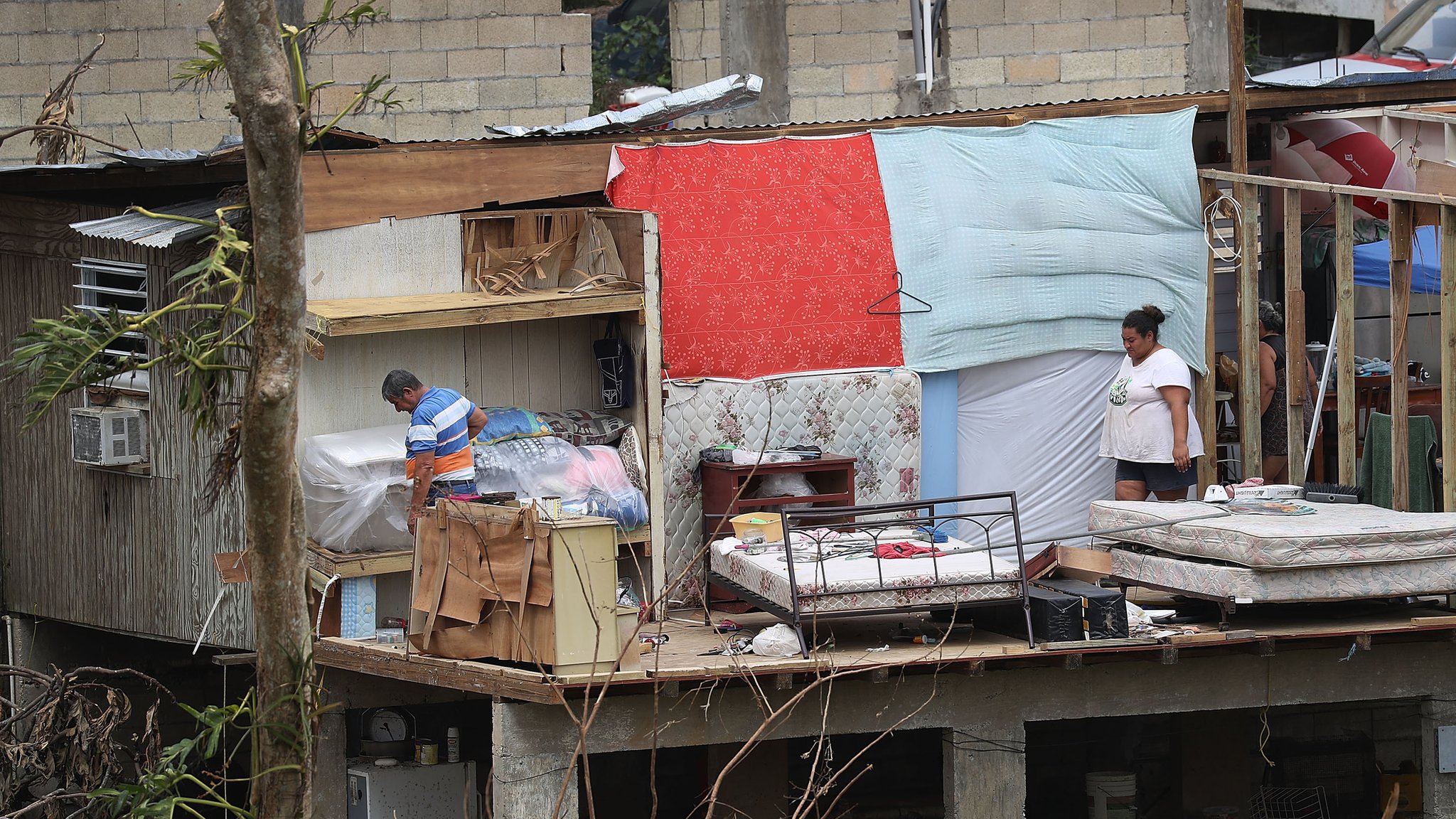
The most powerful hurricane to hit Puerto Rico in nearly 90 years, Maria swept across the island last Wednesday.
Image copyrightGetty Images
How bad is the situation on Puerto Rico?
Many of its 3.4 million residents have been without electricity, reliable drinking supplies and other basic necessities since the storm struck.
The death toll was not as bad as the scores killed by Hurricane Irma – Maria claimed more than 30 lives in the Caribbean, including at least 16 in Puerto Rico.
But Maria knocked out the US territory’s entire power grid, crippling its water and sewage treatment system.
More than 90% of cellular communication sites remain out of service, US officials say.
Puerto Rico, which gets most of its fuel by ship from the US, has been under petrol rationing since the hurricane struck.
Service stations have been able to stay open only a few hours at a time, while most hospitals lack power or fuel for their electrical generators.
Residents have been queuing for hours to get diesel fuel to power generators, and some have mobbed water-supply tankers.
One resident, Juan Cruz, told Reuters news agency as he filled a container from a water tanker: “We can use more help. We are US citizens. We are supposed to be treated equally.”
Ricardo Rossello, the island’s governor, has called its devastation an unprecedented natural disaster.
Media playback is unsupported on your device
Media captionUS Navy evacuates residents from storm-devastated Dominica
How is the US responding?
Federal emergency management officials and the US military have stepped up relief efforts as the scale of the island’s crisis has become clear.
The Federal Emergency Management Authority said it had delivered more than 4.4m meals and 6.5m litres of water to Puerto Rico and the US Virgin Islands by Wednesday.
But the transport of relief supplies has been hampered by roads rendered impassable by fallen trees or flooding.
The 1,000-bed US Navy hospital ship Comfort will arrive next week, after sailing from its home port in Virginia on Friday.
President Trump was criticised for spending the weekend focusing on a feud with NFL players and coaches, instead of the Puerto Rico disaster.
What is the Jones Act?
By waiving the Jones Act, the US will allow for more rapid delivery of aid to Puerto Rico.
The legislation, known formally as the Merchant Marine Act of 1920, requires goods ferried to US ports to be sent on ships that are built, owned and operated by Americans.
The regulation was created to promote the American commercial shipping industry.
But it has made the price of goods in Puerto Rico more expensive than those on the US mainland or other Caribbean islands.
The cost of living in Puerto Rico is also higher as a result.
Foreign goods must first be sent to the US mainland and transferred to American ships before they can be sent to US territories such as Puerto Rico.
This means aid from countries such as the nearby Dominican Republic cannot directly be sent to the devastated island.
The US waived the Jones Act during the recent Hurricanes Harvey and Irma to help ships quickly reach Texas and Florida.
Note: This story is auto-generated from BBC syndicated feed and has not been edited by AFRICA PRIME NEWS
Gombe (Nigeria) — A Church in the United States, Church of the Servant King, Gardena, California, is asking permission from the Nigerian Government to offer university scholarship to four Chibok girls from northeast part of the country, recently released by Boko Haram.
The four girls, though unnamed, were among the over 200 school girls kidnapped by Boko Haram, but recently regained their freedom.
The request was contained in a letter signed by its pastor, Richard Read, and addressed to the Minister of Women Affairs, Jummai Alhassan, through its Nigerian contact, Pastor Mercel Zamdai Sunny – a copy of which was made available to Journalists in Gombe on Wednesday.
The Church said it has finalized arrangement for the girls to gain admission into HOPE International University, Fullerton, California in time for the 2017/18 academic session.
The church said it is sponsoring the university education of the girls in order to give them hope and a better life.
“Back in the 70s and 80s, we sponsored 30 Cambodian people. We assisted them in assimilating and establishing new lives in a new world and lived in our homes with us. We believe this situation warrants the same kind of response.
“We are well prepared to love and care for these young women while they are in the US. Our prayers are that these four will achieve success to counterbalance the horror they went through with the Boko Haram,” part of the letter reads.
The church disclosed that a number of benefactors would offset all expenses for the girls to start their university education in the US.
The church said while the await the approval of the minister, they are authorizing their local church pastor in Nigeria, Pastor Zamdai, to “facilitate and navigate through the acceptance forms, the correct documents, the departure forms and paperwork.”

 A Coalition of Youth groups from Southern Kaduna senatorial zone in northern Nigeria has declared its support for the incumbent Senator, Danjuma La’ah, for a second term in office come 2019.