Home Blog Page 1450

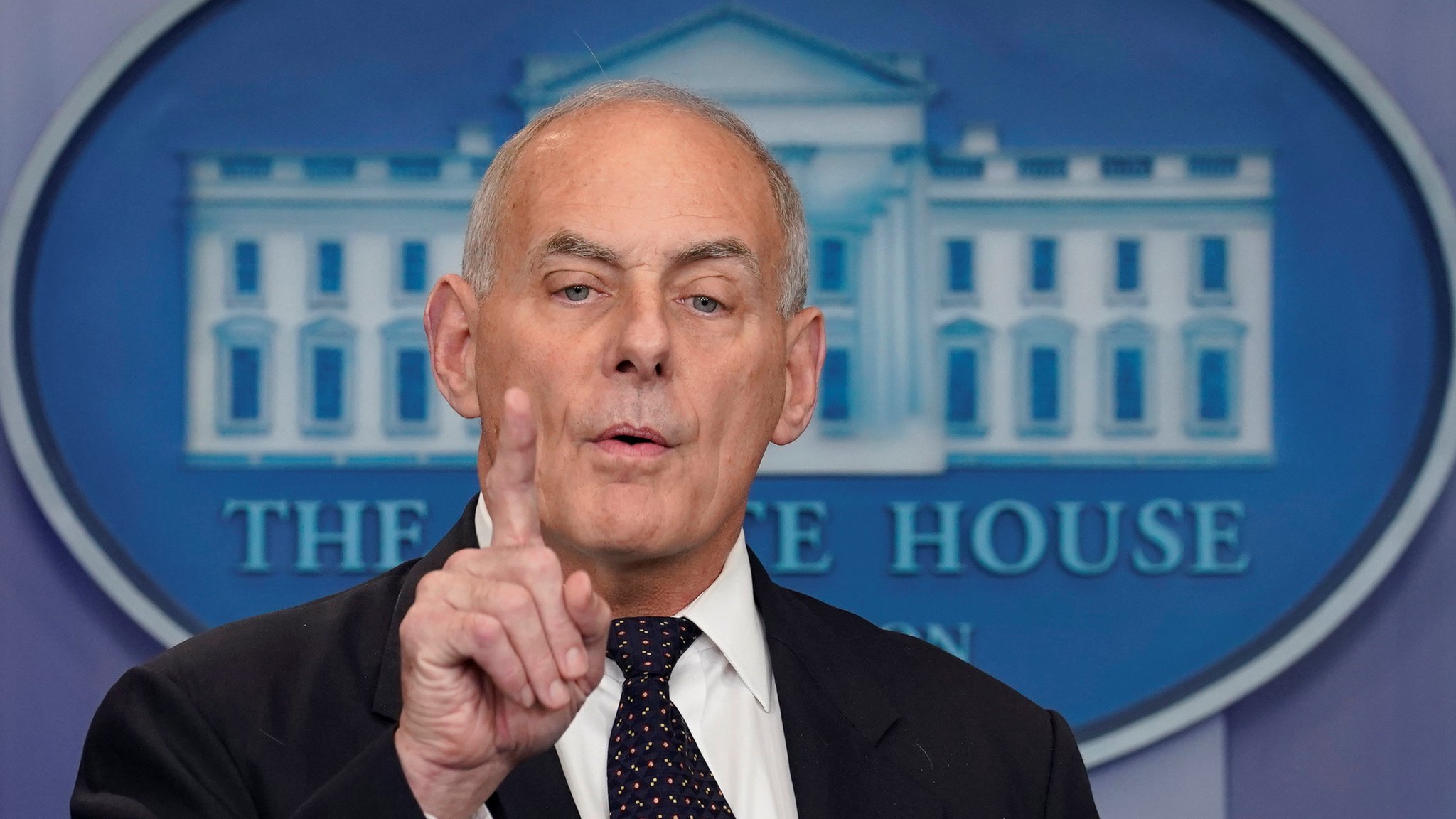
White House chief of staff John Kelly defends Trump over widow remarks

0

Media playback is unsupported on your device

Media captionKelly defends Trump’s call to widow

The White House chief of staff has launched an impassioned attack on a “selfish” congresswoman who said President Trump made a war widow cry.

General John Kelly said he was “broken-hearted” by the Democrat’s criticism of the president’s condolence call to Sgt La David Johnson’s wife.

Sgt Johnson was one of four killed in Niger by Islamist militants this month.

Gen Kelly also said he did not receive a call from President Barack Obama when his son died in Afghanistan in 2010.

Trump sends cheque after family complains

The chief of staff, a former Marine Corps general, said in the White House briefing room that Representative Frederica Wilson was “an empty barrel”.

Image copyright CBS News/US Army
Image caption Sgt Johnson’s widow with his coffin at Miami International Airport

The Florida Democrat said on Wednesday that she had overheard Mr Trump telling bereaved Myeshia Johnson of her slain husband: “He knew what he was signing up for, but I guess it hurts anyway.”

Ms Wilson said the president’s alleged remarks, shortly before Sgt Johnson’s coffin arrived by aircraft in his home city of Miami, made Ms Johnson break down in tears.

President Trump said the congresswoman had “totally fabricated” the comments.

On Thursday, Gen Kelly said he was so “stunned” by Ms Wilson’s attack that he spent more than an hour walking among soldiers’ graves at Arlington National Cemetery, just outside Washington.

Media playback is unsupported on your device

Media captionCongresswoman Frederica Wilson: “How insensitive can you be?”

The chief of staff said he had advised the president not to call the loved ones of the four American servicemen killed in Niger, telling him: “There’s nothing you can do to lighten the burden on these families.”

Gen Kelly described such a task as “the most difficult thing you can imagine”.

“There is no perfect way to make that phone call,” he added.

Five reasons Trump’s widow story stings

He also discussed the death of his own son, Robert Kelly, a 29-year-old Marine first lieutenant who died when he stepped on an Afghan landmine.

Gen Kelly said: “He [President Trump] asked me about previous presidents. And I said, ‘I can tell you that President Obama, who was my commander-in-chief when I was on active duty, did not call my family.’

Media playback is unsupported on your device

Media captionGold Star Mother Christina Ayube: “We don’t need to be reminded of that on the way to receiving the body”

“That was not a criticism. That was just to simply say, I don’t believe that President Obama called. That’s not a negative thing.

“I don’t believe President Bush called in all cases. I don’t believe any president, particularly when the casualty rates are very, very high, that presidents call.”

The controversy began on Monday when a reporter asked Mr Trump at the White House why he had still not called the families of the four soldiers killed in the fatal ambush in Niger on 4 October.

The president provoked outrage by suggesting that his predecessor, Barack Obama, and other former US presidents did not call the relatives of dead service members.

On Tuesday, Mr Trump ratcheted up the row by stating that President Obama did not call Gen Kelly’s family.

Mr Kelly also said the Pentagon was investigating the details of the deaths of Sgt Johnson and the other servicemen in the west African country.

But Senator John McCain, the chairman of the Senate Armed Services Committee, said he was not being given any details, adding that he could issue a subpoena for the information.

Asked by reporters what information he still lacked, he said “everything”.

And asked if the White house had been forthcoming, he responded: “Of course not.”

Note: This story is auto-generated from BBC syndicated feed and has not been edited by AFRICA PRIME NEWS

Canada producer leaves TV amid flurry of sexual abuse allegations

0
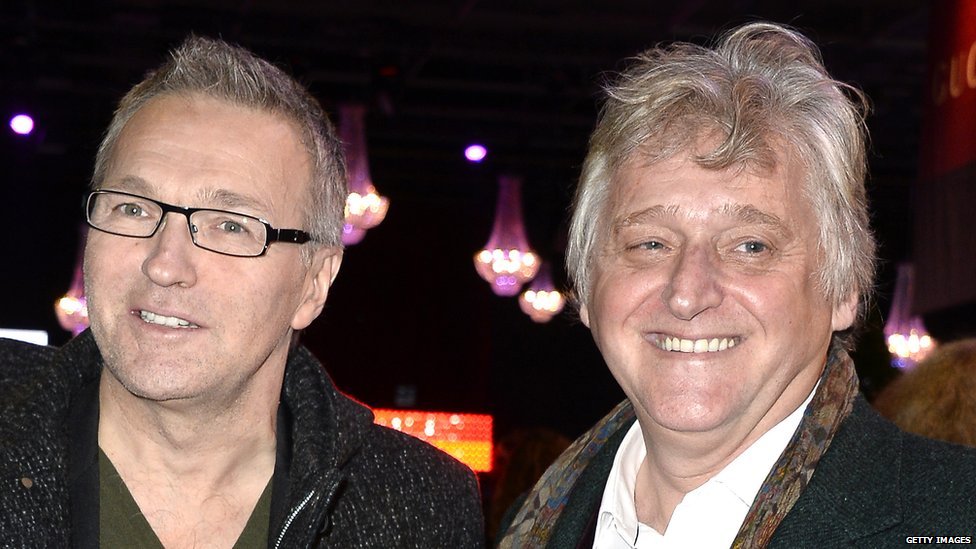
Gilbert Rozon (right) at a Gucci event in ParisImage copyright Getty Images
Image caption Gilbert Rozon (right) at a Gucci event in Paris

Canadian producer Gilbert Rozon has left several television productions amid accusations he sexually abused and harassed several women.

Montreal police are investigating an incident that took place in Paris in 1994, Radio Canada reported.

The 62-year-old resigned from his role as boss of the Just For Laughs comedy festival on Wednesday.

French channel M6 also suspended its broadcast of “France’s Got Talent”, which features Mr Rozon as a judge.

Mr Rozon issued a statement on Facebook shortly before a story by Montreal newspaper Le Devoir was published, detailing allegations of sexual abuse and sexual harassment from nine women spanning three decades.

“Shaken by the allegations against me, I want to dedicate all my time to review the matter,” Rozon wrote on Facebook. “To all those who I may have offended in my life, I’m sincerely sorry.”

In addition to leaving Just for Laughs, he also announced that he would be resigning from his role as commissioner of the Montreal 375th anniversary preparations.

Mr Rozon did not elaborate on the allegations, which range from sexual harassment to forced penetration, none of which have been proven in court.

Image copyright Getty Images
Image caption Just For Laughs is one of the world’s largest comedy festivals and attracts talents such as John Cleese

Mr Rozon is famous in both his home country of Canada and abroad. He founded the Just for Laughs festival in 1983 and has expanded the brand to include television shows and specials. The brand is currently used in 150 countries, and is considered the largest comedy festival in the world.

He also had a prominent role as a judge, similar to talent show judge Simon Cowell, on the French television show France’s Got Talent.

But allegations of sexual misconduct have swirled around him for at least a decade. He pleaded guilty to sexual assault of a 19-year-old woman in 1998, which resulted in an absolute discharge.

Note: This story is auto-generated from BBC syndicated feed and has not been edited by AFRICA PRIME NEWS

Richard Spencer speech at Florida campus sparks mass protest

0
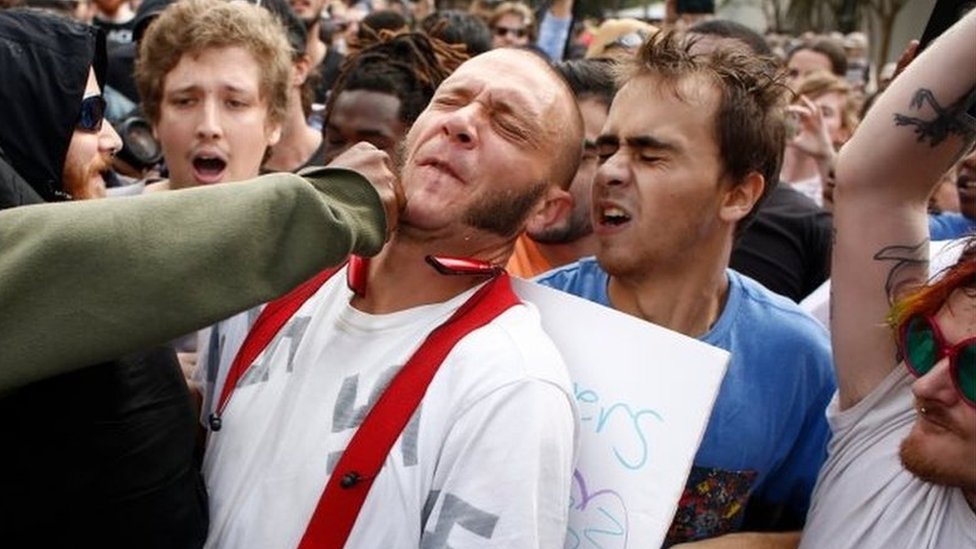
A man wearing a shirt with swastikas is punched by a member of a crowd of protesters at University of Florida's campus, where white nationalist Richard Spencer gave a speech.Image copyright Getty Images

Protesters chanting “Go home Nazis” have disrupted a white nationalist’s speech at the University of Florida.

Richard Spencer’s address in Gainesville prompted Florida’s governor to declare a state of emergency.

Outside the event, police officers stood guard as hundreds of demonstrators shouted: “Go home, Spencer!”

His speech comes two months after a far-right rally in Charlottesville, Virginia, left a woman dead.

Several dozen supporters of Mr Spencer in the campus auditorium were overwhelmingly outnumbered by protesters who shouted down the speaker.

“I’m not going home, I will stand here all day if I have to,” Mr Spencer said, calling the crowd a mob of “shrieking and grunting morons”.

Audience members continued to heckle him, chanting “Nazis are not welcome here” and “Let’s go, Gators!” – a reference to the college mascot.

The university said it did not want to let “vile” Mr Spencer speak, but was obligated under law to do so.


Spencer taunts crowd – Nada Tawfik, BBC News, Gainesville, Florida

The university was prepared for the worst. Roadblocks and barricades were set up to control the crowds. And helicopters and drones circled, while snipers stood atop buildings surrounding the Phillips Center for Performing Arts.

Most students avoided this side of campus altogether, but a sizable number did still turn out, either to attend the speech or decry it. Spencer’s national policy institute tried to screen those seeking tickets, but once the so-called leader of the alt right started speaking, it was clear they had failed.

Richard Spencer began his remarks declaring everyone had the right to free speech, ideology aside. But immediately, it was clear that the majority of the crowd was determined to drown him out with their own message. They chanted “go home” and “Nazis are not welcome here”.

Dozens held raised fists in a sign of resistance, others chose the middle finger to express themselves. Mr Spencer taunted the crowd in return, calling them shrieking and grunting morons, a mob whose action he said was the best recruiting tool for his group.

Police began dressing in riot gear as the emotions ran high but Mr Spencer left the stage once his allotted time ran out. And both sides have remained for the most part peaceful.


Image copyright Getty Images
Image caption Richard Spencer denied he is a white supremacist during a press conference before his speech

Before Thursday’s speech at the college performing arts center, Mr Spencer addressed media to thank university president Kent Fuchs for allowing him to speak, according to the Miami Herald.

The newspaper also reported that two Democratic state legislators filed bills on Thursday to remove all remaining Confederate monuments from the state’s public spaces.

Mr Fuchs tweeted: “I don’t stand behind racist Richard Spencer”.

According to the Anti-Defamation League, a Jewish anti-bigotry group, flash mobs are being encouraged by the Daily Stormer, a neo-Nazi website, at minority and Jewish institutions during the speech.

The college said it would have to spend more than $500,000 (£380,000) on security while hundreds of state and local police were deployed to campus.

Mr Spencer’s organisation, the National Policy Institute, is paying $10,000 to rent the facility.

Image copyright Getty Images
Image caption Protesters disrupted the event, raising their fists and shouting as Mr Spencer spoke
Image copyright Getty Images
Image caption Hundreds of protesters gathered outside, some of whom shouted: “We don’t want your Nazi hate”

Protesters unfurled a sign on campus proclaiming “Love, not hate” and drew chalk designs on a pavement promoting inclusiveness and diversity.

Meanwhile, former President George W Bush decried intolerance while addressing an event in New York.

“Bigotry or white supremacy in any form is blasphemy against the American creed,” he said.

The Southern Poverty Law Center, which monitors US hate groups, said Mr Spencer is “a radical white separatist whose goal is the establishment of a white ethno-state in North America”.

Mr Spencer has described this week’s emergency declaration by the state governor as “flattering” but “most likely overkill”.

Media playback is unsupported on your device

Media captionWhite supremacist Richard Spencer: ‘Donald Trump’s arrow is pointing in our direction.’

Mr Spencer, a figurehead of the racist alt-right movement, rose to prominence when he led chants of “Heil Trump” to a Nazi-saluting group in Washington after the president’s election victory.

He also helped to organise August’s rally in Charlottesville, where he was the ringmaster of a large group of far-right activists chanting “Jews will not replace us” and “blood and soil” (a Nazi slogan).

More on race in America

Media playback is unsupported on your device

Media captionCan removing Confederate statues help heal a nation?

Media playback is unsupported on your device

Media captionPost-war US anti-Nazi film makes comeback

Note: This story is auto-generated from BBC syndicated feed and has not been edited by AFRICA PRIME NEWS

Trump’s Renoir painting is not real, Chicago museum says

0
Pierre-Auguste Renoir's Two Sisters (On The Terrace)Image copyright Art Institute of Chicago
Image caption Pierre-Auguste Renoir’s Two Sisters (On The Terrace)

A US museum says an Impressionist painting which President Donald Trump reportedly claims to own is a fake.

In a recent interview, Trump biographer Tim O’Brien said he was once told by the future president that his artwork was an original.

But the Chicago Institute of Art says the real painting, Two Sisters (On The Terrace) by Pierre-Auguste Renoir, has hung in its gallery for 80 years.

A museum spokesperson said it is “satisfied that our version is real”.

The painting was gifted to the institute in 1933, spokeswoman Amanda Hicks told the Chicago Tribune.

The donor acquired it for $100,000 (£760,000) from an art dealer who bought it directly from the French Impressionist painter in 1881, she added.

But O’Brien said during a recent interview with Vanity Fair’s Hive podcast that Mr Trump has repeatedly claimed to him that his version of the painting was authentic.

During a flight on Mr Trump’s private jet while he was writing his 2005 book, TrumpNation: The Art of Being The Donald, O’Brien said he spotted the painting and asked about it.

“You know, that’s an original Renoir,” the author said Mr Trump had told him, adding that the property tycoon repeated the claim the following day.

“Donald, it’s not,” he recalled telling Trump. “I grew up in Chicago, that Renoir is called Two Sisters on the Terrace, and it’s hanging on a wall at the Art Institute of Chicago.

“That’s not an original.”

The artwork was later apparently moved to Trump Tower, the author said, saying it was visible in the background of a CBS 60 Minutes interview that Mr Trump gave shortly after his election.

“I’m sure he’s still telling people who come into the apartment, ‘It’s an original, it’s an original,'” O’Brien said on the podcast.

Mr Trump sued O’Brien for $5bn because the author wrote in TrumpNation that rather than being a billionaire, his net worth was actually as low as $150m.

The defamation lawsuit was dismissed.

Note: This story is auto-generated from BBC syndicated feed and has not been edited by AFRICA PRIME NEWS
Trump gives Puerto Rico relief effort top marks

0

[unable to retrieve full-text content]Note: This story is auto-generated from BBC syndicated feed and has not been edited by AFRICA PRIME NEWS

Expert Advocate Increase In Nigeria’s National And Subnational Health Budget Line

0
Map of Nigeria Showing Kaduna State

Intro

A health expert Hajiya Aisha Tukur has advocated for increase in national and subnational budget line to meet the Abuja declaration on health.

She was speaking with our health correspondence Andrew Ibrahim Mshelia, against the backdrop of one out of five children in Kaduna dies of pneumonia, which contributes 13 percent, while Diarrhea contribues 16 percent.

Andrew Ibrahim Mshelia tells us more his report.

George W Bush decries bigotry and conspiracy theories

0

[unable to retrieve full-text content]Note: This story is auto-generated from BBC syndicated feed and has not been edited by AFRICA PRIME NEWS

Young Obama’s angst-ridden love letters

0
Fanned across a table, two hand-written cursive letters begin "Dear Alex–", while an envelope in the pile is clearly addressed to a Barack Obama in New York City.Image copyright Emory
Image caption The letters are affectionate, but mostly deal with Mr Obama’s life as a young graduate

Angst-ridden letters from a young Barack Obama to his girlfriend reveal a 20-something plagued by insecurities about race, class and money.

The handwritten letters are between a young Mr Obama and Alexandra McNear, who he met in California as a student.

Some show the future president’s early struggles, working a job he cares little for just to get by.

Acquired by Emory University’s Rose Library in 2014, they have only now been published.

“They are quite beautifully composed and reveal the search of a young man for meaning and identity,” library director Rosemary Magee said.

“They show the same kind of yearnings and issues that our own students face – and that students everywhere encounter.”

Long distance

The letters were written between 1982 and 1984, five years before Mr Obama’s first date with his eventual wife Michelle.

In one of the earliest letters, he wrote: “I trust you know that I miss you, that my concern for you is as wide as the air, my confidence in you as deep as the sea, my love rich and plentiful.”

It was signed: “Love, Barack.”

Image copyright Getty Images
Image caption Mr Obama – pictured here in 2004 – wrote the letters while in a long-distance relationship

But the long-distance relationship did not last. By 1983, he tells her: “I think of you often, though I stay confused about my feelings.”

“It seems we will ever want what we cannot have; that’s what binds us; that’s what keeps us apart.”

Finding his path

In one letter, a young Obama writes about his friends preparing to settle down or take over the family business.

But born in Hawaii, to a father from Kenya, and spending much of his early years in Indonesia, he felt different.

“I must admit large dollops of envy,” he wrote.

“Caught without a class, a structure, or a tradition to support me, in a sense the choice to take a different path is made for me.”

“The only way to assuage my feelings of isolation are to absorb all the traditions, classes, make them mine, me theirs.”

Image copyright Emory
Image caption The nine letters run to about 30 pages of thoughts and affections

But it was not so easy.

As a graduate in 1983, returning to Indonesia where he grew up, he found that he no longer belonged there. “I can’t speak the language well anymore,” he said.

“I’m treated with a mixture of puzzlement, deference and scorn because I’m American – my money and my plane ticket back to the US overriding my blackness.”

“I see old dim roads, rickety homes winding back towards the fields, old routes of mine, routes I no longer have access to.”

Portrait of the president as a young man

The young graduate knew he wanted to work in the kind of community projects he would later champion as president – but, like many young people, had to be practical.

“One week I can’t pay postage to mail a resume and writing sample, the next I have to bounce a cheque to rent a typewriter,” he wrote in 1983.

“Salaries in the community organisations are too low to survive on right now, so I hope to work in some more conventional capacity for a year, allowing me to store up enough nuts to pursue those interests next.”

Media playback is unsupported on your device

Media captionMore than 30 years later, Mr Obama paid tribute to his wife as he ended his term of office

Taking a job at publishing house Business International, he said he became “one of the ‘promising young men’… with everyone slapping my back and praising my work”.

But he worried the corporate job might have “dulled my senses or done irreparable damage to my values” and left shortly afterwards.

And there were other signs in his writing of who he might become. In a 1984 letter to Alexandra, he pondered what he could do with more influence.

“My ideas aren’t as crystallised as they were while in school, but they have an immediacy and weight that may be more useful if and when I’m less observer and more participant,” he said.

Note: This story is auto-generated from BBC syndicated feed and has not been edited by AFRICA PRIME NEWS

Currency Exchange Rates

USD - United States Dollar
ZAR
0.06
EUR
1.17
CAD
0.73
ILS
0.31
INR
0.01
GBP
1.34
CNY
0.14
Enable Notifications OK No thanks