Home Blog Page 1448

Malawi cracks down on ‘vampire’ lynch mobs

0
A woman appearing in public in Mulanje area, southern Malawi alleging she was attacked by a blood-sucking vampire.Image copyright Frank Kandu
Image caption Several people have come out in public and said they were attacked by vampires.

Police in the south-east African state of Malawi say they have arrested 140 members of lynch mobs who attacked people suspected of being vampires.

At least eight people are believed to have been killed, including two men on Thursday in the second city, Blantyre.

One was set on fire and the other stoned, according to police.

Two others were arrested for threatening to suck people’s blood but police say they have no medical reports of any actual bloodsucking.

Vigilante killings started on 16 September when three people suspected of being blood suckers were killed by a mob.

Traditional leaders in southern Malawi believe the vampire rumours started across the border in Mozambique where rumours of blood sucking have led to violence this week.

In Mozambique, protesters have targeted police because they believe they are protecting the supposed vampires, leading a northern town’s administrator to flee the city.

The villagers in these areas believe human blood sucking is a ritual practised by some to become rich. They also believe they are failing to catch the blood suckers because they use magical powers.

If these communities believe in “mysterious magical explanations for things, then people will tend to attribute their difficulty on what they call blood suckers,” Dr Chioza Bandawe, a clinical psychologist at the University of Malawi, said.

For some that represents “the life of the hope being sucked out of them,” he said.

But this has been “expressed on innocent people or on people who are different”.

James Kaledzera, Malawi’s national police spokesperson, told the BBC that police patrols had been stepped up in areas affected.

He also said they would “arrest anybody who is deemed to have taken part in the killings”.

A curfew has been imposed in parts of the south, and earlier this month, the UN instructed staff to move to safer areas.

President Peter Mutharika, who has been visiting the areas concerned, has vowed to investigate the killings.

Many aid agencies and non-governmental organisations work in Malawi, one of the world’s poorest countries.

Educational standards are low, with belief in witchcraft widespread. Vigilante violence linked to vampire rumours also erupted there in 2002.

Note: This story is auto-generated from ‘BBC News’ syndicated feed and has not been edited by Africa Prime News staff.

Millions caught in South Africa’s ‘worst data breach’

62
Photograph of local website running cyber breach article
Image caption South Africa has been hit by what is described as the worst data breach in history

Authorities in South Africa are investigating a data breach which has seen the personal details of more than 30 million citizens leaked on the internet – placing them at risk of identity theft.

The information contained in a 27GB file was discovered by Australia-based internet security expert Tony Hunt earlier this week.

It contains their names, full identity numbers, income, gender, employment history, contact numbers and even home addresses.

South Africa’s population is about 54 million, so more than half of the country is affected by what has been described as the country’s worst leak of private data.

The country’s State Security Agency (SSA) would not be drawn into discussing the implications of such a breach and whether it could threaten security.

“We are looking in to the matter. There is an investigation. We are obviously very concerned,” SSA spokesperson Brian Dube told the BBC.

“It’s important to us to get to the bottom of this, see how it came about and do whatever we have to do, to deal with it,” he said.

Local newspaper, The Times, is reporting that the breach has even reached senior politicians, including President Jacob Zuma, but this has not been confirmed.

What could go wrong?

There are many unknowns.

According to Mr Hunt, the file dates back to April 2015 but it is not clear how long the information was on the internet prior to his find.

Image caption The file has since been removed but it is not clear how many people have already accessed it

The information could have been accessed by anyone from anywhere in the world if they knew what to look for.

Experts say this is the sort of data that companies would pay good money for.

Mr Hunt said on Twitter this week that the data breach “is one of the worst I’ve ever seen on many levels”.

The server of a property company called Jigsaw Holdings appears to be the source of the breach, this was traced through an IP address, according to local reports.

While Jigsaw has not been available for comment, it is not believed the cyber breach was a result of malice or negligence.

What happens now?

Some local newspapers have been calling for South Africans to use Mr Hunt’s website haveibeenpwned which works by checking one’s email address to see if their account has been compromised.

I took his advice. I’ve been using a private email address for years which I have always believed to be secure – but it turns out I’m in the 30 million.

It is not clear what happens now and perhaps that is the part that is most unnerving – do you wait until you are a target? Will you be a target? Do you warn your credit providers? Or simply do nothing?

So what’s the risk?

The publisher of Stuff Magazine, a technology magazine in South Africa, says in the wrong hands, the information could be used to impersonate people.

“All of this information could be used to open a bank account, a credit card account and they would use it knowing that someone will else have to pay for it when the bill comes,” Radio 702 quotes Toby Shapshak as saying.

He also speculated in the same interview that as many as 60 million people have had their personal data compromised, if you include the details of people who have died.

Time to panic?

South Africa’s banking institutions are said to be among the safest in the world, but they could be caught off-guard if the information was misused.

Image copyright iStock
Image caption Experts say cyber crime is still not taken as seriously as conventional crime despite its links in some cases to terrorism

It is said to be the largest leak of the details of private citizens in the country’s history – and yet it seems to have gone largely undetected.

There is no outcry.

But Mr Shapshak says South Africans “should panic”.

“Yes the data may be five years old but our ID numbers stay the same, our employment history stays the same and these are the sort of things that make it possible to create fake identities. It is a serious problem and I’m not being paranoid.”

Experts say cyber crime is still not taken as seriously as conventional crime, even though it can be used to fund all sorts of illicit activities including terrorism. While the possibility of identity theft could open a whole new door for criminals here.

“It’s too early to say anything at this moment… There are a lot of reports going around, but we are concerned and looking into it,” said Mr Dube.

And so we wait – and hope that the right people are doing all the right things to protect the country’s citizens from those who live on the dark web.

Note: This story is auto-generated from ‘BBC News’ syndicated feed and has not been edited by Africa Prime News staff.

Nigeria: Peoples Democratic Party National Chairmanship Contest, Stalwart Canvases Support For Gbenga Daniel 

0
Gbenga Daniel

 By Peter Usman

Gbenga Daniel

Abuja (Nigeria) — A Chieftain of the People’s Democratic Party (PDP), Kudla Satumari has enjoined members of the party across the country to support former Ogun state Governor, Gbenga Daniel to lead the party as National chairman.

Satumari described Gbenga Daniel as a visionary leader that will lead the party to electoral victory, adding that he has the credentials, capacity and support to regain the PDP’s lost glory.

Satumari who was speaking with  newsmen in Abuja  assured  that PDP will produce leaders that will take the nation to the next destination under the leadership of Gbenga Daniel.

He urged members of the party in the country who really mean well for the unity, progress and growth of the party to throw their weight behind the aspirant  with all  necessary support to lead the party.

According to him, “You can see the support exhibited so far today by the youths and women, this shows that Gbenga Daniel has the credentials and capacity to lead PDP, the largest party in Africa. His acceptance cut across the board which is an indication that he has what it takes to pilot successfully the affairs of the party.

“With Gbenga Daniel, I think we are sure of a leadership that is all encompassing and if you are sincere and you want PDP to come back the way it was, then let us give him full support,” he said.

Satumari who is also the Managing Director and Chief Executive, of Aerokeys Nigeria Limited, urged those with pre-conceived position that Gbenga Daniel cannot lead the party successfully to have a rethink considering the fact that he has structural approach to address complex and national issues, coupled with genuine interest he has for the party.  

“After seeing in him the genuine and sincere interest for the PDP, with the ability to  be able to tackle radical issues in the party, some of us have no option than to give him support to lead the party” he said.     

Anger over Donald Trump’s UK crime tweet

57
Donald TrumpImage copyright Getty Images

Donald Trump has been accused of fuelling hate crime with a tweet erroneously linking a rise in the UK crime rate to “radical Islamic terror”.

He said crime in the UK had risen by 13% amid the “spread” of Islamist terror – despite the figure referring to all crimes, not just terrorism.

The Labour MP, Yvette Cooper, said the statement was “inflammatory and ignorant”, while ex-Labour leader Ed Miliband said Mr Trump was “a moron”.

The Home Office declined to comment.

Mr Trump’s tweet used data from the Office for National Statistics (ONS)’s latest crime update, which reported a 13% increase across all offences in the 12 months to June.

It covered England and Wales, not the whole of the UK.

Police recorded 5.2m offences in the last year, the bulk of which were not associated with terrorism.

Rises were recorded in crime public order offences, stalking and harassment, possession of weapons and robbery.

The statistics – which made no reference to “radical Islamic terror” – showed that 35 out of the 664 homicides in England and Wales were caused by terror attacks in London and Manchester.

US media outlets have speculated whether Mr Trump’s tweet followed a TV report on One America News Network, a conservative TV channel, which aired the statistics on Friday morning.


Reality Check: Did the president have a point?

By Danny Shaw, BBC home affairs correspondent:

Donald Trump is half right.

Crime has gone up by 13% – but not in the UK. The increase announced yesterday covered England and Wales whereas Scotland and Northern Ireland publish their data separately.

But overlooking that mistake, what about the phrase that appears to connect the increase to the “spread of radical Islamic terror”?

The number of cases of murder and attempted murder linked to Islamist-related extremism, has indeed gone up substantially.

Image copyright AFP/Getty Images

Of the 664 homicides recorded in the year ending June 2017, 34 resulted from the Westminster Bridge, Manchester Arena and London Bridge attacks – there were no such deaths last year.

The attacks also accounted for the majority of the 426 additional attempted murders registered by police.

Arrests for terror-related offences went up as well, from 226 to 379, across England, Wales and Scotland, though that number also includes people detained for far-right extremism.

But in terms of overall offending, this increase in terror-related crime represents a fraction, when you consider that there were an extra 579,553 offences recorded by police compared with the year before.

More from Reality Check: Is crime up or down?


However, the tweet sparked a fierce backlash in the UK and was widely condemned on social media.

Labour MP Yvette Cooper, chair of the Commons Home Affairs Committee, said Mr Trump’s comments could fuel hate crime.

She said: “Hate crime in the UK has gone up by almost 30% and rubbish like this tweet from Donald Trump is designed to provoke even more of it.

“If we are to properly tackle hate crime and every other crime, we have to challenge this kind of nonsense.”

Conservative backbencher Nicholas Soames, grandson of Sir Winston Churchill, called the US president a “daft twerp” who needed to “fix gun control”.

Lib Dem deputy leader Jo Swinson also responded to the president’s tweet, accusing him of “misleading and spreading fear”.

In September, the US president was criticised for a tweet claiming that the “sick and demented people” behind the partially-exploded bomb at a London Tube station were “in the sights of Scotland Yard”.

The Metropolitan Police described his tweet as “unhelpful”.

He had earlier lashed out at Sadiq Khan, tweeting that the London mayor had offered a “pathetic excuse” to Londoners after the London Bridge terror attack by telling people not to be alarmed.

The Office for National Statistics said it would not comment on Mr Trump’s tweet, but added that the survey relates to all crimes in England and Wales between 2016 and 2017.

Note: This story is auto-generated from BBC syndicated feed and has not been edited by AFRICA PRIME NEWS

Nigeria’s House Of Representatives Speaker, Dogara Seeks Transformation Of Water Sector

0
Yakubu Dogara

Texas city requires Israel pledge for hurricane relief

0
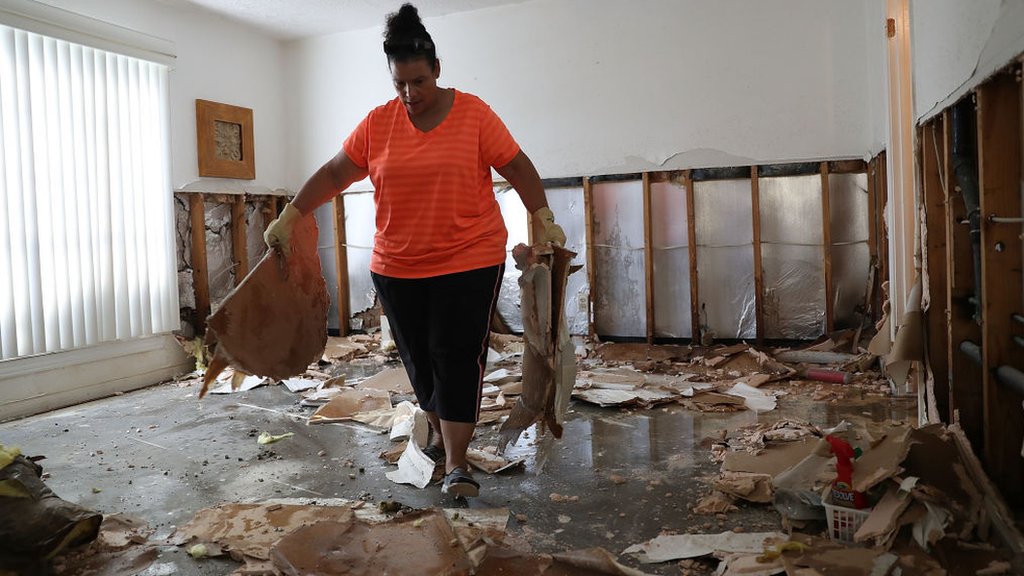
Homeowner clears debrisImage copyright Getty Images
Image caption Texas officials have warned clean-up efforts from Hurricane Harvey may cost up to $180bn (£136bn)

A Texas city has required residents who are seeking government disaster relief funds in the wake of Hurricane Harvey to pledge not to boycott Israel.

The city of Dickinson, about 30 miles (48km) south of Houston, posted grant applications for anyone seeking money for repairs after the category 4 storm.

Local officials say the pro-Israel clause is required under a Texas state law enacted earlier this year.

The application has drawn a strong rebuke from free-speech activists.

In the four-page, recovery aid application posted on the city’s website, a section reads: “By executing this Agreement below, the Applicant verifies that the Applicant: (1) does not boycott Israel; and (2) will not boycott Israel during the term of this Agreement.”

The provision stems from a law barring the state from entering a contract with any business unless it “does not boycott Israel”.

Boycotting Israel includes any action intended to “to penalise, inflict economic harm on, or limit commercial relations specifically with Israel”, according to the law.

Image copyright Getty Images

The law, known as the Anti-BDS (Boycott, Divestments, and Sanctions) bill, was signed by Republican Governor Greg Abbott in May.

“Anti-Israel policies are anti-Texas policies, and we will not tolerate such actions against an important ally,” the governor said in a statement earlier this year.

Media playback is unsupported on your device

Media captionBoycott campaigner Michael Deas explains the BDS movement

The American Civil Liberties Union (ACLU) criticised the city for the requirement, saying it was “an egregious violation” of free speech rights under the First Amendment.

“The First Amendment protects Americans’ right to boycott, and the government cannot condition hurricane relief or any other public benefit on a commitment to refrain from protected political expression,” said Andre Segura, the legal director of ACLU’s Texas chapter.

Image copyright Getty Images
Image caption Hurricane Harvey has been blamed for 47 deaths

Texas is not the only state to require this provision. The ACLU is suing on behalf of a public school teacher in Kansas over a similar anti-BDS law.

Hurricane Harvey made landfall on 25 August and was the first in a series of hurricanes to hit the Gulf of Mexico region.

The storm has been blamed for 47 deaths and Governor Abbott has warned that clean-up efforts could cost up to $180bn (£136bn).

Note: This story is auto-generated from BBC syndicated feed and has not been edited by AFRICA PRIME NEWS

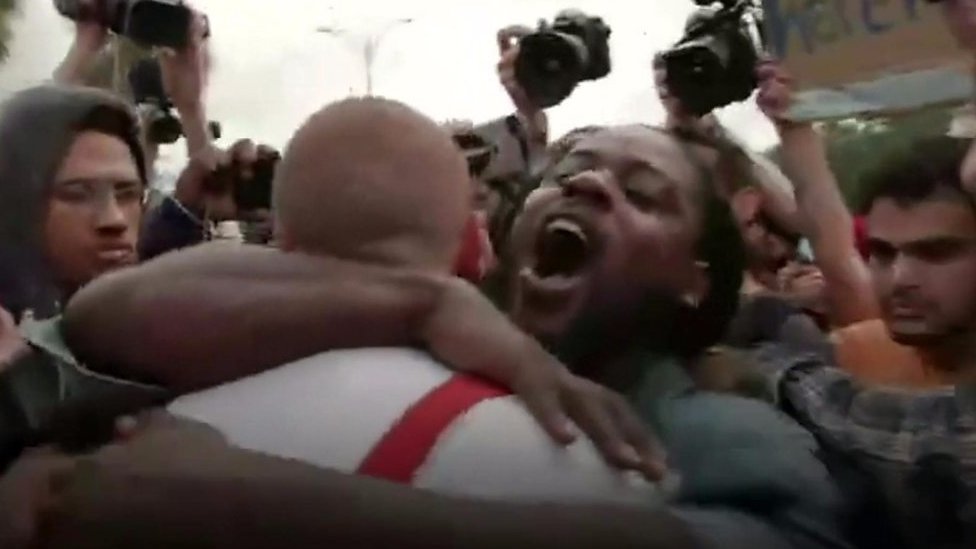
Why did a black man hug a neo-Nazi skinhead?

0

[unable to retrieve full-text content]Note: This story is auto-generated from BBC syndicated feed and has not been edited by AFRICA PRIME NEWS

Publisher apologises for ‘racist’ text in medical book

0
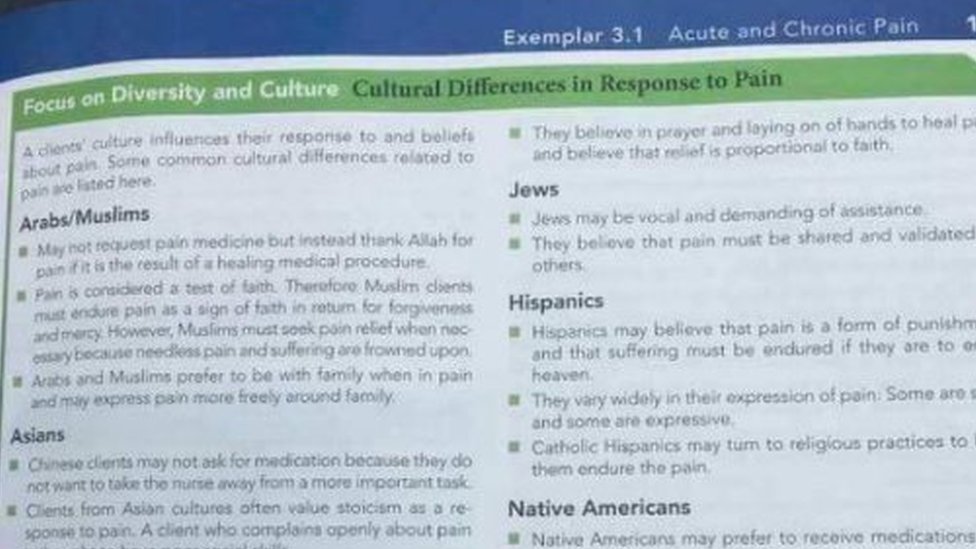
passages from textbookImage copyright Onyx Moore

The publishers of a textbook for nurses that has been criticised by social media users for containing racist material, have apologised for the offence caused and removed the offending passages.

Nursing: A Concept-Based Approach to Learning, contains advice for nurses when administering pain relief to people from different ethnic backgrounds.

It begins: “A client’s culture influences their response to, and beliefs about pain. Some cultural common differences related to pain are listed here.”

The page contains headings for different communities. Here are some of the excerpts:

Arabs/Muslims

  • May not request pain medicine but instead thank Allah for pain if it is the result of the healing medical process.
  • Pain is considered a test of faith. Muslim clients must endure pain as a sign of faith in return for forgiveness and mercy.

Asians

  • Chinese clients may not ask for medication because they do not want to take the nurse away from a more important task.
  • Indians who follow Hindu practices believe that pain must be endured in preparation for a better life in the next cycle.

Blacks

  • Blacks often report higher pain intensity than other cultures.
  • They believe suffering and pain are inevitable.

Jews

  • Jews may be vocal and demand assistance.
  • They believe pain must be shared and validated by others.

Hispanics

  • Hispanics may believe that pain is a form of punishment and that suffering must be endured if they are to enter heaven.
  • They vary in their expression of pain. Some are stoic and some are expressive.

Native Americans

  • Native Americans may prefer to receive medications that have been blessed by a tribal shaman.
  • They may pick a sacred number when asked to rate pain on a numerical pain scale.

The image of the page was shared on Facebook on Monday by Onyx Moore in California. She posted: “This is an excellent example of how not to be even remotely culturally sensitive.

“These assumptions are not evidence based, they encourage nurses to ignore what the patient is actually saying.

“If someone tells you their pain level is high you need to believe them.”

Her post has been widely shared on both Facebook and Twitter attracting thousands of comments from users, most of whom expressed outrage at what they perceived as racist stereotyping.

One Facebook user posted: “I’m so disgusted. In 2017 how is this being published?”

Another user commented: “How old is this book? Like… 200 years old?”

But another Facebook user suggested: “I know this looks awful, but I don’t think it’s as much about thinking other cultures don’t experience pain. It’s about how they express/interpret their pain.”

You may also like:

By the middle of the week, Ms Moore’s Facebook post was gaining traction across other social media platforms. Lyndsay Morgan in California tweeted the post. She told the BBC: “Seeing the page in a textbook like this is shocking for me as a Jewish disabled woman.

“When I’m in hospital I want a nurse to see me for what I am – someone who needs medical attention not as a Jew that needs attention and validation.”

The social reaction to the post prompted an apology by the textbook’s publisher Pearson.

Further apologies were issued on Pearson’s Twitter page as the criticisms on social media increased amid fresh accusations that the excerpts were not limited to one textbook but featured in at least one other.

One Twitter user compared the content to Nazi propaganda: “It legit short-circuited my brain for a minute when I read it. I’m used to seeing that in eugenics-era books.”

On Friday Pearson uploaded a two-minute video on its YouTube channel of Tim Bozik the president of the company’s global development addressing the complaints.

Image copyright Pearson/You Tube
Image caption Tim Bozik: “It was wrong. We should have been more thoughtful about the information we put in our curriculum.”

In a statement to the BBC the publisher said: “While differences in cultural attitudes towards pain are an important topic in medical programs, we presented this information in an inappropriate manner.

“We apologise for the offense this has caused and we have removed the material in question from current versions of the book, electronic versions of the book and future editions of this.

“In addition, we now are actively reviewing all of our nursing curriculum products to identify and remove any remaining instances of this inappropriate content that might appear in other titles.”

Note: This story is auto-generated from BBC syndicated feed and has not been edited by AFRICA PRIME NEWS

Currency Exchange Rates

USD - United States Dollar
ZAR
0.06
EUR
1.17
CAD
0.73
ILS
0.31
INR
0.01
GBP
1.34
CNY
0.14
Enable Notifications OK No thanks