US President Donald Trump has launched a Twitter tirade about the “guilt” of Hillary Clinton and the opposition Democratic Party.
His Sunday morning outburst came amid reports that the first arrest in the Russian collusion inquiry would be made this week, possibly as early as Monday.
Mr Trump insisted allegations of collusion between his campaign and Russia were “phony” and a “witch hunt”.
He said Republicans were united behind him, before urging: “DO SOMETHING!”
Media reports say the first charges have been filed in the investigation led by special counsel Robert Mueller into alleged Russian interference in the 2016 election to assist Mr Trump.
It is not clear what the charges are and whom they are targeting, CNN and Reuters report, quoting unnamed sources.
“Never seen such Republican ANGER & UNITY as I have concerning the lack of investigation on Clinton made Fake Dossier (now $12,000,000?),….
“…the Uranium to Russia deal, the 33,000 plus deleted Emails, the Comey fix and so much more. Instead they look at phony Trump/Russia,….
“…’collusion,’ which doesn’t exist. The Dems are using this terrible (and bad for our country) Witch Hunt for evil politics, but the R’s…
“…are now fighting back like never before. There is so much GUILT by Democrats/Clinton, and now the facts are pouring out. DO SOMETHING!”
About an hour later he tweeted: “All of this ‘Russia’ talk right when the Republicans are making their big push for historic Tax Cuts & Reform. Is this coincidental? NOT!”
Critics on Twitter were quick to accuse him of attempting to divert attention from the Russian investigation by complaining about the lack of focus on an opponent he defeated in the presidential election nearly a year ago.
US intelligence agencies have already concluded that the Russian government sought to help Mr Trump win the election.
Mr Mueller’s investigation is looking into any links between Russia and the Trump campaign. Both deny there was any collusion.
His team is known to have conducted extensive interviews with several current and former White House officials.
Image copyrightReutersImage caption Mueller was appointed special counsel after Trump fired FBI director James Comey
Mr Mueller, a former FBI director, was appointed by the department of justice as special counsel in May shortly after Mr Trump fired FBI director James Comey.
Mr Trump said on Friday that it was now “commonly agreed” that there was no collusion between him and Russia but said that there were links between Moscow and Mrs Clinton.
Republican lawmakers have said that a uranium deal with a Russian company in 2010, when Mrs Clinton was secretary of state, was sealed in exchange for donations to her husband’s charity.
A Congressional investigation has been opened into the case. Democrats say it is an attempt to divert attention from the alleged ties between Russia and Mr Trump.
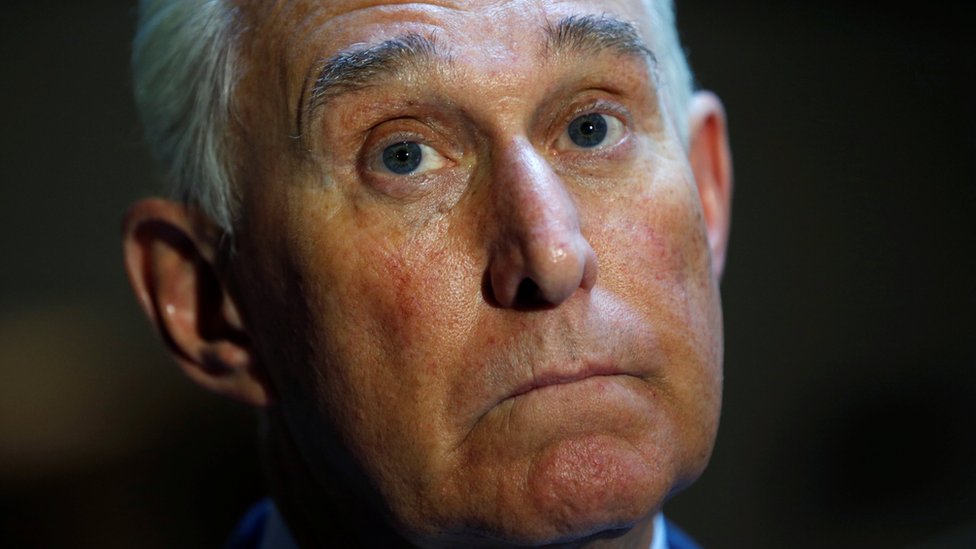
His suspension came hours after he used abusive and homophobic language to target journalists, including a gay CNN presenter, Don Lemon.
Mr Stone has said he will sue Twitter for blocking his account.
Twitter has not commented or confirmed if Mr Stone’s suspension is permanent.
He was an aide to President Richard Nixon in the 1970s and became a political consultant. He says in the Netflix documentary Get Me Roger Stone that he got Mr Trump to run for president.
While he acted as an adviser during the early days of the Trump campaign, he left his role in disputed circumstances in August 2015 – Mr Stone says he quit, Mr Trump says he was fired.
Since then, Mr Trump has tried to put some distance between himself and Mr Stone, who regularly appears on network television to support his former employer.
Over several hours on Saturday, Mr Stone took to Twitter to attack CNN and New York Times journalists over their reporting.
His attacks came hours after CNN reported that the first charges had been laid by a grand jury in the investigation into Russian influence on the 2016 election.
In a Facebook post, Mr Stone said he believed his suspension should have ended “some time ago yet my Twitter feed is still not functional”.
In an interview with entertainment website The Wrap, he said he had hired “one of the best telecommunications lawyers in the country” and would sue Twitter, but it is not clear whether there are legal grounds to do so.
“I have been inundated on Twitter with bloggers threatening to kill me, my wife my kids and even my dogs yet Twitter seems unconcerned about that,” he said.
One of the people he targeted on Saturday, CNN contributor Ana Navarro, said she did not sympathise with Mr Stone over his suspension.
Note: This story is auto-generated from BBC syndicated feed and has not been edited by AFRICA PRIME NEWS
Image copyrightAFPImage caption President Nkunrunziza’s third term bid led to violent clashes between pro- and anti-government groups
Burundi has become the first country to withdraw its membership from the International Criminal Court (ICC).
It accused the ICC of deliberately targeting Africans for prosecution.
The government of Burundi is accused of committing crimes against humanity, including execution and torture. The UN Commission of Inquiry is urging the ICC to open a prosecution soon.
In theory its withdrawal from the ICC has no effect on the court’s ongoing investigations on the country.
Fadi El-Abdallah, a spokesman for the ICC, told the BBC’s Newsday programme that “article 127 states that withdrawal does not affect the jurisdiction of the ICC over the crimes that have been committed” while the country was a member.
But the case of Sudan’s President Omar al-Bashir, one of the ICC’s “most wanted”, has highlighted the difficulty of getting a non-member to co-operate in surrendering suspects.
Unrest
The withdrawal comes a year after Burundi lodged an official notice to quit the organisation, which has 122 member countries, 34 of which are African nations.
In 2015, Burundi saw major unrest and a crackdown by the security forces after President Pierre Nkurunzize decided to run for office for a third time, leading to protests from the opposition which deemed it unconstitutional.
The BBC’s Anna Holligan in The Hague, where the ICC is based, says Burundi’s decision to leave the ICC is unprecedented – a statement that if you don’t like the focus of the prosecutor, you can simply leave.
She adds that the real impact – and whether or not it creates a domino effect – will be determined by what happens next.
Kenya and South Africa have made similar threats to withdraw their membership.
Note: This story is auto-generated from ‘BBC News’ syndicated feed and has not been edited by Africa Prime News staff.
Image copyrightGetty ImagesImage caption Species like Chimpanzees seeing large reductions in numbers, there are now 50% less than three generations ago
A UN-backed wildlife conference held in the Philippines has voted for additional protections for a list of 33 endangered species including chimpanzees, leopards and giraffes.
Whale sharks, the world’s largest fish, were also included on the list.
The six-day long Convention of Migratory Species (CMS) concluded on Saturday, demanding better protections for species that cross country borders.
The groups executive secretary said “everybody has to pitch in” to efforts.
“It has helped to convey the message that the future of migratory wildlife is integral to our own future and that we all have the responsibility to act,” Bradney Chamber said.
Governments also made commitments to cooperate on reducing the negative impacts of marine debris, noise pollution and climate change on migratory species.
Image copyrightAFP/GETTYImage caption Visitors can swim with whale sharks in the Philippines as part of an eco-tourism initiative
More than 1,000 delegates from 129 countries debated species’ protection at the 12th conference of its kind, backed by the United Nations Environment Programme.
China is still not part of the delegation, but organisers said the country had made some advances on animal protection, such as committing to shut-down the ivory trade and banning the serving of endangered species, such as shark fin soup, at government events.
Hosts the Philippines lobbied for the inclusion of whale sharks, which have become a tourist attraction for the nation. Three other shark breeds were also included in the list.
Ten species of vultures were also singled out for special protection, alongside well-known African mammals deemed to be in danger.
Giraffes are on decline on the continent, with only 90,000 thought to be left in the wild.
Lesser-known species were also singled out for protection – including the Gobi Bear found in the Gobi desert in Mongolia and China. Organisers said only 45 of them remain in the wild.
Note: This story is auto-generated from ‘BBC News’ syndicated feed and has not been edited by Africa Prime News staff.
The referee stepped in to end the fight with Joshua on top in the 10th round
Anthony Joshua defended his WBA and IBF world heavyweight titles by wearing down a game Carlos Takam with a controversial 10th-round stoppage at a raucous Principality Stadium.
The Briton, 28, damaged his nose after a heavy head collision early on and did not have things all his own way against a fighter who took the bout at 12 days’ notice.
But in a key fourth round in which both men enjoyed success, Joshua dropped his man with a hook and badly damaged the eye of his rival.
Takam was twice inspected by ringside medics but battled on until he was overwhelmed in the 10th, when referee Phil Edwards stepped in to end the contest, much to the challenger’s frustration.
Takam, 36, was under pressure but not out on his feet and some inside the Cardiff venue booed the stoppage.
‘I don’t make the decisions’
Joshua’s nose was broken in the second round in an accidental clash of heads
The crowd in Wales clearly felt the decision to stop the fight was premature, but Joshua said he has “no interest” in what the officials do.
“I come to fight, I don’t sit on the edge and make decisions,” he said. “It was a good fight until the ref stopped it, so I have the utmost respect for Takam.
“I have no interest in what is going on with the officials, that’s not my job. I think people want to see Takam unconscious on the floor, and that’s what I was trying to get to.”
Watford fighter Joshua said his nose had been badly swollen by Takam when the pair clashed heads in the second round.
“I had to keep my cool,” added Joshua. “I’ve got a few months to heal it up. I’ll go and see some good doctors to crack it back in place.
“If I showed any signs of weakness, the ref could have jumped in. That’s what he (Takam) tried to do, but the ref stopped it.”
Takam said: “I want a rematch, I made my preparations with 12 days to fight Anthony. I want to box him again. I want him, he is a great champion.”
A tricky test negotiated
Cardiff’s fans may have wanted a more clinical ending, having waited 10 years for boxing’s return to this passionate venue but Joshua had come through a tricky test.
Things started badly when his walk-on music failed to play and the boisterous crowd howled as replays of the second-round head collision played in the stadium.
But the fourth round was pivotal in giving the masses the British win they came for. After two early Takam right hands, Joshua retaliated and floored the Cameroon-born fighter, who returned to his stool badly cut above his right eye.
Referee Edwards scrutinised work on the injury in the corner and medics interrupted the fifth and ninth rounds to assess the issue further.
The challenger deserves immense credit despite a fourth defeat in 40 fights. After settling in, the shorter and lighter man took risks to adopt his style of fighting up close and, when he briefly backed the champion up in the seventh round, groans of concern tumbled down the tiers to ringside.
Joshua raw but making history
Joshua is yet to be taken the distance in his 20 professional victories
The fact that Takam caught Joshua heavily several times perhaps points to the champion’s raw nature, with just 20 bouts under his belt.
Inexperienced or not, Joshua’s last two bouts have now delivered a post-war record attendance for a UK boxing event and, on this occasion, a world record for a fight staged indoors.
He has many years left at the top but history will surely show British fans have witnessed a phenomenon over the last six months.
There will be setbacks – such as the withdrawal of his original opponent Kubrat Pulev at less than two weeks’ notice – but Joshua showcased his adaptability in stopping a man who had only ever been beaten inside the distance once before.
Defeat would have arguably been the biggest upset this marquee division had seen since Hasim Rahman stunned Lennox Lewis in 2001.
It never looked likely, although some will perhaps point to Joshua’s career-high weight as the reason he at times looked a touch sluggish, and question why he could not blitz his way to victory.
Ultimately, Joshua is setting high standards to be judged upon.
He was at times drawn into a fight, notably when landing a left hook after Takam had enjoyed success in the seventh, but he found the poise to pick his way to a 20th straight stoppage when Takam was backed into the ropes in the 10th.
In doing so, Joshua keeps hope alive that WBC champion Deontay Wilder and WBO king Joseph Parker could share a ring with him in 2018.
Edwards’ intervention arguably came too soon but Joshua’s momentum looks increasingly hard to break, and he remains on course to threaten history books and become the first man to hold all four heavyweight belts.
Reaction to Joshua stopping Takam in the 10th
Handsome & he can rap – why everyone loves Joshua
Note: This story is auto-generated from ‘BBC News’ syndicated feed and has not been edited by Africa Prime News staff.
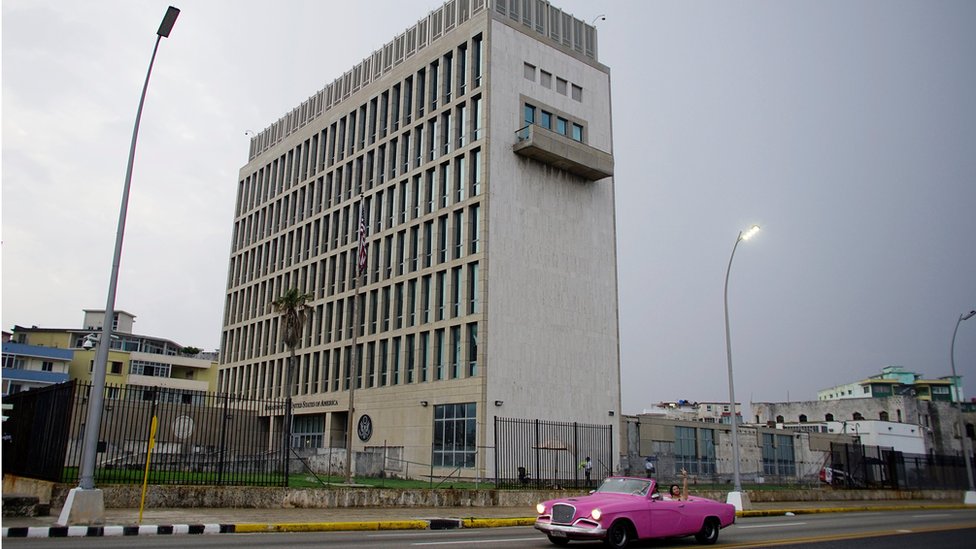
Image copyrightReutersImage caption The US says nearly two dozen staff were affected by the alleged attacks
Cuba says there have been no sonic attacks against US embassy staff in its capital, Havana, and that the claims are a “political manipulation” aimed at damaging bilateral relations.
Foreign Minister Bruno Rodriguez dismissed allegations of any kind of attack as “totally false”.
The US said nearly two dozen personnel had health problems after the alleged attacks and cut its staff as a result.
Reports suggest sonic attacks were to blame, but nothing has been proven.
Washington has not blamed Havana for the alleged attacks, and the Cuban government has previously denied targeting embassy staff.
The US expelled 15 Cuban diplomats, saying that Havana had failed to protect its employees, but Cuba said the move was “unjustified”.
The US government also suspended visa processing in Cuba indefinitely.
Image copyrightAFPImage caption Mr Rodriguez dismissed as false “any type of attack”
Speaking in Washington at a meeting of Cubans living in the US, Mr Rodriguez said the allegations have caused a “serious deterioration in the relationship between both governments and both countries”.
“It’s unacceptable and immoral, from the point of view of the Cuban government, for people to be harmed by a difference between governments,” he added.
The reported health problems ranged from mild brain trauma and deafness to dizziness and nausea.
Mystery in Havana
Late 2016: US embassy staff and at least one Canadian began to notice symptoms
May 2017: US expels two Cuban diplomats for failing to protect its diplomats
August: US says 16 employees have been treated but attacks seem to have stopped
Early September: US says attacks are continuing and 19 staff members have now been hurt
29 September: Washington pulls out diplomatic staff, warns US citizens not to visit and says 21 embassy employees now injured
3 October: US expels Cuban diplomats from Washington
Note: This story is auto-generated from BBC syndicated feed and has not been edited by AFRICA PRIME NEWS
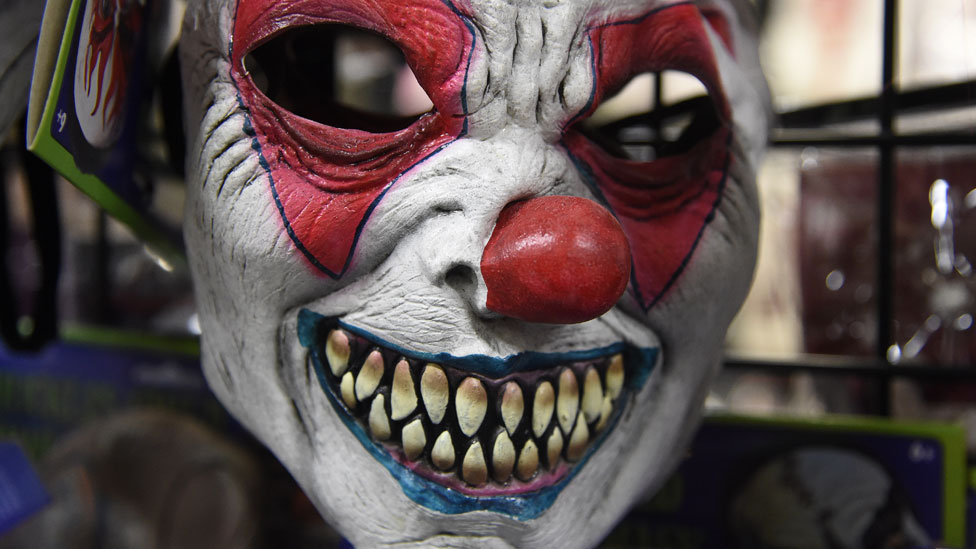
Image copyrightAFP/Getty ImagesImage caption Shopping for Halloween
Canadian schools are wrestling with how to guide students and parents towards Halloween costumes that aren’t considered offensive or culturally insensitive.
In early October, a Canadian school board emailed a checklist “Is my costume appropriate?” to parents planning their children’s Halloween costumes.
Fuschia Martians, mythical creatures, and animals got the all clear.
On the what not to wear list for 31 October – cowboy and Indian costumes, slaves, terrorist, gypsy, Rastafarian and “urban ghetto resident”.
The checklist from the Conseil scolaire Viamonde, which oversees 51 schools in Ontario, was criticised as an example of political correctness gone haywire.
But school board spokeswoman Claire Francoeur said the guidelines, first sent out in 2016, has generally garnered positive reactions from parents.
She says complaints mostly stemmed from stressed parents frustrated at “having another thing to think about” or who had hoped to recycle old costumes that failed the checklist.
The board believes strongly in its values of “respect for each other” and that includes Halloween, Francoeur says.
“We live in a society that has changed a lot in the past 10, 15 years,” she says. “So this is another change.”
Educators are trying to navigate the holiday where costumes must be neither too gory nor too scary, as well as age-appropriate and culturally sensitive.
The date 31 October is now being celebrated as “tie and scarf” day, one of four themed costume days the school settled on instead of celebrating Halloween.
Image copyrightCourtesy Ohio University Image caption Examples of Ohio University’s Students Teaching About Racism in Society costume campaign
In 2011, Ohio University launched the “We’re a Culture Not a Costume” campaign.
Similar campaigns have subsequently been adopted across North America, including by Canadian universities and primary and secondary schools.
Costumes have become a fraught issue on Canadian university campuses too.
Student unions have taken steps to avoid controversies like the 2014 one at Ontario’s Brock University, where white students dressed in blackface as a Jamaican bobsleigh team and won a prize for a get-up decried as racist.
Brock University’s student union now vets the costumes of people attending their annual Halloween party and refuses entry to participants who don’t to comply with costume rules.
The no-no list includes: black face, traditional or religious head dresses, geisha costumes, and Day of the Dead makeup.
Last November, Queen’s University said it would investigate after photos of students at a party dressed as Buddhist monks, Middle East sheiks and Vietcong was published online, sparking controversy.
At Waterloo University, the student union has launched an “I am not your costume” social media campaign.
“Making someone else’s culture and/or identity a caricature for you to wear for one night is a terrible costume idea,” the group says on its website.
But not everyone thinks dressing up as someone not of your culture or race is automatically problematic.
Image copyrightAFP/Getty Images Image caption A family shops for Halloween costumes
Ottawa writer Kate Jaimet wrote an op-ed for the Toronto Star – provocatively titled “The Halloween ethno-police frighten me” – after her four-year-old daughter was told she couldn’t dress as a “Native princess”.
“The message my daughter got was that she could not pretend – could not even imagine herself – to be a Native person,” Jaimet wrote.
Jaimet says she heard from some indigenous readers who explained to her why they felt the costume was inappropriate,
“I’ve realised that a child’s Halloween costume is not a hill to die on and that if agreeing that non-indigenous people shouldn’t dress up as indigenous people for Halloween is part of what it takes to have better race relations in this country, then I can accept that,” she told the BBC.
“But I don’t think that we should generalise that to saying that no child should wear a costume from any different culture, or that no artist should represent different cultures in their work, or that no one should incorporate the traditions or wisdom of other cultures into their lives.”
Jaimet’s daughter eventually dressed as an angel.
At Conseil scolaire Viamonde, students who show up in costumes that are “subject of discussion” aren’t sent home. Instead, they’re used to start in-class conversations.
Schools and boards across Canada have since reached out to Viamonde asking for copies of the checklist.
“For people who say we’re alone in this – I don’t think so,” says Francoeur.
Costume malfunctions elsewhere
Wesleyan University in Connecticut posted a flier advising students to avoid costumes with dreads, afros or anything that might “trivialise human suffering, oppression, and marginalisation”
A white student was expelled from a fraternity at the University of Central Arkansas for wearing blackface
At Texas’s Baylor University, students dressed up as maids and construction workers for a Mexican-themed “Cinqo de Drinko” fraternity party. The whole fraternity was suspended
In 2005, Prince Harry dressed up as a Nazi for a fancy-dress party and later apologised
Additional reporting by Robin Levinson-King
Note: This story is auto-generated from BBC syndicated feed and has not been edited by AFRICA PRIME NEWS
A mill town with high unemployment has seen its fortunes changed by Facebook’s need for data servers. But will the town have to radically change to save itself?
The people of Prineville live deep in a valley surrounded by dense forests. In the 1800s, it was the first place in central Oregon where white settlers drove out Native Americans to start a city.
Steve Forrester’s grandparents got here in 1902. When he was growing up in the 1970s, Prineville felt idyllic.
“It was a magical, magical place to grow up,” he remembers.
“My dad worked in the sawmill industry as an electrician; my mom didn’t work. We all learned to hunt and shoot a gun.
“We all learned how to drive in the forest before we were 16. In the spring, we could snow-ski in the morning and water-ski in the afternoon.
“And everybody had a job, and everyone did well.”
Prineville was the largest producer of ponderosa pine in the world. But when the federal government restricted logging and increased protections for animals like the spotted owl, the city’s milling industry was decimated.
As an adult, Forrester took a job with one of the few remaining mills, because he wanted to live in Prineville.
Eric Klann was driven by the same devotion. He’s the seventh generation of his family to live here. Out of college, he also took a job in Prineville that he knew wouldn’t last.
“There was always a little voice in the back of my head saying, ‘What are you doing – you want to be here, but you’re in a dying industry,'” he says.
A few years later, the US housing bubble burst and demand declined for parts made by the last mills. Lots of people lost jobs and left. It felt like Prineville couldn’t catch a break.
Image copyrightAlan BrandtImage caption One of Prineville’s new kind of “factory” – a data server farm
Both Forrester and Klann felt lucky to land jobs at the city – Forrester as city manager, Klann as city engineer. Their chance to save Prineville arrived in 2009 in the form of a mysterious email from a company called Vitesse.
“For the longest time, we had no idea what Vitesse meant,” he says.
All Klann knew is that Prineville’s natural resources made it perfect for a new industry – the information industry, created to save the massive amounts of information people post on the web.
Vitesse wanted to build a big warehouse and fill it with rows and rows of servers – servers that tend to get hot. Central Oregon’s cold nights could cool them naturally.
Klann remembers the first in-person meeting with Vitesse, and how it felt like Prineville’s last chance.
“Right before I walked into our conference room to meet with their nine lawyers, I got an email and our unemployment rate had peaked at 23%,” Klann says. “I got that email and I walked into that room, and I kept thinking, ‘I better not screw this up.'”
Klann and Forrester decided to outperform the other cities Vitesse was considering. They showed the company their small town could move at big-city speed, by responding to Vitesse’s questions day and night.
“What we heard back is that other cities weren’t doing that,” Forrester says.
Their strategy worked, and in 2010, Prineville finally learned who Vitesse actually was.
“They had the big finger with a thumb-up Facebook sign, and we all pressed the button and it lit up, et cetera,” Mayor Betty Roppe says, recounting the new data centre’s groundbreaking.
“That was the big announcement – it was Facebook.”
It was Facebook’s first data centre of its own. Mark Zuckerberg was there, and Roppe had planned to give him a cowboy hat to show the city’s pride in its cowboy culture.
“Cowboy hats are not cheap. They said, ‘Do not get Mark Zuckerberg a cowboy hat. He does not want a cowboy hat.’ OK. So, I got him a hoodie. He wears hoodies all the time,” she says.
When she presented the gift, Roppe gave Facebook’s founder a kiss on the cheek. “He just blushed like he wanted to have the floor open up and swallow him.”
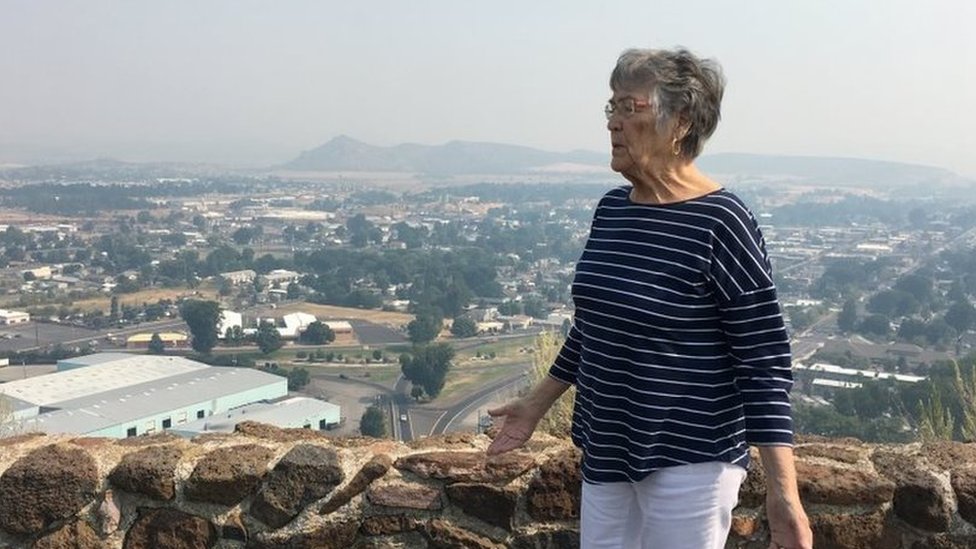
Image copyrightRupa ShenoyImage caption Mayor Betty Roppe oversaw Prineville’s transformation after data centres were built in the city
Seven years later, Facebook has two more data centres in Prineville and six others across the world. Apple’s moved into Prineville, too – it’s built three data centres here. All of them sit high above Prineville’s valley, in huge, long, flat buildings painted pale blue and grey so they blend in with the sky.
About 500 employees work in the centres, most of them from Prineville. Security’s tight, so few other people ever see inside. Despite their low profile, the data centres have had a profound impact.
Roppe says the mills taught Prineville a lesson – not to rely on just one industry. So they’re putting in things that appeal to lots of employers – like good roads, walking and biking paths, modern wastewater treatment, a new hospital and a state college outpost.
But now that the city’s successful, officials have a lot more to think about. Like, how do you slow success down?
“We can keep the small-town feel. I’m sure of it,” Roppe says. “We don’t want to be a big city.”
The cost of housing is up, so city officials know they have to build more affordable housing. And Mayor Roppe’s own granddaughter, with a college degree, can’t find a living wage job. So, they have to keep bringing in new employers.
All city manager Forrester can do is calibrate the development carefully. He worries about Prineville changing too much, too.
“We are small-town people. We live the Western lifestyle,” Forrester says. “The quiet and peace of central Oregon is a beautiful, beautiful thing, and to be able to make a living here is tremendous.”
But Forrester says he’s seen that central Oregon towns that don’t adapt will die.
And he knows they have to risk changing Prineville in order to save it.

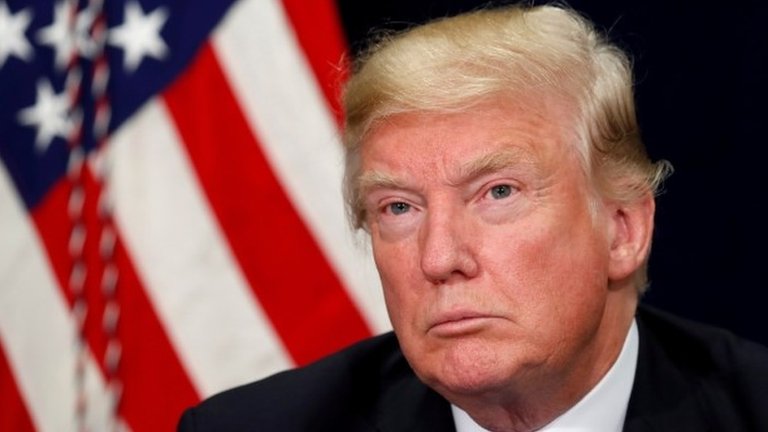
 Image copyright Reuters