Home Blog Page 1432

US sailors’ rescue: Doubts emerge over survival story

0

Media playback is unsupported on your device

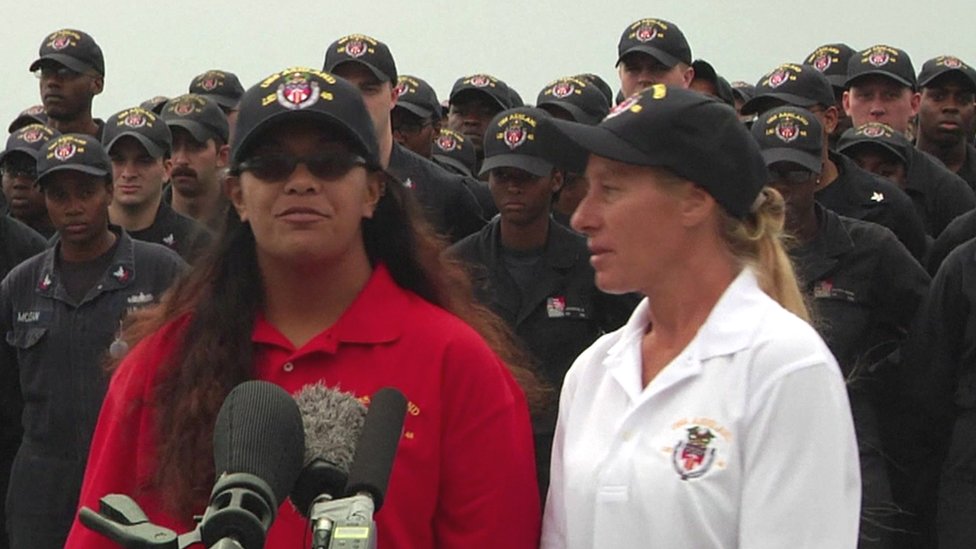
Media captionRescued US sailors Tasha Fuiava (left) and Jennifer Appel praise the US Navy for saving their lives

Doubts have emerged about the survival story told by two US women who said their lives had been saved when they were rescued by the navy after spending five months adrift in the Pacific.

The US Coast Guard said that neither Jennifer Appel nor Tasha Fuiava activated an emergency beacon onboard.

There appear to be inconsistencies in other details of their story as well.

The pair said they became adrift in May when their boat’s engine failed as they headed to Tahiti from Hawaii.

They said the boat was without power or communications in the open seas about 1,500km (930 miles) south-east of Japan before a fishing vessel alerted US authorities to rescue them last week.

The pair, travelling with two dogs, had strayed significantly from their planned course.

Ms Appel later said that she and Ms Fuiava were “incredibly lucky” to survive because they were running out of food and had endured a tiger shark attack.

Why are there doubts?

US Coast Guard spokesman Lt Scott Carr said that interviews with the two women – coupled with a Coast Guard review of the incident – revealed that the pair had an Emergency Position Indicating Radio Beacon (EPIRB) aboard, but did not turn it on.

Such devices emit a distress signal to help rescuers find vessels in an emergency.

It is unclear why the women did not do this if they were in distress, and there is no suggestion they did not know how to work the EPIRB – or that it was faulty.

Image copyright Getty Images
Image caption The women – and their dogs – say they survived thanks to a water purifier and a store of dry food

The women later said that they chose not to activate the EPIRB because they never feared their lives were in imminent danger.

Moreover, Lt Carr told the Associated Press (AP) news agency that when the Coast Guard made contact with the Sea Nymph – the name of the women’s boat – in June near Tahiti, the captain said that they were not in distress and expected to return to land soon.

He said that contact was made after the pair claimed they had lost use of their engines and sustained damage to their rigging and mast because of a storm.

It is also not clear if the women tested their radio equipment before they embarked on their voyage – last week they said they had six forms of communication on board but all went dead.

Retired Coast Guard officer Phillip Johnson told AP that the emergency beacons rarely fail and are designed to be suddenly dropped in the ocean.

What other parts of the women’s story have been questioned?

The pair said the tropical storm they encountered took place on their first night at sea in early May, and lasted for three days.

Image copyright Getty Images
Image caption There are inconsistencies in the story of Jennifer Appel (seen here being welcomed on board USS Ashland), critics say

But National Weather Service records reportedly show there were no such storms in the region during that time.

There have also been questions as to why the two dogs travelling with the women were in such good health if they were really engaged in a struggle to survive.

In addition critics have asked why the women did not use distress flares or stop at various islands on their route – including Maui, Lanai and Christmas Island – to get help. The Coast Guard is continuing to review the case.


You may also be interested in…


What do the women say?

On arrival in Japan, Ms Appel said that they owed their lives to the US Navy.

In a statement released last week they said that their engine broke at the end of May. They originally thought they would be able to reach land by relying on wind and their sails.

But two months into their journey – and long past their estimated arrival time in Tahiti – they began to issue distress calls, the statement said.

Ms Appel said they issued distress signals daily for nearly 100 days but received no response.

Image copyright EPA
Image caption There have been questions as to why the two dogs travelling with the women were in such good health if they were running out of food

They said they managed to survive the ordeal thanks to a water purifier and more than a year’s worth of dry goods such as oatmeal and pasta.

On 24 October, a Taiwanese fishing vessel spotted the 50ft (15m) Sea Nymph bobbing in the ocean and contacted authorities on the US territory of Guam.

The USS Ashland, which was in the area, arrived early the following day to rescue the sailors – both from Honolulu, Hawaii – and their canine companions Valentine and Zeus.

Sailors rescued after five months adrift in Pacific

Note: This story is auto-generated from BBC syndicated feed and has not been edited by AFRICA PRIME NEWS

Nigerian Minister Hails African lnternational Film Festival For Lifting Movie Industry

0
Nigeria’s Minister of Information and Culture

By Amos Tauna

Kaduna (Nigeria) — The Minister of Information and Culture, Lai Mohammed, has expressed delight with the initiative of the African International Film Festival (AFRIFF), for providing the platform for film-makers in Africa and the rest of the world to exhibit excellent movies.

He noted that the platform was to provide an avenue for filmmakers to engage themselves in creative conversations that would improve the profession.

Segun Adeyemi, Special Adviser to the Minister of Information and Culture, in a statement said Mr. Mohammed made the commendation on Sunday night in Lagos at the opening of the 7th edition of AFRIFF

“Standing here and gazing at this great gathering, I can feel the confluence of passion and creativity and the promises and possibilities that the future holds for the global movie industry,” he said.

Mohammed, who commended Nollywood for inspiring the movie industry in Africa, said the government of Nigeria was constantly engaging stakeholders towards growing the industry.

“The object of our gathering tonight, the platform on which we celebrate African and International film-makers, is one of the great stories of Nollywood, for AFRIFF – the festival with a vision to inspire and indeed create an ecosystem for the global movie community – was birthed because there is Nollywood,” he added.

The Minister disclosed that the government was pushing for a single-digit interest on loans for infrastructural developments for the Industry, and supporting the building of 100 community cinemas to be evenly spread across the country and also supporting them.

”We are also close to having a world-class pre and post-production facility using the current NTA infrastructure with a few additions,” he stressed.

He said with the advent of the Digital Switch-Over in television broadcasting, the federal government was ensuring that the set-top boxes are enabled to allow the 24 million TV households in Nigeria to buy movies with and without the need of data.

The Minister, who thanked AFRIFF for training 1,500 African aspiring film-makers at home and abroad in its untiring effort to develop the industry, stressed the need to have an industry that could deliver a profitable return on investment for all the players.

AFRIFF is the annual gathering of local and international filmmakers and professionals, celebrities, actors, directors, film critics, and other stakeholders.

Odimegwu Onwumere Makes Finalist In West Africa Media Excellence Conference and Awards

0
Odimegwu Onwumere

By G.U Chukwu

A Nigerian Journalist, Odimegwu Onwumere has made it to the final stage at the maiden edition of West Africa Media Excellence Conference and Awards held Saturday night, at the Mövenpick Ambassador Hotel, Accra, Ghana.

Onwumere emerged finalist in the Anti-Corruption Reporting Category, with his article published in ‘The Nigerian Voice’, Nigeria.

A statement by a three member judges of the awards in the persons of Ms. Sophie Ly, Mr. Lanre Idowu, and  Ms. Elizabeth Ohene, over 400 published stories that were sent in by journalists from 12 countries across West Africa. 15 journalists made the finalists from six categories.

Jesusegun Alagbe of The Punch, Nigeria, won in the Anti-Corruption Reporting Category.  

Commenting, Onwumere expressed delight for being a finalist, adding that it is an indication that he is doing better in his chosen career.

 He added that objective journalism pays better than an oppressive government anywhere in the world, especially such that Nigerians have come to endure in the recent times in the name of democracy.

Onwumere said that objective journalism is hated by oppressive leaders but journalists inclined in objectivity in their reportage would stop at nothing to expose the highhandedness of the looting leaders and keep in touch with the different communities of their ill behaviours.

 He, therefore, called on moneybags and the authorities to help journalism and journalists in this clime, by pumping in money to sustain them.

Alastair Leithead: Kenya re-run legitimacy unclear

0
flames shooting out of a tyre as a crowd looks onImage copyright AFP
Image caption Protesters in Kisumu, western Kenya, barricaded roads and burned debris and tyres during the election

The re-run of Kenya’s presidential election has taken place, but early signs are the overall turnout has been far lower than the first poll which was annulled by the Supreme Court.

The legitimacy of this election was being questioned even before the voting began, but if the 46% of the country who voted for the opposition last time have failed to turn up, the whole process will be further undermined.

Kisumu, like other parts of western Kenya, is an opposition stronghold and very few – if any – votes have been cast here.

The returning officer at Kisumu Central constituency tallying centre cut a lonely figure.

He and just two other Independent Electoral and Boundaries Commission (IEBC) officials turned up for work – out of the 400 who should have been running the poll here.

The ballot boxes hadn’t arrived by 07:00, but were then dropped off by a Prisons Service coach.

Media playback is unsupported on your device

Media captionA nurse explains how medics tried to save a man shot by police in Kisumu

Although the three IEBC staff went through the motions by placing the voting kits into each ballot box, there was nobody to take them to the polling stations or to oversee the election.

And even if there had been, they probably wouldn’t have been allowed to enter the various buildings in town set aside for voting.

Intimidation was the cause.

Commercial truck drivers didn’t want to risk carrying ballot boxes or voting slips, as gangs of youths were out, threatening anyone associated with trying to make the vote happen.

The main roads in Kisumu were blocked by lines of rocks and burning tyres every 150m (164yds), most of them manned by angry young men with sticks.

They shouted anti-Kenyatta slogans and complained at the way the police were firing live bullets and teargas to disperse the protests.

Throughout the day they played a cat-and-mouse game with the security forces: rocks and slingshots versus teargas and in some cases live ammunition – usually fired overhead.

But there were a handful of gunshot injuries and at least one person was killed.

George Odhiambo, 19, was brought into hospital with a serious bullet wound in his upper leg and died after losing too much blood.

Image copyright AFP
Image caption The returning officer in Kisumu Central, John Ngutai Muyekho, said he had been struggling to distribute voting materials

When Kenya’s Supreme Court annulled the August presidential election, the decision was lauded as a triumph of judicial independence and African democracy in action.

Both were shattered in the lead-up to the vote.

Riddled with bullets

The courts were kept busy trying to cope with claims and counter-claims, but two key things will haunt this second ballot and provide ammunition for claims of illegitimacy.

The first was the hail of gunfire that seriously injured the deputy chief justice’s bodyguard two nights before the ballot.

The second was that Supreme Court judges were simply unwilling to turn up to work.

It’s perhaps not surprising Lady Justice Philomena Mwilu did not attend court the morning after her car was riddled with bullets.

Luckily she was not in the vehicle at the time.

It was clearly interpreted as a serious threat to her life – a grotesque and blatant attempt to intimidate the country’s second most senior judge.

And it worked.

Image copyright EPA
Image caption The Supreme Court is Kenya’s highest – Lady Justice Mwilu is second left, Chief Justice David Maraga centre – library picture

The Chief Justice, David Maraga, apologised to all parties who had gathered for an urgent petition asking the court to stop the re-run of the presidential vote the day before the ballot.

They were unable to hear the case, he said, because they didn’t have a quorum.

Five of the court’s seven judges must be present for decisions to be valid, but only two made it into work that day.

Lady Justice Mwilu was not in a position to come to court “following the events of last night which are in the public domain,” the chief justice said.

Media playback is unsupported on your device

Media captionAfrica Editor Fergal Keane visits two very different Kenyan polling stations

Justice Mohammed Ibrahim had been ill for some time and was out of the country.

Lady Justice Njoki Ndung’u was “unable to get a flight back to Nairobi in time” and Justices Ojwang and Wanjala “are not able to come to court,” he said, without any further explanation.

‘Difficult to guarantee’

The highest court in the land – with an opportunity to rule on the contradictions of electoral law, the constitution and its various interpretations – stepped back and allowed the election to go ahead without further discussion.

Image copyright EPA
Image caption Kenya faces continued uncertainty following the vote

The case has been suspended – it will no doubt be revisited, but only after it’s too late.

After faith in the IEBC was shattered by its failings on the first attempt, it seems unlikely a large percentage of the population will accept the re-run result.

Just last week the chairman of the IEBC, Wafula Chebukati said: “It is difficult to guarantee a free, fair and credible election.”

But he nevertheless announced the ballot would go ahead, “based on the assurances given to the commission” on security and on the progress made in ensuring the vote was free and fair.

And in many parts of the country it did go ahead – ruling party strongholds no doubt recorded plenty of votes, but overall it appears the numbers are down.

The lower the turnout, the louder the voices of dissent will be.

And with opposition strongholds unwilling to vote and seemingly prepared to prevent others from doing so, Kenya faces continuing uncertainty.

Note: This story is auto-generated from ‘BBC News’ syndicated feed and has not been edited by Africa Prime News staff.

Ethiopia and Rwanda to meet in play-off for place at 2018 CHAN

0
Egypt were originally eliminated from the CHAN by new hosts Morocco in August

Ethiopia and Rwanda will meet in a two-legged play-off for the right to replace Egypt at the 2018 African Nations Championship (CHAN) in Morocco.

Egypt pulled out of the tournament– which is for African players based in their domestic leagues – because of a timing clash.

Ethiopia and Rwanda were eliminated in the final round of East Zone qualifiers, and the Confederation of African Football (Caf) confirmed both teams had been picked for the play-off as “a part of a concern for fairness”.