Media captionTexas officials give details on church mass shooting
At least 26 people have been killed and 20 others wounded after a gunman opened fire at a Texas church during Sunday service.
The attack happened at the First Baptist Church in Sutherland Springs, a small town in Wilson County. The victims’ ages ranged from five to 72.
The suspected gunman was later found dead in his vehicle some miles away.
Police identified him only as a “young, white male”, but US media named him as Devin Patrick Kelley, 26.
Kelley is reported to have been discharged from the US Air Force in 2014 following a court-martial for assaulting his wife and child.
The motive for the killings is not yet clear.
Image copyrightAFPImage caption A candlelit vigil was held for victims of the shooting in Sutherland Springs
Texas Department of Public Safety regional director Freeman Martin said the attacker, dressed all in black and wearing a bulletproof vest, opened fire with an assault-style rifle outside the church at around 11:30 local time (17:30 GMT) and then went inside.
As the gunman left the church, a local citizen grabbed his own rifle and began shooting at the suspect, who then dropped his weapon and fled in a vehicle.
The citizen pursued the suspect, who eventually drove off the road and crashed his car at the Guadalupe County line.
Police found the man dead in his car, but it is unclear if he died from a self-inflicted gunshot wound or from injuries received when fired on by the local citizen. The car contained several weapons.
Mr Martin added: “We have multiple crime scenes. We have the church, outside the church. We have where the suspect’s vehicle was located.
“We have been following up on the suspect and where he’s from. We have Texas Rangers at all the hospitals locating those and interviewing those who were injured.”
Governor Greg Abbott, confirming the death toll, said it was the worst mass shooting in the history of Texas.
“This will be a long, suffering mourning for those in pain,” he said at a news conference on Sunday.
Media playback is unsupported on your device
Media captionDriver Jordan Steubing describes the scene
The First Baptist Church’s pastor, Frank Pomeroy, told ABC News that his 14-year-old daughter, Annabelle, was among those killed.
Mr Pomeroy, who was in Oklahoma at the time of the attack, described her as “one very beautiful, special child” in a phone call to the television outlet.
At least 10 victims, including four children, were being treated at the University Health System in nearby San Antonio, the hospital said in a tweet.
Sheriff Joe Tackitt said authorities could not confirm the names of any victims yet as they continued to work through the crime scene.
Officials said 23 people were found dead inside the church while two people were fatally shot outside. Another died in hospital, authorities said.
Media playback is unsupported on your device
Media captionHow US mass shootings are getting worse
One witness, Carrie Matula, told NBC News: “We heard semi-automatic gunfire… we’re only about 50 yards away from this church.
“This is a very small community, so everyone was very curious as to what was going on.”
Sutherland Springs, which has a population of about 400, lies about 30 miles (50km) south-east of the city of San Antonio.
Media playback is unsupported on your device
Media captionA guide to the weapons available in the US and the rate at which they fire
President Donald Trump, on a tour of Asia, said the gunman was “a very deranged individual” and denied that guns were to blame for the shooting.
“We have a lot of mental health problems in our country, but this isn’t a guns situation,” he said.
The shooting comes just a month after a gunman in Las Vegas opened fire on an outdoor music festival, killing 58 people and wounding hundreds in the deadliest mass shooting in recent US history.
Are you in the area? If it is safe to do so let us know about your experiences. Email haveyoursay@bbc.co.uk with your stories.
Please include a contact number if you are willing to speak to a BBC journalist. You can also contact us in the following ways:
US President Donald Trump has lashed out at Japan over trade and said he would push for a fairer economic relationship between the two countries.
Speaking to business leaders in Tokyo on Monday he said Japan “has been winning” on trade in recent decades.
He also called on Japan to build more cars in America, a claim at odds with industry data on manufacturing.
Mr Trump’s comments come at the start of a 12-day Asian tour expected to be dominated by North Korea and trade.
The US leader said his country had “suffered massive trade deficits at the hands of Japan for many, many years”.
“We want free and reciprocal trade but right now our trade with Japan is not free and it’s not reciprocal and I know it will be and we’ve started the process,” Mr Trump told the group of US and Japanese executives.
He praised Japan, which counts the US as its second largest trade partner after China, for buying American military hardware.
Mr Trump also said he wanted his country to be the most attractive place to hire and invest.
Trade ties
Japan had a $69bn (£52.8bn) trade surplus with the US in 2016, according to the US Treasury department.
The remaining 11 nations to the Trans Pacific Trade partnership are proceeding with negotiations on the agreement without the United States.
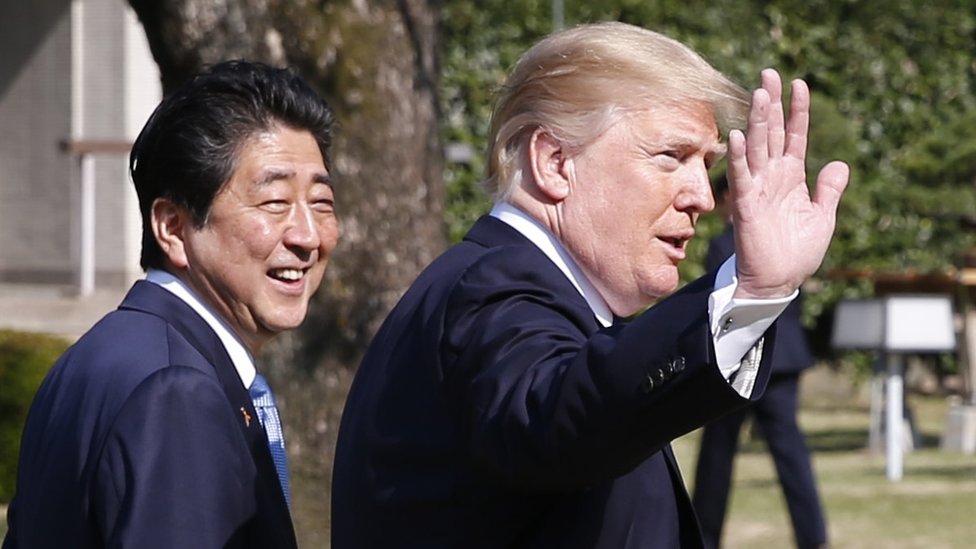
Image copyrightAFPImage caption Japanese prime minister Shinzo Abe held formal talks with US president Donald Trump in Tokyo on Monday
Made in America
Mr Trump also took aim at Japanese carmakers in Tokyo on Monday.
“Try building your cars in the United States instead of shipping them over. That’s not too much to ask,” the US president said at the briefing, adding, “is that rude to ask”?
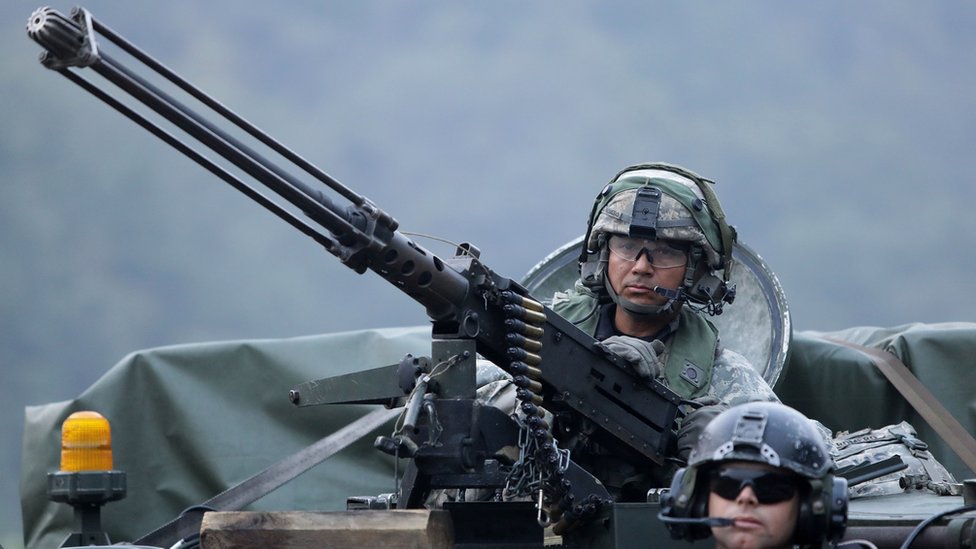
Image copyrightGetty ImagesImage caption US soldiers take part in “Warrior Strike” exercises in South Korea in September
A Pentagon assessment has declared the only way to completely destroy all parts of North Korea’s nuclear weapons programme is through a ground invasion.
Rear Admiral Michael Dumont expressed the opinion on behalf of the Joint Chiefs of Staff in a letter to Congressman Ted Lieu.
Mr Dumont said calculating “even the roughest” potential casualty figures would be extremely difficult.
He also gave some detail on what the first hours of a war would involve.
“The only way to ‘locate and destroy – with complete certainty – all components of North Korea’s nuclear weapons programs’ is through a ground invasion,” he wrote in response to Congressman Lieu’s questions about a potential conflict.
The risks involved included a potential nuclear counter-attack by North Korea while US forces attempted to disable its “deeply buried, underground facilities”, he said.
“A classified briefing is the best venue for a detailed discussion,” he added.
The Joint Chiefs of Staff directly advise the president of the United States on military matters.
In a statement with more than a dozen other military veterans turned congressmen, Mr Lieu, a Democrat, said the assessment was “deeply disturbing” and warned that a conflict “could result in hundreds of thousands, or even millions of deaths in just the first few days of fighting.”
“Their assessment underscores what we’ve known all along: there are no good military options for North Korea,” the statement said.
The letter was published as Donald Trump begins his mammoth tour of Asia, during which the North Korean threat is expected to be a major topic of discussion.
The president has previously said that if forced to defend the US or its allies, he “will have no choice but to totally destroy North Korea.”
“The President needs to stop making provocative statements that hinder diplomatic options and put American troops further at risk,” Mr Lieu’s joint statement said.
Media playback is unsupported on your device
Media captionTrump: ‘Rocket Man’s suicide mission’
Rear Admiral Dumont opened his letter with a clear indication that his office supported economic and diplomatic solutions ahead of any military action.
Potential casualties from a conflict depended heavily on the intensity of any attack on South Korea’s capital, Seoul, which lies just 35 miles (56 km) from the border, as well as how much advance warning the US and its allies had, he said.
He said a counter-offensive from artillery battery fire and air strikes might help limit casualties.
The Joint Chiefs also fear that Pyongyang would use biological weapons in a conflict, despite international conventions banning their use, as well as chemical weapons – which it has never agreed to abandon.
“It likely possesses a [chemical weapons] stockpile,” the letter said.
The assessment by military chiefs follows the release of a report from the non-partisan Congressional Research Service, which warned that even a brief conflict without the use of banned weapons could cost tens of thousands of lives.
Note: This story is auto-generated from BBC syndicated feed and has not been edited by AFRICA PRIME NEWS
Kaduna (Nigeria) — Kogi Journalists Forum (KJF), has condemned in strong terms the recent sponsored publications in some national dailies, names of the entire civil servants by the Kogi State government to disguisedly convince Nigerians that they had been paid their salaries.
The money wasted on this ill – advised exercise would have been used to settle the backlog of salaries of workers in some ministries or agencies.
The Forum, a body of journalists from Kogi State based in Kaduna, northwest Nigeria, stated this in a communique at the end of its meeting to deliberate on what it calls a disturbing situation in Kogi, north central of the country.
The journalists who see the situation as a total failure in their home state, asked all leaders of thought and friends across the country to speak to the Governor to have a change of mind.
According to the communique,”It is no longer news that workers in the state are not being paid and the state government has continued with propaganda aimed at hoodwinking the people.
Truth must be told, that Kogi has never had it so bad since its creation.
Government programmes and policies are yet to touch the lives of the people, rather it continued embarking on an endless verification exercise leading to the deaths of innocent Kogites.
“Recently, a senior civil servant whose wife gave birth to triplets committed suicide by hanging himself because of the failure of government to pay salary.
The administration reportedly mis used the bailout funds to purchase vehicles for police and traditional rulers. This colossal fund could have squarely gone a long way in tackling some of the challenges bedeviling the state.
“We condemn government’s resort to attack on personalities when issues concerning the state are raised. The Journalists are wondering why millions of naira should be used by the state government in publishing names of workers it claimed to have paid.
“We see this as a dearth of administrative incompetence on the part of Yahaya Bello and his media team. This is an unnecessary expenditure on the part of government and we condemn it.
“The state government should immediately put its acts together and settle workers salary if the administration is worthy being at the Lugard House.
“It is divinely unpardonable to deny workers the fruit of their labour.
“Workers are being owed salaries of 21 and government is not worried, haba.
“This government on assumption of office timidly demolished roundabouts in Lokoja, the State capital and up till now, it has not been able to rebuild them, the people must talk, they cannot keep mute.
“The silence of APC and the Presidency over the plight of Kogi people is a sign of conspiracy against the people that voted enmass for the party in 2015 “, the communiqué frowned.
In this report, Odimegwu Onwumere unearths that the utilisation of the local content in the oil and gas sector is still a tall dream since the Nigeria Oil and Gas Industry Content Development Act was enacted in 2010; and $380b dollars or more have been lost in 50 years in the industry, upon the billions of dollars also being pumped in, to sustain the scheme
Stakeholders in the oil and gas sector and the federal government have been gasping for breath to fashion out a lasting plan for the utilisation of the local content in the sector since the Nigeria Oil and Gas Industry Content Development Act was enacted in 2010. This socio-economic term, which is as old as man, has had setbacks in several occasions in the country with companies and the authorities pumping in money into the initiative that is habitually never accomplished. The incessant hope given by opinion leaders pointing out that by making use of local content, about $191 billion could be maintained, while 300,000 new nonstop job opportunities were green in such areas as engineering, sciences, technical services and manufacturing of the oil and gas sector, might have been dashed by the oil companies and Nigerian authorities.
The “exploration, production, manufacturing, fabrication, procurement and allied services sectors of the oil business” which were the canons for the implementation of local content in the oil and gas sector are not being realised with the attendant results they deserve. Most times, while the stakeholders push to accomplish the “value added in local oil industries”, they make loss upon creating proposed chances and heartening indigenous oil companies to vigorously take part in maximizing local content.
Investigation by this writer has revealed that the local content, which was supposed to be a win-win affair, has been laced with controversies by the different stakeholders; hence there is a gap in promoting alliance amid “national oil companies, local companies and international organization.” The local content initiative is still struggling to be all inclusive, because there is drought of enabling environment for business, therefore leading to un-optimized moves to carry out Corporate Social Responsibility (CSR) by the companies involved and not insuring utmost earnings for all.
Billions Of Dollars On Local Content The Nigerian National Petroleum Corporation (NNPC), defines local content in the oil and gas company as “The quantum of composite value added or created in the Nigerian economy through the utilization of Nigerian human and material resources for the provision of goods and services to the petroleum industry within acceptable quality, health, safety and environment standards in order to stimulate the development of indigenous capabilities.”
To realise this, experts have said that the government of Nigeria made mammoth venture up to $10 billion USD yearly to achieve 70% local content goal by the end of 2010 in the oil and gas sector. But as spectators have seen, the aim was defeated.
However, just on October 16, 2017, Vice Chairman/ Managing Director of Nigerian Agip Oil Company (NAOC), Mr. Massimo Insulla, while speaking during this year’s Nigerian Content Activities, hosted by Eni in Yenagoa, disclosed that the company spent over $5.4 billion in making sure that the Nigerian content gets to the peak in the last six years.
This is even as Chevron Nigeria Limited (CNL) said it spent $2.5 billion on local content development in Nigeria’s oil and gas sector, “representing 65 per cent of the total Nigerian goods and services expenditures for the year.”
According to Chairman of the Board and Chief Executive Officer of Chevron, John Watson, “We do so through partnerships with national and local governments, national oil companies, Non-Governmental Organisations (NGOs), and development agencies.”
Upon Companies Boast Of Expending Billion Dollars Meanwhile, the Federal Government by August 24, 2017, had geared up to launch $200m (about N61bn at the official exchange rate of N305 to a dollar) local content interference fund. This was apart from its unyielding billions of dollars expended yearly to end local content quagmire by the end of 2010 that never came to light.
According to the Federal Ministry of Petroleum Resources, the novel move was “in pursuant of the Business Environment and Investment Drive Component of the #7BIGWINS, known as a document of the ministry that focuses on the short and medium-term priorities targeted at growing the nation’s oil and gas industry between 2015 and 2019.”
But on the contrary, the Nigerian Content Development and Monitoring Board (NCDMB) might not be certain with its compass’s navigation on the local content. On September 25 2017, in Lagos, the NCDMB said that it was looking up that the Nigerian Content Intervention (NCI) fund would hit $1 billion in the next three years. It could be sensed that the NCDMB was using permutation in carrying out its national duty than it was using betting. This is even as it had said through its Executive Secretary, Engr. Simbi Kesiye Wabote at a public hearing conducted by the Joint Senate Committee on Petroleum Upstream and Gas in Abuja on July 26 2017 that it intended to establish a Local Content Bank of Nigeria.
While the NCDMB might not be certain with accountability of the funds to the tone of trillions of naira dished out for various projects over the years, media reports affirmed, “The bank when set up will focus on establishment of facilities for domiciliation of services with emphasis on the optimal use of local resource inputs.”
Buttressing this, Wabote in December 2016, (during a media dialogue on his plans to make these companies to meet the terms with the Nigeria Oil and Gas Industry Content Development (NOGICD) Act 2010 by making a payment to the Fund) gave an insight that some companies do not remit their one per cent contributions to the Nigerian Content Intervention (NCI) Fund.
Explaining, those who know better said, “The NCI Fund is a pool made available by the NCDMB to meet the funding needs of manufacturers, service providers and other key players in the Nigerian oil and gas industry. It was however, gathered that some upstream companies do not contribute to the NCI Fund at all.”
Meanwhile, this is contrary to a July 27 2017 report, stating, “On the Nigerian Content Development Fund (NCDF), the Executive Secretary reported that international oil companies comply reasonably in remitting one percent of the value of their contracts but some service companies and indigenous operating firms default in their payment.”
$380bn Lost In Oil/Gas Sector Due To Lack Of Local Content While Nigeria was boasting of the billions of dollars she had expended in boosting local content in the oil and gas sector, by September 2017, while speaking at an oil and gas forum held in Accra, Ghana, Wabote disclosed that a whooping sum of $380b dollars or more have been lost in 50 years in oil and gas industry in the country.
“This capital flight is due to the absence of regulation on local content development in the oil and gas industry,” said the source.
However, Wabote added, saying, “Local content development in Nigeria has brought about the domiciliation and domestication of value addition in the oil sector, culminating in 26 percent in-country value retention compared to the five percent prior to the enactment of the Local Content Act in 2010.”
While this lasted, at the opening of the sixth Practical Nigerian Content Conference, in Abuja, in September 2016, to enlarge implementation of the local content policy to the midstream and downstream of the oil and gas sector, Wabote had explained that “a blueprint would soon be unveiled to attract the needed investment to the sector. And besides the creation of industrial parks for the sector, the NCDMB is also working towards the establishment of three pipe mills across the country.”
100% Local Fabrication Of Modular Refineries At the same time, Nigeria can be seen is confused on how to go about her local content, whereas in 1962 when Norway’s offshore oil industry took off, the country recorded a huge growth in its Gross Domestic Product (GDP) and by 1965, the Norwegian Petroleum Law was enshrined and by 1972, the local content law was enacted in Article 54 of the Royal Decree of 1972.
According to reports, “The Royal Decree of 1972 mandated that Norwegian government should vigorously pursue the goal of insuring that Norwegian goods and services be given preference in the running of the oil and gas industry, provided they were competitive in terms of price, quality, schedule and service.” But since the 50s oil was explored in Nigeria at Oloibiri, a small community in Ogbia LGA located in Bayelsa State, Nigeria was by August 24, 2017 ‘still’ initiating plans to achieve 100 per cent local fabrication and this is especially of modular refineries in Nigeria.
A discussion with the Original Equipment Manufacturers (OEM), the federal government was also not certain when to achieve a lasting use of local content in the oil and gas sector. Just as it has been pumping billions of dollars in order to realise the local content by the end of 2010, the federal government through the Minister of State for Petroleum Resources, Dr. Ibe Kachikwu was not certain when the deadline for the local fabrication of oil vessels and Floating, Production, Storage and Offloading vessels (FPSO), would berth. This is even as “the Bank of Industry said the newly launched $200 million intervention fund could be used for contract financing and loan refinancing for oil companies.”
According to the media, “Speaking at the Memorandum of Understanding (MoU), signing ceremony on the implementation of the $200 million Nigerian Content Intervention Fund (NCIF), between BoI and the Nigerian Content Development Monitoring Board (NCDMB), Kachikwu said Nigeria would not continue to award contracts, but set deadlines on when to localise most of the vessels and projects in the country.”
Senate Uncertain With Local Content Implementation In Oil Industry While the Malaysian oil industry began in the 1950s and objectives set for Malaysia’s oil and gas policy, which was to “maximise local benefits through the development of local capabilities and industrial base to support the growing onshore and offshore oil and gas industry”, Nigeria was thus far probing the local content implementation in the oil and gas industry in the country by July 18 2017.
The Red Chambers at the National Assembly was afraid that investors were not considering Nigerian companies while investing, hence the senate referred the investors to Nigeria Oil and Gas Industry Content Development Act, which states inter alia: “Investors were mandated to consider Nigerian companies as an important element in their project development and management.”
According to news reports, “The Senate Joint Committee on Petroleum Resources (Upstream) and Gas Resources has commenced investigation into the implementation of local content in the oil and gas industry in the country.
“Opening the session of an investigative hearing on the issue on Tuesday in Abuja, President of the Senate, Bukola Saraki, who was represented by the Leader of the Senate, Sen. Ahmed Lawan, said the National Assembly was concerned with the level of implementation of local content in Nigeria.”
It is expected that the stakeholders in the oil and gas sector will get the local content right this time with Wabote saying recently that NCDMB was presently putting into practice a 10-year tactical roadmap fastened on transporting five pillars of sustainable local content, with an intention of attaining 70 per cent of local content in the next 10 years.
Odimegwu Onwumere is a Poet, Writer and Media Consultant based in Rivers State. Tel: +2348032552855. Email: apoet_25@yahoo.com
Dubbed sometimes as the political capital of Africa, Addis Ababa is a buzzing hub of economic, social and political activity and home to monuments of great collections which include but not limited to: Ethiopian National Museum which houses the fossilized skeleton of Dinkinesh, or Lucy, the Australopithecine discovered in the area in the 1970s, Ethnological Museum, Tiglachin Monument and the Holy Trinity Cathedral, which is home to the tombs of the Emperor Haile Selassie I and Empress Menen Asfaw, as well as other members of the Imperial Family.
Located in the eastern part of Africa, Ethiopia is also known for its strong roots to Reggae and thus will forever remain at the heart of many reggae enthusiasts around the world.
Alli Suliat, a graduate of Chemistry from one of Nigeria’s most prestigious university and an obsessive tourist recently journeyed Addis Ababa.
In this interview with Alli Abiola, she recounts her experience.
Welcome back from Addis Ababa, what informed the tour in the first place? Did you travel alone or in company with a group?
The tour was a treat from dad since I recently graduated from the university. It was more like I went there to relax and have some fun. I travelled with my dad and brother. They both live there, I was their guest then and it was the second visit.
How will you describe the trip?
The trip was awesome. I had a swell time and I learned a bit about their culture.
How long were you there, and where did you stay?
I spent three weeks in Ethiopia. I stayed in the capital city, Addis Ababa (which is not too far from Bole – where the airport is located).
Tell us the most interesting place(s) you visited?
I visited their national museum in Adidas Ababa University. I was fascinated to see the popular Haile Selassie’s bedchamber and that of his wife too, at the museum. I also visited the oldest church on top of the hill (you could see the whole city from there) and their first empire’s residence is also situated there; I mean the original house he lived in. At the museum, I saw Lucy’s fossil and so many other things related to their ancestors, culture, and ways of life.
What was the first thing that caught your attention in Ethiopia?
The people, their skin colour. Having visited a number of African countries, I always had this mentality that everyone in Africa is black or dark in complexion. I was surprised. Not that they don’t have dark skinned Ethiopians but not as dark as ours. Also, the AU building in Addis Ababa, Ethiopia caught my attention, it’s magnificent, and the architectural design is on point (It was actually designed by a Nigerian, so I heard), I see the building from my bedroom window every day and the evening I passed by it, I was glued to the car window staring in awe.
Are there similarities between Ethiopia and Nigeria?
Yes, they are both African countries (big grin). Well! About the similarities, I can’t say much, the two countries are quite distinct. Addis Ababa is also a bustling city like Lagos and so much development is still taking place there.
I interacted with some locals and from what they said; I was able to deduce that most people come from other parts of the country to make ends meet there (Addis Ababa) which is quite similar to our Lagos. I don’t know if this makes sense, but that’s how similar they are to me.
What particularly impressed you about Ethiopia(ns)?
(Maybe because) Ethiopia wasn’t colonized. Planning the trip, I thought I was going to an ancient country, however, on arrival, I was impressed with how far they had gone even though they still relish their culture and heritage so much. The country is still developing though, and they have excellent coffee (smiles).
I was also impressed with the fact that even though the world is changing around them and so much is going on, they are still stuck on and respect their culture and heritage so much. They still use their own ancient calendar (Amharic) etc.
They are mostly Orthodox Christians. I didn’t come across any Pentecostal church or whatever, and this is their ancient way!
Do you think there is anything spectacular about the local food and the music?
Well, the most popular food there is Injeera (a staple flatbread) and they have varying sauces for it. They’ve got excellent coffee as well; I enjoyed all my coffee dates and I was always looking forward to the next (date).
Their music is rich too, they have different music, based on the tribes (they have three major tribes and they include: Amhara, tigre, oromo) etc.
They have a common cultural cloth which has different patterns, designs. I was opportune to visit the cultural market. They greet a lot there, you greet virtually every stranger you come across. They are nice people. They admire and respect foreigners a lot.
How was the weather of the city you visited? Was it friendly?
Yes, it was friendly! The temperature is always cooler, than Nigeria’s weather condition and not as sunny. Because of the altitude, I believe.
Ethiopia is said to have strong roots to Reggae. How true is that?
I can’t say because I wasn’t there for so long to know this and the locals I interacted with, the music I heard, isn’t enough to support that fact.
As a Nigerian, what are those thing(s) or idea(s) worth emulating from Ethiopia(n)s?
Food is cheap there (smiles). Where I resided, electricity was 20 hours a day on the average, (I can’t say about other parts of the country), but in the part of Nigeria where I reside, we can’t boast of that. Their government is working over there; you will see signs of this in every corner of the city and from the interactions I made with the locals, they said their government is trying but you know Nigeria is really richer than Ethiopia.
Are you saying we can import electricity from Ethiopia?
(Laughs), Not in that context; though the Nigerian government and agencies should please work on this, it’s a shame that our country even as rich as we are, I mean we are the African giants, we can’t boast of stable electricity.
It’s a big shame. Comparing Ethiopia with Nigeria, their government is really working and the people are hardworking. The country is majorly into coffee export in Ethiopia compared to Nigeria’s oil.
Whenever I said I was from Nigeria to them it’s like I am from the US or UK, they always wanted to talk to me, ask me about Nigeria. I couldn’t divulge how messed our country is. Things are generally cheap in Ethiopia.
How would you rate the reception of Ethiopians to foreigners, particularly, Nigerians?
On a scale of 10, I will give Ethiopia 9. Indeed, they are so good at receiving foreigners,you will know this right from the plane, that is, the Ethiopian airline.
How much about Nigeria do they know in Ethiopia?
Interestingly, they know the good stuff basically. Some also know about the insurgency in the north- an Ethiopian actually asked me about it.
(Smiles) On a particular day, I was in a public transport; a man got on the bus, he looked at me and said “you are not Ethiopian”, I replied with a “Yes, I am a Nigerian”, his response was; “wow, Dangote’s country!!!” He was amused. So they know quite a lot about us and are willing to know more. On another occasion, an Ethiopian said to me; “Nigeria is a powerful country, strong one.”
What would a first-time visitor find most striking about Ethiopia?
The air! The ambiance is just different, the way they speak too; they speak a lot in their local language. The most popular one is Amharic, right from the airport; you will be hearing “Salam naesh.” The air there is just different, the streets smell so spicy and you can spot coffee stalls or sellers at almost every corner.
What do Salam naesh means?
It means hello.
How would you assess their Technology industry over there, compared to Nigeria?
To me, Nigeria’s tech industry is more advanced than theirs, not that Ethiopia is really lagging behind, but they can still improve.
On what area, please?
You don’t see many locals hooked on the internet in Ethiopia like Nigeria. Even from what I observed, it’s like they are just starting out with regards to that. Although, most of them use smartphones, can’t be compared to Nigerians.
From what I heard too, they have many remote areas in the country. Addis Ababa (maybe because it’s the capital city) is the most developed part of the country, so definitely tech might be in shape there, but not other parts of the country; unlike Nigeria.
What else don’t we know about Alli Suliat?
I love traveling a lot! I will tour more countries of the world. I am still within Africa, at the moment. Ghana, Togo, Benue republic and Ethiopia is gone, others to come!!! Then I will start touring Europe, the Americas, Insha Allah.
On a Final note, if you could give an intending traveler a vital advice. What would that be?
You should always wear a smile. You will get help real quick in some situations. Also, it’s not every food seen on the streets; you should consume or eat, even though they are so cheap. Take caution so that your intestines wouldn’t get clogged.
We, tourists like things such – always eager to taste all delicacies. I would advise that you’d please always carry bottled water around too, their altitude there is quite different from ours here, and one gets tired easily without doing much. Water will help; I was also advised on this.
I am still trying to understand this, maybe you should check up on it, though. Dad was always advising me to drink water and take lots of fruits there; one can easily get flu so as to prevent it. Maybe, because I am a foreigner. Stay healthy to enjoy your trip o!
Ethiopia has lots of fine diners too; International cuisine etc. I even went to a Nigerian and Chinese restaurant. They have excellent meals even the Japanese as well.
Cho! (In Ethiopian language, that would mean ‘Bye’).