Home Blog Page 1420

Texas shooting: Gunman Devin Kelley ‘had row with mother-in-law’

0
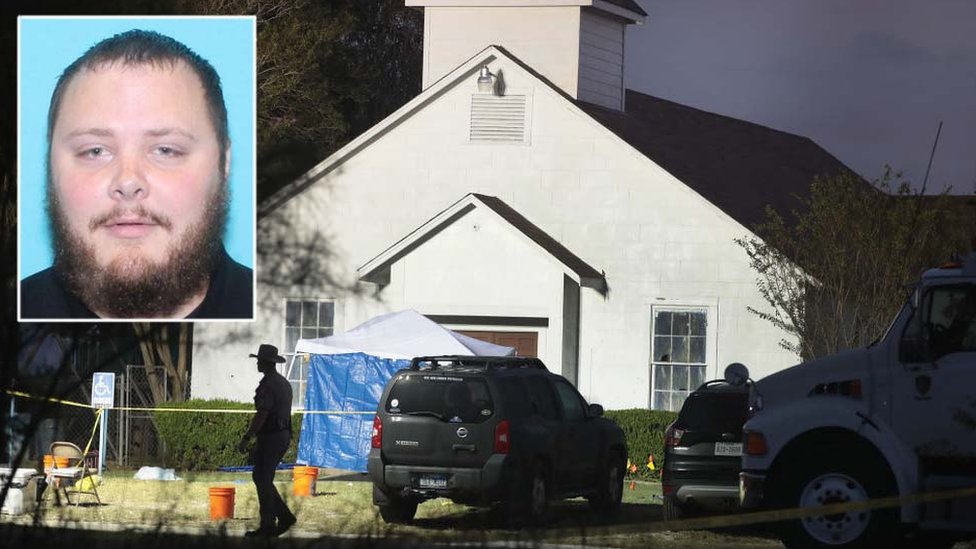
Texas church gunman Devin Patrick Kelley (L) and the First Baptist Church in Sutherland Springs, a small town in Wilson County, Texas.Image copyright Getty Images
Image caption Kelley is believed to have been in a family row with his ex-wife and in-laws, police say

Texas church gunman Devin Patrick Kelley was armed with three guns and had argued with his mother-in-law before the rampage, officials say.

The attack on the small church outside San Antonio during Sunday services left 26 people dead and 20 injured.

Kelley called his father after he was shot by an armed bystander and said he did not think he would survive.

He was not legally permitted to own the weapons, which included a semi-automatic rifle and two handguns.

Freeman Martin, the regional director for the Texas Department of Public Safety, told reporters it appeared that Kelley died from a self-inflicted gunshot wound after first being shot by a “good Samaritan”.

“This was not racially motivated, it wasn’t over religious beliefs,” Mr Martin said.

“There was a domestic situation going on with the family and in-laws,” he said, adding that Kelley had sent threatening texts to his mother-in-law.

“We know that he expressed anger towards his mother-in-law, who attends this church,” Mr Martin said.

Wilson County Sheriff Joe Tackitt said that the family members had not been present at the time of attack.

Media playback is unsupported on your device

Media captionHow the Texas church mass shooting unfolded

Kelley fled the scene after exchanging gunfire with a local resident who heard gunshots from coming from across the road, Mr Martin said on Monday.

Johnnie Langendorff told local media that he picked up the Texas man, identified by US media as Stephen Willeford, and the pair pursued Kelley in a car chase.

He said they drove at speeds of up to 95mph (153km/h) until the gunman lost control of his car and crashed.

Kelley was later found dead inside his vehicle with what appeared to be a self-inflicted gunshot wound, police said.

Who were the victims?

Officials have not yet identified the victims who were killed at the First Baptist Church in Sutherland Springs, a small town in Wilson County, which lies about 30 miles (50km) south-east of the city of San Antonio.

Of the 20 wounded, 10 are in hospital in a critical condition, four are in a serious condition and six are stable, officials say.

About half the victims were children, including one who was just 18 months old, according to Sheriff Tackitt.

The First Baptist Church’s pastor, Frank Pomeroy, told US media his 14-year-old daughter, Annabelle, was among those killed.

Media playback is unsupported on your device

Media caption‘Belle died with her church family,’ her mother said

Officials said 23 people were found dead inside the church while two people were fatally shot outside. Another died in hospital, authorities said.

As many as eight members of the Holcombe family were killed in the shooting, the Washington Post reported.

The BBC spoke to the Holcombes’ neighbour Pauline Garza, who said the family did not come back from church.

Who was the gunman?

Kelley was court-martialled in 2012 after he was accused of assault against his wife and child. He was sentenced to 12 months confinement.

He received a “bad conduct” discharge two years later, according to Ann Stefanek, a US Air Force spokeswoman.

Texas Governor Greg Abbott said on Monday: “It’s clear this is a person who had violent tendencies, who had some challenges, and someone who was a powder keg, seeming waiting to go off.”

Mr Abbott added that the attacker should not legally have been allowed to own a firearm, after having been denied a gun owner’s permit by the state.

The suspect had a licence to work as an unarmed security guard, a job that police described as “similar to a security guard at a concert-type situation”.

“There were no disqualifiers entered into the national crime information database to preclude him from receiving a private security licence,” Mr Martin said.

How did Kelley obtain a gun?

Analysis by Anthony Zurcher, BBC News, Washington

He was kicked out of the US Air Force, but how it happened may be important in understanding how he was able to purchase the weapons he used to kill 26 individuals in Sutherland, Texas.

Individuals who have been dishonourably discharged from the US military are prohibited from possessing firearms. Kelley had a “bad conduct” discharge, which is a level below “dishonourable” and didn’t automatically qualify for a ban.

Kelley received his discharge because he was convicted in a military court of assaulting his wife and child, which – under federal and Texas law – could have been deemed a domestic violence incident that would have prevented him from purchasing a firearm.

In addition, if the conviction was classified as a felony, that too would have been an automatic disqualification.

The key, it seems, is translating a court martial verdict into its civilian equivalent. A prison sentence of a year or more, which Kelley received from the military court, is also grounds for a gun-ownership prohibition.

None of this apparently came up on Kelley’s instant background check when he sought to buy firearms from a sporting goods store in Texas, however. Kelley also did not disclose details of his military criminal justice record on his purchase paperwork.

Media playback is unsupported on your device

Media captionHow US mass shootings are getting worse

The shooting comes just a month after a gunman in Las Vegas opened fire on an outdoor music festival, killing 58 people and wounding hundreds in the deadliest mass shooting in recent US history.

Note: This story is auto-generated from BBC syndicated feed and has not been edited by AFRICA PRIME NEWS

Nigeria: Poverty and Misery Serve as Fuel to Violence, Dogara Warns

0
Speaker Nigerian House Of Reps, Hon. Dogara Yakubu
Speaker House Of Reps, Hon. Dogara Yakubu
Speaker House of Representatives, Nigeria, Yakubu Dogara
By Joseph Edegbo
Kaduna, (Nigeria)– Speaker, Nigeria’s House Of Representatives, Yakubu Dogara has warned that for citizens of democracy to overcome violence, they must defeat extreme poverty.
The Speaker made the remark on Monday in Abuja, the nation’s capital, at a Summit on Legislative  Frame Work for Economic Recovery and Sustainable Development organized by the House Ad hoc Committee on Economic Recession.
Dogara said it is important to note that unemployment remains high, while poverty and inequality continue to take their toll on our hard working but beleaguered people.
“Issues of exchange rate stability, high inflation rate, inadequate fiscal response, have also increased the nation’s misery index to about 56% which is spectacularly dismal.
“For most of our families, the situation has been pathetic. They have endured the economic downturn with grace; suffering quietly as they deal with recession by trying to dig their way out of a pit defined by unrelenting economic  bleakness.
“The terminal date of a recession is usually no cheering news for families as the traumatic effects of a recession on families lasts far more than the duration of an economic downturn, Dogara noted.
He stated that in the face of this grim reality, no responsible and proactive Parliament or, Institution of democracy should fold its hands and look the other way as intense poverty and misery hold the knives out for our citizens.
As such, he said, the Lawmakers have no alternative but to craft a viable legal framework upon which sustainable economic growth and progress can be built.
“We must reverse the nose-diving trend of the hope and opportunity curve of our dear country to stamp out the slide towards violence which is fast becoming the language of the despondent and hopeless”, he said.
The Speaker therefore enjoined policy makers, members of parliament at both federal and state levels, captains of industry, the academia, organised labour, civil society and non-governmental organizations to interface and proffer lasting solutions to the socio-economic and infrastructural challenges facing our dear country.
 He further hoped that the summit will result in recommending a legislative framework that will promote transparency, provide robust governance solutions, clearly define roles, and provide a standardised and acceptable framework for financial management.

Paradise Papers: Apple’s secret tax bolthole revealed

0

Media playback is unsupported on your device

Media captionParadise Papers: Apple’s secret tax bolthole revealed

The world’s most profitable firm has a secretive new structure that would enable it to continue avoiding billions in taxes, the Paradise Papers show.

They reveal how Apple sidestepped a 2013 crackdown on its controversial Irish tax practices by actively shopping around for a tax haven.

It then moved the firm holding most of its untaxed offshore cash, now $252bn, to the Channel Island of Jersey.

Apple said the new structure had not lowered its taxes.

It said it remained the world’s largest taxpayer, paying about $35bn (£26bn) in corporation tax over the past three years, that it had followed the law and its changes “did not reduce our tax payments in any country”.

The Paradise Papers is the name for a huge leak of financial documents that is throwing light on the world of offshore finance.


Paradise Papers – Tax secrets of the ultra-rich


Up until 2014, the tech company had been exploiting a loophole in tax laws in the US and the Republic of Ireland known as the “double Irish”.

This allowed Apple to funnel all its sales outside of the Americas – currently about 55% of its revenue – through Irish subsidiaries that were effectively stateless for taxation purposes, and so incurred hardly any tax.

Instead of paying Irish corporation tax of 12.5%, or the US rate of 35%, Apple’s avoidance structure helped it reduce its tax rate on profits outside of the US to the extent that its foreign tax payments rarely amounted to more than 5% of its foreign profits, and in some years dipped below 2%.

The European Commission calculated the rate of tax for one of Apple’s Irish companies for one year had been just 0.005%.

Media playback is unsupported on your device

Media captionApple CEO Tim Cook in 2013: “We pay all the taxes we owe. Every single dollar”

Apple came under pressure in 2013 in the US Senate, when CEO Tim Cook was forced to defend its tax system.

Angry that the US was missing out on a huge amount of tax, then-Senator Carl Levin told him: “You shifted that golden goose to Ireland. You shifted it to three companies that do not pay taxes in Ireland. These are the crown jewels of Apple Inc. Folks, it’s not right.”

Mr Cook responded defiantly: “We pay all the taxes we owe, every single dollar. We do not depend on tax gimmicks… We do not stash money on some Caribbean island.”

Apple’s questionnaire

After the EU announced in 2013 that it was investigating Apple’s Irish arrangement, the Irish government decided that firms incorporated there could no longer be stateless for tax purposes.

Media playback is unsupported on your device

Media captionPanorama’s Richard Bilton tries to speak to Appleby about Apple in Jersey

In order to keep its tax rates low, Apple needed to find an offshore financial centre that would serve as the tax residency for its Irish subsidiaries.

In March 2014, Apple’s legal advisers sent a questionnaire to Appleby, a leading offshore finance law firm and source of much of the Paradise Papers leak.

It asked what benefits different offshore jurisdictions – the British Virgin Islands, Bermuda, the Cayman Islands, Mauritius, the Isle of Man, Jersey and Guernsey – could offer Apple.

The document asked key questions such as was it possible to “obtain an official assurance of tax exemption” and could it be confirmed that an Irish company might “conduct management activities… without being subject to taxation in your jurisdiction”.

They also asked whether a change of government was likely, what information would be visible to the public and how easy it would be to exit the jurisdiction.

Source document: Apple questionnaire (extract)

Leaked emails also make it clear that Apple wanted to keep the move secret.

One email sent between senior partners at Appleby says: “For those of you who are not aware, Apple [officials] are extremely sensitive concerning publicity. They also expect the work that is being done for them only to be discussed amongst personnel who need to know.”

Apple chose Jersey, a UK Crown dependency that makes its own tax laws and which has a 0% corporate tax rate for foreign companies.


Paradise Papers documents show Apple’s two key Irish subsidiaries, Apple Operations International (AOI), believed to hold most of Apple’s massive $252bn overseas cash hoard, and Apple Sales International (ASI), were managed from Appleby’s office in Jersey from the start of 2015 until early 2016.

This would have enabled Apple to continue avoiding billions in tax around the world.

Apple’s 2017 accounts showed they made $44.7bn outside the US and paid just $1.65bn in taxes to foreign governments, a rate of around 3.7%. That is less than a sixth of the average rate of corporation tax in the world.

Apple and Ireland vs the EU

In August 2016, after a three-year investigation, the European Commission finds that Ireland gave an illegal tax benefit to Apple.

The EC says Apple must repay Ireland taxes for the period within its remit of investigation, 2003-2013, a total of €13bn (£11.6bn) plus interest of €1bn.

Ireland and Apple launch an appeal.

Apple’s Tim Cook calls the EC ruling “total political crap”, with “no reason for it in fact or in law”. Ireland says the EU is encroaching on sovereign taxation. It fears multinationals will go elsewhere.

Ireland agrees to collect the €13bn, to be held in a managed escrow account pending the appeal verdict.

In October 2017, the EU says it will take Ireland to court as it has not yet collected the money. Ireland says it is complicated and it needs time.


Massive GDP spike

When the “double-Irish” loophole was shut down, Ireland also created new tax regulations that companies like Apple could take advantage of.

One of the companies that Apple moved to Jersey, ASI, had rights to some of Apple Inc’s hugely valuable intellectual property.


If ASI sold the intellectual property back to an Irish company, the Irish company would be able to offset the enormous cost against any future profits. And since the IP holder, ASI, was registered in Jersey, the profits of the sale would not be taxed.

It appears Apple has done just that. There was an extraordinary 26% spike in Ireland’s GDP in 2015 which media reports put down to intellectual property assets moving into Ireland. Intangible assets rose a massive €250bn in Ireland that year.

Ireland’s department of finance denied that the new regulations had been brought in to benefit multinationals.

It said Ireland was “not unique in allowing companies to claim capital allowances on intangible assets” and had followed “the international norm”.

Media playback is unsupported on your device

Media captionInvestigative journalist Richard Brooks on Apple’s questionnaire and the Isle of Man’s response to it

Apple declined to answer questions about its two subsidiaries moving their tax residency to Jersey.

It also declined to comment when asked whether one of those companies had helped create a huge tax write-off by selling intellectual property.

Apple said: “When Ireland changed its tax laws in 2015, we complied by changing the residency of our Irish subsidiaries and we informed Ireland, the European Commission and the United States.

“The changes we made did not reduce our tax payments in any country. In fact, our payments to Ireland increased significantly and over the last three years we’ve paid $1.5bn in tax there.”


The papers are a huge batch of leaked documents mostly from offshore law firm Appleby, along with corporate registries in 19 tax jurisdictions, which reveal the financial dealings of politicians, celebrities, corporate giants and business leaders.

The 13.4 million records were passed to German newspaper Sueddeutsche Zeitung and then shared with the International Consortium of Investigative Journalists (ICIJ). Panorama has led research for the BBC as part of a global investigation involving nearly 100 other media organisations, including the Guardian, in 67 countries. The BBC does not know the identity of the source.

Paradise Papers: Full coverage; follow reaction on Twitter using #ParadisePapers; in the BBC News app, follow the tag “Paradise Papers”

Watch Panorama on the BBC iPlayer (UK viewers only)

Note: This story is auto-generated from BBC syndicated feed and has not been edited by AFRICA PRIME NEWS

The town where everyone knows a victim

0
Laundry at Sutherland Springs

When a mass shooting happens in a small town like Sutherland Springs, Texas, everyone knows a victim.

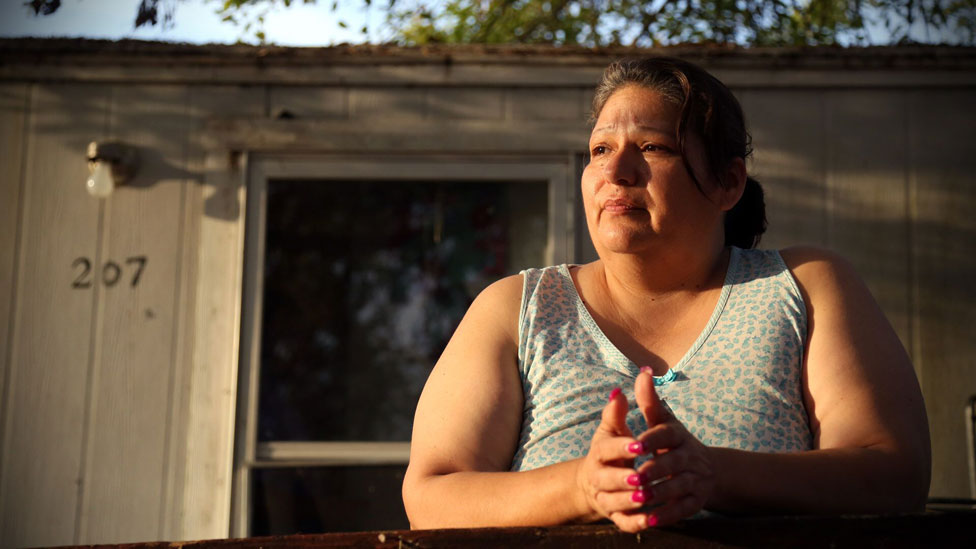
Pauline Garza was lazy on Sunday morning, and it might have saved her life.

She and her 11-year-old daughter were thinking about going to church. She isn’t a regular, but her daughter was baptised there.

This time, they decided not to. “Feeling lazy,” she says, standing on her porch 24 hours later.

Soon afterwards, they heard the gunfire.

Image caption More people will carry guns now, says Pauline

Pauline’s neighbours, the Holcombes, were also churchgoers.

Pauline thinks they were in church on Sunday morning. She hasn’t seen them return.

The Holcombes’ two dogs lie on the drive, waiting. The gate is still locked; the porch light is still on.

The families are close. Pauline’s daughter stays over at the Holcombes’ place.

“Very nice family,” says Pauline, 47. “They’re always out in the yard.

“The kids will play with my daughter all the time. Very nice.”

When Pauline heard the shots, she thought it was a neighbour working on his house.

“I asked my daughter – ‘What was that noise?’ She said ‘I don’t know’.

“We came to the door. I saw my (other) neighbour standing there. You could still hear the shots being fired.

“I never thought it was gunshots. I never did.”

And when she found it was gunfire?

“I thought ‘How can that happen here?’ It’s unreal.”

Image caption The town will recover, says Julius

Around 400 people live in Sutherland Springs, a small town in Texas, 30 miles (48km) east of San Antonio.

It isn’t a wealthy place. There are neat, well-built houses, but there is decay, too.

Rusty, abandoned cars inhabit front gardens. Some houses disappear under weeds.

The All Coin Laundry, long forgotten, hasn’t washed a shirt in 10 years, at least. People work in “nursing homes, hospitals, the convenience store,” says Pauline.

But – while it isn’t wealthy – it is friendly. Neighbours know each other. People say hello. The school bus driver waves at passers-by.

In one garden, a sign says: “Cowboys make good points with spurs and barbed wire.”

The next sign says: “Welcome to Texas.”

“I love it here,” says Pauline. “You don’t have all that loud stuff like the big cities.”

Image caption The Holcombe family home

Julius Kepper, 53, has lived in Sutherland Springs for seven years. At first, he thought Sunday’s gunfire was building work.

When he realised it wasn’t, he grabbed his gun and ran out of the house.

He wasn’t the only one. His neighbour, Stephen, had already shot the attacker and given chase.

Julius didn’t go to church, but he knew “a bunch of people” who did.

“Some of the young guys who went would cut my yard,” he says.

“It’s a small community. You can’t help but know people.”

Julius is drinking a large Coke in the petrol station on the edge of town. Another customer sits at a table, drinking coffee.

Behind the counter are rows of Texas caps. The San Antonio Express-News sits on the counter.

“Time for worship turns to horror,” says the headline.

Julius thinks the town will heal, but it will take time.

“For this to happen in a little country town with 300 people, it’s inconceivable,” he says.

“You kind of expect it in big cities. Not here.”

Back on her porch, Pauline Garza thinks the shooting means more people will carry guns.

“Even to church,” she says. “We would never think out here in the country you would need a gun to protect yourself. Now you’re going to have to.

“Now you got crazy people walking around everywhere.”

Pauline didn’t sleep on Sunday night. The what-ifs were playing through her mind.

And, though she and her daughter are safe, their suffering isn’t over.

“How do I talk to my daughter about this?” she asks. “How can I do that?”

Photographs by Paul Blake

Note: This story is auto-generated from BBC syndicated feed and has not been edited by AFRICA PRIME NEWS
Woman fired for showing Trump motorcade the middle finger

0
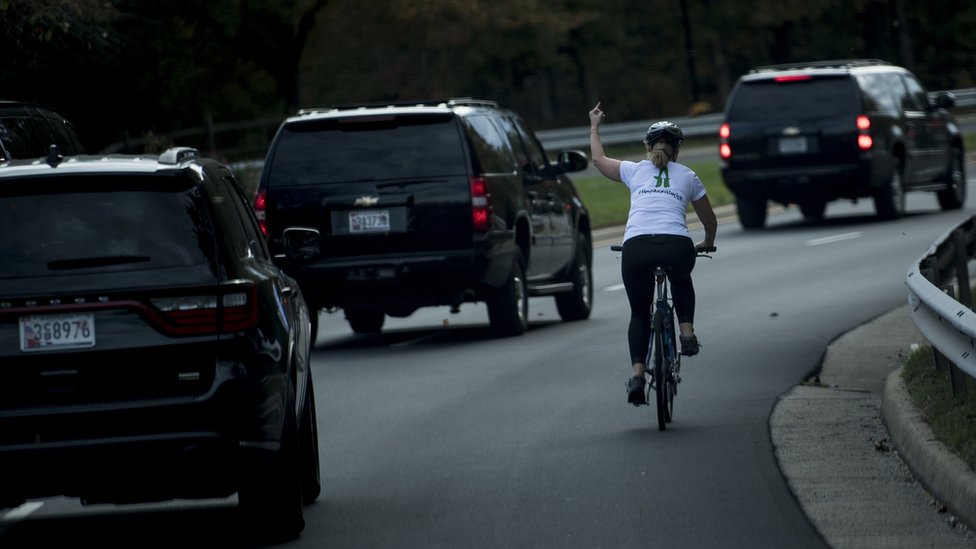
A line of motorcade cars and Juli Briskman on a cycle making a middle finger gestureImage copyright AFP/GETTY
Image caption Despite losing her job, the 50-year-old says she does not regret “flipping off” the motorcade

A woman pictured raising her middle finger toward US President Donald Trump’s motorcade has reportedly been fired from her job over the photograph.

The image went viral after it was taken on 28 October in Virginia, close to a Trump golf resort.

Juli Briskman, who was identified as the cyclist in the image, alleges she was fired by employers Akima LLC after she posted it to her online profiles.

The company did not respond to the BBC’s request for comment.

Ms Briskman told US media the firm had called her into a meeting a day after she informed their HR department she was the subject of the widely circulated image.

She told the Huffington Post news website that executives had told her they classified the image as “lewd” or “obscene”, and therefore deemed that it violated their social media policies after she had posted it to her Twitter and Facebook accounts.

However Ms Briskman said she had emphasised to management that she had not been in working hours when the photograph was taken and had not mentioned her employers on the social media pages.

Ms Briskman also alleges that a male colleague was allowed to keep his job after deleting a post deemed as offensive in a separate incident.

She therefore questions why she was immediately dismissed from her role.

The 50-year-old mother-of-two had reportedly been at the government contractor firm for six months working in communications.

Image copyright AFP/GETTY
Image caption Motorcade protests are not uncommon: this was taken by press photographer Mike Smialowski on the same day

Despite losing her job, Ms Briskman said she did not regret making the gesture.

“In some ways, I’m doing better than ever,” she told The Huffington Post

“I’m angry about where our country is right now. I am appalled. This was an opportunity for me to say something.”

The press photographer, Mike Smialowski, told the AFP website that it was common to see people protesting or making obscene gestures at presidents as they drove by.

He said that he had been struck by the “tenacity” of Ms Briskman after she made the gesture several times and made attempts to catch up with the motorcade.

Note: This story is auto-generated from BBC syndicated feed and has not been edited by AFRICA PRIME NEWS

Nigeria: Restore Full Payment of Salaries, Allowances of LG. Health Workers, Council Tells Govt.

0
Map of Nigeria showing Gombe State
Map of Nigeria Showing Gombe State

By Auwal Umar

Gombe (Nigeria)– Gombe state Council on Health has asked the state government to resume payment of full monthly salaries and allowances of local government health workers which was suspended since 2012.

The Council on Health made the call in a communique issued at the end of its 4th meeting held in Gombe, north east of the country .

 The Council also recommends that relevant health professionals should be involved in procurement of health consumables and equipment as well as the designing of health facilities to ensure that correct specifications are met.

 The state government, the communique said, must ensure that after giving approvals for employment, a mechanism should be put in place to ensure that only trained health workers are employed, especially at the local government level.

 The Council recommends the establishment of blood transfusion services in each senatorial district in the state in order to reduce to the lowest minimum, transfusion transmissible diseases.

Strengthening of drug revolving funds, instead of separating it from the laboratory revolving fund in the state ministry of health, to avoid duplication of efforts.

“The state should establish Hospital Management Board, while the ministry should ensure that Pharmacists, Medical Laboratory Scientists, Physiotherapists and Nurses are included in clinical ward rounds in all hospital in the state

 The Council also recommends the establishment of the state mega drugs distribution center to curtail issues of fake drugs proliferation and bonding of doctors and other health professionals be reviewed from 5 years to 3 years.

The Council wants government to be proactive by taking ownership of the scourge of HIV/AIDS and increase funding, and more efforts should be made in exploring innovative financing methods.

The communique calls on the  government to strengthen the capacity of the College of Health Science and Technology Kaltungo, to train medium level manpower for universal health coverage in the  state, while the Directorate of Nursing Services in the ministry of health should manage all matters relating to nurses and midwives, as stipulated in the Federal Republic of Nigeria Official Gazette.

Wydad are crowned African champions

0
Wydad Casablanca celebrate after winning the 2017 African Champions League

Wydad Casablanca of Morocco became African champions for a second time when they defeated Al Ahly of Egypt 1-0 on Saturday in the second leg of the African Champions League final.

Walid El Karty scored the only goal on 69 minutes to give the home team a 2-1 aggregate triumph after they forced a 1-1 draw in the Egyptian city of Alexandria last weekend.

Achraf Bencharki, who equalised in the first leg, set up the goal with a deflected cross for El Karty to score his third goal of the competition.

The victory bridged a 25-year gap for Wydad, who conquered Africa for the first time in 1992 when they defeated Al Hilal of Sudan.

Wydad pocketed a record $2.5 million and are guaranteed at least another $1 million by competing at the Fifa Club World Cup in the United Arab Emirates during December.

Wydad’s Walid El Karty struck their winning goal in the 69th minute

Although Ahly dominated possession and territory during the goalless opening half, Wydad came closest to breaking the deadlock with 30 minutes gone.

A long clearance from goalkeeper Zouheir Laaroubi set in motion a move that ended with a deflected shot from Abdeladim Khadrouf rattling the crossbar.

Relieved Ahly had a great chance to take the lead four minutes later when first-leg scorer Moamen Zakaria broke clear to go one-on-one with Laaroubi.

But the Egyptian was thwarted by Wydad’s keeper who used both hands to make a brilliant block.

Wydad Casablanca coach Hussein Amotta has led his team to seven wins out of seven at home in the Champions League this season

Smoke from flares enveloped the pitch as the second half started in the Moroccan commercial capital, making visibility temporarily difficult for the near-capacity crowd.

Wydad were more adventurous as the half progressed, using the flanks to put pressure on Ahly, and forcing their first corner with 58 minutes gone.

Morocco-born Walid Azaro, battling to make an impact as the lone Ahly striker, was withdrawn on the hour by coach Hossam El Badry with Ahmed Hamoudi taking his place.

As the second leg drifted into the final quarter, play continued to be confined mainly to midfield with Wydad in pole position thanks to the away goal.

With 69 minutes gone the deadlock finally ended as El Karty struck with his point-blank header evading Ahly captain and goalkeeper Sherif Ekramy.

El Badry reacted to his team falling behind by introducing veteran striker Emad Meteab and winger Walid Soliman as he sought the goal that would level the final on aggregate.

But it was Wydad who came closest to scoring in a frenetic finish.

Note: This story is auto-generated from ‘BBC News’ syndicated feed and has not been edited by Africa Prime News staff.

Sadio Mane ‘happy to be back’

0
Sadio Mane returned from injury to help Liverpool win 4-1 at West Ham on Saturday

Liverpool forward Sadio Mane says he is ready for Senegal’s World Cup qualifier against South Africa on Friday after returning to first-team action.

Mane, 25, injured a hamstring while playing for Senegal on 7 October and only made his return in Liverpool’s 4-1 victory over West Ham on Saturday.

Senegal need two points from their remaining two qualifiers to secure a place at next year’s World Cup.

“I am very happy to be back because it was not easy,” Mane told BBC Sport.

“There’s no excuse for me now – I was injured but I was always working hard.”

Senegal lost 2-1 to South Africa last year but Fifa ordered the match to be replayed after finding Ghanaian referee Joseph Lamptey guilty of match manipulation.

The replayed game will take place in South Africa on 10 November, with the Senegalese capital Dakar hosting the final qualifier four days later.

“It’s going to be tough because we know how South Africa is, even when they are not in good form,” said Mane.

“We respect them but we also know we have quality and we have a great team and I think we can do it.”

Sadio Mane injured a hamstring in Senegal’s 2-0 victory over Cape Verde

Mane is desperate to help the Teranga Lions qualify for their first World Cup since 2002, when Senegal reached the quarter-finals in Japan and South Korea.

“Everybody knows what it means for the country – especially the fans – and I think it will be a dream for us and hopefully God will help us to qualify,” he said.

And Mane has shrugged off concerns that he may get injured again while on international duty.

“Every player would love to play until the end of the season without injury. It’s part of football so we accept it and move forward.”

Liverpool boss Jurgen Klopp admitted there are always injury concerns during international windows.

“It’s the most difficult time for me but I have no problem with international games,” he said.

“We are happy for Senegal if they can go to the World Cup, and they need Sadio Mane for this and I understand it.

“He’s fit to play – the only thing I would ask for is if they can make it in the first game it would be cool if he could come back.”

Note: This story is auto-generated from ‘BBC News’ syndicated feed and has not been edited by Africa Prime News staff.

Currency Exchange Rates

USD - United States Dollar
ZAR
0.06
EUR
1.17
CAD
0.73
ILS
0.31
INR
0.01
GBP
1.34
CNY
0.14
Enable Notifications OK No thanks