Home Blog Page 1418

Nigeria kidnapping: Ian Squire killed and three freed

0
Ian SquireImage copyright Courtesy of the Squire family
Image caption Ian Squire was kidnapped in southern Nigeria in October

A British aid worker kidnapped last month in southern Nigeria has been killed, while three other hostages have been freed, says the Foreign Office.

Ian Squire, an optician, was one of four Britons working for a medical charity in the Niger Delta when taken.

Suspected militants stormed the rural community of Enekorogha on 13 October.

UK and Nigerian authorities successfully negotiated the release of Alanna Carson, David Donovan and Shirley Donovan.

BBC Lagos correspondent Stephanie Hegarty said there was little detail around Mr Squire’s death, but that locals told her the kidnappers were a criminal gang who had been operating in the area for around a year.

Our correspondent said: “This is their first kidnapping of foreigners. They had kidnapped very recently the mother of a local politician, but before that they were just carrying out petty crime.

“We know that a ransom was demanded but we don’t know if it was paid.”

Established charity workers

According to reports, Dr and Mrs Donovan have lived in Nigeria for the past 14 years, running a Christian charity called New Foundations, which gives aid to remote villages in the Niger Delta.

Image copyright Courtesy of the Donovan family
Image caption Dr and Mrs Donovan (pictured) were released and are now home safely

Mr Squire normally ran a practice in Shepperton, Surrey, and locals told the BBC he travelled to Africa every year to carry out charity work.

Mr Squire’s friend Paul Allan, who ran a neighbouring business, described him as a “good friend” and a “very straight forward, nice, gentle guy”.

He described how Mr Squire fundraised in the community for his trips and even collected old glasses to take and reuse.

“I just can’t believe what’s happened,” added Mr Allan. “I find it shocking to believe for someone who has gone out to do good in the community overseas that the action has cost him dearly. It has cost him his life. It is beyond belief.

“It is a sign of this day and age, but he wasn’t concerned about that. He just wanted to go out and help people in less fortunate situations than ours.”

Image copyright BBC news online

Ms Carson, a Specsavers optometrist, is now staying with her family in Northern Ireland, according to her employer in Leven, Fife.

Relatives of the four said they were “delighted and relieved” that Ms Carson and Dr and Mrs Donovan had returned safely.

“Our thoughts are now with the family and friends of Ian as we come to terms with his sad death,” they said in a statement issued on their behalf.

Image copyright Courtesy of the Carson family
Image caption Ms Carson (pictured) was working alongside Mr Squire

The Foreign Office currently advises against all but essential travel to much of Delta state, saying there is a “high threat of criminal kidnap”.

It said Nigerian authorities were investigating the kidnapping, adding: “Our staff will continue to do all we can to support the families.”

Note: This story is auto-generated from ‘BBC News’ syndicated feed and has not been edited by Africa Prime News staff.

Malaria breath test shows promise

0
Malaria breath test shows promise
Child in Malawi doing the testImage copyright Washington University

People with malaria give off a distinctive “breath-print” that could be used as a test for the disease, according to American scientists.

They had already tried out a crude prototype breathalyser in Africa, a tropical medicine conference heard.

The test was reasonably good at detecting cases in children, but needs developing to become a routine device.

One of the odours it sniffs out is identical to a natural smell that attracts insects that spread malaria.

Pine trees and conifers emit these terpenes to summon mosquitoes and other pollinating insects, say the researchers, from Washington University in St Louis.

Image copyright Getty Images

They believe people with malaria who have this odour in their breath may also attract mosquitoes and infect more of the biting insects, which can then spread the disease to other people that they bite.

Although the test needs perfecting, it could offer a new cheap and easy way to help diagnose malaria, Prof Audrey Odom John and colleagues say.

Distinct odour

The prototype breath test detects six different odours or volatile organic compounds to spot cases of malaria.

The researchers tried it on breath samples from 35 feverish children in Malawi, some with and some without malaria.

It gave an accurate result in 29 of the children, meaning it had a success rate of 83%.

This is still too low for the test to be used routinely, but the researchers hope they can improve its reliability and develop it into an off-the-shelf product.

Simple, rapid blood tests for malaria are already available, but they have limits, say the Washington University researchers.

Testing blood can be expensive and technically challenging in rural settings.

A non-invasive method of detection that does not require blood samples or technical expertise could be of great benefit.

Prof James Logan from the London School of Hygiene and Tropical Medicine said: “The rapid detection of asymptomatic malaria is a challenge for malaria control and will be essential as we move towards achieving the goal of malaria elimination. A new diagnostic tool, based on the detection of volatiles associated with malaria infection is exciting.”

He said more work was now needed to see if it could be made into a reliable test.

The findings are being presented at this year’s annual meeting of the American Society of Tropical Medicine and Hygiene.

Follow Michelle on Twitter.

Note: This story is auto-generated from ‘BBC News’ syndicated feed and has not been edited by Africa Prime News staff.

South Africa: Danish ‘FGM’ man guilty of multiple charges

0
Peter Frederiksen sits in court in 2015Image copyright AFP
Image caption Charges against Peter Frederiksen ranged from fraud to conspiracy to murder

A Danish man whose freezer contained women’s genitals has been found guilty of various crimes by a South African court – but not female genital mutilation.

Peter Frederiksen was found guilty of rape, production and possession of child pornography, conspiracy to murder and numerous other charges.

But the charges relating to mutilating women were dropped last month.

A judge was unable to find him guilty due to a loophole in South African law.

According to local media, the law was unclear on what penalties removing body tissue without consent should carry.

‘Not a man of high morals’

Police found 21 women’s body parts in his freezer in Bloemfontein in 2015, neatly labelled in plastic bags with a date, the name of a woman and where she was from, the BBC’s Milton Nkosi reported at the time.

Frederiksen, who was also wanted in his native Denmark for alleged illegal dealing in firearms, was arrested and held in prison while he awaited trial.

His wife Anna Matseliso Molise was due to testify against her husband at his trial.

However, she was killed a month later, dying in hospital after being shot four times outside her home in Maseru, Lesotho.

The court heard in August how he paid a man he met in prison, who turned state’s witness, to arrange her death.

Judge Johann Daffue, sitting at the Bloemfontein High Court, found him guilty of the remaining 36 out of 38 counts, laying them all out in a judgement which took almost four hours to deliver, according to IOL Africa.

“The accused is certainly not a man of high moral standing,” he told the court. “He simultaneously married two women and was involved with people who believed in Satanism.”

Frederiksen will be sentenced at a later date, with Danish newspaper Ekstrabladet [in Danish] reporting he faces up to 25 years behind bars.

He has vowed to appeal, the newspaper said.

Note: This story is auto-generated from ‘BBC News’ syndicated feed and has not been edited by Africa Prime News staff.

Nigeria: Kaduna Community Constructs Classrooms To Tackle Illiteracy Amongst Children, Seeks Government Assistance

0
Image of Classrooms


By Ibrahima Yakubu

Kaduna(Nigeria)– Unguwan-sarki-Baba, is an ancient village situated near Rigachukun town, in Igabi local government area of Kaduna state, north-west Nigeria.

The community has been in existence for over 200 years. It is said that some of their forefathers and others fought  both the first and second world wars as well as the Nigerian Civil war, commonly known as the Nigeria-  Biafran War (6 July 1967 – 15 January 1970)

There are over 400 settlers who are predominantly Gwagyi by tribe and depend on farming as their preoccupation  at both the raining and dry season.

Lack of social amenities in the area has however been the greatest challenges facing the community.

Regardless of these shortcomings including lack of socio-Economics, political and other developments, the community identified education as a key towards changing the trend, hence the villagers took upon themselves to team up to construct 5 classrooms to educate their children for greater tomorrow.

A part from education, bad road is also one of the greatest challenges facing the inhabitants of the village.

The villagers’ means of transportation are motor-cycles, heavy trucks, bicycles animals,as well as wheel barrows to convey food stuff on the 20 kilometre road distance to the town.

Speaking with some journalists who visited the village, Danladi  Baba, age 63, a younger brother of the village head  said lack of school in the community forced  them to construct 5 classrooms with local sand, so as to fight against illiteracy among their children .

Danladi narrated how the village head gathered all the residents in the village to task every parent to make his own contribution either in cash or in kind to build the structure, ”every one contributed money along moral support in building this school, because we are tired of seeing our children always at home without going to school, we want them to be educated like the children living in the cities, so that they too can be educated and become leaders of tomorrow.

“Illiteracy is really a disease, and that is why we team-up in the community to fight it in this village. The 5 Room classes was constructed with local blocks which are made of sand, grass, stones mixed with other local construction materials in other to make it look strong, so that it can last for Hundreds of years.
”Immediately we finished constructing the building, we then wrote a letter to the District Head of Rigachukum, on the need to provide teachers for the newly constructed school, and since then, we never lack school teachers in the school.
“This is only school in this area that accommodates large number of students including others from the   neighboring communities .
We  still need more classes for children, toilet, library and a fence for the school, football pitch, first-Aid-Box, and other learning materials to assist our children”, Danladi stated.

He said though the community appreciates government for painting the school, they also want it to establish a secondary school to enable the pupils further their education.

  Amos Sarki is one of the youth leaders and a farmer in the village.  He told journalists that “the highest level of   education one acquires in the community is primary 6, and then go back to farm, ” and  even when we harvest our farm produce, we find it difficult to convey them to town”.

Amos spoke of the need for the state government to find means of introducing Entrepreneurship programs for  village youth, so as to engage them in creative activities instead of depending wholly on farming.
“Government at all levels should remember the youth residing in Ghetto and villages to prevent them migrating into cities”.

A woman leader in the village, Ladi Dauda, appealed to the Kaduna state government  to construct a borehole for the villagers, so as to check water borne diseases.

Ladi pointed out that due to the consumption of bad water, there have been cases of water related diseases among the children.

She also called on the state government to find means of reducing the high –rate of maternal maternity in the village by establishing more Primary Health Care Centers, PHC in villages across the 23 local Government area of kaduna state.

Wealthy individuals, Development partners, corporate organizations, Non-governmental organizations, Civil society organizations, and medical Doctors or Volunteers, She said, could be visiting the rural areas, so as the see the pitiable standard of living Nigerian villagers are experiencing.

Nigeria: Workers Shut Down Federal University Kashere Over Non-Payment Of Salary

0

By Ahmad Umar

Gombe (Nigeria) — Non Academic staff of Federal University, Kashere, in Gombe State, Northeast Nigeria, have embarked on strive action, shutting down academic and administrative activities of the institution over August salary shortfall, and delay in payment of October salary,

The Joint Action Committee (JAC) comprising Senior Staff Association of Nigerian Universities (SSANU), Non-Academic Staff Union of Universities (SANU) and National Association of Academic Technologists (NAAT) disclosed this in a notice of warning strike by the three Chairmen of the Associations.

The workers staged a peaceful demonstration at the university premises, where they called for the resignation of the vice-chancellor.

They held placards with captions reading, “Gani Must go, you can’t be a one-man army,” among others.

The JAC chairman of the three affiliate unions, Mukhtar Muhammad, said the unions had decided to drop their tools over the management’s failure to pay a shortfall of August salary and the whole of October salary.

Speaking on the issues, the Vice Chancellor of the university, Professor Alhassan Muhammad Gani, said the non-payment of October salary was as a result of delay by IPPIS, a platform used to pay salary by the office of the Accountant-General of the Federation.

He added that the Office of the Account General of the Federation changed the platform of the salary payment from IPPIS to Government Integrated Financial Management Information System (GIFMIS), which is difficult to use, adding that the officials from the office of the accountant general were working to rectify the problems.

Nigeria: Indefinite Strike Action: Teachers Issue Two Weeks Ultimatum To Kaduna Government

0


By Amos Tauna

Kaduna (Nigeria) — Nigeria Union of Teachers, NUT), has issued a two week ultimatum of indefinite strike action to Kaduna State Government.

This followed the decision of the State government to terminate the appointment of over 21,000 primary schools teachers for allegedly failing a competency test.

A statement by the Assistant Secretary General of NUT, Adamu Ango, condemns Kaduna State Government for purportedly conducting a competency test for all teachers in public primary and secondary schools.

The statement says, “That, the NUT, Kaduna State Wing as a responsible stakeholder in the educational sector even though aware of the position of the law as it relates to the body statutorily empowered to regulate the teaching profession cooperated with the Kaduna State government under the mistaken believe that the intention of the state government was altruistic,  in the sense that it is aimed at enhancing state. However, with the benefit of hindsight we now know better.

“That it is agreed by all stakeholders in the educational sector that the pass mark for the competency test be pegged at 60 per cent while those who are unable to score up to 60 per cent be retrained.

“However, in a classical display of bad faith which started as a rumour, the Kaduna State government unilaterally and arbitrarily pegged the pass mark for the competency test at an unprecedented 75 per cent.

“Your Excellency,  while hosting a delegation of World Bank officials,  you announced to the whole world that 21,780 teachers will be disengaged in Kaduna State Public primary and secondary schools for not scoring up to 75 per cent in the competency test, while 25,000 will be recruited in their stead.

“That, the NUT, Kaduna State Wing wrote a letter to you,  appealing to your conscience to rescind the decision above, but as usual,  you ignored the letter and went ahead with your avowed determination to impose your will against the consensus of bonafide stakeholders in the educational sector.

“The NUT subsequently as a last resort and in the spirit of constitutional democracy,  rule of law,  due process decided to approach the National Industrial Court, Kaduna division to adjudicate on the issue of whether the Kaduna State government has the statutory power to conduct the competency test and which Court processes have been served on you and the office of the Attorney General.

“However, contrary to all standards of decency in a democratic setting and in spite of the service of Court process on the Kaduna State government,  you have gone ahead to publish on your tweeter handle,  a list of teachers who purportedly passed the competency test by scoring 75 per cent and above.

“All the above, leaves the Kaduna State Wing of the MUT with no option other than to serve the instant notice in compliance with the wishes of its members expressed at the meeting of the state wing executive council held on the 6th November,  2017. “

Trump urges N Korea to ‘come to table’ over nuclear issue

0
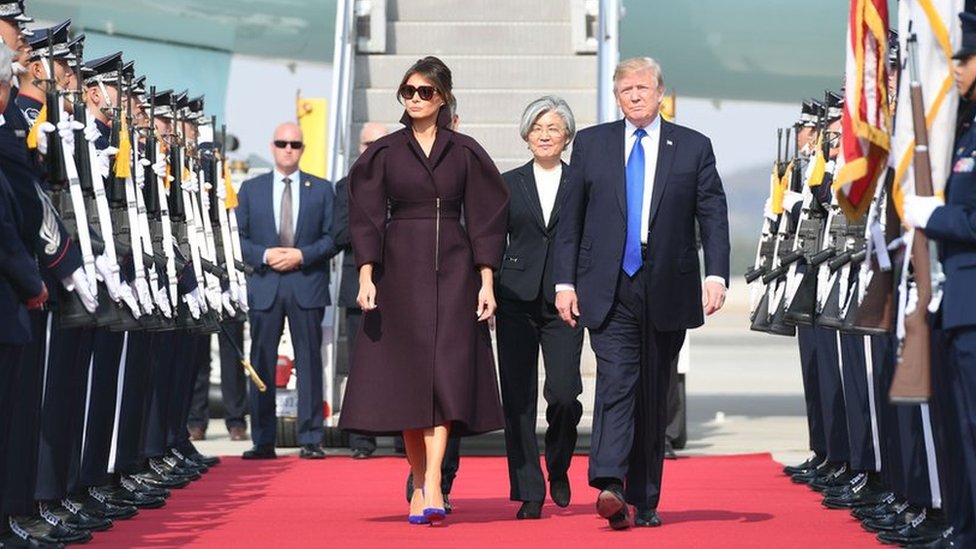
US President Donald Trump gestures during a joint press conference with South Korea's President Moon Jae-in at the presidential Blue House in Seoul on 7 November 2017.Image copyright AFP/Getty Images
Image caption Mr Trump said he “hoped to God” he would not have to use the US’ full military capabilities against Pyongyang

US President Donald Trump has urged North Korea to “come to the table” and discuss giving up its nuclear weapons.

Striking a different tone from previous fiery rhetoric, he said he “hoped to God” he did not have to use the US military against Pyongyang.

Mr Trump was speaking at a press conference with his South Korean counterpart Moon Jae-in in Seoul, as part of his tour of Asia.

The US leader has previously threatened “fire and fury” against Pyongyang.

He is on a five-nation tour of Asia, where North Korea’s nuclear ambitions have been high on his agenda.

At a press conference, Mr Trump and Mr Moon reiterated their call for the North to denuclearise, with Mr Trump saying it “makes sense for North Korea to come to the table”, and to “do the right thing, not only for North Korea but for humanity all over the world”.

Though the US had deployed a significant military presence in the region, he said he “hoped to God” he would not have to use it against North Korea.

The two leaders also called on China and Russia to put pressure on Pyongyang, and said they were lifting the limit on South Korean missile payloads, which they had agreed to do in September.

Image copyright Reuters
Image caption Mr Trump and Mr Moon held talks on Tuesday on trade and North Korea’s nuclear programme

Mr Trump also said that South Korea would be ordering “billions of dollars” in military equipment from the US, which he said would reduce their trade deficit.

It was unclear if a deal was already struck, but Mr Moon said they had agreed to “begin consultations on acquisitions” that would enhance South Korea’s defence capabilities.

Mr Trump had earlier tweeted that “massive military and energy orders” from Japan were also happening, and claimed on Monday that Japan could shoot down Pyongyang’s missiles with US equipment.

Japan’s leader Shinzo Abe said earlier that he was considering it.

Media playback is unsupported on your device

Media captionHow would war with North Korea unfold?

Though the US president will only spend about 24 hours in South Korea, it is perhaps the most symbolic stop in his Asian tour, says the BBC’s Robin Brant in Seoul.

The trip is designed to bolster the military alliance that has long protected South Korea, and strength in unity is the message they want to send to North Korean leader Kim Jong-un just across the border, says our correspondent.

But the two leaders also have their differences. Mr Trump has previously accused Mr Moon’s government of trying to appease the North.

He has also previously criticised the free trade agreement between the US and South Korea, and has made clear he wants to re-negotiate its terms.

Mr Trump, during the press conference, said the deal had been “quite unsuccessful” for the US, and that the two countries were going to “pursue a much better deal”.

Media playback is unsupported on your device

Media captionSouth Korean villagers voice anger over THAAD

Protests against Mr Trump, as well as counter-rallies welcoming him, have been held in Seoul and elsewhere.

Many in South Korea are hoping that Mr Trump will not repeat his strong rhetoric against North Korea, which many here regard as unnecessary and incendiary, says our correspondent.

Mr Trump will be going to China, Vietnam and the Philippines in the coming week.

Note: This story is auto-generated from BBC syndicated feed and has not been edited by AFRICA PRIME NEWS

Man jailed for 27 years for plotting to murder US judge

0
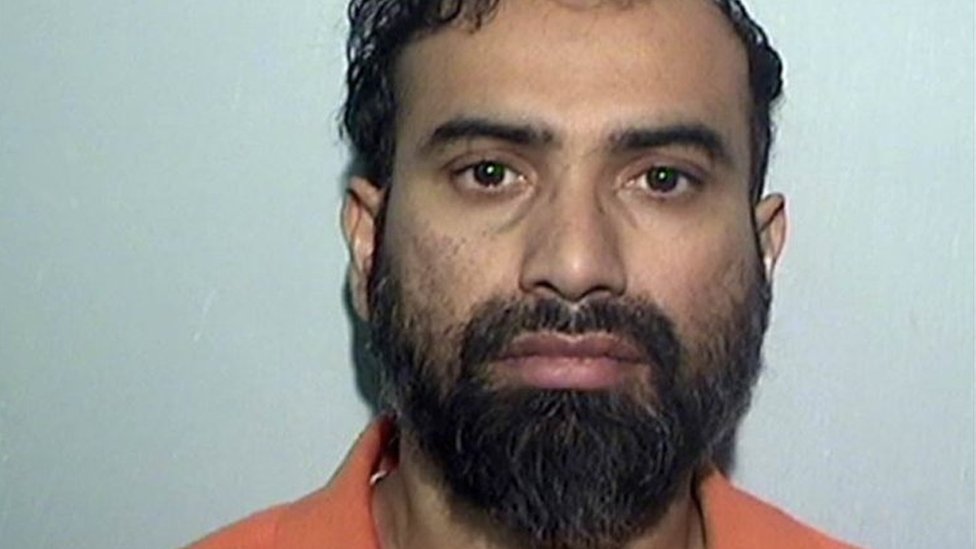
Image shows Yahya Farooq MohammadImage copyright Lucas County Corrections Center
Image caption Yahya Farooq Mohammad came to the US in 2002 to study at Ohio State University

An Indian citizen has been jailed for 27 years in the US for sending funds to al-Qaeda and plotting to kill a judge.

Yahya Farooq Mohammad, 39, was awaiting trial on charges of sending money to the Islamist militant network when he offered an inmate $15,000 (£11,000) to murder the judge due to hear his case.

The inmate introduced him to a man who was in fact an undercover FBI agent.

Mohammad, who lives in Ohio, has admitted helping to send funds to US-born al-Qaeda leader, Anwar Al-Awlaki.

“He threatened the safety of our citizens, a judge and the independent judiciary. Now he is being held accountable,” said US Attorney Justin Herdman.

The federal judge Mohammad plotted to have kidnapped and killed was Jack Zouhary. He has served as a district court judge in northern Ohio for more than a decade.

In a statement shared by local news website the Toledo Blade, Judge Zouhary said: “I never anticipated I would face the ordeal of a defendant putting a price on my head and taking concrete steps to hire for my murder.”

Yahya Farooq Mohammad pleaded guilty to one count of conspiracy to provide and conceal material support or resources to terrorists and one count of solicitation to commit a crime of violence.

He came to the US in 2002 to study at Ohio State University and married a US citizen in 2008.

Three other men, including Mohammad’s brother, are pleading not guilty to sending money to al-Qaeda and are awaiting trial.

The four men were arrested in September 2015 and charged with sending $22,000 (£17,000) to the cleric Anwar Al-Awlaki, a leader of Yemen-based al-Qaeda on the Arabian Peninsula. Al-Awlaki was later killed in a drone strike.

Note: This story is auto-generated from BBC syndicated feed and has not been edited by AFRICA PRIME NEWS

Currency Exchange Rates

USD - United States Dollar
ZAR
0.06
EUR
1.17
CAD
0.73
ILS
0.31
INR
0.01
GBP
1.34
CNY
0.14
Enable Notifications OK No thanks