Kaduna (Nigeria) — Teachers Registration Council of Nigeria (TRCN), has expressed readiness to partner state governments on teachers training and retraining to ensure that only qualified and competent teachers teach in Nigerian schools.
The Registrar and Chief executive of the council, Josiah Ajiboye, while interacting with newsmen in Kaduna, northwest Nigeria after meeting with relevant education stakeholders from the North West said, the Council do not support the disengagement of unqualified teachers, adding that what the council wants with states are opportunities for unqualified teachers to be trained and retrained.
“We want to seek understanding with state governments to make sure that unqualified teachers undergo training to become qualified and qualified teachers are retrained to ensure professionalism.
“Such alliance with state governments would enable us ensure that only qualified and competent teachers teach in the country. This is because no nation can rise above the quality of its teachers.
“Kano state for example, has trained about 8,000 unqualified teachers in the state as at middle of 2017, and planned to train 19,000 others in the beginning of 2018,” he explained.
He explained that the meeting with chairmen of states Universal Basic Education Board and other relevant stakeholders was organised to discuss the mandate, activities and achievement of TRCN.
He said that the meeting also provided an avenue for the stakeholders to suggest ways of addressing challenges affecting the teaching profession in the country.
“Our goal is to take the teaching profession to the highest level with a view to making the desired impact on education and development of the country,” he added.
On regulating the teaching profession, the registrar described TRCN as the only body in the country empowered to register, monitor and regulate the teaching profession in Nigeria to ensure professionalism.
He said that the council has so far registered and certified 1.8 million professional teachers in the country.
TRCN Coordinator in Kaduna State, Malam Kabir Yar’adua, said that the council has a good working relationship with the state government and Nigerian Union of Teachers with regard to teacher professionalism.
He commended the state government for making TRCN certificate a requirement in its planned recruitment of 25,000 primary school teachers. Malam Idris Aliyu, Deputy Director School, Kaduna State Ministry of Education, Science and Technology said that there are no plans to sack any unqualified teacher in Kaduna state.
Aliyu said that the state government was only trying to bring sanity and professionalism into the teaching profession by removing those that has no business being in the classroom.
He said that what the state government intends to do was to redeploy unqualified teachers to other agencies and establishments where they fit in and replace them with more qualified teachers.
The Kaduna State Wing of the Nigerian Union of Teachers (NUT) had in a press briefing on Monday announced its decision to embark on indefinite strike to protest the sack of 21,780 teachers.
The state’s Universal Basic Education Board (SUBEB) has recently released a list of 11,220 out of 33,000 primary school teachers, who successfully passed the competency test organised by the state government.
The board’s chairman, Nasiru Umar said that 21,780 failed to score the 75 per cent pass mark set by the state government, adding that three months notice would be given to those who failed the test for disengagement.
Media captionTrump to N Korea: ‘Your weapons are not making you safer’
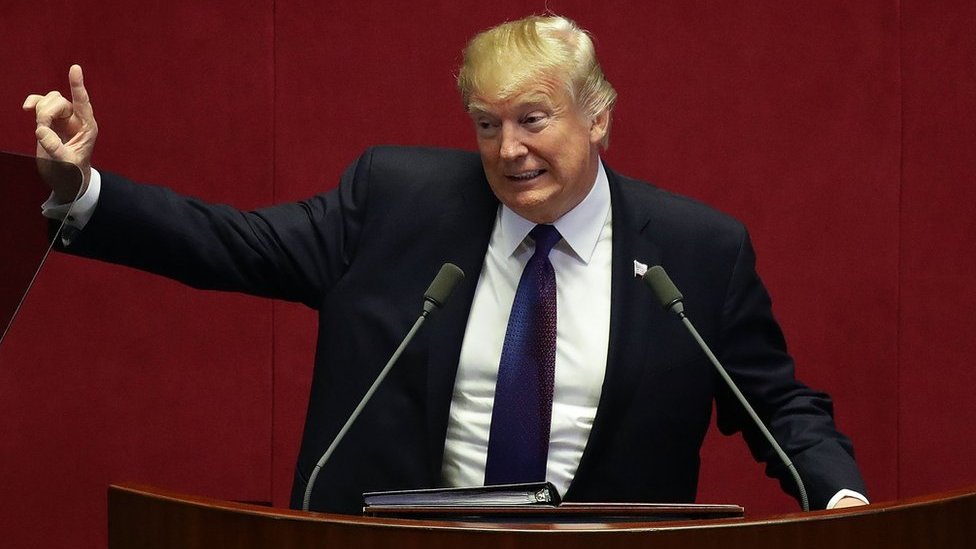
US President Donald Trump has issued a blunt warning to North Korea’s leader Kim Jong-un in an address to South Korea’s parliament.
“Do not underestimate us. Do not try us,” he said, while also condemning the “dark fantasy” of life in the North.
He addressed Mr Kim saying “the weapons you are acquiring are not making you safer”, and urged other nations to join forces to stop Pyongyang.
The US leader is now in China as part of a five-nation tour of Asia.
He will meet Chinese counterpart Xi Jinping for talks likely to focus on trade and North Korea.
Pyongyang’s nuclear ambitions have been high on Mr Trump’s agenda throughout this trip. Over the past year North Korea has carried out missile tests in defiance of UN sanctions and in September conducted its sixth and biggest nuclear test.
Mr Trump’s words to South Korean lawmakers were being closely watched and while his rhetoric was stark, he did not repeat his previous bombast towards the North.
These are the most striking points from his speech:
Trump made a personal address to Kim Jong-un
In an unexpected move, Mr Trump chose to directly address North Korea’s leader in his speech, urging him to discard his nuclear programme and weapons.
“They are putting your regime in grave danger,” warned Mr Trump. “Every step you take down this dark path increases the peril you face.”
Media playback is unsupported on your device
Media captionHow would war with North Korea unfold?
He also made reference to North Korea’s founder and Mr Kim’s grandfather, Kim Il-sung, in words likely to inflame Pyongyang.
“North Korea is not the paradise your grandfather envisioned. It is a hell that no person deserves.”
But Mr Trump also appeared to reiterate Tuesday’s offer to reach a deal, saying that “despite every crime you’ve committed… we will offer you a path for a better future”.
He warned the North against ‘fatal miscalculation’
He said that to interpret past US restraint as weakness “would be a fatal miscalculation”, as there was now a different US administration in place.
“Today, I hope I speak not only for our countries but for all civilised nations, when I say to the North: ‘Do not underestimate us. Do not try us’.”
Media playback is unsupported on your device
Media captionSouth Korean villagers voice anger over THAAD
He pointed to the heavy US military presence in the Korean peninsula including aircraft carriers and fighter jets, saying: “I want peace through strength.”
But he also made sure to single out North Korea’s biggest economic supporter, China, as well as Russia, calling on them to sever all ties including economic ones.
Analysis – A warning, not war: Mark Lowen, BBC News, Seoul
Image copyrightEPA
After the “rocket man” and “fire and fury”, nobody knew quite what to expect from Donald Trump today. In the end, those in the administration urging him to tone down his rhetoric carried sway.
The speech was a warning but not a rush to war. He pushed China and Russia to up their pressure on North Korea. The horror stories of daily life in the North were effective, particularly when compared to liberal South Korea. And the olive branch to Kim Jong-un was the most concrete offer Mr Trump has made yet to the regime.
The problem is: there’s virtually no chance that the condition for talks – denuclearisation – will be accepted. Having seen what happened to the leaders of Libya and Iraq, North Korea feels only nuclear weapons will guarantee regime survival. The hermit state will have blocked its population from listening to Mr Trump.
Optimists now say at least there’s been no weapons test since September. But the fact that’s seen as progress shows how low the bar now is.
‘Horror’ of North versus ‘miracle’ of South
Mr Trump spent a significant portion of his speech paying tribute to the achievements of the South since the Korean War, which cemented the division of North and South Korea.
Image copyrightReutersImage caption After his speech, Mr Trump and his wife visited Seoul’s National Cemetery which honours the war dead
He contrasted this with the “horror of life” in North Korea and said their separate trajectories were “a tragic experiment in the laboratory of history”.
“The more successful South Korea becomes, the more decisively you discredit the dark fantasy at the heart of the Kim regime,” he told lawmakers.
He also talked golf
While listing South Korea’s achievements, Mr Trump also spent considerable time noting its prowess in the golfing world, saying its players are “some of the best on Earth”.
Mr Trump, an avid fan of the sport, played in Japan earlier in his Asian tour.
Earlier on Wednesday, Mr Trump was forced to drop a surprise visit to the demilitarised zone (DMZ) between North and South Korea due to bad weather.
The US president will also be visiting Vietnam and the Philippines this week.
Note: This story is auto-generated from BBC syndicated feed and has not been edited by AFRICA PRIME NEWS
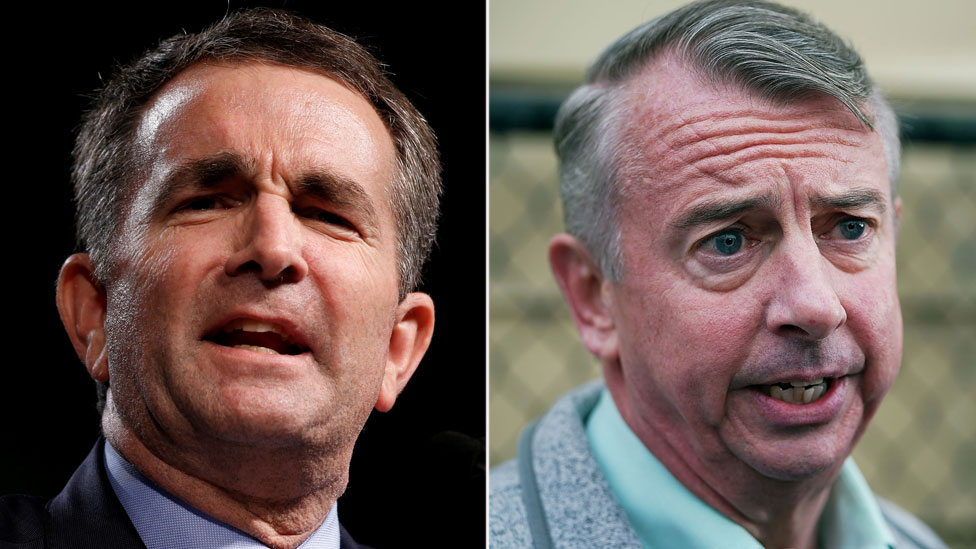
Image copyrightGetty ImagesImage caption Ralph Northam (L) and Ed Gillespie
Democrats have scored two significant victories in the US – in the first statewide elections since President Donald Trump came to power in January.
In Virginia, Ralph Northam defeated Republican Ed Gillespie in a governorship race marked by tussles on immigration and Confederate statues.
Phil Murphy, who beat Kim Guadagno, will be New Jersey governor.
The results could give an early indication of how next year’s midterm congressional elections will turn out.
New York City’s Democrat mayor was also comfortably re-elected.
Meanwhile, Virginia voters also made history by electing their first openly transgender state legislator.
Democrats have been craving something to celebrate after defeat in four congressional special elections this year, despite a groundswell of grassroots opposition to President Trump.
Overcoming the flip-flops
With nearly all the votes countered in Virginia, Mr Northam had 53.9% against 44.9% for Mr Gillespie.
Mr Northam, the lieutenant governor of Virginia, will now replace popular Governor Terry McAuliffe, a Democrat.
Mr Northam won despite a series of flip-flops during the campaign.
Progressive supporters were outraged after Mr Northam reversed stance to say he would oppose any attempt by a Virginia city to provide sanctuary to illegal immigrants.
The Democrat offered to work with President Trump after previously calling him “a narcissistic maniac”.
Mr Northam also vowed to lead efforts to remove Confederate statues, only to say later that he would leave the decision to local authorities.
And his camp was further embarrassed by a racially charged advert, released by a group supporting his candidacy.
Mr Gillespie, a Washington lobbyist and former Republican party chairman, had accused Mr Northam of failing to curb gang violence and seeking to tear down statues honouring Civil War, pro-slavery secessionists.
Media playback is unsupported on your device
Media captionVirginia election: Ed Gillespie running on Trumpism without Trump
Mr Gillespie’s style was combative – but he distanced himself from President Trump.
Responding to the election result, Mr Trump tweeted that Mr Gillespie “did not embrace me or what I stand for”.
Ed Gillespie worked hard but did not embrace me or what I stand for. Don’t forget, Republicans won 4 out of 4 House seats, and with the economy doing record numbers, we will continue to win, even bigger than before!
Meanwhile, Virginia voters elected their first openly transgender state legislator in Danica Roem.
The 32-year-old journalist and stepmother ousted a long-time, pro-Trump, incumbent Republican in a race that focused on traffic issues.
Her rival, Bob Marshall, described himself earlier this year as Virginia’s “chief homophobe”.
Image copyrightAFPImage caption Virginia voters also made history by electing their first transgender candidate
In New Jersey, Mr Murphy was comfortably leading the race with 55.5%. His Republican rival Ms Guadagno has 42.6%, with about 90% of the votes counted.
Mr Murphy will replace Republican Chris Christie, who was in office for eight years.
Reasons for Republicans to worry
Analysis by Anthony Zurcher, BBC News, Washington
Democrats finally have a victory of the non-moral kind. After coming up short in a handful of special elections across the US, they went to the polls in a battleground state and posted a huge win.
How the Democrats, from governor candidate Ralph Northam on down, swept through election night in Virginia should be particularly concerning to Republicans across the US.
Turnout from Democratic supporters surged. They ran up huge margins with college-educated voters and residents in the wealthy Northern Virginia suburbs. The legions of rural voters who turned out for Donald Trump in 2016 were a non-factor.
Democrats won legislative races that were considered to be in play only in the rosiest of Democratic wave scenarios. Exit polls show a plurality of Virginians went to the polls to send a message to Mr Trump. Their top issue was healthcare. At least in Virginia, the president’s dismal approval ratings translated into ballot-box poison.
The stage is now set for the midterm elections in 2018. Republicans will have a year to brace for what could be an anti-Trump tsunami forming on the horizon. What they – and Mr Trump – do next could decide their fate.
A year since Trump upset the odds
Media playback is unsupported on your device
Media captionThey gambled on Trump – did it pay off?
Note: This story is auto-generated from BBC syndicated feed and has not been edited by AFRICA PRIME NEWS
For the BBC World Service documentary, Trump Re-Elected, I spoke to political insiders and reporters who had a front row seat for election night 2016.
From a campaign assured they were entering the history books with the first female president, to a victorious but surprised Trump team surrounded by the raucous supporters who brought them there.
My election night started at Hillary Clinton’s victory party at the Javits Convention Center, where crowds were gathering to witness what they thought would be a night that would change America.
It was, but not like they imagined.
JIM MARGOLIS, senior Clinton campaign consultant
“You know I’m normally a glass half empty kind of guy… I’m always thinking we are never going to make it, even in 2012, in that race with President Obama. This was the first big presidential campaign – and I’ve been involved in a lot of them – where I was absolutely convinced we were gonna win.“
AMY WATERS, national editor, The Cook Political Report
“The mood suggested a Hillary Clinton victory was on its way.“
Image copyrightGetty Images
Among the thousands in the Javits Center was someone with a very different view: Charlie Spiering, the White House reporter for Breitbart, the conservative website headed by Steve Bannon, which had done much to propel Donald Trump’s campaign.
CHARLIE SPIERING, White House reporter, Breitbart
“I was really looking for a sort of weird night for me, because this is a candidate who attacked my news organisation, as well as my boss, [Steve Bannon]. We showed up and they’d put most reporters in this massive basement with these huge TVs, so there wasn’t very much to do other than to talk to other journalists.“
Meanwhile at Donald Trump’s victory party a few blocks away at the Hilton hotel, it seemed the set-up was geared more for a concession speech – or a least a final party before his team members went their separate ways.
MARK MCKINNON, presenter and executive producer, The Circus
“You know, in all their body language and all the signals we look for in campaigns, they looked like a campaign that was preparing for a bad night.”
SEBASTIAN GORKA, Trump campaign adviser
“I guess if I was honest with myself I was more than a little concerned. But hopeful…“
JOSH GREEN, author, Devil’s Bargain: Steve Bannon, Donald Trump, and the Storming of the Presidency
“There was a sense they had done all they could.“
WATERS
“And then the early exit polls came in… which also showed her ahead in the key states. And then election night started to unfold.“
KRISTEN SOLTIS ANDERSON, columnist and conservative pollster
“On election night I was on ABC News in New York City, I was going to be on–air with their team. We had a meeting to discuss these exit polls.
Media playback is unsupported on your device
Media captionListen to Kristen describe her initial reaction to exit polls
JENNA JOHNSON, Washington Post campaign reporter
“I was in Latrobe, Pennsylvania. Even though I had been covering the campaign and could have been at the election headquarters, I wanted to be out amidst the people who voted for him, and people who believed in him.
I talked with all sorts of people. A lot of people in their 50s and 60s who hadn’t voted in a couple of elections who used to be Democrats, but just really believed in Trump and really wanted to vote for him.
That night I was in a bar in Latrobe called Sharkeys, and there was a dozen or so people there. Nearly all of whom seemed to have voted for Trump, and they were watching the results come in.”
GREEN
“Bannon told me that he was never worried, he always believed Trump was going to win. The only time he admitted to me his confidence was shaken was just after 5pm, when the first exit polls came out and showed Clinton either ahead, narrowly in a lot of swing states, or tied in states the Trump campaign had been sure they were going to win.
And that shook his faith briefly.“
Media playback is unsupported on your device
Media captionListen to Josh describe a moment of nervousness from Bannon
In this election, the two candidates both claimed New York as their home, and their election night headquarters were set up within mere blocks of each other.
GREEN
“The 5th floor of Trump Tower, which was a wide–open, almost industrial–looking space, had once been used to film The Apprentice. There was nothing there except for some card tables and a room that had been constructed out of plywood so ugly that Dave Bossie, the deputy campaign manager, dubbed it the crack den.
And that was where the Trump brain trust had decided to set up, it was their VIP room. Bill Stepien, the political director, had a laptop which he could project onto the walls of the crack den, so they could see the returns as they came in and figure out what they wanted to do and respond.
A lot of people would cycle in and out. This was the place with the information.
And of course Trump and Melania were high upstairs in their penthouse waiting for the proper moment to come down.“
Image copyrightGetty ImagesImage caption Two women talk ahead of the Trump election night event
MARGOLIS
“I spent the evening in what was [Clinton’s] private office, near Times Square.
That included a lot of the senior folks from the campaign, chairman John Podesta, a lot of senior staff, pollsters and so on.
Early, before results started to come in, there was a sense it was going to be a good night. We had a pretty strong turn–out operation in a lot of the states, and it was just standing by to get results.
The first sort of warning sign was early when we began to look at Florida…“
STEVE SCHALE, Florida political consultant, involved in Obama campaigns
“I was actually in a bar in Orlando, Florida. I was hosting a group of election dignitaries because I was not working the election cycle. What’s interesting is about 70% of Florida voters had voted before election day. So between 7 and 7:05 a lot of of the early counties reported huge numbers of votes, and actually, early in the night it looked very, very good for Secretary Clinton. “
WATERS
“Democrats had been boasting for the last couple of weeks about the early vote, how they had bagged all these early voters, especially Hispanic, younger voters.“
Image copyrightGetty ImagesImage caption Hillary Clinton casts her vote on election day
ANDERSON
“And eventually I began noticing, sure, Hillary Clinton is doing perfectly fine in Orange County, a typical bellwether county, but look at what is happening in Sumter County, just to the north of Orlando, where you have The Villages, a very popular senior citizen retirement community. It looks like turnout is very high there. What’s going on in Sumter County? Maybe Orange County is not the bellwether.“
SCHALE
“By 7:45 it became pretty obvious she was not going to be where she needed to be.“
MARGOLIS
“And we were quickly trying to talk to anybody we knew in Florida.“
SPIERING
“I remember at some point around 7pm, when the media atmosphere was very celebratory, and they were pretty certain they had a story ready for the conclusion, but around 7pm it got serious again. I remember taking a picture of everyone getting ready really quickly.“
MARGOLIS
“And as we were starting to get some of our numbers in at headquarters… I want to talk to Schale, I wanna know what’s going on down there.“
SCHALE
“In Florida, about 10 counties vote in the central time zone. Democrats traditionally lose those counties by 100,000 votes, so she was actually not ahead by enough votes knowing what she was going to lose in the panhandle. So about 7:45 I called the Clinton operation and pretty much told them that they were going to lose.“
“What was interesting [was] for over the next hour there was a lot of disagreement with my observations.“
MARGOLIS
“[Schale] was one of the first people, he said ‘Look, this isn’t over but I got real concerns about what’s taking place down here.’ I think he was probably the first person that said, to me at least, ‘This isn’t going to happen.’“
Image copyrightGetty Images
SCHALE
“I was surprised it took the news networks until 11 o’clock to call Florida. I thought they could have called it at 8:15pm
They really thought they had Florida… She was ahead by almost 250,000 votes going into Election Day. So they had reason to be optimistic, and they were just shocked, as we all were.“
MICHAEL STEELE, former Republican National Committee chairman
“Republicans were still sort of scratching their heads going – “He can’t win this, can he?”– and that was the thinking for almost an hour and a half afterwards, as it became very apparent that something was going on in parts of the country that was going to change the dynamic of this race, and potentially its outcome.“
For Trump’s supporters, there was a sense that their calculation about the electorate was paying off.
GORKA
“The thing about this election, it was being measured by prior models. They just didn’t apply. States that were deemed to be a given blue state were no longer blue states.“
JONATHAN ALLEN, journalist, author of Shattered: Inside Clinton’s Doomed Campaign
“He is far outperforming Mitt Romney in [Florida], not just rural areas, but also suburban areas. And they see that and start to realise if they start – [meaning] her data analysts and campaign manager – if they extrapolate that North Carolina is going to look the same. It’s the same in Pennsylvania, same thing in Wisconsin and Michigan. And so she may lose.“
GREEN
“When I was down in the [Trump] campaign bunker, a couple of weeks before the election, they had a tool – the battleground optimiser path to victory – which spit out the likeliest path through the states. And Florida was far and away the most important state to them.“
GORKA
“Steve was always optimistic and Steve said to me – ‘We will win this.’“
Now that a path to the presidency was opening for Donald Trump, attention shifted to the Trump campaign victory party. Breitbart’s Charlie Spiering concluded a change of location was necessary as it became apparent that Trump was on a path to victory.
Image copyrightGetty ImagesImage caption A woman shows off a bust of Donald Trump at the election night party at the Hilton Hotel
SPIERING
“There really wasn’t much left at Hillary HQ for us as Breitbart reporters, so we decided to head back to the Trump campaign.
I remember looking back and seeing this massive glass cage, and I joked they are literally inside a glass cage of emotion. So we took a cab up.“
ALEEM MAQBOOL, BBC News
“The mood changed really quickly, and never went back. From that moment it felt there were no doubts. It did turn into a victory party, hours before the results were announced.”
Security was tight, only credentialed media and invited guests could get into the hotel.
McKINNON
“It became a riot. People just going crazy as you do on any election, but more so when you just don’t expect it. People were just going mad.“
In the Javits Center, the mood turned tense. Amanda Litman, Clinton’s email director, had arrived there after 10pm, having been at the Clinton campaign office in Brooklyn.
AMANDA LITMAN, email director, Clinton campaign
“That night we were already a little anxious. The news wasn’t looking as good as we had thought.“
MARGOLIS
“People in the campaign are still trying to see how you might win. ‘Oh there are still this many people who haven’t voted in Wayne County, Detroit. We’re going to make it all up when we get to Detroit.‘
And you are doing it over and over again.“
LITMAN
“I have a very visceral memory of one of the communications staffers standing in front of the team of about 50 of us.”
Media playback is unsupported on your device
Media captionListen to Amanda describe moment when they knew Clinton had lost
JON SOPEL, BBC North America editor
“There was a sort of swagger about the place, then there was a little bit of anxiety, then deep depression, then total disbelief. And this was played out in the course of three or four hours. People arriving six or seven in the evening, really upbeat, by nine o’clock, that’s when the dawning realisation came that they had failed, Trump had succeeded. Oh my goodness, what a night of misery.“
Donald Trump supporters cheered as state after state that was supposed to vote for Hillary Clinton was carried by Donald Trump.
MAQBOOL
“They were much more critical of the media, the political elite and were more bullish as the evening wore on, to the extent that I got poked in the chest.”
JOHNSON
“And there’s just this feeling of optimism and excitement.”
Media playback is unsupported on your device
Media captionListen to Jenna describe Pennsylvania Trump supporters’ surprise
ALLEN
“David Siemens, the White House political director, at one point called Robbie Mook, the Clinton campaign manager, with words to the effect that [Obama] doesn’t want to see this dragged out.
Mook’s response was, ‘We don’t really have a concession speech, she’s not ready to go out and face the public.’“
But in Trump Tower, Donald Trump was still watching the results.
GREEN
“Trump didn’t want there to be any doubt at all that he had won. [He] was absorbing most of this through cable TV, Clinton‘s staff were saying it‘s not over.
So Trump didn’t want to take any chances, but as soon as the Associated Press called Pennsylvania, it became clear they were going to head over to the Hilton hotel.“
ALLEN
“So then the president himself calls Clinton and says more or less, Hillary you need to concede. And he doesn’t think he’s done the job entirely, because then he calls John Podesta, who is the campaign chairman.“
SOPEL
“And then you had that terrible moment, memorable moment, when John Podesta came onto the stage.“
Image copyrightGetty Images
MARGOLIS
“John was dispatched to the Javits Center to talk to the crowd. And at that point in the evening it was unclear what we were going to do. It was still conceivable based on absentee votes and precincts that had not yet reported that, even late into the night, there was a conceivable way that she could have won enough electoral votes.“
In a recent interview on the BBC, Hillary Clinton described the mood.
CLINTON
“There was just a dead silence in our hotel, people were so distraught, we went into the dining room, and we sat down because I hadn’t even prepared a concession speech.“
Once Pennsylvania was finally called for Donald Trump, he, his family and entire entourage set off for the hotel where his fans were waiting in jubilation.
Image copyrightGetty Images
GREEN
“Miller, Priebus, Spicer, Bannon… a lot members of the Trump family were all huddled off to the side of the stage, trying to prepare Trump for the remarks he was about to give when the phone rang.“
CLINTON
“I had to call Donald Trump.“
MARGOLIS
“I was on with Robbie, the campaign manager, when the secretary made the call to Trump. I could hear the call in the background because he stopped to listen as well.“
CLINTON
“So he was very obviously ebullient, and I wished him well and said if I could help I would do so – and it was painful.“
GREEN
“With that formality out of the way, the only thing left for Trump to do was to go out on stage.“
Image copyrightGetty Images
McKINNON
“They wandered in like nobody had really prepared for that moment. And the fact is nobody really had.
It was not choreographed at all, but that’s sort of the way the whole campaign was.“
SPIERING
“They were all lined up on stage… Reince Priebus, my former boss, Bannon, and many more, it was definitely this feeling of a shared victory.“
GORKA
“We cracked open the cigars.“
To the theme of Air Force One movie, Trump, his family, aides and supporters descended from the balcony to speak to the crowds.
Listen to more, including whether those involved think Trump can win re-election, in Anthony’s documentary: Trump Re-Elected
Editing and production by Taylor Kate Brown
Find out more – A year since Trump upset the odds
Media playback is unsupported on your device
Media captionThey gambled on Trump – did it pay off?
.
Note: This story is auto-generated from BBC syndicated feed and has not been edited by AFRICA PRIME NEWS
Kaduna (Nigeria) — Speaker of Nigeria’s House of Representatives, Yakubu Dogara, says there is no national challenge that the country cannot overcome if the executive and legislature work together.
The Speaker also commended members of the National Assembly for displaying true leadership qualities, patriotism and a sense of national purpose by providing a peaceful environment for President Buhari to deliver his budget address amidst a hazy relationship between the two arms.
Dogara made these statements on Tuesday while delivering remarks at the occasion of the presentation of the 2018 Budget Estimates by President Muhammadu Buhari at the National Assembly.
He said the Constitution already makes it clear that the three arms of government must work hand in hand on any major national issue, adding that failure to do so would mean that progress suffers.
“This is the way we must go as our Constitutional Order is organsed in a way that deliberately denies any of the three arms the strength to go at it alone on any major national issue. Where that has happened, it’s progress that suffers. That reminds us of the adage that says, ‘If you want to go fast, go alone but if you want to go far, go together’.
“Examples abound on how fast but not far, the Executive have gone on some national issues where they have decided to go alone. There is no national challenge we cannot overcome if we work together.
“To our colleagues, members of the Senate and House of Representatives, I salute your patriotism and sense of national purpose in providing the peaceful enabling environment for Mr. President to deliver his Budget Address.
“The success of this event separates us as true Leaders who in the midst of a hazy Executive – Legislative relationship elected not to turn on ourselves but to turn to each other in the very interest of our constituents and national progress.”
He, however, acknowledged that the newly appointed Secretary to the Government of the Federation, Mr. Boss Mustapha, who, in an unprecedented move, visited the leadership of both Houses of the National Assembly to canvass support for government policies and to strengthen the often strained Executive – Legislative relations.
Going further, he thanked the President for “competently and graciously fulfilling his constitutional obligation of presenting the estimates of receipts and expenditure proposed for the next financial year for the Federal Republic of Nigeria to the National Assembly”, the Vice President and his entire cabinet, particularly, the Hon. Minister of Budget and National Planning, Senator Udoma O. Udoma and the Honourable Minister of Finance, Mrs. Kemi Adeosun.
The Speaker also saluted all Heads of MDAS, Service Chiefs, leaders of political parties, most especially Chief John Oyegun, Chairman of the ruling Party, APC, captains of industry, and distinguished elder statesmen and personalities present at the event.
He also commended the Clerk to the National Assembly, Ataba Sani-Omolori, and the entire bureaucracy of the National Assembly and all those that provided support services including the Media, Security agencies and other unseen hands for their contribution to making the event a success.
Kaduna (Nigeria) — Speaker of Nigeria’s House of Representatives, Yakubu Dogara, has urged President Muhammadu Buhari not to totally abandon the 2017 Budget, adding that its fiscal targets must be enforced and provisions complied with as authorised by the legislature.
Similarly, the Speaker expressed fears that the 2018 Budget passage may suffer delay caused by inadequate consultations between the MDAS and various over- sighting Committees of the National Assembly.
Dogara made these known Tuesday while delivering remarks at the occasion of the presentation of the 2018 Budget Estimates by President Buhari at the National Assembly.
Dogara said, “Mr. President, as legislators, what agitates us is the prospects of totally abandoning the 2017 Budget and the dire consequences of doing so.
“The questions that must be answered include whether we have effectively enforced 2017 fiscal targets and whether managers have complied with the budget as authorized by the legislature.
“Our experience with the implementation of the 2016 Budget amply demonstrates that obeying our Appropriation Laws maximises the release of our potentials while violating the Appropriation Laws caps the release of our national potentials.
“This means that we have to redouble our efforts in implementing the 2017 Budget, if we must retire it in January or at the very least rollover most of the projects in 2017 budget to 2018. No need to remind us that fiscal indiscipline is as grievous as corruption which this government is busy eliminating.”
While commending President Muhammadu Buhari for honouring the provisions of the 2016 Appropriation Act which required the budget to last for 12 months in line with the provisions of S. 318 of the Constitution, from May 2016 when it was assented to, to May 2017, he said the singular act “enabled the Executive to report an accomplishment of over N5 Trillion expenditure out of the N7.4 Trillion budgeted for 2016, an unprecedented record by all standards, made possible only because the execution of the budget was allowed to last for 12 months. That is what the National Assembly has always called for inline with the original intent of the framers of our constitution.
On the 2018 budget preparation, Dogara stated, “Once again, let me place it on record that the 2018 Budget preparations suffer from inadequate consultations between the MDAS and various over- sighting Committees of the National Assembly. Consequently, one can only hope and pray that it does not lead to delay in consideration and passage of the Budget.
On recession,Dogara congratulated PresidentBuhari for leading Nigeria out of recession but noted that most Nigerian families were still struggling for survival.
The Speaker said as a government, the executive and legislature must do all within their powers to hasten the long night of panic and fear of many struggling Nigerians into a glorious morning through sustained economic growth and development.
He said, “May I also use this opportunity to congratulate Mr. President for leading Nigeria out of recession. Although recession has technically ended, most Nigerian families are still struggling. As a Government, we must do all within our powers to hasten their long night of panic and fear into a glorious morning.
“We must never allow this nation to slide into recession, not now, not ever again. We cannot therefore discountenance policy consistency and synergy between all stakeholders, if we must sustain economic growth and development, going forward.
“Mr. President, I urge that you take no prisoners in the implementation of your well crafted and thought-out Economic recovery and Growth Plan which you launched in January 2017.”
President Muhammadu Buhari of Nigeria Tuesday presented the 2018 budget proposal to the joint session of the National Assembly in Abuja.
Buhari proposed to spend N8.6 trillion 2018, representing an increase of 16 percent from the 2017 budget estimate.
The expenditure comprises recurrent costs of N3.494 trillion; debt service of N2.014 trillion; statutory transfers of N456 billion; sinking fund of N220 billion; and capital expenditure of N.428 trillion.
If passed, the budget is expected to result in a deficit of N2.005 trillion, amounting to 1.77 percent of the country’s gross domestic product (GDP).
To finance the deficit, the Nigerian government would borrow an estimated N1.699 trillion.
Below is the full text of Mr. Buhari’s speech:
PROTOCOLS
1. I am here to present 2018 Budget Proposals. Before presenting the Budget, let me thank all of you Distinguished and Honourable Members of the National Assembly, and indeed all Nigerians, for your support and prayers for my full recovery while I was on medical vacation.
2. I am very pleased to address this Joint Session of the National Assembly, on the revenue and expenditure estimates, and related matters, of the Federal Government of Nigeria for the 2018 fiscal year.
3. The 2018 Budget will consolidate on the achievements of previous budgets and deliver on Nigeria’s Economic Recovery and Growth Plan (ERGP) 2018 – 2020.
OVERVIEW OF ECONOMIC DEVELOPMENTS IN 2017
4. 2017, so far, has been a year of uncertainty on many fronts across the world. Whether it is Brexit, the crisis in the Korean Peninsular, or indeed, the political uncertainty in key oil producing nations of the Middle East and South America, we can all agree that these developments have in one way or another impacted Nigeria’s economic fortunes.
5. By all accounts, 2018 is expected to be a year of better outcomes. The tepid economic recovery is expected to pick up pace and the global political terrain is expected to stabilize. The International Monetary Fund (IMF) is anticipating global GDP growth of 3.7 percent in 2018. Emerging markets and developing economies are expected to lead with GDP growth of 4.9 percent, while advanced economies are projected to grow at a slower rate of 2 percent.
6. Nigeria’s journey out of the recent recession was a revealing one. We heard many opinions from within and outside Nigeria on how best to address our economic woes. We listened carefully and studied these proposals diligently. Our belief has always been that the quickest and easiest solution may not necessarily be the best solution for a nation as diverse as ours. We took our time to create a balanced and equitable response, keeping in mind that only tailored Nigerian solutions can fix Nigeria’s unique problems.
7. And from the recovery that we are seeing today, it is clear that we made the right decisions. Distinguished and Honourable Members of the National Assembly, I am now asking you to continue to support our economic policies in order to consolidate and sustain on the success achieved so far. We simply cannot go back.
8. In the non-oil sector, crop production has been one of the main contributors to non-oil growth, which rose to 0.45 percent in the second quarter of this year. This was primarily driven by our ongoing financial, capacity building and infrastructure development programs.
9. The Ministry of Agriculture and Rural Development, working with development partners and the private sector, have embarked on numerous capacity building projects. We have also completed over 33,000 Hectares of Irrigation Projects that have increased water availability in key food producing states. We shall continue to intensify our interventions through the Anchor Borrowers’ Programme and the Presidential Fertilizer Initiative to ensure that this momentum is sustained. We have also made provisions in the 2018 Budget to complete ongoing Irrigation Projects at Ada, in Enugu State; Lower Anambra, in Anambra State; and Gari, in Jigawa State. In 2017, many factories and projects in the food and agricultural sectors were commissioned in Kebbi, Nasarawa, Kaduna, Anambra, Edo, Jigawa, Rivers, Niger, Ogun and Ebonyi States, to mention a few. This is a clear statement that our economic diversification and inclusive growth ambitions are coming to fruition.
10. Significant progress has also been made in the Solid Minerals development sector. In Ondo State, for instance, work is ongoing to fully exploit the bitumen resources to meet the 600,000 MTs of asphalt imported per annum for roads and other construction projects. To consolidate on these efforts, we have also established a 30 billion Naira Solid Minerals Development Fund to support other minerals exploration activities across the country.
11. In the oil and gas sector, the relatively higher crude oil prices supported our economic recovery. Our mutually beneficial engagement with oil producing communities in the Niger Delta contributed immensely to the recovery in oil production experienced in recent months. We would like to thank the leadership and communities in the Niger-Delta for their continued support and to also reiterate our assurances that this Administration will continue to honour our commitments to them. We cannot afford to go back to those dark days of insecurity and vandalism. We all want a country that is safe, stable and secure for our families and communities. This means we must all come together to address any grievances through dialogue and peaceful engagement. Threats, intimidation or violence are never the answer.
12. We are working hard on the Ogoni Clean-up Project. During the year, we engaged 8 international and local companies proposing different technologies for the mandate. To enable us select the best and most suitable technology for the remediation work, we asked each company to conduct Demonstration Clean-up Exercises in the 4 Local Government Areas of Ogoni Land. These Demonstrations were recently concluded and the results are being studied by the Governing Council of the Ogoni Clean-up Project. Although the Project will be funded by the International Oil Companies, we have made provisions in the 2018 Budget for the costs of oversight and governance, to ensure effective implementation.
13. On the international front, I would like to thank our friends and partners in the Joint OPEC / Non-OPEC Ministerial Monitoring Committee (JMMC) who graciously granted Nigeria an exemption from the output cuts imposed on OPEC Member Countries in January 2017. This exemption, which was extended in September 2017, significantly helped during our most challenging time. We shall continue our positive engagement with other oil producing nations to ensure that the momentum generated is sustained.
14. Permit me, Mr. Senate President and Right Honourable Speaker, to state that despite the downturn in oil prices and our challenging economic circumstances, this Administration was able to invest an unprecedented sum of over 1.2 trillion Naira in capital projects through the 2016 Budget. This is the highest ever in the history of this country. This is a clear demonstration of our commitment to consolidate on our economic diversification reforms and lay a stronger foundation for future growth and development.
15. Our Sovereign Wealth Fund, which was established in 2011 with US$1 billion, did not receive additional investment for 4 years when oil prices were as high as US$120 per barrel. However, despite record low oil prices, this Administration was able to invest an additional US$500 million into the Fund. This further demonstrates that in our struggle to have a stable and secure nation today, we have not, and will not, lose sight of the need to lay a solid foundation for the future prosperity of successive generations.
16. We have asked the Sovereign Wealth Fund to look inward and invest locally. Some of the successes we are seeing today in the agricultural sector are driven by this new investment approach by the Nigeria Sovereign Investment Authority (NSIA). The NSIA also has a very strong pipeline of local investments that will support our inclusive and diversified economic growth plan.
17. Stability has been restored to the foreign exchange market due to the interventions by the Central Bank of Nigeria to improve access to liquidity, discourage currency speculation and increase net foreign exchange inflows. As at the 30th of October, 2017, our external reserves had increased to US$34bn. This stability has supported our efforts to provide the enabling environment and interventions needed to empower Micro, Small and Medium-Sized enterprises, investors, manufacturers and exporters, to sustain and in some cases, grow their operations. Indeed, by the second quarter of 2017, exports significantly outpaced imports, resulting in a trade surplus of 506.5 billion Naira.
Ease of Doing Business Reforms
18. One of the targets we set for gauging our progress in creating an enabling environment for business was to achieve a positive movement in the World Ease of Doing Business Index. You would recall Nigeria experienced a decade-long decline in this ranking. In 2008, Nigeria was ranked 120th. By 2015, our situation had deteriorated to 169th of the 189 countries surveyed. Our very simple, logical and user-friendly reforms are reversing this trend. A recently released World Bank business ranking report announced that Nigeria had moved 24 places to 145th position in 2017. I am delighted that we have met and even surpassed our target of moving at least 20 paces up this global ranking. The same World Bank report also stated that Nigeria is among the top 10 reforming countries in the world.
19. To ensure these reforms are institutionalized, Executive Order Number #1 on the Promotion of Transparency and Efficiency in the Business Environment was issued in May 2017. The Order contained measures that ease the process of business registration, approval of permits, granting visas and streamlining port operations. We are committed to continuing and accelerating the Ease of Doing Business reforms, which are critical to attracting new investments, growing the economy and creating jobs for our people.
Improved Tax Administration
20. Although the economy is diversified with non-oil Sector accounting for over 90 percent of total Nominal GDP, the Government’s revenues are not as diversified yet. Our Tax-to-GDP ratio of about 6% is one of the lowest in the world. This situation is not consistent with our goal of having a diversified, sustainable and inclusive economy. Accordingly, we are stepping up efforts to ensure all taxable Nigerians comply with the legal requirement to declare income from all sources and remit taxes due to the appropriate authorities.
21. Already, we have introduced the Voluntary Assets and Income Declaration Scheme (VAIDS) on the 1st of July, 2017. The Scheme provides non-compliant taxpayers with a nine-month window to regularise their tax status relating to historical periods. In return, overdue interest and penalties will be forgiven. In addition, no investigations or criminal charges will be brought against participating taxpayers. We expect that this Scheme will widen the tax net for both the Federal and State Governments. I am therefore, asking all Nigerians to seize this opportunity and do right thing. Let us not shy away from our duty to build a better Nigeria.
Optimising Efficiency in Expenditure
22. In 2016 this Administration adopted a policy of allocating at least 30 percent of our annual budget to capital expenditure. This was entrenched in the ERGP to unlock further growth in the economy. This tradition was maintained in the 2017 Budget and has been reflected in the proposal for 2018, in which 30.8 percent of total expenditure has been set aside for the capital vote.
23. To support these efforts, you would recall that an Efficiency Unit was set up under the Federal Ministry of Finance to reduce wastage, plug leakages and foster greater fiscal transparency. We have intensified the implementation of the Integrated Payroll and Personnel Information System (IPPIS) across government MDAs to automate personnel records and salaries’ payment process, with the goal of eliminating ghost workers. 461 Federal MDAs have been captured on the system, so far. Our target is to enroll all MDAs. I have directed the military and other security agencies to ensure total compliance without further delay.
Increased Investment in Infrastructure
24. Mr. Senate President, and the Right Honourable Speaker, we shall continue to develop our infrastructure across the country. Although a lot of progress has been made, the huge contractor liabilities we inherited have adversely impacted our infrastructure development timetable. Indeed, contractors were owed trillions of Naira when this Administration came into office. In some areas, we have made payments so projects may be completed; while in others, we are reconciling the liabilities to identify and settle legitimate claims. As a responsible and accountable Administration, we decided that clearing this backlog was an important priority.
25. For instance, at the outset of this Administration in 2015, the Abuja Metro-Rail Project, which began in 2007 was only 50% completed, after 8 years. Today, in just 18 months, we have pushed the project to 98% completion. This was achieved as the Nigerian Government was diligently able to meet its counterpart funding obligations for the Chinese loans.
26. We have also continued work on key strategic Roads. Over 766 kilometres of roads were constructed or rehabilitated across the country in 2017. For instance, work is at various stages of completion on these strategic roads with immense socio-economic benefits:
a. Rehabilitation of Ilorin-Jebba-Mokwa-Birnin-Gwari-Kaduna Road;
b. Dualization of Oyo-Ogbomosho-Ilorin Road;
c. Rehabilitation of Gombe-Numan-Yola Road;
d. Dualization of Kano-Maiduguri Road;
e. Rehabilitation of Sokoto-Tambuwal-Jega Road and Kotangora-Makera Road that transverse Sokoto, Kebbi and Niger States;
f. Rehabilitation and Reconstruction of Enugu-Port-Harcourt Road;
g. Rehabilitation of Enugu-Onitsha Dual Carriageway Road;
h. Rehabilitation of Aleshi-Ugep Road and the Iyamoyun-Ugep Section in Cross River State;
i. Rehabilitation, Reconstruction and Expansion of Lagos-Ibadan Dual Carriageway Road;
j. Construction of Loko-Oweto Bridge over River Benue in Nasarawa and Benue States; and
k. Construction Gokanni Bridge along Tegina-Mokwa-Jebba Road in Niger State.
27. Under the Federal Roads Development Programme, we recently completed a Data Collection Exercise on the 7,000km Federal Road Network which was funded by the World Bank. This information is enabling us to make informed decisions regarding the planning, budgeting and management of the Federal Road Network. Going forward, we will be working based on facts rather than subjectivity.
28. Furthermore, we have also invested a lot of time and effort in identifying alternative means of funding new projects. For example, the recent 100 billion Naira Sukuk Financing will cater specifically for the development of 25 roads across the country. We also developed different structures that empower private investors to contribute to the development of roads of significant national importance. Already, we are seeing results. For example:
a. The Bonny-Bodo Road is being jointly funded by the Federal Government and Nigeria LNG Limited. This project was conceived decades ago but it was abandoned. This Administration restarted the project and when completed, it will enable road transportation access for key communities in the Niger- Delta region; and
b. The Apapa Wharf-Toll Gate Road in Lagos State is also being constructed by private sector investors in exchange for tax credits.
29. Distinguished Members of the National Assembly, our Power Sector Reforms still remain a work in progress. Although we have increased generation capacity significantly, we still have challenges with the Transmission and Distribution Networks. That said, I am pleased to announce that since 2015, the Transmission Company of Nigeria (TCN) and Niger-Delta Power Holding Company (NDPHC) have added 1,950 MVA of 330-132kV transformer capacity at 10 Transmission stations, as well as 2,930 MVA of 132-33kV transformer capacity to 42 substations nationwide. With these additions, the Transmission Network today can handle up to 7,000 Mega Watts (MW).
30. The key bottleneck now is the Distribution Network where the substations cannot take more than 5,000 MW. This is constraining power delivery to consumers. We are working with the privatized Distribution Companies to see how to overcome this challenge. Nigerians should be rest assured that this Administration is doing all it can to alleviate the embarrassing power situation in this country.
31. Furthermore, to sustain the continued expansion of generation capacity and enhance evacuation, we approved a Payment Assurance Guarantee Scheme which enabled the Nigerian Bulk Electricity Trader (NBET) to raise 701 billion Naira. This assures the Generation Companies of up to 80% payment on their invoices. This intervention has brought confidence back into the sector and we expect additional investment to flow through, particularly in the gas production sector.
32. Distinguished Members of the National Assembly, this Administration is committed to the development of Green Alternative Energy Sources. To date, we have signed Power Purchase Agreements (PPA) with 14 solar companies. We also approved:
a. The completion of the 10 MW Wind Farm in Katsina State, a project that was abandoned since 2012; and
b. The concession of 6 small hydro-electric power plants with a total capacity of 50 MW.
33. To enable the successful take-off of these, and future Green Projects, I am pleased to inform this Distinguished Assembly that the Federal Government will be launching the first African Sovereign Green Bond in December 2017. The bond will be used to finance renewable energy projects. We are very excited about this development as it will go a long way in solving many of our energy challenges, especially in the hinterland.
34. On Rail, we recently received 2 additional locomotives and 10 standard gauge coaches for the Abuja-Kaduna Rail Line. These will be deployed for the new non-stop express service between the two cities that will only take one hour and fifteen minutes. This new service will complement the existing service currently in place. We plan to commission this by December 2017.
35. We have also kick-started the abandoned Itakpe-Ajaokuta-Warri Rail Line. This project has been on for over 17 years. We had to take some drastic measures but I am pleased to announce that work is ongoing and we expect to commission this service by September 2018. This service will start with 7 standard gauge coaches.
36. The situation at the Apapa port complex is a top priority for this Administration. The delays due to congestion and their adverse impact on business operations and costs is a key concern to our Government. As I mentioned earlier, we are partnering with the private sector to fix the road. We shall do the right thing considering. We will not cut corners.
37. In addition to the road, we have also commenced the extension of the Lagos-Ibadan Standard Gauge Rail Line to connect Apapa and Tin Can Port Complexes. This project will significantly ease the congestion at the ports and enhance both export and import operations. This project shall be completed by December 2018. Already, working with the private sector, we have repaired the Apapa Port Narrow Gauge Line which is currently being used to evacuate goods from the port, thereby easing congestion.
38. As we all know, sometimes doing the right thing takes time and requires sacrifices. I am therefore appealing to all stakeholders to work with us in ensuring we deliver a solution that we will all be proud of.
39. Certainly, the infrastructure requirement to reposition Nigeria for the future is huge and our resources are limited. Government, therefore, will pursue private partnerships to maximise available capital and developmental impact. In the next fiscal year, we will also establish 7 tertiary health institutions across the country through partnership with our Sovereign Wealth Fund and other private sector investors.
Agricultural Development
40. The agricultural sector played a crucial role in Nigeria’s exit from recession. Today, it remains the largest employer of labour and holds significant potential to realise our vision of repositioning Nigeria as a food secured nation.
41. We will consolidate on existing policies and develop new ones to ensure the numerous value chain challenges in the agricultural sector are addressed. As I mentioned earlier, several investors have deployed significant capital in the production and processing of rice, sugar, maize, soya, cassava, yams, tomato, oil palm, rubber and poultry, to mention a few. We are also seeing increased investment in the agro-inputs manufacturing sector such as fertilisers.
42. We are determined to protect these investments and encourage more. Food Security is an important aspect of this Administration’s National Security agenda. Any person involved in smuggling of food items is a threat to our National Security and will therefore be dealt with accordingly. A Committee chaired by the Vice President is working on this matter. A key part of their work will be the reactivation of the Badagry Agreement signed between Nigeria and the Republic of Benin in 2003. This agreement, which was abandoned by previous Administrations, established a mutually beneficial framework for the two neighbours and allies to partner in tackling smuggling and other cross border crimes. I would like to assure investors in the agricultural value chain that the menace of smuggling will be handled decisively.
43. To further support investors and State Governments, we will accelerate the establishment of at least 6 Staple Crop Processing Zones, in the first phase. This initiative will develop infrastructure for the production, processing and storage of strategic commodities. The focus is on backward integration for grains, horticulture, livestock, fisheries and sugar; as well as exportable commodities such as cocoa, cassava and oil palms.
Health Sector Developments
44. During 2017, the country had a number of disease outbreaks such as Meningitis, Yellow Fever, Monkey Pox and Lassa Fever. I would like to commend the Federal and State Ministries of Health for their selfless service and timely responses to contain these outbreaks. I would also like to thank the World Health Organisation, the Global Fund and UNICEF, for their continued support during these trying times. This collaboration was a key factor in the low mortality rates experienced. To further improve our response to such outbreaks, we are working to upgrade our Integrated Disease Surveillance and Response System. This will further enhance the efficiency of our diagnostic and clinical management processes.
45. In this respect, I urge this Distinguished House to expedite the passage of the Bill for the Nigeria Centre for Disease Control to enable us consolidate on the successes recorded to date.
Implementing the Social Investment Program
46. I am pleased to inform you that we have recorded tremendous success in the implementation of the Federal Government’s Social Investment Program. Specifically,
a. Over 4.5 million Primary 1 to Primary 3 pupils in public schools are being fed under the School Feeding programme;
b. Over 200,000 unemployed graduates have been employed under the N-Power Scheme in education, health and agricultural sectors;
c. Over 250,000 enterprises have benefitted from the sum of 12.5 billion Naira, which has been disbursed to entrepreneurs to expand their businesses; and
d. Over 110,000 households are currently benefitting from the Conditional Cash Transfer programme across the country.
PERFORMANCE OF THE 2017 BUDGET
47. The 2017 Budget of Recovery and Growth was based on a benchmark oil price of US$44.5 per barrel, oil production of 2.2 million barrels per day, and a Naira-to-US Dollar Exchange Rate of 305. Based on these assumptions, total revenue of 5.084 trillionNaira was projected to fund aggregate expenditure of 7.441 trillion Naira. A projected fiscal deficit of 2.356 trillion Naira was to be financed mainly by domestic and external borrowing.
48. On revenue performance, collections were 14 percent below target as of September 2017, mainly due to the shortfall in non-oil revenues.
49. A key revenue shortfall was from Independent Revenues; only 155.14 billion Naira was remitted by September 2017 as against the projected pro-rated sum of 605.87 billion Naira. This represents a 74 percent shortfall, which is very disappointing.
50. This recurring issue of under-remittance of operating surpluses by State Owned Entities is absolutely unacceptable. You will all recall that in September 2017, the Joint Admissions and Matriculation Board (JAMB) announced that they were ready to remit 7.8 billion Naira back to the Government. The shocking discovery was that in the last decades, JAMB only remitted an aggregate of 51 million Naira. This clearly illustrates the abuses that occur in State Owned Entities as well as their potential for increased Independent Revenues, if only people would do the right thing. We all need to play our role to ensure the right thing is done. I would also like to remind Nigerians that the Whistle Blower lines are still open.
51. Accordingly, I have directed the Economic Management Team (EMT) to review the fiscal profiles of these agencies, to ensure strict compliance with the applicable Executive Orders and Financial Regulations. There may be a need to consider a review of the Fiscal Responsibility Act and the Executive will be approaching the National Assembly on this issue in due course.
52. On the expenditure side, a total of 450 billion Naira of the capital vote had been released as at the end of October 2017. With your support for our funding plan, our target is to release up to 50% of the capital vote for MDAs by the year’s end. We have prioritised payments of our counterpart obligations on our concessionary loans, as well as funding of critical infrastructure and other projects with socio-economic benefits. Furthermore, MDAs have made provisions to carry over to the 2018 Budget, capital projects that are not likely to be fully funded by year-end 2017, to ensure project continuity.
53. Regrettably, the late passage of the 2017 Budget has significantly constrained budget implementation. As you are aware, the 1999 Constitution authorized necessary Federal Government expenditures prior to the 12th of June, 2017 when the 2017 Appropriation Act was signed into law. This year, we have worked very hard to achieve an earlier submission of the Medium-term Expenditure Framework and Fiscal Strategy Paper (MTEF/FSP), and the 2018 Appropriation Bill. Our efforts were to avail the National Assembly with sufficient time to perform its important duty of passing the Appropriation Bill into law, hopefully by the 1st of January, 2018. It is in this spirit that I solicit the cooperation of the Legislature in our efforts to return to a more predictable budget cycle that runs from January to December.
PRIORITIES FOR THE 2018 BUDGET OF CONSOLIDATION
54. The 2018 Budget Proposals are for a Budget of Consolidation. Our principal objective will be to reinforce and build on our recent accomplishments. Specifically, we will sustain the reflationary policies of our past two budgets. In this regard, the key parameters and assumptions for the 2018 Budget are as set out in the 2018-2020 Medium Term Expenditure Framework (MTEF) and Fiscal Strategy Paper (FSP). These include:
a. Benchmark oil price benchmark of US$45 per barrel;
b. Oil production estimate of 2.3 million barrels per day, including condensates;
c. Exchange rate of N305/US$ for 2018;
d. Real GDP growth of 3.5 percent; and
e. Inflation Rate of 12.4 percent.
Federally-Collectible Revenue Estimates
55. Based on the above fiscal assumptions and parameters, total federally-collectible revenue is estimated at 11.983 trillion Naira in 2018. Thus, the three tiers of Government shall receive about 12 percent more revenues in 2018 than the 2017 estimate. Of the amount, the sum of 6.387 trillion Naira is expected to be realised from oil and gas sources. Total receipts from the non-oil sector are projected at 5.597 trillion Naira.
Federal Government Revenue Estimates
56. The Federal Government’s estimated total revenue is 6.607 trillion Naira in 2018, which is about 30 percent more than the 2017 target. As we pursue our goal of revenue diversification, non-oil revenues will become a larger share of total revenues. In 2018, we project oil revenues of 2.442 trillion Naira, and non-oil as well as other revenues of 4.165 trillion Naira.
57. Non-oil and other revenue sources of 4.165 trillion Naira, include several items including: Share of Companies Income Tax (CIT) of 794.7 billion Naira, share of Value Added Tax (VAT) of 207.9 billion Naira, Customs & Excise Receipts of 324.9 billion Naira, FGN Independently Generated Revenues (IGR) of 847.9 billion Naira, FGN’s Share of Tax Amnesty Income of 87.8 billion Naira, and various recoveries of 512.4 billion Naira, 710 billion Naira as proceeds from the restructuring of government’s equity in Joint Ventures and other sundry incomes of 678.4 billion Naira.
Proposed Expenditure for 2018
58. A total expenditure of 8.612 trillion Naira is proposed for 2018. This is a nominal increase of 16 percent above the 2017 Budget estimate. In keeping with our policy, 30.8 percent (or 2.652 trillion Naira) of aggregate expenditure (inclusive of capital in Statutory Transfers) has been allocated to the capital budget.
59. We expect our fiscal operations to result in a deficit of 2.005 trillion Naira or 1.77 percent of GDP. This reduction is in line with our plans under the ERGP to progressively reduce deficit and borrowings.
60. We plan to finance the deficit partly by new borrowings estimated at 1.699 trillion Naira. Fifty percent of this borrowing will be sourced externally, whilst the balance will be sourced domestically. The balance of the deficit of 306 billion Naira is to be financed from proceeds of privatisation of some non-oil assets by the Bureau of Public Enterprises (BPE).
61. The proposed 8.612 trillion Naira of 2018 Aggregate Expenditure comprises:
a. Recurrent Costs of N3.494 trillion;
b. Debt Service of N2.014 trillion;
c. Statutory Transfers of about N456 billion;
d. Sinking Fund of N220 billion (to retire maturing bond to Local Contractors);
e. Capital Expenditure of N2.428 trillion (excluding the capital component of Statutory Transfers).
Statutory Transfers
62. 456.46 billion Naira was provided in the 2018 Budget for Statutory Transfers. The 5 percent increase over last year’s provision is mainly due to increases in transfer to Niger Delta Development Commission (NDDC) and the Universal Basic Education Commission (UBEC), which are related directly to the size of oil revenue.
Debt Restructuring
63. We are closely monitoring our debt service to revenue ratio. We shall address this ratio through our non-oil revenue-generation drive and restructuring of the existing debt portfolio. Presently, domestic debt accounts for about 79 percent of the total debt. Our medium-term strategy is to reduce the proportion of our domestic debt to 60% by the end of 2019 and increase external debt to 40 percent. It is noteworthy that rebalancing our debt portfolio will enhance private sector access to domestic credit. In addition, annual debt service costs will reduce as external debts are serviced at lower rates and repaid over a longer period than domestic debt.
Recurrent Expenditure
64. A substantial part of the recurrent cost proposal for 2018 is for the payment of salaries and overheads in key Ministries providing critical public services such as:
a. N510.87 billion for Interior;
b. N435.01 billion for Education;
c. N422.43 billion for Defence; and
d. N269.34 billion for Health.
The allocation to these Ministries represent significant increases over votes in previous budgets.
Personnel Costs
65. Personnel costs is projected to rise by 12 percent in 2018. Although we have made substantial savings by registering MDAs on the Integrated Personnel Payroll Information System (IPPIS) platform, the increase is mainly due to provision for staff promotion arrears, and recruitments by the Military, Police Force and para-military agencies. Furthermore, I have directed agencies are not to embark on any fresh recruitment unless they have obtained all the requisite approvals. Any breach of this directive will be severely sanctioned.
Overhead Costs
66. Overhead costs is projected to rise by 26 billion Naira in 2018, a modest increase of about 12 percent reflecting inflationary adjustments. MDAs are required to adhere to government regulations regarding cost control.
Capital Expenditure
67. To consolidate on the momentum of the 2017 Budget’s implementation, many ongoing capital projects have been provided for in the 2018 Budget. This is in line with our commitment to appropriately fund ongoing capital projects to completion. By allocating 30.8 percent of the 2018 Budget to capital expenditure, the Federal Government is also demonstrating its strong commitment to investing in critical infrastructure capable of spurring growth and creating jobs in the Nigerian economy.
68. Key capital spending allocations in the 2018 Budget include:
a. Power, Works and Housing: N555.88 billion;
b. Transportation: N263.10 billion;
c. Special Intervention Programmes: N150.00 billion;
d. Defence: N145.00 billion;
e. Agriculture and Rural Development N118.98 billion;
f. Water Resources: N95.11 billion;
g. Industry, Trade and Investment: N82.92 billion;
h. Interior: N63.26 billion;
i. Education N61.73 billion;
j. Universal Basic Education Commission: N109.06 billion;
k. Health: N71.11 billion;
l. Federal Capital Territory: N40.30 billion;
m. Zonal Intervention Projects N100.00 billion;
n. North East Intervention Fund N45.00 billion;
o. Niger Delta Ministry: N53.89 billion; and
p. Niger Delta Development Commission: N71.20 billion.
69. As I had previously indicated, we aim to consolidate on our achievements in 2017. We shall meet our counterpart funding obligations. We shall complete all ongoing projects. And we shall carry forward all strategic projects that were budgeted for but which we were unable to kick start due to liquidity challenges, late passage of the budget, prolonged contractual negotiations, and other matters.
70. Specifically, I would like to bring your attention to the following key projects and programmes that we are determined to implement in 2018:
a. N9.8 billion for the Mambilla hydro power project, including N8.5 billion as counterpart funding;
b. N12 billion counterpart funding for earmarked transmission lines and substations;
c. N35.41 billion for the National Housing Programme;
d. N10.00 billion for the 2nd Niger Bridge; and
e. About N300 billion for the construction and rehabilitation of the strategic roads mentioned earlier.
Consolidating on the Social Intervention Programme
71. This Administration remains committed to pursuing a gender-sensitive, pro-poor and inclusive growth. We are keenly interested in catering for the most vulnerable. Accordingly, we have retained the 500 billion Naira allocation to the Social Intervention Programme. Under the programme, 100 billion Naira has been set aside for the Social Housing Programme.
72. Government will also continue to implement the Conditional Cash Transfer (CCT) programme, as well as the National Home-Grown School Feeding programme in 2018. These initiatives are already creating jobs and economic opportunity for local farmers and cooks, providing funding to artisans, traders and youths, as well as supporting small businesses with business education and mentoring.
Regional Spending Priorities for Peace, Security and Development
73. To maintain peace and security in the Niger Delta for economic and social activities to thrive, the provision of 65 billion Naira for the Presidential Amnesty Programme has been retained in the 2018 Budget. In addition, the capital provision for the Ministry of Niger Delta has been increased to 53.89 billion Naira from the 34.20 billion Naira provided in 2017. This is to further support the development in the region. We will complete all critical projects, including the East-West Road, which has a provision of about 17.32 billion Naira in 2018.
74. Across the nation, and particularly in the North East region, our commitment to the security of life and property remains absolute. We will ensure that our gallant men and women in arms are properly equipped and well-motivated. The result of our efforts is evident in the gradual return to normalcy in the North East. It is in this spirit that I recently assented to the North-East Development Commission Bill that was passed by this Distinguished House. We expect that this development will consolidate on our ongoing efforts to combat insurgency, reintegrate Internally Displaced Persons and rebuild communities in the North East Region, which have been adversely affected by the insurgency.
75. Similar attention is being given to efforts to reduce violent crime across the country. The Nigerian Army was recently deployed to combat the growing scourges of cattle rustling and banditry that have plagued our communities in Kaduna, Niger, Kebbi, Katsina and Zamfara States. We will also continue to arrest the incidence of Armed Robbery, Kidnapping and other Violent Crimes across our nation.
76. We have also increased our focus on cyber-crimes and the abuse of technology through hate speech and other divisive material that is being propagated on social media. Whilst we uphold the Constitutional rights of our people to freedom of expression and association, where the purported exercise of these rights infringes on the liberties of other citizens or threatens to undermine our National Security, we will take firm and decisive action.
77. In this regard, I reiterate my call for Nigerians to exercise restraint, tolerance and mutual respect in airing any grievances and frustrations. Whilst the ongoing national discourse on various political issues is healthy and welcome, we must not forget the lessons of our past. I trust that the vast majority of our people would rather tread the path of peace and prosperity, as we continue to uphold and cherish our Unity in Diversity.
CONCLUSION
78. Distinguished and Honourable Members of the National Assembly, you will recall that in my 2017 Budget Speech, I promised a new era for Nigeria and an end to the old ways of overdependence on oil revenues. The statistics and initiatives I mentioned clearly show that this new era has come and the old Nigeria is surely disappearing. We must, therefore, all work together to protect and sustain this CHANGE to create a new Nigeria:
a. A Nigeria that feeds itself;
b. A Nigeria that optimally utilizes its resources;
c. A Nigeria with a diversified, sustainable and inclusive economy.
79. Mr. Senate President, Mr. Speaker, Distinguished and Honourable Members of the National Assembly, this speech would be incomplete without commending the immense, patriotic and collaborative support of the National Assembly in the effort to move our great nation forward. I wish to assure you of the strong commitment of the Executive branch to deepen the relationship with the Legislature.
80. Nigeria is currently emerging from a very difficult economic period. If we all cooperate, and support one another, we can consolidate on our exit from the recession and firmly position Nigeria for economic prosperity. All the projects presented within this Budget have been carefully selected and subjected to extensive consultations and stakeholder engagements. As a Government, we are determined to bring succour to our people, improve their lives, and deliver on our promises to them. 2018 is a crucial year as we strive to ensure that we consolidate our successes and institutionalize the policies and practices that drove this turnaround.
81. I appeal to you to swiftly consider and pass the 2018 Appropriation Bill.
82. It is therefore with great pleasure and a deep sense of responsibility, that I lay before this Distinguished Joint Session of the National Assembly, the 2018 Budget Proposals of the Federal Government of Nigeria.
83. I thank you most sincerely for your attention.
84. May God bless the Federal Republic of Nigeria.
Gombe -(Nigeria)– Economic and Financial Crimes Commission, EFCC, have arrested former Ag. Governor of Taraba State, north east of the country, Sani Abubakar Dalladi over alleged N450million naira 2015 presidential election campaign funds.
The Economic and Finance Crimes Commission disclosed this in a press statement made available to Journalists in Gombe.
The statement alleged that Dalladi collected the money through Senator Joel Dallami Ikenya and Mark Bako Useni during the 2015 Presidential Election.
The amount in question was part of the N23b allegedly doled out by former Minister of Petroleum Resources, Diezani Alison Madueke to influence the out come of the 2015 presidential election
“Dalladi told interrogators that he chaired the 8man committee that disbursed the money for Taraba state. He further stated that, he and the other members of the committee shared N36m among themselves while the balance of N414m was distributed to other stakeholders across the 16 local government areas of the state and one Development Area Council”, EFCC said.
The statement said that Dalladi was arrested and detained in Abuja last week, and later released on bail to reliable sureties, but asked to report to EFCC Gombe Zonal office for further investigation.