Former President John Mahama says history will remember Robert Mugabe kindly, describing the forced resignation of the former Zimbabwean leader as “a sad ending”.
The 93-year-old former leader of Zimbabwe resigned on Tuesday after an impeachment process was triggered in the country’s Parliament to have him removed from office.
Mr Mugabe had previously refused to resign despite last week’s military takeover, and days of protests against his rule.
Commenting on the matter on Facebook, John Mahama said he was hopeful the events in Zimbabwe will deepen democracy in the southern African country.
“A sad ending for a liberation hero, a patriot and a great Pan Africanist. I pray the dramatic events of November serve as a reboot for democracy and prosperity in #Zim. History will remember Comrade Mugabe kindly,” former President Mahama said.
Mugabe had been in power since independence in 1980.
Gabby Douglas is a three-time Olympic gold medallist
Gabby Douglas has become the third member of the USA’s London 2012 Olympic gold medal-winning team to say she was abused by team doctor Larry Nassar.
Douglas, 21, had been accused of blaming victims last week, after saying that women should “dress modestly” to avoid enticing “the wrong crowd”.
She apologised for the comments, which came after team-mate Aly Raisman revealed she was abused by Nassar.
And a representative has since confirmed Douglas was also a victim.
Team-mate McKayla Maroney, who was part of the ‘fierce five’ who won gold in London, has also come forward to say she had been molested by Nassar.
In a statement posted on Instagram, captioned ‘please hear my heart’, Douglas offered support to her team-mates and said: “I didn’t publicly share my experiences as well as many other things because for years we were conditioned to stay silent and some things were extremely painful.”
Nassar was involved with the USA team for nearly three decades and worked with the gymnasts at four Olympic Games.
He is due in court on Wednesday, having pleaded guilty to child pornography charges, and is reportedly set to be jailed for 25 years under a deal agreed with prosecutors over 22 criminal sexual misconduct charges he is facing.
Nassar’s case was part of a scandal which saw USA Gymnastics president Steve Penny resign last year. Penny was accused by victims of failing to quickly notify authorities about abuse allegations.
Douglas posted this statement on Instagram on Tuesday
Note: This story is auto-generated from BBC syndicated feed and has not been edited by AFRICA PRIME NEWS
Accra (Ghana) –Director Counter Terrorism, Ministry of National Security, Commissioner of Police George Asiamah (Rtd), has announced a multi-agency simulation exercise codenamed, ‘’Exercise Home Shield’’, to counter terrorism.
COP Asiamah, who disclosed this on Tuesday at a news conference in Accra, said the simulation exercise is to mimic real-life professional scenarios for an objective assessment of the capabilities of Counter Terrorism respond agencies.
‘’In a nutshell, it is a form of rehearsal to sharpen our capability to respond to terrorist attack and recover from it.
‘’It is an Exercise which seeks to ensure that appropriate Command and Control arrangements are surely in place, problems and shortcomings identified and corrected in advance and for different organisations to become accustomed to working effectively together. It will also improve interoperability of emergency services and security agencies’’, he said.
COP Asiamah said they would put in place a crises communication team, comprising the Military, Police, National Ambulance Service, Fire Service, Ghana Health Service, Prison Service, Information Services Department, NADMO and the Ghana Immigration Service.
He said the communication team would be made up of Public Relation Officers from the security services who have been assigned to coordinate media activities throughout the exercise.
He said terrorism was a serious security threat to international peace and security and a global menace, which requires both national and international counter-measures.
He said the threat posed by terrorist networks, organisations and individuals has assumed dramatic shifts in its methodology and modus operandi.
Hitherto, he said a phenomenon, that was considered to be isolated vicious crimes has now assumed new and alarming proportions with devastating consequences.
He said a key manifestation of contemporary terrorism in West Africa has been its transnational nature, whereby an attack executed in one location may be premeditated in another with human and material resources from multiple other locations.
He further stated that Ghana was not an exception to the increasing threat of terrorism, adding that, while Ghana has not directly experienced attack on home soil regional, global trends and recent incidents in neighbouring states gives serious cause for concern.
‘’As Ghanaians, we take pride in our strong communal value systems, which are rooted in the extended family structure and traditional local cultures.
‘’Building a resilient Ghanaian society to tackle terrorism demands the use of our shared values embedded in our customs and traditions.
‘’We are going to embark on very serious measure of building resilience through the development of intellectual and human capital needs of all actors at the centre of the fight against terrorism. We need to build and sustain a community of counter terrorism professionals through multi-disciplinary training and refresher courses periodically to sustain our alertness.
‘’We have started public education and awareness programme which would be rolled out soon”, he said.
The armed forces announced, in two separate statements, the killing of five militants in central and north Sinai operations to hunt down takfiri elements, military spokesperson Tamer Al-Refai said.
On Monday night, the spokesperson announced that a militant was killed in clashes with security forces, while 18 others were arrested in the process. He added that several cars, motor bikes, and explosive devices were destroyed. The killed militant was described in the statement as a leader of takfiri groups, but his identity was not revealed.
On Tuesday morning, another statement announced the killing of four militants in north Sinai, as well as the destruction of several dens and hideouts allegedly used by extremists.
Local media reported that security forces have been on alert since Monday morning when an Israeli soldier was shot, amid suspicions that the bullet came from the Sinai peninsula. Israeli media quoted sources from the Israeli Defence Forces saying that the soldier might have been injured due to a spillover from internal fighting between militants and Egyptian security forces.
Since 2013, state security forces, represented by both the army and the police, have been engaged in violent clashes with Sinai Province, known previously as Ansar Beit Al-Maqdis. In 2014, the group declared its affiliation to IS and has launched deadly attacks on army and police checkpoints.
Over the course of the last two years, the Egyptian armed forces launched counter-attacks against militants across the Sinai peninsula, where the group is based, particularly in the cities of Sheikh Zuweid, Rafah, and Al-Arish.
The AU chairman, President Alpha Conde of Guinea, demanded prosecutions over a “despicable” trade “from another era”.
Migrants trying to reach Europe have spoken of being held by smugglers and forced to work for little or no money.
The footage released by CNN appears to show youths from Niger and other sub-Saharan countries being sold to buyers for about $400 (£300) at undisclosed locations in Libya.
“These modern slavery practices must end and the African Union will use all the tools at its disposal,” Mr Conde said.
Libya has opened an investigation into the practice, CNN reported on Friday.
Image copyrightAFPImage caption Many thousands of migrants each year try to reach Europe by crossing the Mediterranean
In April, the International Organization for Migration (IOM) said it had gathered evidence of slavery in Libya.
The IOM’s chief of mission for Libya, Othman Belbeisi, told the BBC at the time that migrants were priced according to their abilities.
“Apparently they don’t have money and their families cannot pay the ransom, so they are being sold to get at least a minimum benefit from that,” he said.
“The price is definitely different depending on your qualifications, for example if you can do painting or tiles or some specialised work then the price gets higher.”
Image copyrightShymaImage caption Shyma wrote that she had not anticipated the backlash against her video
An Egyptian singer has reportedly been detained for a week after she appeared in a music video in her underwear while suggestively eating a banana.
Shaimaa Ahmed, a 25-year-old known professionally as Shyma, was arrested by Egyptian police on Saturday on suspicion of “inciting debauchery”.
It came after the racy video for her song, I Have Issues, sparked outrage in the socially conservative country.
She has apologised to people who took the video “in an inappropriate way”.
“I didn’t imagine all this would happen and that I would be subjected to such a strong attack from everyone,” she wrote on her now-deleted Facebook page.
In the video, the singer appears in a classroom with several young men.
Standing in front of a blackboard bearing the phrase “Class #69”, she proceeds to eat an apple, banana and some crisps in a sexually suggestive manner.
The scene is interspersed with pictures of her wearing lingerie.
“Shyma presents a lesson in depravity to youths,” wrote the Youm al-Sabaa newspaper after the video was released.
On Monday, two days after her arrest, the public prosecutor’s office ordered that Shyma’s detention be extended for a week, Youm al-Sabaa reported. Arrest warrants were also issued for the directors of the video, it said.
Last year, Egyptian courts sentenced three female dancers to six months each in prison after convicting them of inciting debauchery in music videos.
A lawsuit was filed after video emerged showing Sherine Abdel Wahab being asked at a concert last year to sing Mashrebtesh Men Nilha (Have You Drunk From The Nile?). She responded by saying “drinking from the Nile will get me schistosomiasis” – a disease commonly known as bilharzia.
Note: This story is auto-generated from ‘BBC News’ syndicated feed and has not been edited by Africa Prime News staff.
Media captionHow news of Robert Mugabe’s resignation was greeted across Zimbabwe
Zimbabwe’s former vice-president, whose sacking led to the shock resignation of long-time leader Robert Mugabe, could be sworn in as the new president within hours, the ruling party says.
Emmerson Mnangagwa, who fled to South Africa two weeks ago, is due to arrive back on Wednesday, the Zanu-PF says.
His dismissal led both the party and the military to intervene and force an end to Mr Mugabe’s 37-year long rule.
The news sparked wild celebrations across the country late into the night.
The announcement that the 93-year-old was stepping down came in the form of a letter read out in parliament on Wednesday, abruptly halting impeachment proceedings against him.
In it, Mr Mugabe said he was resigning to allow a smooth and peaceful transfer of power, and that his decision was voluntary.
A Zanu-PF spokesman said Mr Mnangagwa, 71, would serve the remainder of Mr Mugabe’s term until elections which are due to take place by September 2018.
He is expected to land back in Zimbabwe at 11:30 GMT and later be sworn-in, an ally to the former vice-president, Larry Mavhima, told Reuters news agency.
“Together, we will ensure a peaceful transition to the consolidation of our democracy, and bring in a fresh start for all Zimbabweans and foster peace and unity,” Mr Mnangagwa said in comments to Zimbabwe’s NewsDay on Tuesday.
Image copyrightAFPImage caption Emmerson Mnangagwa was once a key Mugabe ally but also chief rival to Grace Mugabe as possible successor
Mr Mnangagwa’s firing by Robert Mugabe two weeks ago triggered an unprecedented political crisis in the country.
It had been seen by many as an attempt to clear the way for Grace Mugabe to succeed her husband as leader and riled the military leadership, who stepped in and put Mr Mugabe under house arrest.
The move to appoint Mr Mnangagwa as Robert Mugabe’s successor appears to go against the constitution, which would normally give the post to the serving vice-president, Phelekezela Mphoko.
Mr Mphoko – a key ally of Grace Mugabe – is not believed to be in the country.
Some have questioned whether the handover to Mr Mnangagwa will bring about real change in the country.
Opposition leader Morgan Tsvangirai told the BBC he hoped that Zimbabwe was on a “new trajectory” that would include free and fair elections.
He said Mr Mugabe should be allowed to “go and rest for his last days”.
Media playback is unsupported on your device
Media captionMorgan Tsvangirai told the BBC he hoped that Zimbabwe was on a “new trajectory”
Prominent opposition politician David Coltart tweeted: “We have removed a tyrant but not yet a tyranny.”
African Union president Alpha Conde said he was “truly delighted” by the news, but expressed regret at the way Mr Mugabe’s rule has ended.
“It is a shame that he is leaving through the back door and that he is forsaken by the parliament,” he said.
Celebrations in the streets
At 93, Mr Mugabe was – until his resignation – the world’s oldest leader. He once proclaimed that “only God” could remove him.
Lawmakers from the ruling party and opposition roared with glee, when the resignation letter was read aloud in parliament on Wednesday.
Media playback is unsupported on your device
Media captionActivist and political candidate Vimbaishe Musvaburi breaks down in tears of joy
Activist and political candidate Vimbaishe Musvaburi broke down in tears of joy speaking to the BBC.
“We are tired of this man, we are so glad he’s gone. We don’t want him anymore and yes, today, it’s victory,” she said.
A city sings
Fergal Keane, BBC Africa editor, Harare
Driving through Harare, the cheers and the blaring of car horns signalled the end of the Mugabe era.
The man who dominated Zimbabwe for so long has already begun to fade into history here. It is a city singing with the noise of joy.
Exactly a week after the military first moved against President Mugabe, I was standing in parliament as legislators debated the motion to impeach him.
Suddenly, there was cheering.
An usher approached the speaker and handed him a letter. He stood to speak and we strained to hear his words. They were muffled but momentous. Robert Mugabe had resigned.
On the floor of the parliament I met jubilant MPs. Some danced. Celebrations spilled into the hallways and out into the street.
Robert Mugabe – Timeline of a political life
Image copyrightAFPImage caption President Mugabe was accused of preparing the presidency for his wife Grace
1924: Born in Kutama
1964: Imprisoned by Rhodesian government
1980: Wins post-independence elections
1996: Marries Grace Marufu
2000: Loses referendum, pro-Mugabe militias invade white-owned farms and attack opposition supporters
2008: Comes second in first round of elections to Morgan Tsvangirai who pulls out of run-off amid nationwide attacks on his supporters
2009: Amid economic collapse, swears in Mr Tsvangirai as prime minister, who serves in uneasy government of national unity for four years
2017: Sacks long-time ally Vice-President Emmerson Mnangagwa, paving the way for his wife Grace to succeed him. Army intervenes and forces him to step down
Media playback is unsupported on your device
Media captionMugabe: From war hero to resignation
Note: This story is auto-generated from ‘BBC News’ syndicated feed and has not been edited by Africa Prime News staff.
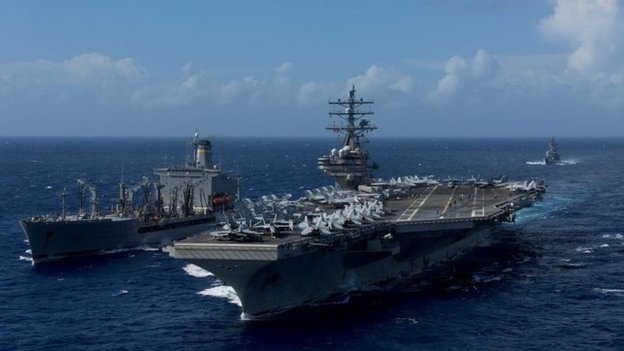
Image copyrightReutersImage caption The aircraft was ferrying passengers to the USS Ronald Reagan in the Philippine Sea
A US Navy aircraft carrying 11 crew and passengers has crashed into the sea off the coast of Japan.
The cause of crash is unknown and the names those onboard are being withheld while next of kin are notified, the US Navy said in a statement.
The aircraft was en route to the aircraft carrier USS Ronald Reagan in the Philippine Sea.
US military vessels have been involved in a number of accidents in recent months in East Asia.
The US Navy lost 10 personnel in August, when the USS John McCain collided with a tanker near Singapore.
Two months earlier, in June, the USS Fitzgerald smashed into a cargo ship off the coast of Japan, killing seven.
In two other non-fatal incidents, the USS Antietam ran aground near its base in Japan in January, and in May USS Lake Champlain collided with a South Korean fishing vessel.
Note: This story is auto-generated from BBC syndicated feed and has not been edited by AFRICA PRIME NEWS