Home Blog Page 1388

Trump-Russia: Michael Flynn admits lying to FBI

0

Media playback is unsupported on your device

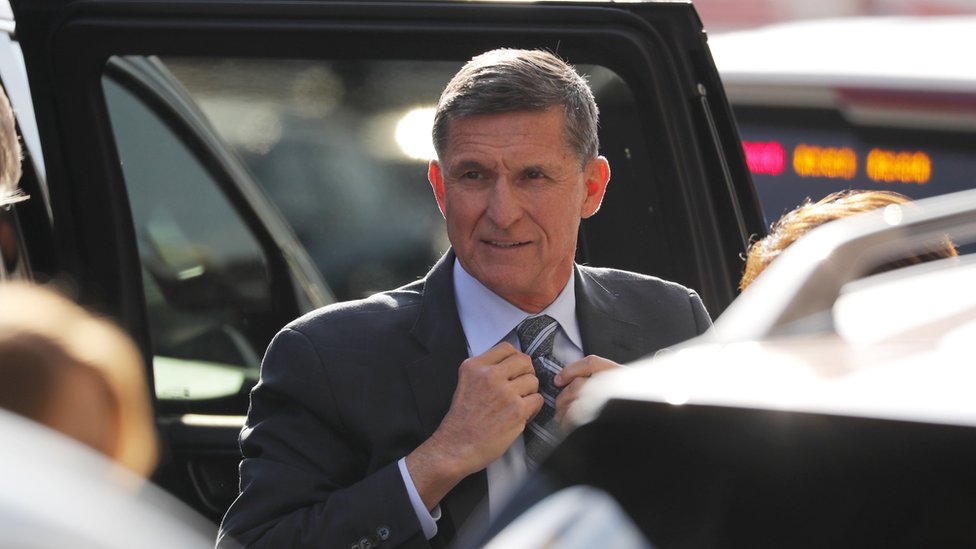
Media captionFlynn ignored reporters’ questions and shouts from the public as he arrived at court

Ex-national security adviser Michael Flynn has pleaded guilty to making false statements to the FBI about meetings with Russia’s ambassador weeks before Donald Trump became president.

The charges were brought by Special Counsel Robert Mueller, as part of his inquiry into alleged Russian meddling in the 2016 US election.

Mr Flynn is the most senior member of the administration to be indicted.

He also revealed he was co-operating with Mr Mueller’s inquiry.

Significantly, a statement made by Mr Flynn to prosecutors appears to implicate a more senior, though unnamed, Trump team official – indicating the direction in which Mr Mueller’s investigation may be heading.

What happened in court?

Image copyright William J Hennessy Jr
Image caption Mr Flynn appeared in court in front of Judge Rudolph Contreras

Appearing in a federal court in Washington DC, he admitted to one count of knowingly making “false, fictitious and fraudulent statements”.

According to an AFP reporter in court, the judge accepted Mr Flynn’s guilty plea and said he would not face trial.

Mr Flynn then issued a statement in which he said: “I recognize that the actions I acknowledged in court today were wrong and, through my faith in God, I am working to set things right”.

He said his plea and co-operation deal “reflect a decision I made in the best interests of my family and of our country”. The retired Army lieutenant-general is unlikely to serve more than six months in prison.

The White House issued a statement saying that “nothing about the guilty plea or the charge implicates anyone other than Mr Flynn”. A presidential appearance in front of reporters was then cancelled.

As he was escorted from court by FBI agents, a handful of protesters shouted “criminal” and “lock him up”, echoing a chant he led against Hillary Clinton during the Republican party convention last year.

What are the charges?

Mr Flynn was forced to resign 23 days into his job in February, a month after he was questioned by the FBI for misleading the White House about meeting then Russian ambassador Sergei Kislyak during the transition period, before Mr Trump took office.

Then, just over a week ago, US media said his legal team had told the president’s lawyers they could no longer discuss the case, prompting suggestions that he had begun co-operating with prosecutors.

It is not clear why he did not tell the truth to investigators. But it is illegal for a private US citizen, as Mr Flynn was during the transition, to conduct foreign affairs without the permission or involvement of the US government.

According to the charge sheet, Michael Flynn is accused of:

  • falsely telling FBI agents that on or about 29 December 2016 he did not ask Mr Kislyak to “refrain from escalating the situation in response to sanctions that the United States had imposed against Russia that same day”
  • failing to recall that Mr Kislyak had later told him Russia was moderating its response to the sanctions as a result of his request
  • falsely saying that, on or about 22 December 2016, he did not ask Mr Kislyak to “delay the vote on or defeat a pending United Nations Security Council resolution”. Although there is no detail of the resolution in question, the discussion came a day before the Obama administration decided not to veto a resolution asserting that Israeli settlements on occupied Palestinian territory “had no legal validity”
  • making false statements about the Turkish government’s involvement and supervision of a project that his intelligence company was taking part in.

Mr Flynn is not the first former Trump official to be charged.

In October, Mr Trump’s former campaign manager, Paul Manafort, and his business associate Rick Gates were accused of conspiring to defraud the US in dealings with Ukraine (both deny the charges). Another ex-aide, George Papadopoulos, has also pleaded guilty to making false statements to FBI agents

How damaging is this for President Trump?

By Anthony Zurcher, BBC News North America reporter

Michael Flynn lost his prized national security adviser post because of December 2016 conversations he had with Sergei Kislyak. Now he’s facing criminal charges.

That’s bad news for Mr Flynn, but it could be even worse news for Donald Trump, who reportedly directly lobbied former FBI Director James Comey to back off the Flynn investigation before firing the top law man.

Mr Flynn has told Robert Mueller’s team that he spoke with Trump presidential transition officials before and after reaching out to Mr Kislyak, and was instructed on how to handle the call. This contradicts public assertions made by the president himself that Mr Flynn was operating independently and against orders.

If the former national security adviser has evidence that corroborates his claims, it would be the biggest bombshell yet in this wide-ranging investigation.

It’s clear the independent counsel investigation is casting a very wide net, and Mr Mueller just landed his biggest fish yet.

What have we learned about Russia?

Media playback is unsupported on your device

Media captionHow Michael Flynn became entangled in Russia probe

As part of his plea bargain, Michael Flynn has signed a “statement of the offence” that gives us a timeline of the days of presidential transition in late December 2016, before Donald Trump was sworn in on 20 January 2017.

This is what federal prosecutors allege happened:

  • 22 December: A “very senior” Trump transition team official tells Michael Flynn to contact foreign governments including Russia to discuss a pending UN Security Council vote on Israeli settlements
  • 22-23 December: Mr Flynn urges Sergei Kislyak to vote against or delay the resolution; the next day Mr Kislyak says Russia would not vote against such a resolution
  • 28 December: Mr Kislyak contacts Mr Flynn – on the day President Obama announces sanctions against Russia for interfering in the presidential election
  • 29 December: Mr Flynn contacts “a senior official” in the Trump transition team at Mar-a-Lago in Florida to discuss a response. He “immediately” calls the ambassador back, urging Russia not to escalate the situation, then gets back in touch with the Trump transition official
  • 30 December: Russian President Vladimir Putin announces no immediate retaliation will take place
  • 31 December: Mr Kislyak calls Mr Flynn to inform him of Russia’s position, and Mr Flynn contacts the Trump transition team.

Note: This story is auto-generated from BBC syndicated feed and has not been edited by AFRICA PRIME NEWS

Nigeria: Bad Roads In Kaduna Community, Youth Resort To Self – Help To Reduce Hardship

120
Youth Working on Maigero Community Road
Youth Working on Ungwan Maigero Community Road

By William Ukpoju

Kaduna (Nigeria) — Following lack of government presence, resulting in dreadful condition of roads in Ungwan Maigero community, a surburb of Kaduna metropolis, northern Nigeria, youth in the area have resolved to take their destiny in their own hands, till government answer their clarion call.

To this end, they have taken upon themselves to arrest the severe health challenge posed to road users and the unremitting dust, which continues to wreck havoc on shop owners and residents along the pitfall and untarred roads.

Residents of the area told AFRICA PRIME NEWS that whopping cough and catarrh have become a major worry in the community as parents spent  huge part of their earnings  to care for their children every now and then.

Maigero,they said, is a major passageway for people residing in Narayi, Barnawa, Sabo and the likes, all in the state capital,  thereby making. the number of road users daily ,quite imaginable.

“Worried by the deplorable state of roads in this community, youths under the aegis of ‘Maigero Youth for Growth’ in Ungwan Maigero, a suburb along Sir Patrick Yakowa Express Way, Kaduna,  organized themselves to provide short-term respite for road users in the community.”

https://www.africaprimenews.com/2017/11/01/environment/nigeria-poor-state-intra-city-roads-kaduna-case-study/

According to the leader of the group, Mr. Clement Colours, the major road was almost becoming less motorable due to pitfalls on  the road. In his words, “We are tired of the unending dust and pot-holes that have continued to make life miserable for the inhabitants of Ungwan Maigero that is why we are determined to help the government provide short-term succour to road users.

“The heap of laterite you see here is the handiwork of our youth. So many have contributed money, resources and time to enable us carry out this community work today. We implore the state and local government to hasten to our aid as our meagre resources may not yield the desired result”, he said.

Speaking further about other basic amenities, Mr. Clement alluded that there is little or no government presence in Maigero; “We currently do not have primary health care centre, school, pipe-borne water and accessible roads; we are making frantic efforts to ensure that this community gets all the basic social amenities needed to make life more comfortable for our people…

“Until help comes from the government, ‘Maigero Youth for Growth’ are committed to donating their personal resources to sanitize and fix bad roads in Ungwan Maigero”, he added.

Nigeria: 50 Per Cent Of People Living With HIV/AIDS In Gombe Not Accessing Treatment

0
Map of Nigeria showing Gombe State

By Ahamd Umar

Gombe (Nigeria) — Civil Society for HIV & AIDS (CiSHAN) Gombe State chapter northeast of the country has said that about 64,000 People are living with HIV/AIDS in the State and half of them are not accessing treatment.

The State Coordinator of the Group, Ahmed Yusuf, disclosed this  at a press Briefing to mark  World HIV/AIDS Day on Thursday in Gombe.

He said that Currently, 90 percent of HIV funding is from international Donor Support, Private Sector 0.3 percent, local government 2 percent, while the state government contributes less than 8 percent.

“Of the 124 million naira allocated to HIV in the State 2017 budget only two million naira was released, and also Donor loss confidence in Gombe State due to the gross lack of commitment, of government and political will and care for citizens’ health, evident in the current piled up outstanding un-paid counterpart from the State Government; coupled with the fact that most Donors are winding up their projects and support.

“There is a protracted inadequate Counseling and Testing commodities in spite the growing demand for HCT and there is an alarming prevalence rate of Stigmatization, 37% of people with negative attitude towards People Living with HIV. Although Anti-Stigma bill has been passed into Law, however, the operationality of the law and citizens awareness are very low at the moment, over 50% of People Living with HIV do not access treatment,”  the Coordinator said.

https://www.africaprimenews.com/2017/11/06/governance/nigeria-restore-full-payment-salaries-allowances-lg-health-workers-council-tells-govt/

Yusuf called on youth to continue to   shun risky behaviors, and educate their peers using every medium possible, and stand to demand for their “Rights to Health…and make it happen”

“Citizens,  especially people Living with HIV should familiarize and engage with the Anti-Stigma Law and assert their “Rights to Health and make it happen for their equal access and treatment in dignity, Ministries, Departments and Agencies especially justice related, Legal Practitioners, must ensure the optimal implementation and operation of the Anti-Stigma Law to ensure citizens’ “Right to Health and make it happen and state government should declare a state of emergency   on HIV & AIDS by clearing all outstanding counterpart Funds within this 2017 budget.”,

Republican holdouts back tax bill despite $1tn deficit alert

0
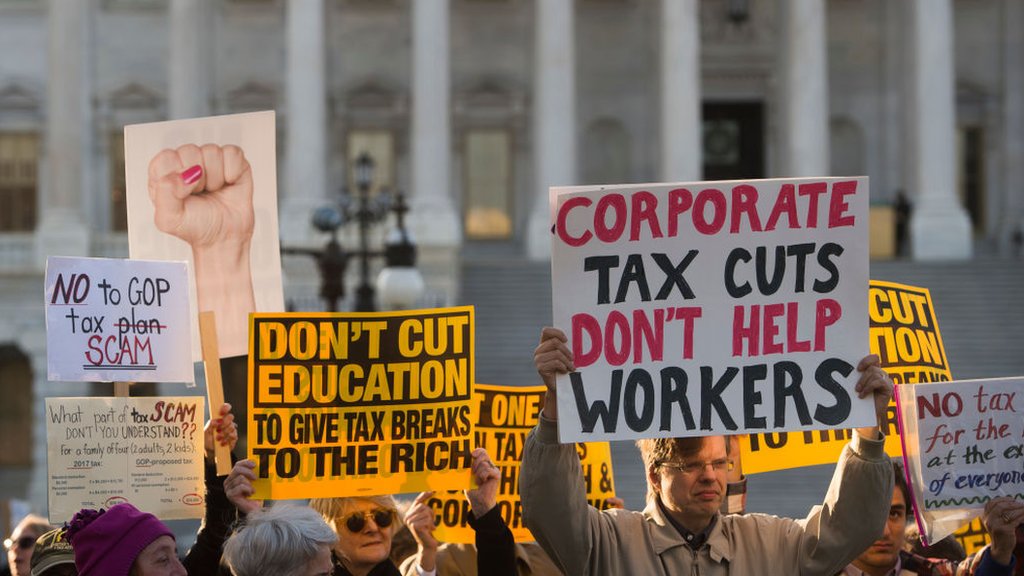
Protesters rally against the bill outside Congress earlier this weekImage copyright Getty Images
Image caption Protesters rally against the bill outside Congress earlier this week

Republicans who control the US Senate say they are confident of passing the biggest tax cuts since the Reagan era as soon as Friday.

Party leaders sounded bullish after three Republican holdouts said yes despite a Senate committee finding it would add $1tn (£742bn) to the deficit.

The committee’s report contradicts a White House claim that economic growth would compensate for the tax cuts.

President Donald Trump wants the measure enacted by Christmas.

The nonpartisan Senate Joint Committee on Taxation found on Thursday that the Tax Cuts and Jobs Act would add significantly to the federal deficit over a decade.

But Senators Ron Johnson, Jeff Flake and Steve Daines said on Friday they would support the legislation, which includes steep corporate tax cuts.

Mr Daines, of Montana, and Mr Johnson, of Wisconsin, and Mr Flake, of Arizona, were among a dwindling band of Republicans on the fence.

“After weeks of fighting for Main Street businesses including Montana’s farmers and ranchers, I’ve decided to support the Senate tax cut bill which provides significant tax relief for Main Street businesses,” Mr Daines said in a statement.

John Cornyn, majority whip of the chamber, said he is confident the party has the votes to pass the bill.

“We are confident of the 50 and would like to build on that,” he said.

Senate Republicans can afford to lose just two members of their party if they are to succeed.

Image copyright Getty Images
Image caption Mr Trump says the new code will be so simple, taxes can be filed on a postcard

The votes of Senators Bob Corker of Tennessee and James Lankford of Oklahoma were also being courted by the Republican leadership.

The party’s fiscal conservatives have for years lamented the nation’s debt time bomb.

But despite the Senate committee’s deficit warning, the party is full steam ahead on the bill.

If it passes, the Senate would need to merge its legislation with that passed last month by the House of Representatives.

The reconciled bill would then be sent to the president’s desk for his signature to be enacted into law.

Image copyright Getty Images

How do House and Senate bills compare?

  • Under the Senate bill, the corporate tax cut would not go into effect until 2019, instead of going into effect immediately.
  • The Senate bill would repeal the requirement that individuals have health insurance or face a fine. That is not included in the House plan.
  • The Senate bill does not allow households to deduct anything for state and local property taxes, a sticking point for lawmakers in high-cost states. The House plan allows families to deduct up to $10,000 in property taxes.
  • The Senate bill doubles the amount of money exempt from inheritance tax. The House plan would also eventually eliminate the inheritance tax entirely.
  • The Senate bill maintains seven tax brackets, but cuts the top rate to 38.5%, while the House would slim the number of brackets to four, preserving a top rate of 39.5%.
  • The Senate preserves some popular benefits for people with medical expenses and student loans, which the House would eliminate.

What is in the bill?

The details of the Senate bill remain in flux.

The heart of the proposal is a move to slash the corporate rate from 35% to 20%, a move that supporters say will make the US more competitive. But as a vote nears, some senators have raised the possibility of lowering the rate to 22%, in an effort to reduce the cost of the proposal.

The plan would also boost the amount individuals and families can deduct from their tax bill, while eliminating other targeted benefits. That change is meant to simplify tax filing for the average household.

But the bill’s effects would be much broader.

For example, the Senate has proposed eliminating a requirement that people have health insurance – a change that would rock US insurance markets.

Who will benefit?

Wall Street expects to benefit from lower rates, as companies use additional cash to buy back shares or pay out higher dividends.

But the effects of the changes are mixed for households.

Wealthy families would benefit from proposals such as one that would increase the amount exempt from inheritance tax.

Analyses suggest some lower- and middle-class families would eventually see higher bills as other benefits expire.

One of the most controversial parts of the bill is a measure that would stop allowing families to deduct their state and local taxes from their federal bills. The issue is especially important in high-tax states, many of which are Democratic.

Note: This story is auto-generated from BBC syndicated feed and has not been edited by AFRICA PRIME NEWS

Why Rex Tillerson is in trouble

0
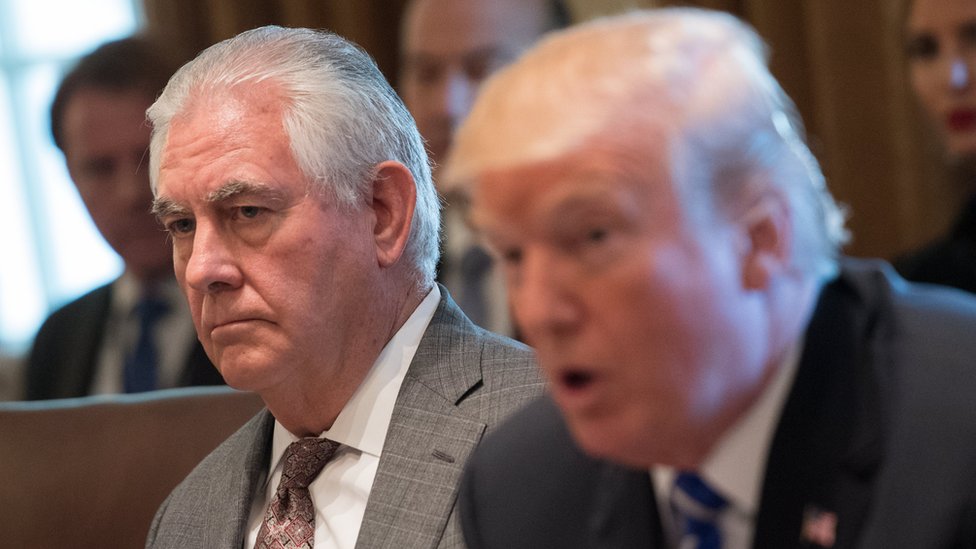
Rex Tillerson and Donald Trump at a Cabinet Meeting at the White House, 20 November 2017Image copyright KEVIN DIETSCH / POOL
Image caption Mr Tillerson and Mr Trump share a complex relationship

US Secretary of State Rex Tillerson dismissed as “laughable” on Friday reports that his job security is uncertain.

But rumours that the White House is considering a plan to replace him because of tensions with President Donald Trump have swirled in Washington DC for months.

The White House has said it has no personnel announcements to make. And the State Department says it is business as usual.

Meanwhile, the drama is further disrupting the already dysfunctional way foreign policy is run in this administration.

So here are my takeaways on where things stand.

Takeaway 1: A complex relationship

It clearly has not been a happy one since the summer, starting with Mr Trump’s politicised speech to the Boy Scouts of America, an organisation that Mr Tillerson used to head.

The secretary of state also distanced himself from the president’s equivocal response to the white supremacist rally in Charlottesville.

Then there was that extraordinary moment in October when Mr Trump suggested an IQ-test challenge after a report that Mr Tillerson had called him a moron (which the latter denounced but did not deny, although his spokeswoman eventually did).

The two have also aired striking policy differences in public: several times Mr Trump has openly undermined Mr Tillerson’s positions with his tweets.

Yet the president has quietly accepted his secretary of state’s diplomatic strategy on some issues, such as dealing with North Korea tensions, co-operating with Russia for a political settlement of the Syrian civil war, and agreeing to punt the Iran nuclear deal to Congress rather than abandoning it outright.

He also gave Mr Tillerson a shout out during his recent trip to Asia, where the two men shared plenty of quality time. But they are chalk and cheese in temperament and the way they work, which matters to a president who operates on instinct and interaction.

And Mr Tillerson has not really learned to play the game of Washington politics – nor does he seem interested in doing so. Which means that if this is a game to try and force him out, it is not clear if he will follow the rules.

CIA director Mike Pompeo is being lined up to replace Mr Tillerson, according to the Beltway rumour mill.

Mr Pompeo plays it well and has cultivated a relationship with Mr Trump, making a point of delivering his intelligence briefings in person. His positions are also much more in line with Mr Trump’s tough approach to national security.

Takeaway 2: A deeply dysfunctional house

I am struck by the parallel universes inhabited by the secretary and his critics at the state department. According to Mr Tillerson, it is functioning well – figures show about the same number of Foreign Service Officers now as this time last year.

It is not being hollowed out, Mr Tillerson says: such reports offend him on behalf of the hardworking career diplomats who have stepped into acting roles during an excruciatingly slow process of appointing political nominees.

As for his controversial redesign of the department, he says changes to its organisation and technology are badly needed. No one disputes that the state department needs to be dragged into the 21st Century.

And at least one anecdotal report from someone who is engaged with the “employee-led” process sounded upbeat about the prospects for organisational reform. But we don’t hear much from these employees leading the process, we do not hear much of anything at all.

More importantly to veteran diplomats, Mr Tillerson has not spelled out what strategy and priorities lie behind his drawing board: the department will be smaller and more efficient, but what will it be for?

And even if the numbers are stable, the expertise is draining away. Dozens of senior officials have been removed from their positions or taken early retirement. Hiring and promotion freezes mean they are not currently being replaced. Communication is a serious problem: between Mr Tillerson’s staff and the rest of the building, and with the press.

Those of us who travel with the secretary find him personable, straightforward, and seriously engaged with the issues. But there is no importance placed on delivering his message to the wider public.

He travels in a smaller plane, which means a scaled back staff that does not give regular updates about his movements, and turns the trips into logistical nightmares.

Morale at the state department is rock bottom.

Takeaway 3: How can he do his job?

The political intrigue that may unseat Mr Tillerson is separate from the state of the state department, but together they have undercut the effectiveness of US diplomacy.

And all this has contributed to confusion about what America stands for. “The whole administration suffers from not having articulated a clear vision for what American foreign policy is beyond the bumper sticker slogan of America First,” Harvard international affairs professor Stephen Walt told me. Nor have they articulated how they will achieve that with a reformed state department.

Mr Tillerson has begun to try and define policy in a more systematic way region by region. His recent speech on Europe was the least “America First” one I have heard from this administration – extolling historic ties and emphasising the importance of and commitment to the transatlantic alliance in the face of a resurgent Russia.

But when he travels to Europe next week, will he be taken seriously? How much weight will governments there give his words if he does not appear to have the president’s confidence? And how much longer can he operate this way, even if he is not sacked?

Note: This story is auto-generated from BBC syndicated feed and has not been edited by AFRICA PRIME NEWS

Cohoes fire: Amateur US blacksmith burns down buildings

0
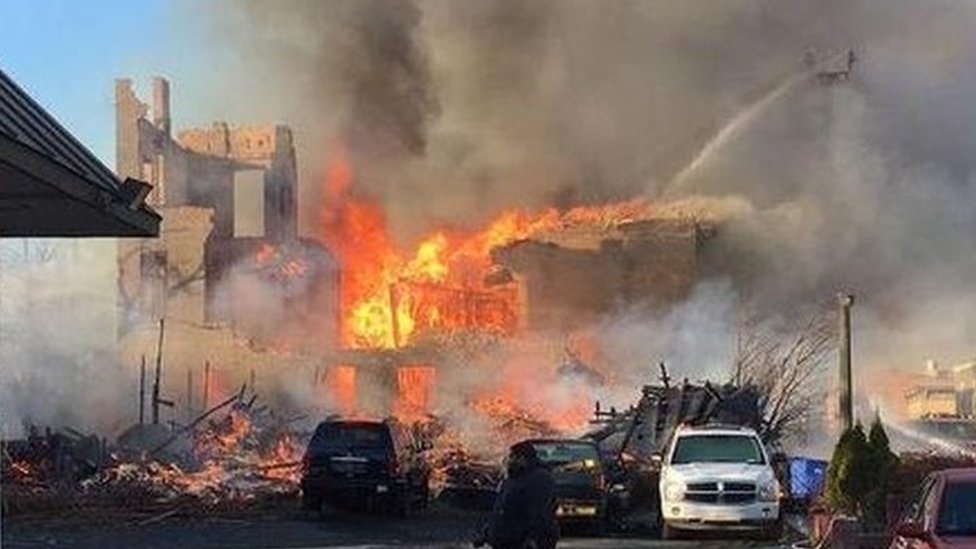
Fire in CohoesImage copyright WRGB
Image caption There’s a reason they say, “Don’t try this at home”

An amateur blacksmith started a fire that engulfed three blocks after attempting to imitate a sword-forging scene he had seen on TV, reports say.

John Gomes from the town of Cohoes in New York state was trying to bend metal in imitation of the TV series Forged in Fire when the yard blaze started.

The series shows professional bladesmiths competing to make “history’s most iconic edged weapons”.

It was the “worst disaster the city has ever seen,” Mayor Shawn Morse said.

Fanned by high winds, the flames destroyed three buildings and damaged 18 others. It was brought under control after three hours but then started up again an hour later, CBS reported.

Twenty people were displaced and a firefighter was taken to hospital with unspecified injuries but no-one else was hurt, the Albany Times Union reported.

Mr Gomes, 52, has been charged with reckless endangerment and arson and is in custody, the newspaper said.

“We often tell people we don’t allow open burns in the city and they often say, ‘What’s the worst that could happen? Well, this open burn just caused millions of dollars of damage and destroyed half our downtown,” CBS quoted Mr Morse as saying.

Mr Gomes’s teenage son defended his father on Facebook.

“My father John Gomes didn’t mean to burn his house down,” 16-year-old John Gomes wrote, the Albany Times Union reported.

Assistant police chief Tom Ross said the fire had been started unintentionally.

Note: This story is auto-generated from BBC syndicated feed and has not been edited by AFRICA PRIME NEWS

Nigeria Inaugurates National Advocates For Health

0
The Advocates
A cross section of The Advocates in a group photograph with the Nigeria's Minister of Health
A cross section of the National Advocates in a group photograph with Nigeria’s Minister of Health

Nigeria’s Minister of Health, Professor Isaac Adewole has inaugurated a group of 26 eminent Nigerians (THE Advocates), as National Advocates for Health.

Drawn from various spectrum, the body is to promote systems approach to healthcare delivery in Nigeria.

Inaugurating the team in Abuja, Nigeria’s Federal Capital, the minister enjoined ‘The Advocates’ to help change the narrative on health at different levels within the country.

Prof Adewole emphasized the need for the advocates to use their influence and networks to advocate improved health service delivery in Nigeria, most importantly at the grassroots.

He promised federal government’s commitment towards improved, refurbished and repositioned healthcare system that will accommodate issues of family planning.

The Minister decried the looming population as a disaster in waiting and therefore called for collective advocacy towards population control. “We cannot allow our population to double in 2020 as I fear its explosion will lead to more problems. Demographic dividends should be the expectation instead of demographic disasters,” he stated.

The advocates include, Prof. O.A Ladipo, Amb. Sunday Dogonyaro, Mrs. Folashade Tinubu-Ojo, Amina Bosede Omoti, Dr. Aminu Magashi Garba, Anthonia Ifeyinwa Omowole, Sen. Ayo Adeseun, Dr. Ekpedeme Udom, Dr. Gloria Laraba Shoda, Mrs. Omobolade Abumere.

Others are , Dr. Halima Yalwa Adamu, Ibrahim Tafawa Balewa, Dr. Ibrahim Wada, Mr. Iliya Kure, Prof. Joy Ezilo, Dr. Laz Ude Eze, Mrs. Margaret Bolaji, Mrs. Moji Makanjuola , Muhammad Nurudeen Lemu, Usman Muhammad, Olusegun Adeniyi, Sani Umar Jabbi, Saudatu Sani, Bishop Sunday Onuoha, and Dr. Uwemedimo Uko Esiet.

https://www.africaprimenews.com/2017/11/02/health/nigeria-governor-ganduje-signs-kano-state-health-trust-fund-law/

Members of ‘THE Advocates’ were selected and trained in April 2017 by Health Policy Plus (HP+), a Project funded by USAID, and implemented by a consortium led by Palladium, in partnership with the Federal Ministry of Health.

The HP+ project was implemented in three states Sokoto, Bauchi and Ebonyi in 2017. 

Through the efforts of ‘THE Advocates’, these states recorded a remarkable increase in budget allocation for family planning.

Reports say, members of the group have been engaging with stakeholders across the country on key issues affecting the health sector which include, improved budgetary allocation for health, release of the 1% Basic Healthcare Provision Fund, allocation of 15% national budget to health and lots more.

At the meeting facilitated by Federal Ministry of Health and HP+, the National Advocates shared the immediate results of their targeted advocacy to key stakeholders and resolved to step up their advocacies for better funding of health care.

They identified the implementation of the National Health Act of 2014 (NHAct 2014), as one of the key opportunities that has remained difficult to realize.

The NHAct 2014 which provides for the Basic Health Care Provision Fund (BHCPF) has the potential of improving funding for the Health Sector and making Universal Health Coverage (UHC) goal, achievable.

The National Advocates proposed to explore possible options to see to the appropriation of the NHAct 2014 in future budgets.

Furthermore, the group is considering the introduction of Innovative Financing Mechanism that will allow for the harnessing of private sector funding for the Nigeria health system and reduce the dependence on external donor funding.

Local Government Election In Akwa Ibom South South Of Nigeria, Police Deploys 15,000 Men, Calls For Orderliness

0
Voting/voters
Nigerians queue to vote in an election

By Amos Tauna,

Kaduna (Nigeria) — As the electorate prepare  for Saturday local government election in Akwa Ibom State, Southern part of the country, the state Police command has deployed fifteen thousand Policemen to  to ensure peaceful conduct before, during and after the election.

A statement issued by the Command’s Public Relations Officer, Bala Elkana said that the Command has put in place adequate security measures for peaceful conduct of the local  Election across the thirty-one (31) Local government areas of the  State.

“Movement of persons and vehicles across the State will be restricted from 12 mid-night of Friday 1st December, 2017 to 6:00pm of Saturday 2nd December, 2017, except personnel on essential duties who must carry their valid identification cards.

 “Voters are advised to conduct themselves in orderly and peaceful manner.

https://www.africaprimenews.com/2017/11/20/security/inspector-general-nigerian-police-extols-officers-anambra-elections/

“The command is well prepared to deal decisively with anyone bent  on causing the breach of peace before, during and after the election.

“Violators of this restriction of movement order will be dealt with in accordance with the Law,” the statement warned.

Currency Exchange Rates

USD - United States Dollar
ZAR
0.06
EUR
1.17
CAD
0.73
ILS
0.31
INR
0.01
GBP
1.34
CNY
0.14
Enable Notifications OK No thanks