Gombe (Nigeria) – Director General of the Nigerian Information Technology Development Agency (NITDA), Ali Isa Pantami, has stressed the need for Nigeria to stop relying on oil and gas for economic development
Pantami was peaking with Journalists in an interview in Gombe, northeast of the Country on Saturday at a sideline of a training program on ICT.
Pantami lamented that oil and gas had continued to remain the main source of revenue for Nigeria, when other countries have since diversified and expressed fear that “Any country that relies on oil and gas without thinking of how to diversify its economy, the future is very dark.
“As far as we continue to rely on oil and gas in this country our feature is very dark. Many nations have since discovered ICT as an alternative for oil and gas while here in Nigeria, ICT is the second to oil and gas, making our GDP to be around 10.26%, he added.
He said the best way for us to develop the ICT is to ensure that, “we are not only ICT consumers but ICT producers” explaining that the training programmes are called ‘Start up Friday’, ‘Start up Clinic’ and ‘Start up Nigeria” organized as a training and competition events.
“We will visit each and every zone of the country to identify young talented Nigerians that have the potentials of making the country proud through their ICT ideas, we will select them through competitions, we train them, we mentor them and at the end of the event we select the best of them and we can see how we can keep in touch with them and we even take them to international events, where their ideas can be presented.
The wisdom behind this, he said, is to build Nigeria’s ICT Eco system to ensure that the country is not only an ICT consumer but ICT producer saying, “We are extending to all Local Governments in the country, and whenever we intend to organize in one zone we ensure that all states participate and we make sure the message reaches their local governments, through that, anyone who has an idea will come forward to present”.
“We contact universities and all higher institutions of learning to get those that are willing to participate and sometimes if we see they have the idea we even invite them. Many people have benefited from our programme in North East through our scholarship for Msc, PhD through our internship programme even recently, about 3 months ago, over 250 people benefited from the North East alone and this in this competition, 12 people participated”
He then called on youth to stop redundancy pointing out that ; “each and every one of us was blessed by God with a certain talent and therefore they should wake up to use their talent so that they become employers of labour and not to be employed”.
The training program in Gombe, northeast zone is the third in the series. The first was conducted in Kaduna, northwest, followed by Lagos for the southwest.
Picture: Two Imo lawmakers, Stan Dara and Ike Amuka kneeling before Okorocha in Govt. House, Owerri
By Walter Duru, Ph.D
In modern democratic societies, the legislature performs three conventional functions of representation, law-making and oversight responsibilities. The 1999 Constitution of the Federal Republic of Nigeria (as amended) has provided the legislature in different sections, the powers to perform these functions at both the central and state levels.
The legislature controls through legislation, all economic, social and political activities of the state or country. It also scrutinizes the policies of the Executive and provides the framework of the judiciary to operate.
Contrary to the above norm, in Imo State, there are three arms of Government – the Executive, the Executive and the Executive. The executive has one name – Rochas Anayochukwu Ethelbert Okorocha, who rules the State (with his family) as a conquered people. The State Assembly is mere O yes rubber stamp. In Imo, it is the state versus her citizens, instead of the state for the citizens. I challenge whoever that thinks otherwise to prove me wrong, with verifiable facts and superior argument(s).
Anyone dreaming that recent developments at the State House of Assembly suggest they have woken up from slumber should wake up from that sleep and take some malaria pills. It is a huge joke and there is nothing like Imo State House of Assembly; instead, we have Okorocha House of clowns, in practical terms. What we have occupying the exulted positions of state lawmakers is a bunch of timid opportunists and puppets, who believe that their ascension to the state legislature is a special favour from the cad governor of the state, hence, they owe him worship.
How else do you describe a state Assembly that cannot boast of any meaningful people-oriented legislation since its inauguration? How else can one explain the fact that the only time people hear about Imo State House of Assembly is when there is a Budget or Supplementary Budget to ‘adopt;’ not pass, as this Assembly has never scrutinized any budget proposal submitted to it. The budgetary process is done in utmost secrecy and is mere ratification of the governor’s submission. Sometimes, the budget is signed and spending commences before the so-called annual budget proposal is submitted to the Assembly. Majority of the members of the State Assembly do not know what goes on in the legislature. Most legislative decisions are taken in the Executive Chambers. Another time you hear of the Assembly is when there is a request for loan for the personal use of the ‘Emperor’ or when there is an obnoxious anti people bill, usually sponsored by the Executive, through one of the puppets? A typical instance is that of the anti-media bill, smuggled in through the Deputy Speaker, Ugonna Ozurigbo.
They are at the beck and call of the Governor and have never and will never investigate whatever the executive is doing. No questions are ever asked; by the way, who, in the State Assembly has the guts to contemplate questioning the Governor or any of his allies?
It is an indubitable fact that the Speaker of the State Assembly, Acho Ihim takes instructions from the executive and can do anything to please the Governor. Some other members of the State Assembly kneel before him and practically tremble at the mention of his (Okorocha’s) name. I refuse to include that ridiculous title of Honourable, because, they are about the most dis-honourable people I have ever seen in public offices.
I simply smiled when a Civil Society colleague in Owerri attempted preaching Open Budgeting to Imo Government. Without apologies to a few of the lawmakers that relate with me, I can bet with my life that majority of them do not even have copies of the annual budget of the state they claim to be passing. Has the Assembly ever interrogated any budget proposal by the Executive? The Imo State Annual Budget is a secret document that only the governor and his cronies have access to. How then can the citizens be involved in the business of governance? How can they track government spending and budget performance?
How many bills that can promote good governance, enhance accountability, improve the socio-economic well-being of the citizens and secure the livelihood and future of Imo people have the present State Assembly passed? If it is not abortion bill today, it is anti-media bill tomorrow; from one obnoxious move to another. How did we get to this point in Imo?
Not even the public outcry that followed the numerous atrocities of the Okorocha-led government has moved them to act. Not even the blood of Soromtochukwu spilled during the illegal demolition of Ekeukwu Owerri. They are so dumb that they could not even pretend to be investigating any of the allegations against this ultra-corrupt government in the state.
From the complete absence of due process and rule of law, to the waste of scarce resources on trivialities; from non-payment of workers’ salaries, gratuities and pension of retirees, to issuance of dud cheques to pensioners; from failure to account for Bailout funds, Paris refunds and even the over one trillion Naira that has entered the state in the last seventy months to the use of state resources in conducting personal businesses.
What about the flagrant disobedience to Court orders and illegal demolition of private and public buildings? Land grabbing is a major characteristic of the present administration. How can a government seize landed property, using governmental powers and convert them to private use?
Nearly seven years into the present administration in the state, no local government election has been held. Where are the hundreds of billions accruing to the twenty-seven local government areas of the state? Is it the billions said to have been spent on statues? Now, Imo has Ministry of Happiness, with the Governor’s younger sister as Commissioner. Indeed, Imo has been rescued.
What about the Imo State Oil Producing Areas Development Commission- ISOPADEC, which funds should be statutory? At some point, Okorocha claimed to be saving the ISOPADEC billions for the construction of a Maritime University in Osemotor in Oguta Local Government Area of the State. Where is the Maritime University, nearly seven years after and where is the money?
The present administration in Imo is synonymous with corruption and is obviously irredeemable. But, where are the other two arms of government? The State Judiciary has become a toothless bulldog and cannot bite. Judicial pronouncements are disregarded with impunity and till date, nobody is in Prison for contempt.
Members of the Legislature that should have been the hope of the people to check the excesses of this ultra-corrupt government in Imo go cap in hand begging for contracts and favour from the executive. At some point, the governor engaged them with executive functions in Local Government areas.
Of all the atrocities of the present administration, the public outcry, media reports and petitions from citizens, which one has the present state Assembly investigated? Which member of the governor’s cabinet has either been summoned or questioned by the Legislature? Which decision of the Governor, no matter how ridiculous and unpopular, has the present Assembly questioned?
How can you have a docile and complicit State Assembly and still expect to have a responsible executive? The fact is that the State Assembly is responsible and should be held responsible for the misdeeds of the present executive.
Recent developments in the State Assembly may have been fueled by the fact that the governor is sitting on their constituency allowance and may have reneged on earlier promises. Following the initial protest of Budget boycott, funds are said to have been released to the leadership of the house and their cronies, who are mere messengers of the executive to rise against their colleagues; yes, divide and rule. Some of the resignation letters flying around may have been written and assented, prior to their emergence as principal officers. No one should be deceived. These guys cannot be trusted.
Ultimately, the surest way forward is for Imo citizens to take their destiny in their hands. Little wonder the mood of the last meeting of Nigerian Human Rights community in Owerri was for a declaration of a State of emergency in the State.
The only way for the State Assembly to redeem its image is to initiate immediate impeachment proceedings against the governor. For the lawmakers already marked for suspension, the die is cast. Can they, for once, get emboldened and stand on the side of the people?
The sorry state of Imo State today should be a lesson for all. 2019 is around the corner. Ndi Imo should not only be interested in who emerges the governor of the state, but those that are going to the State Assembly.
In addition to the business of lawmaking, one of the functions of the Legislature in every democracy is to serve as a check on the activities of the executive. In todays Imo, where are the laws made by the present administration and what checks have they provided? What oversight functions have they performed? Whom do they represent, other than their pockets and pay master? They are playing along so they can return to the Assembly in 2019; what a shame. Governor Okorocha runs Imo like an extension of his private business empire and members of the legislature sit as spectators?
There is no gainsaying the fact that indeed, there is no ‘capacity’ in the State Assembly and its leadership deserves no place in history.
Building a vibrant legislature is one sure way of deepening democracy, checking tyranny, promoting good governance, ensuring checks and balances and indeed, safeguarding the future of the people. From 2019, Ndi Imo must ensure that these ‘traders’ do not return to the state Assembly for any reason and through any means. Write down all their names and blacklist them, as they are undeserving of any position of responsibility.
The step being taken by Imo People’s Action for Democracy to ‘Occupy’ the State during the Christmas celebration is commendable and should have the sign in of all well-meaning Imolites. All stakeholders must join hands in sending a strong warning to this Nebuchadnezzar in Imo. The surest way forward is for the citizens of the state to take their destiny in their hands.
As for the present Imo State House of Assembly, the members should bury their faces shame.
The time to reclaim the people’s state is now. Do not be left out!
Dr. Walter Duru is a Communication expert and Executive Director, Media Initiative against Injustice, Violence and Corruption-MIIVOC. Reach him on: walterchike@gmail.com
ActionAid Nigeria, a national non-governmental organisation and affiliate of ActionAid International says it plans to hold a National Dialogue on Corruption, even as it is set to unveil a new anti-corruption programme in Nigeria next week.
In a statement by the Communications Coordinator of the organisation, Nihinlola Ayanda, Friday, in Abuja, ActionAid Nigeria said the new programme is called ‘Strengthening Citizens Resistance Against Prevalence of Corruption- SCRAP-C.’
According to him, SCRAP-C will seek to look at the fight against corruption “through social norm lenses and complement the law and enforcement approach in Nigeria.”
“The SCRAP-C project is a five-year project supported by the Department for International Development (DfID)’s Anti-Corruption in Nigeria (ACORN) programme. It is managed by a consortium of three national organisations – ActionAid Nigeria (AAN), Centre for Democracy and Development (CDD), and Centre for Communication Production in Nigeria (CCPN) led by ActionAid Nigeria. The project also has four implementing partners Centre for Citizens with disabilities (CCD), Women Advocates Research and Documentation Centre (WARDC), Youth Initiative for Advocacy Growth and Advancement (YIAGA), Human and Environmental Development Agenda (HEDA) who are taking responsibility for communities and groups engagements across six strategic states (Akwa-Ibom, Bornu, Enugu, Kaduna, Kano/Jigawa, and Lagos), including the FCT.”
“The SCRAP-C is a research and citizens’ oriented project. It will employ social marketing tools, research, advocacy, citizens’ mobilisation, media engagements and capacity development to achieve programme result which in this case is the desired behavioural change against corruption. Therefore, it will be more practical and beneficial for Nigerians to key into this innovative project to seek for desired behavioural change against corruption.”
“It is designed to set the pace for citizens’ engagements. It is a holistic and inclusive anti-corruption effort, designed to take innovative and inclusive approaches in its engagement with citizens. We believe that the adopted approach of citizens’ ownership of the anti-corruption battle would promote and nurture the right attitudes of citizens to corruption.”
Giving a background to the project, ActionAid Nigeria Project Manager, Newton Otsemaye explains:
“It is a known fact that past and present governments have indicated interest and indeed made efforts to fight corruption through various programmes and policies. Some have further shown efforts to design legal and institutional frameworks to reduce corruption in Nigeria. In spite of all these, corruption still happens unabated.”
“While our policy makers and political drivers seem to be overwhelmed with the scourge of corruption, and how to address it with cutting-edge strategies, literatures have shown that one of the most likely reasons why past institutional, policy and legal frameworks experienced setbacks is because of the huge disconnect between the anti-corruption efforts and citizens’ participation.”
“For anti-corruption efforts in Nigeria to be more holistic and inclusive, it must go beyond the boundaries of law and enforcement or sanctions to the terrain of society, change in attitude and behaviour. Therefore, social norms seem to be the new window not because it is new or old, but because there is empirical evidence of a strong relationship between social norms and corruption. On this premise, we may suggest that the anti-corruption efforts could leverage on these empirical positions by either appealing to existing social norms or creating new ones, with a view to changing corrupt behavior in Nigeria.”
“The public dialogue on corruption and public presentation of the anti-corruption project- SCRAP-C will bring together participants from the government, private sector, the media, professional bodies, women groups, youth groups, academia, policy makers and enforcers, market associations, labour unions and people living with disabilities to participate.”
The event, with the theme: When the fight against corruption becomes ours; Changing perceptions, beliefs and mobilising people’s movement against corruption is expected to hold in Abuja on the 11th of December, 2017.
Image copyrightAFPImage caption Maj Gen Attahiru Ibrahim was expected to make sure that his troops defeated militant Islamists
Nigeria’s military has sacked the commander leading the fight against militant Islamist group Boko Haram.
His redeployment to an unspecified post follows a string of attacks by the insurgents, including the killing of at least 50 people in a mosque last month.
No official reason was given for Maj Gen Ibrahim Attahiru’s removal.
Army chief Gen Tukur Buratai gave him a deadline in July to deliver Boko Haram leader Abubakar Shekau dead or alive within 40 days.
At least 20,000 people have been killed and thousands more abducted since Boko Haram launched its insurgency in north-eastern Nigeria in 2009.
President Muhammadu Buhari took office in May 2015 with a pledge to beat back the militants.
About seven months later, he declared that Boko Haram had been “technically defeated” after the army recaptured most territory that had fallen to it.
However, Boko Haram has continued carrying out bomb and gun attacks in the north-east.
In July, more than 40 people died during a military operation to free people who had been ambushed in a convoy by the militants.
The dead included soldiers and an oil exploration team.
Maj Gen Attahiru Ibrahim was appointed to lead the offensive against Boko Haram in the north-east in May this year.
He has been replaced with another general, Nicholas Rogers, who led a special military and police force to tackle ethnic clashes in the volatile central region.
Boko Haram at a glance
Image copyrightAFPImage caption Abubakar Shekau (centre) has been Boko Haram’s leader since 2009
Founded in 2002
Official Arabic name, Jama’atu Ahlis Sunna Lidda’awati wal-Jihad, means “People Committed to the Propagation of the Prophet’s Teachings and Jihad”
Initially focused on opposing Western education
Launched military operations in 2009 to create Islamic state
Designated a terrorist group by US in 2013
Declared a caliphate in areas it controlled in 2014
Image copyrightGetty ImagesImage caption The Giza al-Bahriya area of Sirte, days after the entire city was captured from IS in December 2016
One year on from a military campaign that successfully expelled so-called Islamic State (IS) from its Libyan stronghold of Sirte, residents have complained of the scale of destruction that remains.
Months of fighting left scenes of devastation similar to those seen recently in the Syria city of Raqqa, where IS was pushed out in October.
The IS reign in Sirte was known for its brutality. But the euphoria and celebration in the wake of the military offensive that succeeded in ousting the jihadists in December 2016 have dissipated into frustration and a yearning for life to return to normal.
Battle scars remain
Towards the end of 2017, residents from areas of Sirte that were hardest hit by the fighting staged protests against the lack of reconstruction efforts.
They blamed both of Libya’s rival authorities – the eastern-based parliament and the UN-backed Tripoli Government of National Accord (GNA) – for the situation in the city, though Sirte falls under the authority of the GNA.
Some 1,600 homes were destroyed in the bid to push IS out, Libyan media have said.
Demonstrators, including children, held up posters in front of battered buildings. “Dear government, why have you ignored our city?!” read one. “Reconstruction first,” said another.
Image copyright218 TVImage caption Protesters gathered in October calling on the authorities to rebuild Sirte
Struggle for a normal life
“I can’t speak for the protesters, but most Sirte residents just want life to return to normal as quickly as possible,” one local, Abdullah, told the BBC.
He preferred to be identified only by his first name, “because IS continues to pose a threat to us”.
“Sirte’s residents lived for many months under IS’s oppressive rule. We all suffered huge losses. IS killed our relatives and our friends, and left destruction in our city,” said Abdullah, who helps run a local Facebook page.
“After all this fear, we need a long time for our wounds to heal and to rebuild our city.”
Under IS’s brutal rule, people had posted images on social media and shared fond memories of life before the jihadists controlled Sirte.
Image copyright@agly1988 / Getty ImagesImage caption During IS’ occupation of Sirte, people used the Twitter hashtag #beloved_Sirte to recall fond memories of the city
Analysis
By Mary Fitzgerald, Libya analyst
The reconstruction of Sirte is one of a myriad of challenges faced by Libya. With the UN-backed unity government in Tripoli still struggling to impose its authority and too many factions determined to torpedo the entire UN-mediated dialogue process, the prospects of Sirte receiving the attention it needs anytime soon are slim.
Libya’s second city Benghazi has also been devastated by fighting and it too faces the enormous task of rebuilding and reconciliation. As long as Libya’s power struggles continue, its citizens will bear the brunt.
Life has become desperate for many. Some find it so unbearable that they have started taking the smugglers’ boats to Europe. At least 600 Libyans have made that journey this year.
Return of IS?
A serious challenge to Sirte’s recovery is that the threat of IS still looms large.
The group appears to be trying to regroup and attack Sirte from nearby locations.
Image copyrightGetty ImagesImage caption Forces loyal to Libya’s GNA fought for around seven months to expel IS
Losing the city was a major blow to the group’s propaganda efforts to portray it as a foothold on the doorstop of Europe.
Though it is unlikely to retake territory, IS has continued to wage sporadic attacks. In October it released an upbeat video of its fighters in Libya, saying that the group was making a comeback.
“Many people who fled the city have returned now. But we are still worried that the IS terrorists will return. For that we need help and support, so we can guarantee IS isn’t able to come back, and to ensure a safe life for us and our families,” Abdullah told us.
Authorities divided
One obstacle to reconstruction is the seemingly irreparable political crisis.
Rounds of negotiations sponsored by the UN and Libya’s neighbours have so far failed to heal the political rift between its rival authorities. The operations to recapture the city were led by militias sympathetic to the GNA, and supported by US air strikes.
The GNA has not responded to a BBC request for comment. But in November, GNA Prime Minister Fayez Sarraj instructed the authorities to urgently resolve the dire living conditions.
“The government has a vision for Sirte to be one of the main cities prioritised for reconstruction as soon as the financial situation has improved,” his media office said.
From Sirte, Abdullah told us progress could be achieved, but only through unity.
“We are sure that we can get back to normal – it is our duty. The best way to eliminate the danger of IS is to work together in the spirit of partnership. Every day we see volunteer initiatives by the young men and women of Sirte to contribute to reconstruction. We must all encourage them,” he said.
Haniya, from the local council, echoed his words: “The city needs everyone to rally around it, locally and internationally.”
BBC Monitoring reports and analyses news from TV, radio, web and print media around the world. You can follow BBC Monitoring on Twitter and Facebook.
Note: This story is auto-generated from ‘BBC News’ syndicated feed and has not been edited by Africa Prime News staff.
Zimbabwe has taken steps towards ending its economic isolation in its first budget since the end of Robert Mugabe’s 37-year authoritarian rule.
Finance Minister Patrick Chinamasa announced a package of measures aimed at wooing international investors, including new curbs on laws that require firms to be 51% locally owned.
He said privatisation of some state firms was being considered.
He unveiled spending cuts including the closure of some diplomatic missions.
Mr Chinamasa also said all civil servants over the age of 65 would have to retire as the government aims for a 2018 budget deficit of below 4% of GDP.
At present, more than 90% of government expenditure goes to pay civil servants’ salaries.
Since taking office last week, new President Emmerson Mnangagwa has pledged to crack down on corruption.
He has also offered a three-month amnesty for individuals and companies to surrender public funds illegally stashed abroad.
The Indigenisation and Economic Empowerment Act (IEEA), which aimed to place 51% of companies into the hands of black Zimbabweans, was brought in by Mr Mugabe in 2009.
But in Thursday’s budget announcement, Mr Chinamasa said the law would apply only to the platinum and diamond sectors from now on.
At the same time, export taxes on processed platinum would be deferred until 2019.
Note: This story is auto-generated from ‘BBC News’ syndicated feed and has not been edited by Africa Prime News staff.
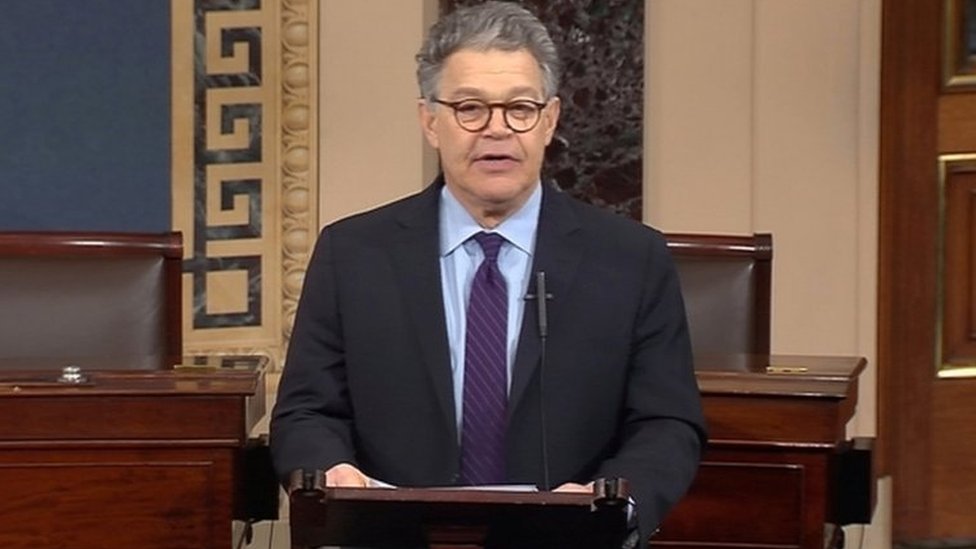
Media captionFranken attacked Donald Trump and Roy Moore in his resignation speech
Democratic Senator and ex-comedian Al Franken has said he plans to quit “in the coming weeks” after string of sexual harassment allegations.
“I am proud that during my time in the Senate that I have used my power to be a champion of women,” the Minnesota senator said from the US Senate floor.
The announcement came after dozens of Democrats called on him to resign.
He is the most prominent lawmaker to resign amid a wave of sexual misconduct claims against high-profile figures.
“Today I am announcing that in the coming weeks I will be resigning as a member of the United States Senate,” he told his colleagues on Thursday.
“I may be resigning my seat but I am not giving up my voice.”
The former Saturday Night Live comedian and two-term senator has apologised to several women who have accused him of groping and sexual harassment, but he faced mounting pressure to resign after a new allegation emerged on Wednesday.
Image copyrightGetty ImagesImage caption Mr Franken arrived at the Capitol holding hands with his wife
Mr Franken said some of the allegations against him “are simply are not true”, but added that women “deserve to be heard and their experiences taken seriously”.
He also referenced the sexual misconduct allegations that have been levelled against US President Donald Trump and Republican Alabama Senate candidate Roy Moore.
“I, of all people, am aware that there is some irony in the fact that I am leaving while a man who has bragged on tape about his history of sexual assault sits in the Oval Office, and a man who has repeatedly preyed on young girls campaigns for the Senate with the full support of his party.”
Media playback is unsupported on your device
Media captionFranken accuser: I was disgusted
Mr Franken is not the only US politician to have found himself accused of sexual harassment in recent weeks.
On Tuesday, Michigan Democrat John Conyers, announced that he would resign amid claims of sexual harassment made by his congressional aides.
Seven women have come forward to accuse Mr Moore, a former Alabama Supreme Court judge, of sexual misconduct decades ago, including one woman who claims he molested her when she was 14 years old while he was in his 30’s and working as an Alabama prosecutor.
Another woman alleges the judge had tried to rape her after he offered her a ride home from her job as a waitress.
Several Democratic female senators – including some who called for Mr Franken’s resignation a day earlier – hugged the lawmaker after his speech.
We have a president who acknowledged on tape that he assaulted women. I would hope that he pays attention to what’s going on and think about resigning.
Fellow Minnesota Senator Amy Klobuchar thanked Mr Franken on Facebook, calling him a “friend to me and many in our state”.
“In every workplace in America, including the US Senate, we must confront the challenges of harassment and misconduct,” she wrote.
“Nothing is easy or pleasant about this, but we all must recognize that our workplace cultures – and the way we treat each other as human beings – must change.”
The decision to replace Mr Franken will fall to Democratic Minnesota Governor Mark Dayton, who said in a statement he has not yet made a decision.
“I extend my deepest regrets to the women, who have had to endure their unwanted experiences with Senator Franken. As a personal friend, my heart also goes out to Al and his family during this difficult time,” he said.
Note: This story is auto-generated from BBC syndicated feed and has not been edited by AFRICA PRIME NEWS
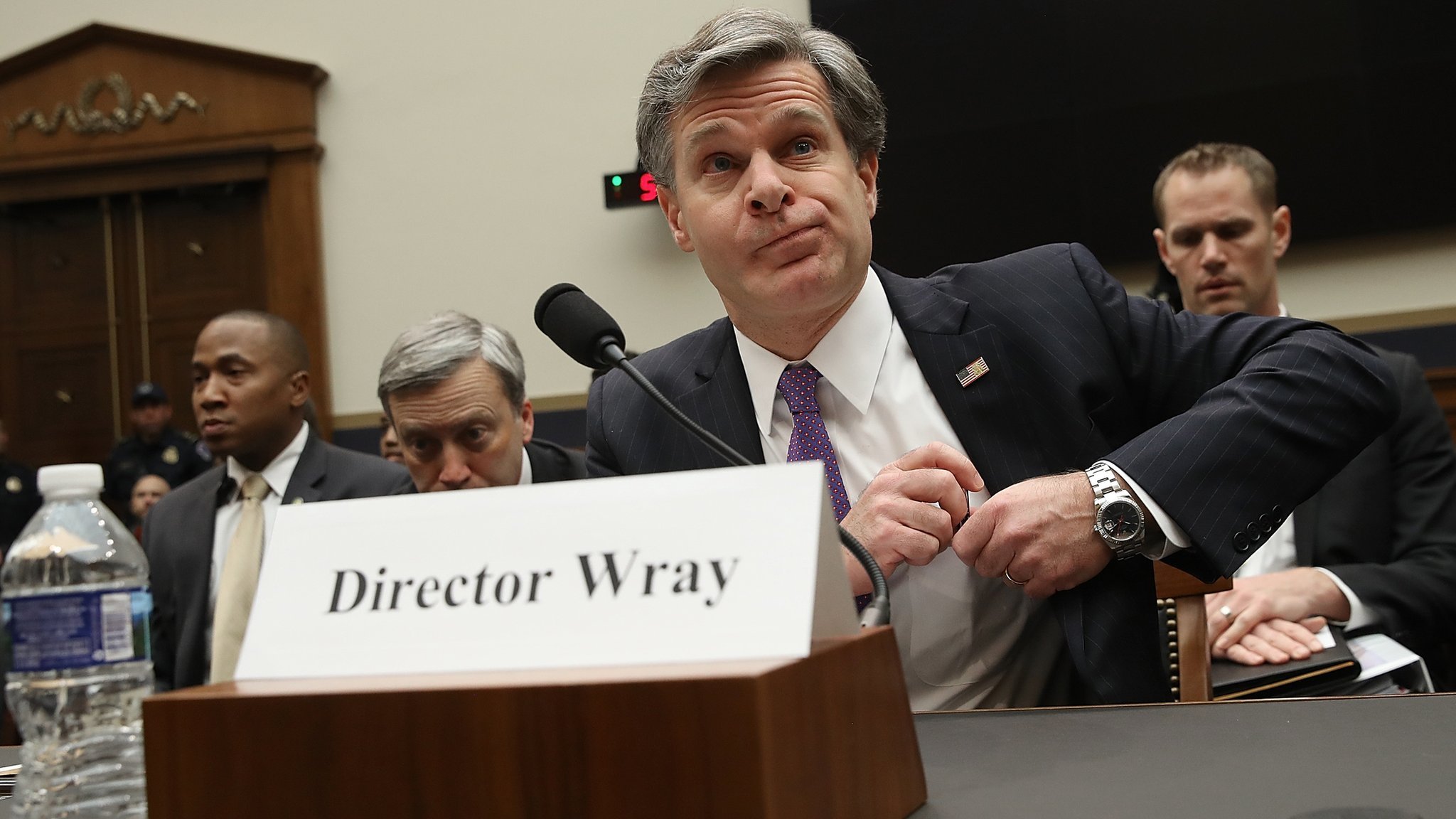
Media captionFBI Director Wray denies Trump claim bureau ‘is in tatters’
FBI Director Christopher Wray has launched a staunch defence of the agency following criticism by US President Donald Trump.
Mr Wray told a committee of lawmakers that there was “no finer institution”.
Mr Trump recently lashed out at the federal law enforcement agency, saying its reputation was “in tatters”.
Special Counsel Robert Mueller, a former FBI director, is investigating alleged Russian interference in the US election to help elect Mr Trump.
Mr Trump denies that his team colluded with Moscow.
“There is no finer institution than the FBI and no finer people than the men and women who work there and are its very beating heart,” Mr Wray told the House of Representatives judiciary committee.
Impartiality of investigation under spotlight
Analysis by Anthony Zurcher, BBC News, Washington
FBI Director Christopher Wray was the man testifying before the committee on Thursday morning, but – at least for the Republican congressmen present – it was special counsel Robert Mueller in the spotlight.
In particular, the Republicans honed in on a former member of Mr Mueller’s team, Peter Strzok, a top FBI counterintelligence officer removed from the investigation this summer after the agency discovered he had written negative text messages about Donald Trump during the 2016 presidential campaign.
The strategy is clear – to raise doubts about the impartiality of Mr Mueller’s investigation. The president’s supporters for months have been pointing to perceived Democratic leanings of some of the investigative team, including a handful of donations made to Democratic candidates.
Mr Strzok – who participated in the interview of Trump confidante Michael Flynn as well as the investigation into Hillary Clinton’s use of a private email server as secretary of state – has now become the most-cited example of possible bias.
Conservative officeholders and commentators are steadily sharpening their criticisms of Mr Mueller, a former Republican-appointed head of the FBI. As his investigation proceeds, and the list of presidential associates facing criminal charges grows, this partisan pressure is sure to mount.
Republican committee members pressed Mr Wray on alleged bias within the FBI.
He responded by saying that all organisations made mistakes but “independent processes” at the FBI would look into the facts surrounding any mistakes and FBI employees would be held accountable if “appropriate”.
Reports emerged last weekend that Mr Mueller had dismissed an FBI officer from the investigation after he was discovered to have made anti-Trump remarks in text messages.
The president seized on the officer’s dismissal and, in a tirade on Twitter, said the FBI’s “reputation is in Tatters – worst in history! But fear not, we will bring it back to greatness”.
Mr Trump also reiterated his denial that he asked former FBI director James Comey to drop an investigation into the conduct of Michael Flynn, the president’s former national security adviser.
Mr Flynn announced a week ago that he was co-operating with Mr Mueller’s investigation. He admitted lying to the FBI and, in return for pleading guilty to a lesser charge, was offered a reduced prison sentence of six months.
Analysts say the deal indicates Mr Flynn has incriminating information about one or more senior members of the Trump administration.
Media playback is unsupported on your device
Media captionAfter Flynn’s guilty plea, what next for the Russia investigation?
Mr Trump has repeatedly criticised the FBI for not taking action against his election rival Hillary Clinton.
Mrs Clinton was investigated by the FBI after it emerged she had used a private email server to conduct state department business. No charges were brought against Mrs Clinton or her team.