Nigeria : Why We Intervened In Finance Minister, DG Security And Exchange Commission Conflict -Speaker
Nigeria: Private Initiative in Kaduna Donates Facilities To Primary School

By Amos Tauna
Kaduna (Nigeria)–As part of measures to provide conducive environment for teaching and learning , Joy Onyesoh Foundation on Thursday presented 35 three-seatter chairs to LEA Primary School Ungwan Boro, Kaduna, northwest Nigeria.
The spokesperson for the Foundation, Talatu Henry explained that the gesture was part of the organisation’s area of focus on providing an enabling environment for pupils to have quality education in Nigeria.
The Joy Onyesoh Foundation was established in September 2017, out of passion to serve humanity.
Nigeria Fadama III Disburses Economic Empowerment Items to IDPs in Gombe.

By Ahmad Umar
Gombe (Nigeria)-Some Internally Displaced Persons in Gombe State, northeast of the country have been provided with some economic empowerment items worth ten million Naira.
The items referred to as non- farm livelihood, include, 120 sewing machines, 119 grinding machines, 10 knitting machines, 6 ox plough, 10 open stalls and a Solar borehole to the host community.
The distribution was made by the State Fadama III Additional Financing II (AF2) under North East Food Security and Livelihood Emergency Support Project on Infrastructures.
The state project coordinator of the Fadama project, Habiba Mohammed who disclosed this at the launching of the programme in Gombe on Thursday, said the gesture was aimed at assisting the internally displaced persons.
Hajiya habiba explained that the project was made possible through the assistance of Federal and State governments, and commended the state Governor for his support
Speaking on behalf of the Internally Displaced Persons, the Chairman of the IDPs in the state, Abba Jatau expressed delight and commended federal and State governments as well as all other stakeholders on the Fadama III additional finance II for rural infrastructures for their tremendous effort in making IDPs reliable.
He said that about five months ago, about 335 million naira was spent on infrastructures in 67 communities hosting internally Displaced Persons in the state.
A community leader, Barau Poli commended the Fadama III project for impacting positively on the lives of the host communities and internally displaced persons.
60M At Risk Of Sleeping Sickness in Sub-Saharan Africa

By Amos Tauna
Kaduna (Nigeria)– A Lecturer with the Faculty of Vetenary Medicine, Ahmadu Bello University Zaria, northwest Nigeria, Shuaibu Mohammed, has said that there are about 70,000 cases of sleeping sickness in Nigeria every year, while an estimated of 60 million people are at the risk of the infection in sub Saharan Africa annually.
Speaking at the First Annual Conference on Climate Change jointly organized by African Climate Reporters and Womenhood Foundation of Nigeria in Kaduna, the Lecturer said, “Climate change is a natural phenomenon that is characterized by global warming, rising sea level and other extreme environmental events.
“Climate is essential to ecosystem services and stability. One of the consequences of climate change is the shifting boundaries for many components and processes within the systems.”
Mohammed explained that among these components, are pathogens and infectious diseases.
“Vector-borne diseases are particularly sensitive to warming because temperature changes can alter vector development rates, shift their geographical distribution and alter transmission dynamics.
“Trypanosome, a vector-borne disease of humans and animals, was recently identified as one of the 12 infectious diseases likely to spread owing to climate change. It is the most critical factor that limits the southwards migration of Fulani.
“ln Northern Nigeria, climate change impacts are mainly flood, drought and rural urban migration,” he added.
Also in a paper on “Effects of Climate Change in Nigeria,” Nurudeen Bello stated that the adverse effect or impact of climate change such as temperature rise, erratic rainfall, sandstorm, desertification, low agriculture yields, drying of water body lake Chad basin, gully erosion and constant flooding are daily realities in Nigeria.
He noted that climate change also known as global warming refers to rise in average surface temperature on earth, saying that overwhelming scientific consensus maintained that climate change was due to human use of fossil fuel which released carbon dioxide and other greenhouse gas estimates into the air.
“The gases trap heat within the temperature, which can have a range of effects on ecosystems including rise in sea levels, severe weather event, drought that render landscape more susceptible to widefires,” he explained.
Earlier, Dr. Yusuf Nadabo, a lecture with Kaduna State University who spoke on the importance of Science journalism enjoined Nigeria media practitioners to show more interest, commitment and zeal to science news and reporting as exemplified in western world for purposes of information and promotion of science research and encouragement.
According to him, science research, discovery and presentation without proper publicity remains a limbo and of little benefit to large public, saying that valuable times spent to read extensively is what it takes to make a good science and climate reporter, and nothing to fear.
African climate reporters from French speaking neighboring countries and Nigeria, attended the event.
Canada TV personality Steve Ecklund shoots cougar, sparking backlash

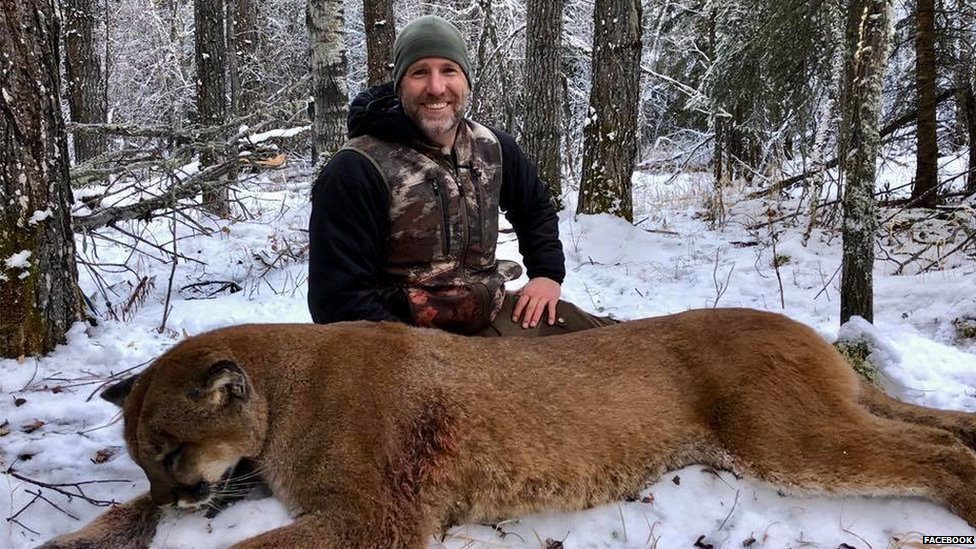
Image copyright Facebook A Canadian television personality is getting pilloried on social media after posting a photo of himself next to a cougar that he had killed.
Steve Ecklund, who hosts the outdoor show The Edge, bragged about killing the large Alberta mountain cat online.
Photos of him next to the dead animal have sparked outrage, including some harsh words from Laureen Harper, the wife of Canada’s former prime minister.
“Must be compensating for something,” she tweeted.
Mrs Harper is the wife of former prime minister Stephen Harper, who was also an MP for Alberta, the province where the animal was hunted.
The couple are noted animal lovers, especially cats. She and her husband rescued many cats throughout his tenure in Ottawa.
Her uncensored reply caused a shock, since she was known to be quite reserved when she was in the public eye.
But Mr Ecklund showed no sign of remorse.
“If you can guess what post has 900 likes, 450 comments, 13 confirmed death threats, 754 swear words and one very happy hunter in it…….I will enter your name into the draw for the new cougar cook book, filled with mouth watering recipes for your next mountain lion,” he wrote on Facebook.
He defended the kill by explaining that he will use every part of the animal.
More like this:
Not everyone felt outrage over the kill. Some defended it, saying the animals are predators and dangerous to humans. Cougars are not endangered in Alberta, and are legal to hunt.
“SO JEALOUS…maybe next year,” wrote one commenter on his Facebook page.
Note: This story is auto-generated from BBC syndicated feed and has not been edited by AFRICA PRIME NEWS
Jerusalem: UN resolution rejects Trump’s declaration


Media playback is unsupported on your device
The UN General Assembly has decisively backed a resolution effectively calling on the US to withdraw its recognition of Jerusalem as the capital of Israel.
The text says that any decisions regarding the status of the city are “null and void” and must be cancelled.
The non-binding resolution was approved by 128 states, with 35 abstaining and nine others voting against.
It came after US President Donald Trump threatened to cut financial aid to those who backed the resolution.
How did UN members vote?
- The nine who voted against the resolution were the US, Israel, Guatemala, Honduras, the Marshall Islands, Micronesia, Nauru, Palau and Togo
- Among the 35 abstaining were Canada and Mexico
- Those voting in favour included the other four permanent members of the UN Security Council (China, France, Russia and the UK) as well as key US allies in the Muslim world
- There were 21 countries who did not turn up for the vote.
Read more: How did your country vote?
What is so contentious about Jerusalem’s status?
The status of Jerusalem goes to the heart of Israel’s conflict with the Palestinians.
Israel occupied the east of the city in the 1967 Middle East war and regards the entire city as its indivisible capital.

Media playback is unsupported on your device
The Palestinians claim East Jerusalem as the capital of a future state and its final status is meant to be discussed in the latter stages of peace talks.
Israeli sovereignty over Jerusalem has never been recognised internationally, and all countries currently maintain their embassies in Tel Aviv. However, President Trump has told the US state department to start work on moving the US embassy.
What does the UN resolution say?
The 193-member UN General Assembly held the rare emergency special session at the request of Arab and Muslim states, who condemned Mr Trump’s decision to reverse decades of US policy earlier this month.
The Palestinians called for the meeting after the US vetoed a Security Council resolution that was similar to the text approved on Thursday.
The text put forward by Turkey and Yemen does not mention the US, but expresses “deep regret at recent decisions concerning the status of Jerusalem”.
It also says “any decisions and actions which purport to have altered the character, status or demographic composition of the Holy City of Jerusalem have no legal effect, are null and void and must be rescinded in compliance with relevant resolutions of the Security Council”.
What do Israel and the Palestinians say?
Israel’s Prime Minister Benjamin Netanyahu had promised to reject the results of the vote, calling the UN a “house of lies”.
Afterwards he said in a statement: “Israel thanks President Trump for his unequivocal position in favour of Jerusalem and thanks those countries that voted alongside Israel, alongside the truth.”
A spokesman for Palestinian President Mahmoud Abbas called the vote “a victory for Palestine”.
How does the US see it?
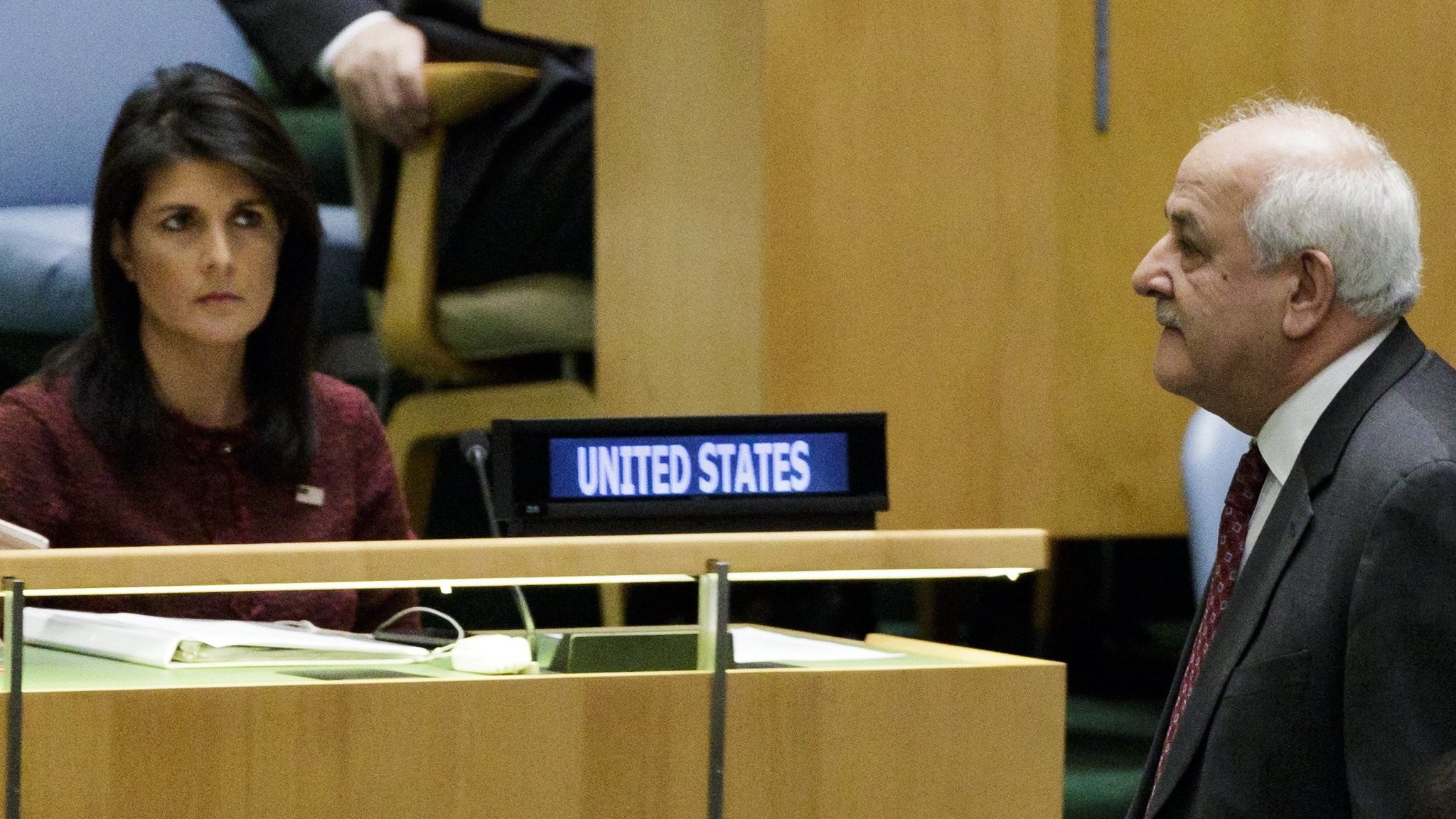
In a speech before the vote, US permanent representative Nikki Haley stressed that the US decision did not prejudge any final status issues, and did not preclude a two-state solution if the parties agreed to that.
“The United States will remember this day, on which it was singled out for attack in the General Assembly for the very act of exercising our right as a sovereign nation,” she said.
“America will put our embassy in Jerusalem. That is what the American people want us to do. And it is the right thing to do. No vote in the Untied Nations will make any difference on that.”

Media playback is unsupported on your device
On Wednesday, Mr Trump warned he might cut financial aid to states who voted in favour of the resolution.
“They take hundreds of millions of dollars and even billions of dollars and then they vote against us,” he said. “Well, we’re watching those votes,” he added. “Let them vote against us. We’ll save a lot. We don’t care.”
Will Trump act in retaliation?
Analysis by Sebastian Usher, BBC Arab affairs analyst
The result of the UN General Assembly vote was inevitable: the US knew that the majority of states would vote for the resolution. But there may have been slightly more abstentions and votes against than had been expected – which will be some comfort to the Trump administration.
There’s little surprise in the countries that voted against – the likes of Micronesia, Nauru and Togo had nothing to gain from voting against the interests of the US, which helps support them.
Canada, Mexico and Poland were amongst those that abstained, in a move that will do nothing to harm their relations with the US.
The votes for the resolution from powerful US allies, such as France, Germany and the UK, could be seen as a slap in the face for President Trump – but all would argue that they simply voted in line with the existing status quo at the UN. There was no pressing reason for them to switch from this stance.
But the real test of the vote will be whether the Trump administration acts on its threats to reconsider financial aid to some of those who backed the resolution. Key, too, will be whether the resolution will give fresh impetus to the protests against the US decision that have been going on ever since it was announced, but have yet to really catch fire.
Note: This story is auto-generated from BBC syndicated feed and has not been edited by AFRICA PRIME NEWS
Florida fraternity engaged in ‘conspiracy’ in student’s death

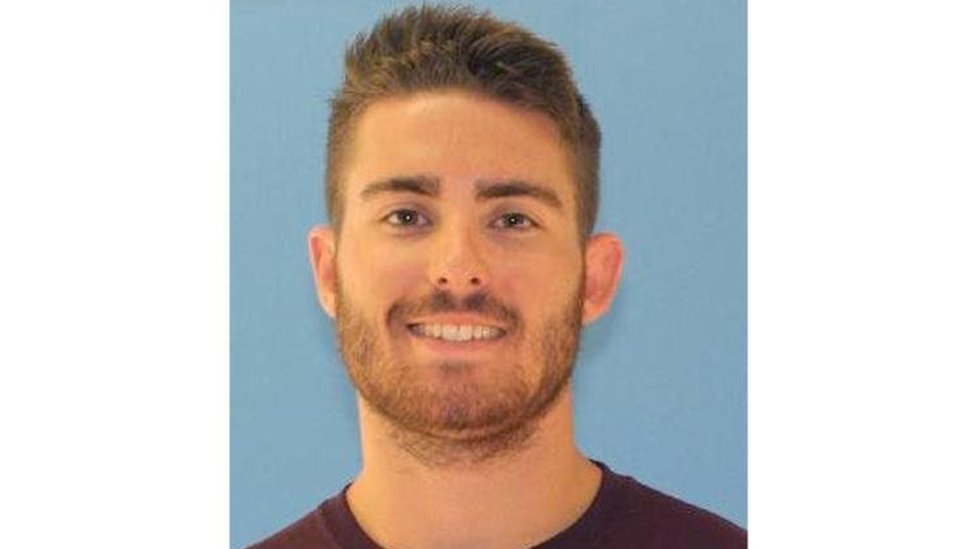
Image copyright Florida State University Fraternity students engaged in a “conspiracy” as they waited to call police when a student died from acute alcohol poisoning, says a court.
Florida State University’s social club tried to obstruct the investigation, said the Leon County grand jury.
The panel was convened to decide if there is enough evidence to press criminal charges in the death of Andrew Coffey, 20, last month.
His family said he “died alone in a room full of people”.
The 16-page grand jury presentment says there is sufficient evidence to prosecute fraternity members.
It is now up to the state attorney to decide whether to pursue the case.
The university suspended all so-called Greek life on campus after Mr Coffey’s death.
More than 80 people, including two paid strippers, attended the members-only “Big Brother” party of the Pi Kappa Phi fraternity on 3 November.
Mr Coffey was given a bottle of bourbon to drink before passing out on a couch.
The fraternity did not force him to drink, but he probably would have been ostracised if he had not joined in, the grand jury said.
It added that the party “occurred in an environment of hazing”.
The grand jury was highly critical of the fraternity members’ actions after they discovered Mr Coffey had no pulse.
His “so-called brothers” wasted 11 minutes calling and texting each other before alerting authorities, the presentment found.
‘Shocking apathy’ to fraternity drinking
Ten charged for fraternity hazing death
The delay would not have saved his life, but it showed the fraternity “were more concerned about getting in trouble than they were about trying to save Coffey’s life”, jurors wrote.
During the investigation, the majority of students refused to speak to police, and those that did seemed to give “rehearsed” and “self-serving” testimonies.
The student’s behaviour points to “elements of conspiracy and obstructionism”, the grand jurors wrote.
They “repeatedly made the choice not to speak out, but rather to remain loyal to a culture of secrecy that cannot be allowed to continue,” the report says.
Sandy Coffey, the young man’s mother, said the grand jury presentment was disturbing.
“The Pi Kappa Phi creed uses words like loyalty, responsibility, standards, conduct,” Mrs Coffey wrote in a statement.
“Easy words to put down on paper. Obviously more difficult to live by.”
She said her son had wanted to join the US Navy.
Note: This story is auto-generated from BBC syndicated feed and has not been edited by AFRICA PRIME NEWS
Grocery store worker serenades patrons with opera voice

[unable to retrieve full-text content]Note: This story is auto-generated from BBC syndicated feed and has not been edited by AFRICA PRIME NEWS