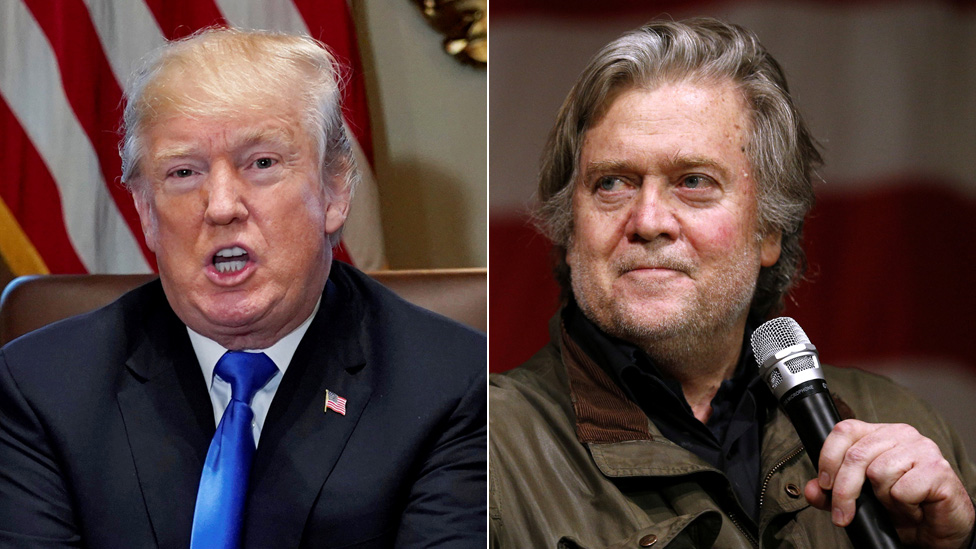
Media captionFive things Trump thinks about Bannon now
US President Donald Trump’s lawyers have written to his former strategist Steve Bannon, saying he has violated a non-disclosure agreement.
The cease-and-desist notice accuses Mr Bannon of defaming the president in speaking to author Michael Wolff.
Mr Wolff’s forthcoming tell-all book describes the president as being unprepared for the job.
Mr Trump responded by saying Mr Bannon had “lost his mind” after losing his White House position.
His lawyers said Mr Bannon had broken his employment agreement by speaking to Wolff about Mr Trump and his family, “disclosing confidential information” and “making disparaging statements and in some cases outright defamatory statements to Mr Wolff about Mr Trump, his family members, and the Company”, the letter said.
In March 2017, then-White House press secretary Sean Spicer told journalists UK intelligence services could have been involved in an alleged spying operation on Trump Tower in New York. GCHQ said the allegation was “nonsense”.
Who is Michael Wolff?
The 64-year-old writer is a former columnist for New York magazine and Vanity Fair. He also wrote a biography of media mogul Rupert Murdoch.
Image copyrightAlamy Image caption Michael Wolff has written a number of books about the media
His book is reportedly based on more than 200 interviews.
According to New York magazine, which first published the extracts, Wolff was able to take advantage of the Trump administration’s political inexperience to gain an unusual amount of insight.
“There were no ground rules placed on his access, and he was required to make no promises about how he would report on what he witnessed,” it says.
Wolff said he was able to take up “something like a semi-permanent seat on a couch in the West Wing” following the president’s inauguration.
How has the Trump administration responded?
“Steve Bannon has nothing to do with me or my presidency,” Mr Trump said in a statement on Wednesday. “When he was fired, he not only lost his job, he lost his mind.”
Media playback is unsupported on your device
Media captionSteve Bannon’s three goals for the Trump presidency
“Steve was a staffer who worked for me after I had already won the nomination by defeating seventeen candidates, often described as the most talented field ever assembled in the Republican party,” he continued.
Press secretary Sarah Sanders described the book as “filled with false and misleading accounts from individuals who have no access or influence with the White House”.
“Participating in a book that can only be described as a trashy tabloid fiction exposes their sad desperate attempts at relevancy”.
An inevitable break-up
Anthony Zurcher, BBC News, Washington
Donald Trump swept to the presidency in part on the back of Steve Bannon and his Breitbart conservative media empire. Now we will see how he fares when he is at war with them.
The president’s blistering reply to Mr Bannon’s comments appears to indicate that the bridge between the politician and his ideological spirit guide has been reduced to cinders. But how will Mr Trump’s legion of supporters react? It is never wise to underestimate their dedication to the man himself, above all else.
No matter the outcome of this coming battle, this has to be viewed as a devastating failure for Mr Bannon personally. After spending years advocating for an anti-establishment conservative populism, he finally had a seat in the halls of power. He said in early 2017 that his goal was nothing short of the “deconstruction of the administrative state”.
Now he is on the outside again, besieged by long-time antagonists and former allies. His president recently signed a tax bill embraced by corporate interests. His first post-2016 foray into elective politics, the Alabama Senate race, ended in humiliating defeat.
Perhaps, given all this, the Bannon-Trump feud was as inevitable as it is certain to be vicious.
How did the Bannon/Trump relationship implode?
Mr Bannon, the president’s former chief strategist, was considered a key player in the Trump White House and helped shape Mr Trump’s “America First” campaign message before he left his post in August.
In April, Mr Trump had declined to affirm that Mr Bannon still had his support, removing him from his elevated role on the crucial National Security Council.
He then appeared to downplay Mr Bannon’s role, declaring in a New York Post interview: “I’m my own strategist”.
After leaving the White House, Mr Bannon returned to his role as the head of the right-wing Breitbart News website, where he said he planned to help Mr Trump’s administration as a “wingman outside”.
Mr Trump reportedly spoke to Mr Bannon as recently as 13 December, the day of the special US Senate election in Alabama that saw the defeat of Republican Roy Moore, whom Mr Bannon supported.
Note: This story is auto-generated from BBC syndicated feed and has not been edited by AFRICA PRIME NEWS
US President Donald Trump has scrapped the voter fraud commission he set up in May to investigate his own allegations of illegal voting.
A White House statement said many US states had refused to cooperate with the commission.
Mr Trump has said fraud had cost him the popular vote in the 2016 election.
His rival Hillary Clinton won three million more votes overall than Mr Trump in results that were certified by the Federal Election Commission.
In a statement, White House spokeswoman Sarah Huckabee Sanders said Mr Trump had decided to dissolve the Presidential Advisory Commission on Election Integrity “rather than engage in endless legal battles at taxpayer expense”.
Democrats had alleged the voter fraud commission is a ploy to suppress left-leaning voters.
Mr Trump won the all-important electoral college vote in November 2016 by prevailing in Midwestern states; however, Mrs Clinton gathered more ballots nationwide – known as the popular vote.
The Republican president has insisted he in fact won the popular vote, “if you deduct the millions of people who voted illegally”, without offering any evidence for the claim.
State election officials have disputed Mr Trump’s claim and many states refused to provide the commission with information for all their registered voters, including their names, addresses, political affiliation and voting history.
Is there any evidence?
Unsubstantiated claim was started by self-styled conservative voter fraud specialist Greg Phillips, who tweeted: “Number of non-citizen votes exceeds 3 million”
His tweets were picked up by right-wing fringe websites such as Infowars.com
Fact-checking website Snopes.com says there is “zero evidence” that “illegal aliens” voted in election
“Don’t buy it,” says Politifact, which points to research suggesting there have been 56 cases of non-citizens voting numbers between 2000-2011
A Pew study in 2012 found millions of invalid voter registrations because people moved or died, but “zero evidence” of fraud
Note: This story is auto-generated from BBC syndicated feed and has not been edited by AFRICA PRIME NEWS
Image copyrightGetty ImagesImage caption Mr Trump sits at the White House Resolute Desk in the Oval Office
Donald Trump was “befuddled” by his election win, did not enjoy his inauguration and was scared of the White House, according to a new book.
Journalist Michael Wolff’s Fire and Fury: Inside the Trump White House also purports to lift the lid on Ivanka Trump’s secret presidential ambitions.
The book details Mr Trump’s regard for media titan Rupert Murdoch, though the admiration was apparently not mutual.
Michael Wolff’s book was reportedly based on more than 200 interviews.
But White House press secretary Sarah Sanders said the book was filled with “false and misleading accounts”.
The author says he was able to take up “something like a semi-permanent seat on a couch in the West Wing” following the president’s inauguration for a close-up insight into the administration.
Here are 10 of the book’s revelations, with commentary from the BBC’s Anthony Zurcher.
1. Bannon thought Don Jr meeting ‘treasonous’
According to the book, former White House chief strategist Steve Bannon thought a meeting between Donald Trump Jr and a group of Russians was “treasonous”.
The Russians had offered Donald Trump Jr damaging information on Hillary Clinton at the June 2016 meeting.
Media playback is unsupported on your device
Media captionFive things Trump thinks about Bannon now
Wolff writes that Bannon told him of the meeting:
“The three senior guys in the campaign thought it was a good idea to meet with a foreign government inside Trump Tower in the conference room on the 25th floor – with no lawyers. They didn’t have any lawyers. Even if you thought that this was not treasonous, or unpatriotic, or bad s***, and I happen to think it’s all of that, you should have called the FBI immediately.”
Bannon reportedly said the Justice Department investigation into links between the Trump campaign and Moscow would focus on money laundering, adding: “They’re going to crack Don Junior like an egg on national TV.”
Anthony Zurcher: In just a few sentences, Bannon manages to detonate a bomb under the White House’s efforts to downplay the significance of that fateful June meeting in Trump Tower and their attempt to dismiss Robert Mueller’s inquiry as a partisan witchhunt. It’s bad, Bannon is saying, and even more unforgivably it was stupid. Taking aim at Mr Trump’s own family in the most personal terms makes it all the more biting.
2. Trump ‘befuddled’ by his victory
In an article for NYMag adapted from his book, Wolff describes the amazement – and dismay – in the Trump camp at his November 2016 election win.
“Shortly after 8pm on Election Night, when the unexpected trend – Trump might actually win – seemed confirmed, Don Jr told a friend that his father, or DJT, as he calls him, looked as if he had seen a ghost. Melania was in tears – and not of joy. There was, in the space of little more than an hour, in Steve Bannon’s not unamused observation, a befuddled Trump morphing into a disbelieving Trump and then into a horrified Trump. But still to come was the final transformation: Suddenly, Donald Trump became a man who believed that he deserved to be, and was wholly capable of being, the president of the United States.”
AZ: This is decidedly different from what has been recited by the Trump circle since election night. While campaign hands – at least the less-than-dedicated ones – may have been positioning themselves for a soft landing after a defeat, Mr Trump and his close allies believed in their success. A “horrified Trump” was never part of the script.
Image copyrightGetty ImagesImage caption The president and first lady
3. Trump ‘angry’ at inauguration
Wolff writes:
“Trump did not enjoy his own inauguration. He was angry that A-level stars had snubbed the event, disgruntled with the accommodations at Blair House, and visibly fighting with his wife, who seemed on the verge of tears. Throughout the day, he wore what some around him had taken to calling his golf face: angry and pissed off, shoulders hunched, arms swinging, brow furled, lips pursed.”
But the first lady’s office rejected the claims.
Communications director Stephanie Grisham said in a statement: “Mrs Trump supported her husband’s decision to run for President and in fact, encouraged him to do so. She was confident he would win and was very happy when he did.”
AZ: These words tell the same story as the viral video clip of a stone-faced Melania forcing a smile when the president looks her way. It also explains why Mr Trump was so insistent about the success of his inauguration and the size of his crowds. He felt slighted and aggrieved and was acting accordingly.
Image copyrightGetty Images
4. Trump found White House ‘scary’
Wolff writes:
“Trump, in fact, found the White House to be vexing and even a little scary. He retreated to his own bedroom – the first time since the Kennedy White House that a presidential couple had maintained separate rooms. In the first days, he ordered two television screens in addition to the one already there, and a lock on the door, precipitating a brief standoff with the Secret Service, who insisted they have access to the room.”
AZ: For much of his adult life, Mr Trump has lived according to his own rules, as a real-estate tycoon whose wealth allowed his every whim or idiosyncrasy to be accommodated. Adjusting to the White House – which Bill Clinton once referred to as the “crown jewel of the federal penitentiary system” and Harry Truman called “the great white jail” – must have been quite a shock.
5. Ivanka hopes to be president
Mr Trump’s daughter and her husband Jared Kushner allegedly struck a deal that she might run for president in future, according to Wolff:
Image copyrightGetty ImagesImage caption Mr Trump pats his pregnant daughter Ivanka during his 2016 campaign
“Balancing risk against reward, both Jared and Ivanka decided to accept roles in the West Wing over the advice of almost everyone they knew. It was a joint decision by the couple, and, in some sense, a joint job. Between themselves, the two had made an earnest deal: If sometime in the future the opportunity arose, she’d be the one to run for president. The first woman president, Ivanka entertained, would not be Hillary Clinton; it would be Ivanka Trump. Bannon, who had coined the term ‘Jarvanka’ that was now in ever greater use in the White House, was horrified when the couple’s deal was reported to him.”
AZ: The feud between Bannon and “Jarvanka” was no secret, and it certainly wasn’t surprising. In a way, the couple represented to Bannon everything he’s fighting against – East Coast elitism and entitlement. Yet, thanks to familial ties, they had the president’s ear and – this new book claims – harboured dynastic hopes.
6. Ivanka mocks dad’s ‘comb-over’
The US first daughter poked fun at her father’s alleged “scalp-reduction surgery”, according to the book.
“She treated her father with a degree of detachment, even irony, going so far as to make fun of his comb-over to others. She often described the mechanics behind it to friends: an absolutely clean pate – a contained island after scalp-reduction -surgery – surrounded by a furry circle of hair around the sides and front, from which all ends are drawn up to meet in the center and then swept back and secured by a stiffening spray. The color, she would point out to comical effect, was from a product called Just for Men – the longer it was left on, the darker it got. Impatience resulted in Trump’s orange-blond hair color.”
AZ: It wouldn’t be particularly surprising if this is one of the anecdotes that Mr Trump finds most irksome. The president is proud of his hair, and once notably let late-night host Jimmy Fallon ruffle it to establish its authenticity. On windy days, Mr Trump usually wears a hat – the origin of the Make America Great Again ball cap – to ensure there are no coiffing malfunctions. The hair is as much a part of the Trump brand as big hotels and gold-plated escalators.
7. White House unsure of priorities
Katie Walsh, the White House deputy chief of staff, asked Mr Kushner, the president’s senior adviser, what the administration wanted to achieve.
But according to the book, Mr Kushner did not have an answer.
“‘Just give me the three things the president wants to focus on,’ she [Katie Walsh] demanded. ‘What are the three priorities of this White House?’ It was the most basic question imaginable – one that any qualified presidential candidate would have answered long before he took up residence at 1600 Pennsylvania Avenue. Six weeks into Trump’s presidency, Kushner was wholly without an answer. ‘Yes,’ he said to Walsh. ‘We should probably have that conversation.'”
AZ: It often takes a new administration a bit of time to find its footing. In Mr Trump’s case, the situation was particularly acute. Having campaigned on some clear policy items – strengthened borders, renegotiated trade deals, a sweeping tax cut and Obamacare repeal – prioritising was clearly a challenge. Once in the White House, he allowed Congress to kick off with healthcare reform, and the difficulties achieving that goal haunted the Trump presidency for nearly a year.
8. Trump’s admiration for Murdoch
Wolff, who previously wrote a biography of Rupert Murdoch, describes Mr Trump’s high regard for the News Corp media titan.
“Rupert Murdoch, who had promised to pay a call on the president-elect, was running late. When some of the guests made a move to leave, an increasingly agitated Trump assured them that Rupert was on his way. ‘He’s one of the greats, the last of the greats,’ Trump said. ‘You have to stay to see him.’ Not grasping that he was now the most powerful man in the world, Trump was still trying mightily to curry favor with a media mogul who had long disdained him as a charlatan and fool.”
AZ: During the campaign, Mr Trump had at times feuded with Murdoch’s Fox News – fighting with presenter Megyn Kelly, boycotting the network and skipping a Fox-broadcast primary debate. The president, however, is one of Fox News’ biggest fans – and the network has become his greatest advocate since his inauguration.
Image copyrightGetty ImagesImage caption Mr Trump is said to regularly speak with Mr Murdoch on the phone
9. Murdoch calls Trump ‘idiot’
But the admiration was not mutual, according to Wolff’s account of a call between Mr Murdoch and Mr Trump about the president’s meeting with Silicon Valley executives.
Mr Trump is said to have told Mr Murdoch:
“‘These guys really need my help. Obama was not very favorable to them, too much regulation. This is really an opportunity for me to help them.’ ‘Donald,’ said Murdoch, ‘for eight years these guys had Obama in their pocket. They practically ran the administration. They don’t need your help.’
‘Take this H-1B visa issue. They really need these H-1B visas.’Murdoch suggested that taking a liberal approach to H-1B visas, which open America’s doors to select immigrants, might be hard to square with his promises to build a wall and close the borders. But Trump seemed unconcerned, assuring Murdoch, ‘We’ll figure it out.’ ‘What a f****** idiot,’ said Murdoch, shrugging, as he got off the phone.”
AZ: There’s sometimes been a disconnect between Mr Trump’s anti-immigration rhetoric and his action as a businessman, where his companies often relied on immigrant labour. Perhaps the president-elect was reflecting his business sensibilities. Or maybe, in this case, he was simply echoing the opinion of the last group of people who had met with him – a criticism that has been lobbed his way on more than one occasion.
Image copyrightGetty ImagesImage caption Michael Flynn emerges from a plea hearing in a Washington DC courtroom
10. Flynn knew Russia ties ‘a problem’
Former US National Security Adviser Mike Flynn knew that accepting money from Moscow for a speech could come back to haunt him, according to the book.
Wolff writes that before the election Mr Flynn “had been told by friends that it had not been a good idea to take $45,000 from the Russians for a speech. ‘Well it would only be a problem if we won,’ he assured them.”
Mr Flynn has been indicted in the Justice Department special counsel’s inquiry.
AZ: Like Paul Manafort, Flynn was one of the members of the Trump campaign’s inner circle whose prior affairs were not ordered in a way that would, shall we say, stand up to close legal scrutiny. If Mr Trump had been defeated, that probably wouldn’t have mattered. Like the protaganists in the film The Producers, however, their success was their undoing.
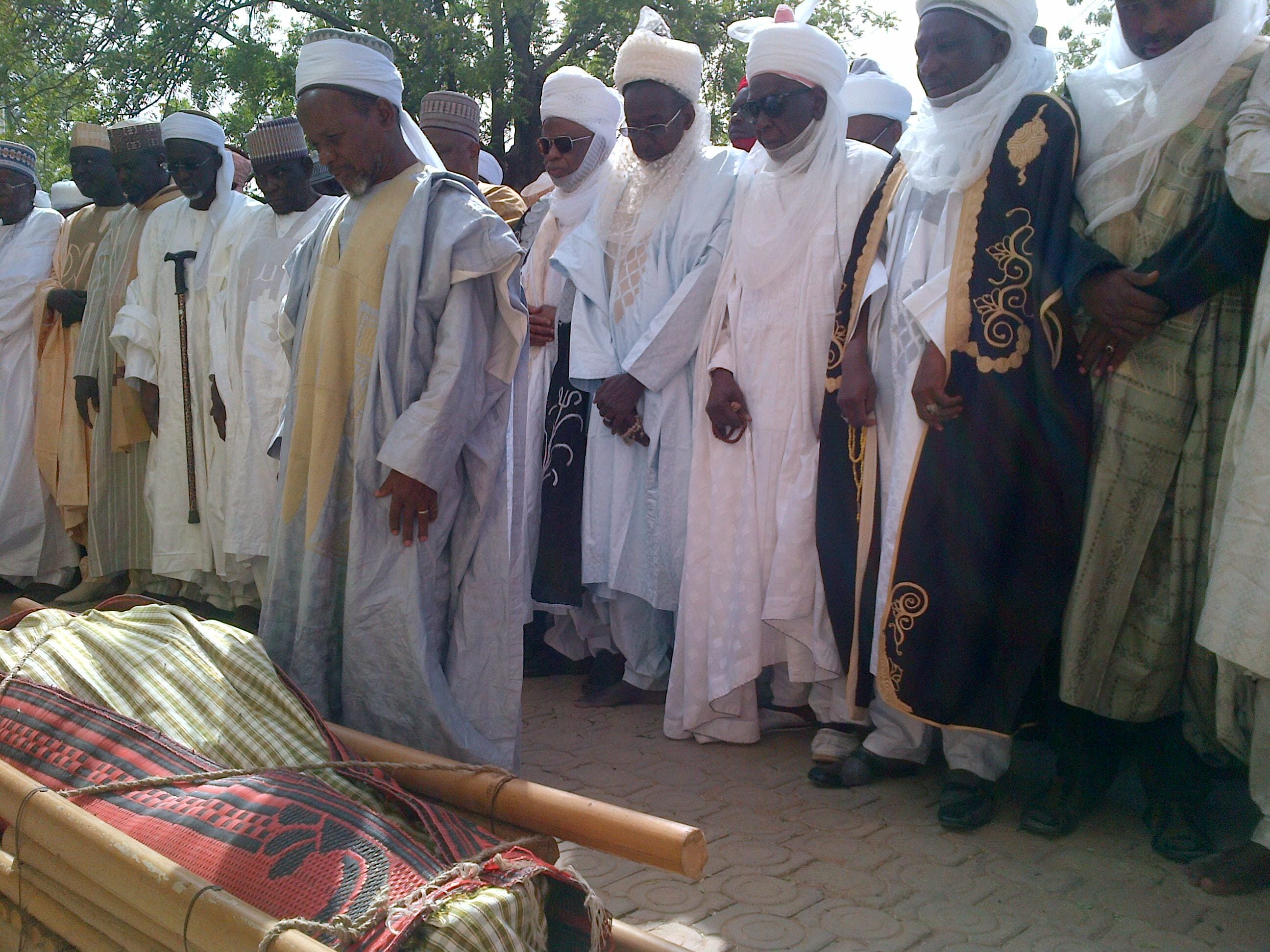
The remains of late former Governor of Old Kaduna State, Lawal Kaita has been laid to rest in Katsina state, northwest Nigeria.
Deputy Chief Imam of Katsina Central Mosque, Malam Mustapha Ratibi led the funeral prayer on the corpse of the former Governor at the Emir’s palace at about 2:10pm and afterwards was conveyed to Danmarna burial ground where he was finally laid to rest.
Speaking with newsmen, Minister of State for Aviation, Hadi Sirika who led the Federal government delegation, described late Lawal Kaita as a patriot, who believed in the Nigerian project,
“It is not only a loss for Katsina, it is indeed a loss for black Africa. Indeed, Muhammadu Lawal Kaita was of eminence, he has such an imposing personality in his life time.
“We will miss him, we will refer him, we will honour him. He is a man of honour and dignity. He was a true royal son. He was indeed worthy of been emulated.
“The advice is that all and sundry should copy the lifestyle of Alhaji Muhammadu Lawal Kaita. A true politician, who lived by his words and dictates, who believed in majority, fairness, equity and justice. We have seen it in him, he had taught us and we will continue to live by his examples,” Sirika said.
The Emir of Katsina, Abdulmumini Kabir Usman expressed appreciation to President Muhammadu Buhari for sending a delegation led by Minister for State on Aviation to sympathise with them.
Ambassador Yahaya Kwande led a delegation that represented former Vice President Atiku Abubakar.
Image copyrightGetty ImagesImage caption The accident took place close to the cable car station on Table Mountain
The bodies of a tourist and his guide have been recovered from South Africa’s Table Mountain following an accident which trapped hundreds of people at the top of the popular attraction.
The man, his local guide and a second tourist are reported to have been using ropes to scale the front of the Cape Town mountain when they fell on Monday.
Rescuers then used the cable car to reach the surviving climber.
But the bodies were not recovered until first light on Tuesday.
The tourists are understood to be of Asian origin while the guide was a South African, a spokeswoman for South Africa’s Sanparks, which runs the country’s national parks, told the BBC.
According to Table Mountain Cableway, the service – which takes thousands of people up and down the mountain every day – was out of action for about four hours, closing an hour after the group was first spotted.
Image copyrightD Tromp/Wilderness Search and RescueImage caption Rescue workers had to use the cable car to reach the group
Mr Marais said an initial attempt to use a helicopter to rescue the climbers was unsuccessful, leading the team to decide that the best way to reach the three would be to abseil from the cable car.
But they were only able to rescue the surviving woman on Monday evening, with the cable car resuming its service at around 22:15 local time (20:00 GMT), when there were still about 500 people at the top of the mountain.
Image copyrightAFPImage caption Harry Kalaba (pictured in 2015) has quit his cabinet role
Zambia’s foreign minister has announced his resignation in a scathing Facebook post, denouncing the country’s “path of insatiable greed and shame”.
Henry Kalaba said his decision was prompted by the “swelling” levels of corruption “perpetrated by those who are expected to be the solution”.
Analysts suspect the move is an attempt to pressure President Edgar Lungu, who is considering seeking a third term.
There is currently a two-term limit in the Zambian constitution.
Mr Lungu, who has been accused of being increasingly authoritarian by his critics, is arguing in the courts that he could stand for a third term, as he only served part of his first term following the death of his predecessor, Michael Sata.
Mr Kalaba, an MP for the governing Patriotic Front (PF), is said to be a possible candidate for the 2021 presidential election, should Mr Lungu step aside, Reuters news agency reports.
“People have started realising that they will not get nominated as long as Lungu insists on standing.” Lee Habasonda, an analyst from the University of Zambia, told Reuters.
“We need to go back to the original agenda of our party, the PF, where the poor and not the corporates must be at the centre of all our decisions,” Mr Kalaba wrote, going on to blame Zambia’s current financial woes on “collective carelessness and indifference”.
The post, which has prompted thousands of comments, concluded: “When people begin to feel overwhelmed by fear for speaking the truth, it is time to realize that critical fundamentals have shifted. We all have a role to play in making things right. This is my little contribution – Zambia is our country, we need and must reclaim it back.”
The president’s office says it has not yet received an official resignation letter.
Note: This story is auto-generated from ‘BBC News’ syndicated feed and has not been edited by Africa Prime News staff.
Image copyrightAFPImage caption Hailemariam Desalegn said a new detention centre will comply with international standards
In a surprise move, Ethiopia’s prime minister has announced the release of all political prisoners and the closure of a notorious detention centre, allegedly used as a torture chamber.
Hailemariam Desalegn told a press conference the move was designed to allow political dialogue.
But it is unclear exactly who will be released – or when it will take place.
Ethiopia, a staunch ally of the West, is accused by rights groups of using mass arrests to stifle opposition.
Amnesty International welcomed Mr Hailemariam’s announcement, saying it could signal “the end of an era of bloody repression in Ethiopia” – although warned the closure of Maekelawi detention centre should not be used to “whitewash” the “horrifying” events which took place under its roof.
This is a landmark moment for the country – not least because it is the first time the government has even admitted to having any political prisoners, previously describing them as “criminals”, BBC Ethiopia correspondent Emmanuel Igunza says.
Rights groups have accused the government of using anti-terrorism laws to jail its critics.
Who are the political prisoners?
Those held in jails across the country include opposition activists from the Amhara and Oromia regions, which were at the centre of anti-government protests in 2015 and 2016, as well as the Southern Nations and Nationalities Peoples Region, and journalists who have criticised the government.
It is difficult to know exactly how many “political prisoners” there are, but our correspondent estimates there are about 1,000 held under the country’s anti-terrorism proclamation, including high profile leaders from the opposition.
However, there are another 5,000 cases still pending, made up of those arrested after a state of emergency was declared in October 2016, he adds.
Will they actually be released?
The government has given no timeline on the release of the prisoners – including those still awaiting trial – or explained exactly who is considered “political” and who is not.
Our reporter notes a number of cases have political backgrounds, but are also linked to groups the government considers to be terrorists. Nineteen people linked to Ginbot 7 – deemed a terror group – were sentenced to prison terms just this week.
Image copyrightAFPImage caption Thousands have been detained since anti-government protests broke out
Whether they will all be released remains to be seen.
Any dialogue would have to include legitimate opposition groups like the Oromo Federalist Congress, whose leaders would have to be freed to fully participate in the process, our correspondent says.
What about the detention centre?
As well as releasing the prisoners, Mr Hailemariam announced the closure of Maekelawi – a detention facility in the capital, Addis Ababa, which Amnesty International described as a “torture chamber used by the Ethiopian authorities to brutally interrogate anybody who dares to dissent, including peaceful protesters, journalists and opposition figures”.
“A new chapter for human rights will only be possible if all allegations of torture and other ill-treatment are effectively investigated and those responsible brought to justice,” Amnesty International added.
A new detention centre will be opened, Mr Hailemariam said, which would comply with international standards.
Why now?
Our correspondent says the detention of political prisoners has always been a major concern. In December, social media users staged a day of action to remember those held behind bars.
Media playback is unsupported on your device
Media captionEthiopian PM Hailemariam Desalegn on regional concerns and human rights
But this decision comes hot on the heels of a meeting between the parties which make up the ruling Ethiopian People’s Revolutionary Democratic Front (EPRDF) coalition.
Over the past months, infighting within the coalition, which has been in power for more than 25 years, has led the prime minister to acknowledge the need for change.
The Oromo Peoples’ Democratic Organization and the Amhara National Democratic Movement, which are part of the coalition, have been pushing for increased political space and the “respect of their people” following the massive anti-government demonstrations that have been witnessed in the country.
Who is Hailemariam Desalegn?
A trained engineer, Mr Hailemariam took the reins of power in 2012, after the death of Meles Zenawi, who had ruled since 1991.
However, while the former deputy prime minister was a close ally of Mr Meles, he struggled to gain approval of the other EPRDF leaders in order to assume his new role.
He is not known for tolerating dissent well, despite statements to the contrary, his critics say.