Home Blog Page 1173

Nigeria: Fears Of Arrest, Abuse by Govs May Kill State Police Bill – Lawmaker

0
Nigerian Senate in session


The Chairman, Senate Committee on Police Affairs, Sen. Abu Ibrahim, says the fear of indiscriminate arrest and detention by state governors may kill passage of the State and Community Police Bill.

Ibrahim, who made this known in an interview with newsmen in Abuja, said the bill which had passed first reading in the Senate, may not get two third majority to allow for a third reading and passage.

He said that while lawmakers from some parts of the country may vote in favour of the bill because of their control system, others may not for fear of abuse.

“My fear is the required numbers. The disagreement between the national assembly members and governors may kill it.

“This is because I know many senators and House of Representatives members think that if state governors get state police, they can trample on them, arrest and detain them.

“From my assessment, there is no way it will get two thirds in the National Assembly.

“Probably the bulk of South West senators will go for it because in the area,  there is some control and there is synergy because of the control system.

“I do not want to mention names but there are states that there is no way they will vote for its passage.

“From the way I see it, nine states out of 37 will no vote for it. But let us see how it goes,” he said.

On whether or not there is merit in the clamour for state and community police, the lawmaker said if passed and signed into law, it would help in tackling security challenges in the country.

However, he said, besides the fear of intimidation and abuse, there were other factors that may not allow the structure to work effectively.

According to him, basically, the problem with the Police is funding.

“If you create state police, will you get a better funding? These are the things we should ask ourselves.

“What are the main reasons for failure of the Federal Police system if it is regarded as failure. The reason is lack of funding.

“You give Nigeria Police N20 billion as budgetary allocation when they require about N300 billion.

“Even the N20 billion is not fully released. It is sometimes between 40 per cent and 50 per cent.

“So, will state police do better. They may know the locality better but do they have the resources?.

“Can the states pay them their salaries and allowances. These are things we should look into, ” he said.

Ibrahim advised that rather than creating a system that would be dead on arrival because of the mirage of problems that would come with, the current internal security system should be overhauled and properly funded.

According to him, creating state police would be overburdening for states that have to be assisted by the Federal Government for not being able to pay workers’ salaries.

He pointed out that if state police must work, there must be change in the revenue allocation formula to give states more money.

“If we maintain the current allocation formula, maybe Lagos, Rivers, Akwa Ibom, Kano, Kaduna may pay. But after that who else.

“This is a federal function, if I have to take a federal function to state, it is reasonable that I reduce the amount going to federal and give more to the states.

“Also, there are questions like, how many functions do you take from federal to states.

“We cannot just say, create state police with the present allocation formula.

“It will not work and that is beside the political angle I spoke about earlier, that is, the relationship between state governors and lawmakers,” he said.

The News Agency of Nigeria (NAN) reports  that a Bill seeking the amendment to the 1999 Constitution to accommodate State and Community Police passed first reading in the Senate on July 12.


https://www.africaprimenews.com/2018/07/06/news/nigeria-only-justice-will-silence-dissenting-voices-in-apc-says-dogara/

Nigeria Police Dismisses 4 SARS Operatives For Robbery, Other Crimes

0
ibrahim-idris-igp
Inspector-General of Nigeria Police, Ibrahim Idris
ibrahim-idris-igp
Inspector-General of Nigeria Police, Ibrahim Idris


Assistant Inspector General of Police in charge of Zone 2 Command, Adamu Ibrahim has approved the dismissal of four policemen attached to the Special Anti-Robbery Squad (SARS), Ikeja, Lagos over alleged robbery and other crimes.

CSP Dolapo Badmus, the Zone’s spokesperson, confirmed the dismissal on Sunday in Lagos.

According to Badmus, the dismissed officers are Sgt. Adeoye Adekunle; Sgt. Adekitan Adebowale; Sgt. Agbi Lucky and Sgt. Odighe Hehosa.

She said that the four policemen were dismissed and subsequently charged to court for armed robbery, kidnapping, unlawful detention, intimidation and threatening violence.

Badmus said that the panel recommended them for dismissal based on the report of the investigation carried out on a petition against them.

She said that a petition was written against them by Mr Chukwudi Godwin Odionye, popularly referred to as ‘Bishop’ on May 2, 2018.

“The petitioner stated that on June 4, 2017, he was in his house around Alagbado area of the state when four armed men stormed his house to effect his arrest on the allegation of performing ‘FAKE’ miracles.

“He stated that after his arrest, he was taken to one hotel at Agege where he was detained and threatened to be killed if he fails to cooperate.

“He explained further that the following day, June 5, 2017, he was taken to the bank where he was made to transfer N7 million to the account of one of the operatives.

“On receipt of the petition, the AIG ordered investigation into the case.

“On the strength of investigation, it was revealed that no proper police procedure for investigation was followed in Mr Chukwudi’s arrest.

“The four SARS operatives actually abducted the man from his house and unlawfully detained him in the hotel under the guard of the suspects for personal gain,” Badmus said.

She reiterated the AIG’s directive that the force would not tolerate any act of misconduct, which undermines the value of international best practices of the police.


https://www.africaprimenews.com/2018/07/13/politics/mandate-police-to-apologise-to-nigerians-over-ekiti-incident-reps-tell-buhari/

Over 70% Nigerian Youths Involve In Drug Abuse – Expert

0
Drug Abuse
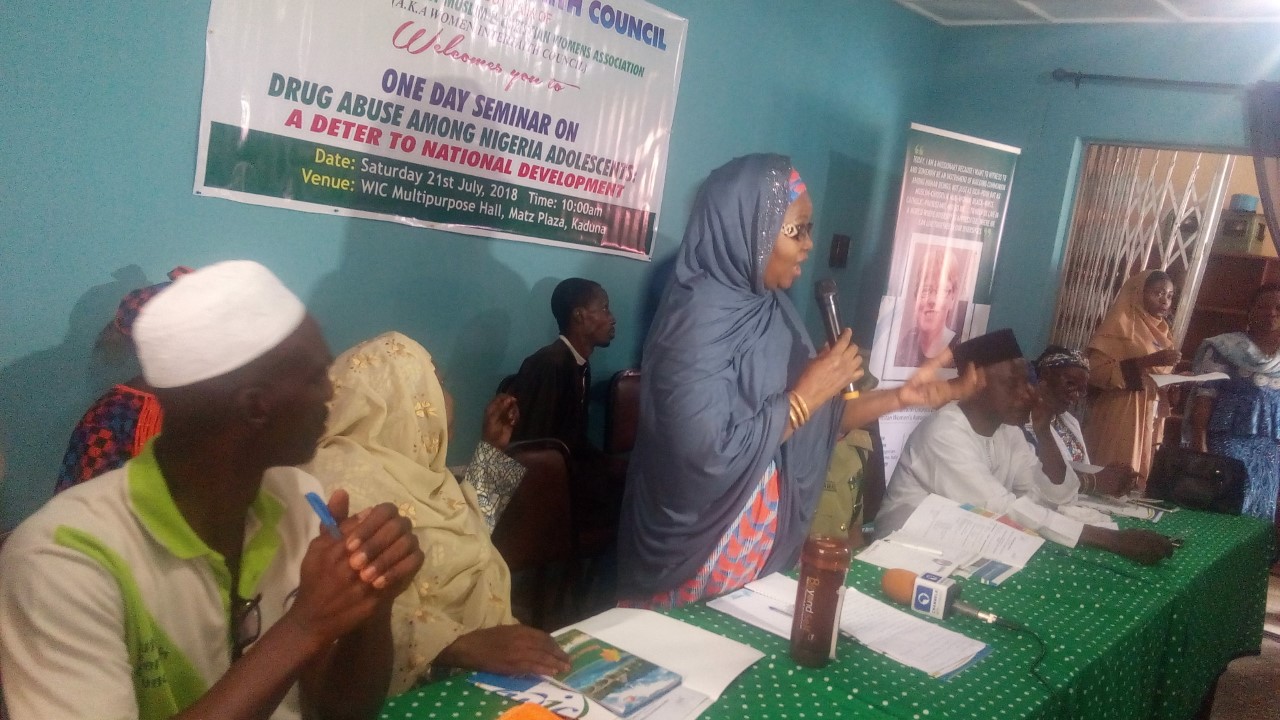
Tunde Banjo of the National Eye Centre, Kaduna North West Nigeria addressing participants
Drug Abuse
Tunde Banjo of the National Eye Centre, Kaduna North West Nigeria addressing participants
By Joseph Edegbo
Over 70% of young Nigerians are involved in drug abuse, with 80% of the drug abusers being children of the rich and elite, a medical expert has said,
Speaking at one-day seminar on; “Drug Abuse Among Nigerian Adolescents: A Deter to National Development” organised by Youth Interfaith Council (YIC) on Saturday, Tunde Banjo of the National Eye Centre, Kaduna North West Nigeria, said some youth don’t even know that they are into abuse of drug.
The expert said daily intake of beverage, kolanut, paracetamol and other analgesics without doctor’s prescription as well as excessive intake of cigarettes and alcohol amount to drug abuse.
Banjo, whose paper was titled, “Effects of Drug Abuse on Young People”, added that drug abuse could emanate from peer group pressure, ignorance, emotional, psychological stress, easy access, desperation, social pathologies, to heighten athletics performance and occupational susceptibilities.
Drug abuse, he emphasised, can have medical, physical, social, economical and psychological effects.
“Any chemical substance incorrectly used is drug abuse, 70% of young people are involved in drug abuse. Taking mineral daily, constant and frequent intake of coffee and painkillers, taking drugs that can change a person’s mood and perception, using drugs for non-medical purposes are all abuse of drugs.
“Other forms of drug abuse include ingestion of cocaine, analgesics, cough syrup, snuff, cigarette, alcohol, nicotine, marijuana, inhalants, hallucinogens, amphetamines coffee, sedatives. The effects of drug abuse include premature death, impotence, damage of the brain, liver, kidney, lung and heart.”
According to the medical expert, while it’s easy to get into drug abuse it’s often difficult to kick away the habit as such people continue to go deeper into it. He urged for strong desire and will power to stop the addiction using attitude, conscience and thinking.
A retired nurse, Rabi Binchan, in her paper titled “National Development: Effect of Positive Youth Contributions”, said without the youth there can be no leadership. She said for unity and peace there is need for neighbourhood friendship and watch, spirit of live and let live, listening to youth and supporting their view, youth involvement in decision making among others.
Chairman of YIC, Sheriff Olutusin said YIC was formed in 2012 to provide platform for Muslim and Christian youth leaders coming together in sincere and concrete dialogue from the various perspectives to identify and address conflict and youth common and specific poverty related challenges. He said they try to preach love, peace, unity and justice.
“Our community today is divided along religious lines and issues of faith, socio- political, cultural and economic  relationships, which are the route cause of many conflicts. YIC strives to build bridges to reduce prejudices and mistrust while creating the space for Integration, understanding and collaboration,” he said.
The seminar which was attended by Muslim and Christian youth faith Organisations and groups also featured good will messages from religious leaders and Security agencies, including the Prisons, Immigration and Federal Road Safety Corps.

Godfatherism, Money Politics Bane Of Nigeria Democracy – Ex-Comm

0
Godfatherism
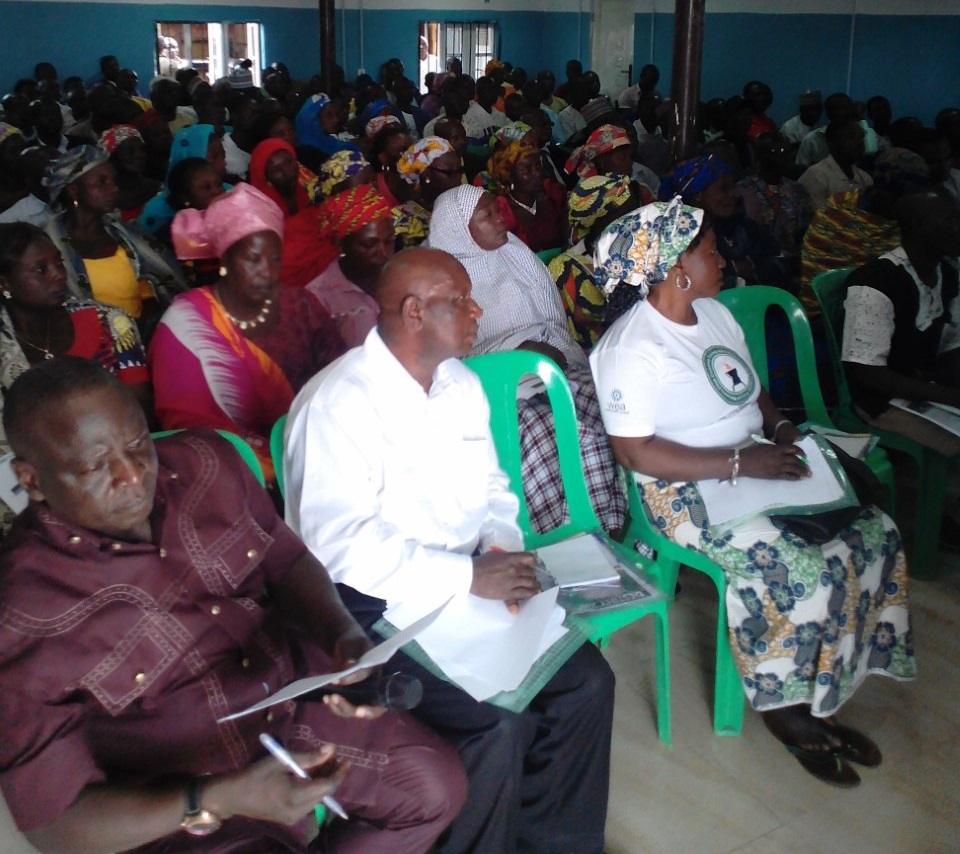
Across section of Participants at the workshop
Godfatherism
Across section of Participants at the workshop


By Amos Tauna

A former commissioner for Water Resources, Kaduna State, northwest Nigeria, Tsahiru Bako, has identified godfatherism and money politics as the bane of democracy in Nigeria.

He said if not changed, it would continue to endanger the principles of democracy of alleviating the suffering of the downtrodden.

Speaking at a one day workshop organised by an Aspirant for the House of Representatives from Zangon Kataf/Jaba Federal Constituency in Zonkwa, Zangon Kataf local government area of Kaduna State, Brig. Gen. Katunku Simon Gora, the former Commissioner noted that politicians should add value to people and politics for a better society,

Tsahiru Bako explained that the workshop was meant to create awareness, sensitise and develop an improved politics of inclusiveness that would carry everybody along in the constituency on issues that affect their wellbeing.

He observed, “We cannot continue to have the same political arrangement that has been in existence for years where aspirants sit at home or in their hotel rooms to call people to themselves just to make nonsense of them.

“General Katunku Simon Gora has come up with a new policy that will be dealing with the people directly because he valued their votes and valued them as a people whose interest he is going to represent if given the mandate.

“He has been going round within the constituency to interact with them as a way of knowing their problems and ensuring a better relationship.

“Today’s event is to see each other from all the nooks and crannies of the constituency to educate them on what he intends to do to the people. The workshop is apt, timely, educative, purposeful and a new development in the political history of this area with a view to  making the electorate appreciate what to expect if they vote him to power.

“Today’s programme as you can see has gone further to show you the type of intention the aspirant has by ensuring his people irrespective of tribe, religion or any other interest relate together to appreciate one another and ensure peaceful coexistence for meaningful development in the constituency.”

The aspirant, General Katunku said he has no money to give to his people but he has ideas that could change the destiny of the people if strictly adhered to.

He explained that he came up with the four cardinal areas of education, security, agricultural and health as areas if properly explored could change the status quo for a peaceful, self reliance and liberating the people from seeking government work that is not available.

Speaking on improving agricultural production and stimulating agro business in Southern Kaduna, Steve Atar said there was the need for the people of the area to avail themselves with modern method of farming to liberate themselves from subsistence farming that has not help them for years.

He enjoined the people of Southern Kaduna to see farming purely from the business point of view, stressing that it is by so doing that they would add value to it.

He explained that new seeds and new farming inputs should be used by the people for them to be able to make impact in farming as a business.

Other papers presented at the workshop include improving security awareness in Southern Kaduna, improving health services delivery and healthy living in Southern Kaduna and improving education in Southern Kaduna.

The one day workshop was attended with participants mostly women and youths  drawn from all the wards that make up the constituency.

https://www.africaprimenews.com/2018/07/04/news/nigeria-2019-kaduna-el-rufai-2015-zonal-campaign-coordinator-dumps-apc-says-party-sinking/

Nigerian Govt. To Engage Media To Promote Exclusive Breastfeeding – Official

0
breastfeeding
Mother breastfeeding a baby
breastfeeding
Mother breastfeeding a baby


Federal Ministry of Health (FMOH), on Friday said it would engage stakeholders, individuals and media organisations to promote and support exclusive breastfeeding in health facilities, communities and workplaces.


Dr Chris Isokpunwu, Head of Nutrition, FMOH, in a statement in Abuja said the engagement would galvanize the actions of the stakeholders in the commemoration of the 2018 Word Breastfeeding Week (WBW).


Isokpunwu said the annual World Breastfeeding Week, scheduled to hold from Aug. 1 to 7, had the theme, “Breastfeeding: Foundation of Life. “


He said the activities lined up for the event would create awareness on the importance of breastfeeding to a child’s survival and how to improve on poor practices of exclusive breast feeding.


“Poor exclusive breastfeeding practices in Nigeria have been associated with inadequate support from husbands, partners and health professionals.


“Others include, delayed initiation of breastfeeding, negative peer influences as well as short paid maternity leave for working mothers.


“A platform for long-term collaboration of all advocates, activists, decision makers, media, and youths are vital for promoting optimal infant and young child-feeding practices,’’ he said.


Isokpunwu noted that the event would commence on Aug. 2 with a High-Level Policy Dialogue and inauguration of ceremony of 2018 WBW by Minister of Health at Transcorp Hilton, Abuja.


https://www.africaprimenews.com/2018/07/06/news/child-birth-spacing-cleric-tasks-media-csos-on-enlightenment/

Nigeria: 3 Killed, 8 Injured In Zamfara Market Attack

3
map Zamfara
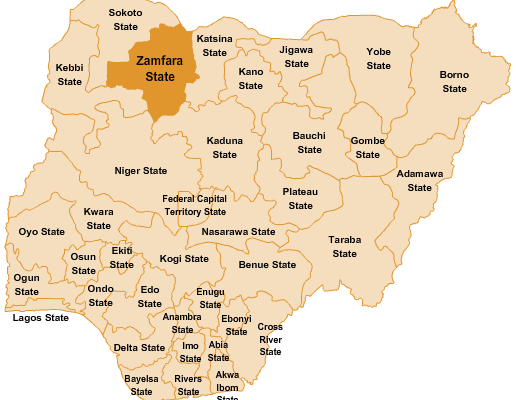
Map of Nigeria showing Zamfara State
map Zamfara
Map of Nigeria showing Zamfara State


By Mohammed Munirat Nasir

At least three people have been reportedly killed in a fresh attack by bandits in Karakai village, Bungudu local government area of Zamfara state, North West of the country.
According to a local source, the attackers in their dozens stormed the village market around 5.30 pm on Thursday and began shooting sporadically  which resulted in the death of the at least three people while 8 were  Injured.
The state Police Public Relations  Officer (PPRO), SP Mohammed Shehu in a statement however confirmed the death of two  in the attack.
Shehu said that on 19th July, there was sporadic shooting by unknown assailants at the Karakai evening market.
 
Police team on market banditry patrol could not exchange firing to avoid loss of innocent lives and collateral damage. However, the assailants used the crowd as human shield to escape from the scene. 2 persons died from the gunshot, while 3 injured rushed to the hospital”, he said.
The State Police Spokesman added that investigation has commenced with a view to fishing  out, arrest and bring to Justice the perpetrators of the dastardly act.
Shehu assured that normalcy has been restored with patrol teams keeping vigil in the affected area.
The latest attack is coming just about three days after similar attacks by bandits in some villages in Maradun local government area.

Nigeria: Protection Of Human Rights, Cardinal Objective Of Buhari Administration – Official

0
Lai Mohammed at Roundtable
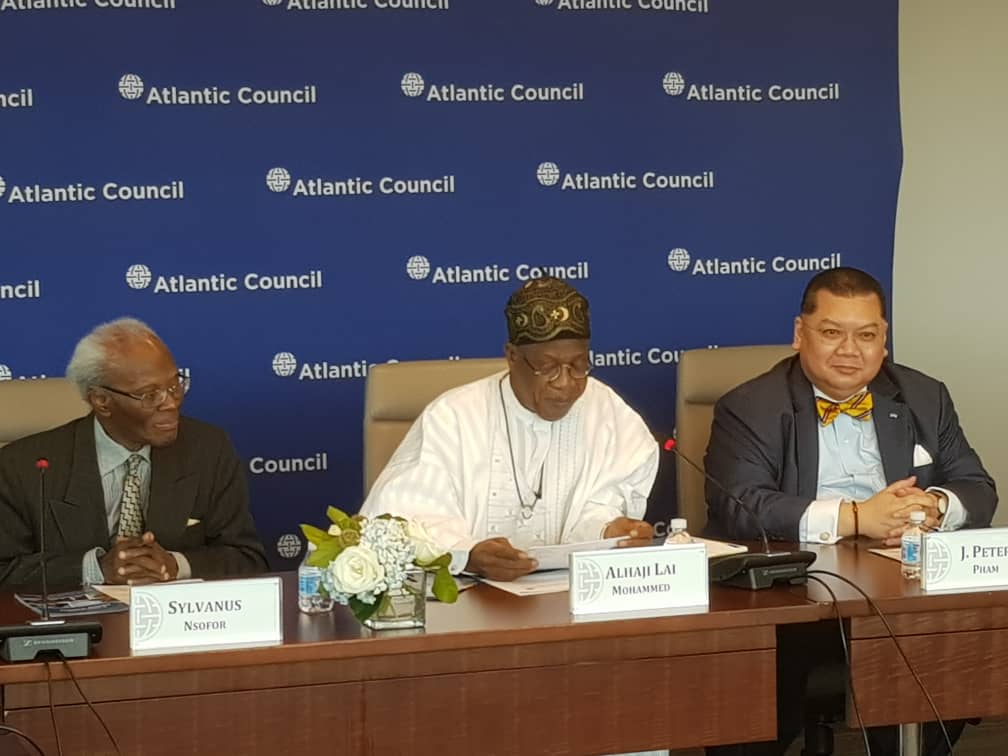
Nigeria's Ambassador to the US Sylvanus Nsofor; Minister of Information and Culture Lai Mohammed and Dr. Peter Pham, Vice President for Research and Regional Initiatives; Director, Africa Centre, Atlantic Council, at a High-Level Roundtable convened by the Council in Washington, DC, US, on Thursday.
Lai Mohammed at Roundtable
Nigeria’s Ambassador to the US Sylvanus Nsofor; Minister of Information and Culture Lai Mohammed and Dr. Peter Pham, Vice President for Research and Regional Initiatives; Director, Africa Centre, Atlantic Council


The Minister of Information and Culture, Lai Mohammed, has said the protection of human rights is a cardinal objective of the Buhari Administration, and that the violation of rights is not a government policy.

Addressing a High-Level Round table organised by the Atlantic Council, an American think tank on international affairs, in Washington, DC, on Thursday, the Minister said the picture of impunity and complete disregard for extant laws and international obligations painted by Amnesty International, in a recent report, is not a true reflection of the character and ethics of the Government of Nigeria or any of its agencies.

Since the counter-insurgency war started in 2009, Amnesty International has issued periodic reports on alleged human rights violations by the Nigerian military, with the latest of such reports bordering on violations of human rights and International Humanitarian Law by the Nigerian Armed Forces and other government agencies.

Lai  Mohammed told the Roundtable that the government has taken several measures to address human rights violation in the course of the counter-insurgency operations, including the establishment of Human Rights Desks in all military formations, the quarterly Human Rights/Military Dialogue, Training on Mainstreaming Human Rights into Counter-Insurgency Operations, and Court Martials of officers indicted for human rights violations.

“Very soon, the Federal Government will adopt a National Policy on the Protection of Civilians in conflict situations to further strengthen and entrench its constitutional practice of Protection of Civilians,” he said.

The Minister also spoke on the counter-insurgency operations, insisting that Boko Haram has been badly degraded hence it is incapable of carrying out organized massive attacks beyond using women and children to carry out suicide bombings against soft targets.

”Many have queried how we could say Nigeria is winning the battle against Boko Haram when the insurgents have continued to carry out deadly attacks. However, to understand this, it is necessary to put things in context. When President Buhari was being sworn into office 29 May 2015, 24 Local Governments making up a territory three times the size of Lebanon were firmly in the hands of Boko Haram. They hoisted their flag, collected taxes, installed their own Emirs and administered a large swath of territory. That is history now as not an inch of Nigeria’s territory is being administered or controlled by Boko Haram.

”Before the advent of this Administration, Boko Haram could carry out attacks anywhere in the North East and beyond at a time of their own choosing. They attacked the UN Complex, the police headquarters, motor parks and a military barrack in the capital city of Abuja. That is now history.” he said.

Mohammed also told the Roundtable that the incessan farmers-herders clashes were neither religious nor ethnic in nature, as they have been portrayed in some circles.

”There is no question that this (conflict) is driven mostly by an increased contest for dwindling natural resources like land and water.

This has been worsened by demographic pressure and climate change. Nigeria’s population in 1960 was 45 million, and this has ballooned to about 200 million in 2018, but the available resources have not grown at all. If anything, they have shrunk.

”As desertification continues to encroach and the Lake Chad that provided a livelihood for over 35 million in several countries shrank from 25,000 to 2,500 square kilometers, herders in particular are forced to move south in search of grazing land and water for their cattle,” he said

The Minister said beyond the main causative factors, however, disgruntled politicians and beneficiaries of corruption, who have vested interest in undermining the Buhari Administration through any means necessary, have latched on to the conflict.

He cited two instances to buttress his assertion that the ethno-religious slant given to the clashes constitutes a false narrative.

”The northern state of Kebbi is predominantly Muslim and Fulani. Yet, 70% of those who are in jail in the state are there over farmers-herders clashes. Yet, the herders are Muslim and Fulani, and the farmers are Muslim and Fulani. There can therefore be no ethno-religious basis for these clashes.

”Also, the northern state of Zamfara is the hotbed of cattle rustling, which perhaps has claimed more lives than the farmers-herders clashes in the entire middle belt. Yet, those rustling cows are Muslim and Fulani, and those whose cows are rustled are Muslim and Fulani. Therefore, to impugn ethnicity and religion into these clashes is simplistic at best and downright mischievous at worst,” Mohammed said.

The High-Level Roundtable, which was convened by the Africa Centre of the 57-year-old think tank, was attended by about 30 current and former senior US government officials, as well as other stakeholders in the US Policy on Africa.

The participants included retired Gen. William E. Ward, former Commander, US Africa Command; former US Ambassador to Nigeria Robin Sanders; Ms Florizelle Liser, President and CEO, Corporate Council on Africa; Mr. Thierry Dongala, Senior Advisor, House Foreign Affairs Committee; Mr. Trevor Keck, Deputy Head of Policy, International Committee of the Red Cross and Dr. EJ Hogendoorn of the International Crisis Group’s Africa Programme.

The Nigerian Ambassador to the US, Ambassador Sylvanus Nsofor, led a team of the Nigerian Embassy officials to the one-day event.


https://www.africaprimenews.com/2018/07/10/news/un-special-rapporteur-urges-north-korea-to-open-dialogue-on-human-rights-situation/

Nigeria: FAAC: FG, States, LGs Share N668.89b, Dispute Over Remittances Unsettled

2
Muhammadu Buhari
President Muhammadu Buhari of Nigeria
Muhammadu Buhari
President Muhammadu Buhari of Nigeria


Federal, States and Local Government Councils have shared N668. 89 billion from the federation account as revenue generated in May.

The Director of Information, Federal Ministry of Finance, Mr Hassan Dodo, made this known in a statement on Friday in Abuja.

Dodo, however, said that the distribution of the funds did not signify the end of the dispute between the Federation Account Allocation Committee (FAAC) and some revenue generation agencies.

“Owing to disagreement on remittances by the Revenue Generating Agencies, especially the NNPC, the sharing of revenues for May 2018 that was meant to be distributed in June 2018 was put on hold.

“However, the urgent need to cushion the undue hardships being experienced by workers nationwide has made it necessary to distribute the May figures, totalling N668.898 billion to the three tiers of government.

“Efforts are being intensified to address the unsatisfactory remittances, ” he said.

Dodo said that the N668.89 billion shared was made up of statutory revenue of N575.47 billion and N 93.42 billion from Value Added Tax (VAT).

He said that the May revenue was shared in line with the extant formula as follows: Federal Government, N282.22 billion; State Governments, N181.16 billion; and Local Government Councils, N136.49 billion.

He said the oil producing states received additional N53.071 billion as 13 per cent derivation while N15.947 billion was paid to the revenue generating agencies as costs of collections.

The News Agency of Nigeria (NAN) reports that FAAC has been unable to share May revenue to the three tiers of government following rejection of NNPC remittances.

When FAAC meeting was held on June 27, representatives of the 36 states rejected the NNPC remittance for May, on the grounds that it was less than the projected revenue for the month.

Again, when the meeting reconvened on July 12, the state commissioners for finance insisted that a permanent solution must be explored to resolve the recurring issue around NNPC under-remittances to the federation account.


https://www.africaprimenews.com/2018/06/29/news/nigerias-monthly-accrued-revenue-disbursement-meeting-ends-in-deadlock/

Currency Exchange Rates

USD - United States Dollar
ZAR
0.06
EUR
1.17
CAD
0.73
ILS
0.31
INR
0.01
GBP
1.34
CNY
0.14
Enable Notifications OK No thanks