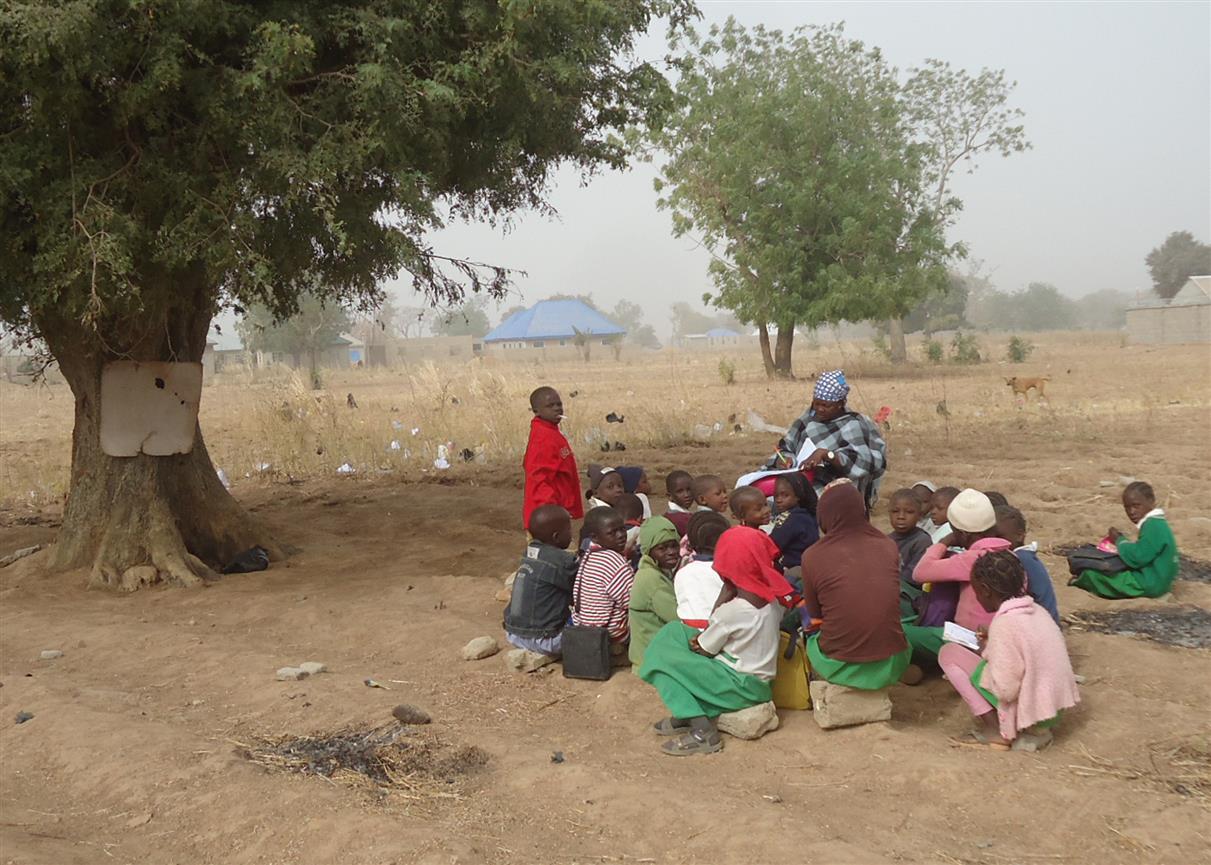
A class under a tree in ungwan maigero, Kaduna Nigeria
A class under a tree in ungwan maigero, Kaduna Nigeria
Lack of access roads remains a major challenge affecting the smooth running of Nomadic schools in Adamawa, the State Coordinator, Nomadic Education Commission, Madam Amina Baba-Kano, has said.
She made this known Thursday in an interview with the News Agency of Nigeria ( NAN) in Yola.
Baba-Kano said that the situation particularly during rain season was so serious that many teachers can’t go to some of the schools.
she said the commission has 141 schools with 670 teachers.
The coordinator who could only provide enrollment statistics of 2016 said the record available was that of 2016 which showed 17, 246 pupils.
Other challenges facing nomadic education in the state listed by the coordinator included dilapidated structures, and lack of teaching and learning materials.
She appealed to the Adamawa government to intervene and save nomadic education from total collapse in the state.
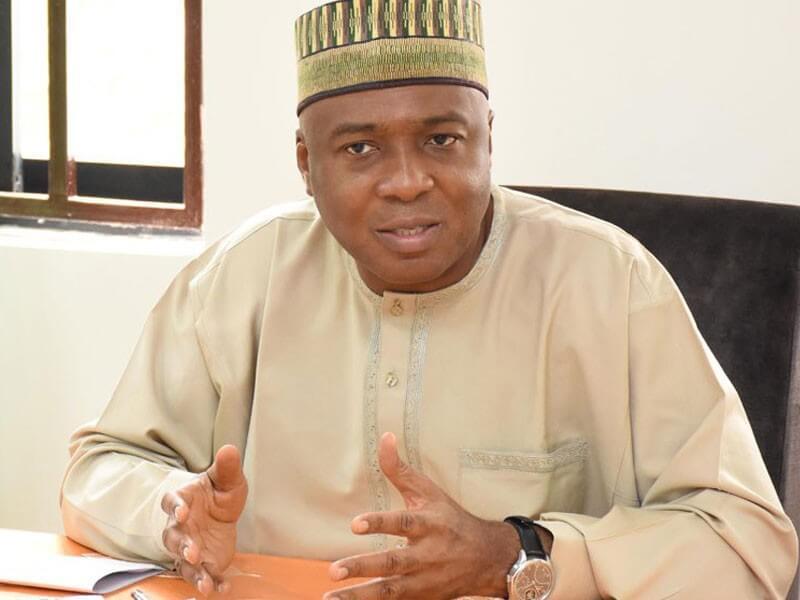
The All Progressives Congress (APC) took off the gloves and knocked Senator Bukola Saraki, with bare knuckle on Thursday, declaring him unfit to be President of the Senate.
The party said this in a blistering statement issued by Yekini Nabena, its acting National Publicity Secretary in Abuja.
It was the first reaction from the party, since Saraki addressed a press conference Wednesday posturing himself as a defender of democracy, against the backdrop of a reckless blockade of the National Assembly by the sacked director-general of the Department of State Services, Lawal Daura.
Saraki heaped the blame on the executive, a claim debunked promptly by the sacking of Daura and condemnation of the action, by acting President Yemi Osinbajo.
The APC was obviously not impressed by Saraki’s grandstanding and declared that he should be put where he belonged.
“The Senate must do everything possible to put Saraki where he rightly belongs; the back seat.
“He is definitely not a fit and proper person to preside over the country’s upper and revered legislative house,”the statement said.
It noted that in every democratic country, the position of the Senate President was one of the highest political offices one could attain.
Such position the statement said, was reserved for the best of the best, experienced and exemplary politicians who by their character and conduct in public offices, the younger generation look up to as role models.
It added that in terms of exemplary personage, the reverse was the case in respect to Saraki.
According to the statement, Saraki has been “a dismal failure” and has been involved in one controversy or the other since he became the President of the Senate.
This, it noted included; budget padding, legislative rascality, and sabotage of matters of national interest, among other criminalities too numerous to mention.
“Having suffered under the 16-year misrule of the Peoples Democratic Party (PDP), Dr Saraki will go down in our country’s history as the worst Senate President Nigeria has had the misfortune to have.
“Since his usurpation of the coveted seat, achieved through a wicked conspiracy with members of the opposition PDP, it has been from one controversy to another.
“The code of conduct trial for false declaration of assets; conspiracy with his deputy to fraudulently alter the rules of the Senate and links to the deadly armed robbers who wasted many lives in the Offa robbery attack.
“It is alleged that some of the robbery suspects were his political thugs used to rig elections; a common adage says: “show me your friends and I will tell you who you are,”it said.
The statement stressed that Saraki was definitely not a good example for political leadership in the country.
It further stressed that all over the world, the leadership of the legislature was provided by the political party with majority members.
It added that in spite of this, Saraki would in the absence of many members of his former party, the APC, connive and conspire with members of the opposition PDP to emerge Senate President.
The statement noted that in the process, Saraki traded off the Deputy Senate President position to the opposition PDP.
It said that even with Saraki’s defection to the opposition PDP, and with APC in the majority in the Senate, he still had the impudence to present himself as the President of the Senate.
The statement maintained that political ambition should be made of nobler stuff.
“One is of course not surprised as Saraki’s greed, selfishness, treachery, disregard for protocol and constituted authority is well-reported.
“In terms of treachery, Dr Saraki’s public humiliation of his late father and sister comes readily to mind; a traitor will always be a traitor, however the time and place,”the statement said.
The party added that a man who betrayed his father, sister (many times), and the APC administration by sabotaging the executive and defecting to the PDP had no character, principles, values and integrity.
The statement added that Saraki was only interested in his personal interest.
“The question is not if he will defect again from PDP if Bukola Saraki’s interest is not served, but WHEN he will do so. Such mean men are not interested in the Nigeria of our dreams,”the statement said.
The Full Statement
In every democratic country, the position of the Senate President is one of the highest political offices one can attain. It is a position reserved for the best of the best, experienced and exemplary politicians who by their character and conduct in public offices, the younger generation look up to as role models.
In terms of exemplary personage, the reverse is the case in respect of the current Senate President, Dr. Bukola Saraki who has been a dismal failure and has been involved in one controversy or the other – budget padding, filibustering, legislative rascality, sabotage of matters of national interest, among other criminalities too numerous to mention.
Having suffered under the 16-year misrule of the Peoples Democratic Party (PDP), Dr. Saraki will go down in our country’s history as the worst Senate President Nigeria has had the misfortune to have. Since his usurpation of the coveted seat, achieved through a wicked conspiracy with members of the opposition PDP, it has been from one controversy to another – the Code of Conduct trial for false declaration of assets; conspiracy with his deputy to fraudulently alter the rules of the Senate and links to the deadly armed robbers who wasted many lives in the Offa robbery attack. It is alleged that some of the robbery suspects were his political thugs used to rig elections; a common adage says: “Show me your friends and I will tell you who you are”.
Dr. Saraki is definitely not our good example for political leadership.
All over the world, the leadership of the legislature is provided by the political party with majority members. But Dr. Saraki would in the absence of many members of his former party, the All Progressives Congress (APC), connive and conspire with members of the opposition PDP to emerge Senate President, and in the process tradeoff the Deputy Senate President position to the opposition PDP – a political betrayal and treachery even the devil would be envious of.
Even at this time he has defected to the opposition PDP, and with APC still in the majority in the Senate, Dr. Saraki still has the impudence to present himself as the Senate President. Political ambition should be made of nobler stuff.
One is of course not surprised as Dr. Saraki’s greed, selfishness, treachery, disregard for protocol and constituted authority is well-reported. In terms of treachery, Dr. Saraki’s public humiliation of his late father and sister comes readily to mind.
A traitor will always be a traitor, however the time and place. The Senate must do everything possible to put Dr. Saraki where he rightly belongs – the back seat. He is definitely not a fit and proper person to preside over the country’s upper and revered legislative house.
A man who betrayed his father, sister (many times), his party PDP in 2014, the APC in 2015 by conspiring with opposition PDP senators to emerge Senate President, APC administration by sabotaging the executive and defecting to the PDP in 2018 has no character, principles, values and integrity. His only interest is Bukola Saraki, Bukola Saraki and Bukola Saraki. The question is not IF he will defect again from PDP if Bukola Saraki’s interest is not served, but WHEN he will do so. Such mean men are not interested in the Nigeria of our dream.
The Federal Ministry of Health on Thursday reiterated its commitment toward achieving 100 per cent exclusive breastfeeding by 2025 in line with global target on Food and Nutrition Policy.
Mrs Chimay Thompson, Assistant Director, Nutrition Division, Family Health Department in the ministry, gave the assurance in an interview with the News Agency of Nigeria (NAN) in Abuja.
She said that the government had put in place policies and regulations that would promote exclusive breastfeeding.
“Nigeria can get up to 100 per cent based on Food and Nutrition Policy, by 2025.
“Nigeria is a signatory to UN policies, including Global Strategy on Infant and Young Child feeding as well as the International Regulation Code of Marketing of Breast Milk Substitute.
“We have the National Policy on Food and Nutrition which was revised in 2016 and launched by the First Lady, Mrs Aisha Buhari, who became the National Nutrition Ambassador.
“In 2017, the Minister of Health launched the National Social and Behavioural Change Communication Strategy, which enabled us to communicate with different communities to know factors that are mitigating against optimal breastfeeding practices.
“All these have been put in place to create an enabling environment and to develop strategies that will support and encourage our mothers to practise exclusive breastfeeding optimally,’’ she said.
Thompson said that the ministry would intensify campaign on exclusive breastfeeding and young child feeding practices in health facilities, communities and workplaces as well as train healthcare professionals.
She said that returning to work before six months was a key barrier to exclusive breastfeeding while limited or nonexistent maternity protection policies prevented many women from having time and space to breastfeed exclusively.
Thompson said that many women in Nigeria were part of labour force, with a substantial number in formal workforce.
“The ministry has helped to increase maternity leave for public servants from 12 weeks to 16 weeks; the Minister of Labour and Employment, according to Abuja Breastfeeding Declaration, is considering an increase to 18 weeks.
“Community Infant and Young Child Feeding Guideline is available as health workers have been trained to promote and support universal breastfeeding coverage.
“This commences with early initiation of breast milk within one hour of delivery, exclusive breastfeeding till six months and then continued breastfeeding with complementary feeding till two years.
“The ministry has also launched Mobile Nutrition Programme through which messages are sent on phones and social platforms where people can communicate and have access to vital information on breastfeeding and nutrition.
“The government has also collaborated with th5s movie industry to promote exclusive breastfeeding, with various jingles on breastfeeding translated in different languages across the country,’’ she said.
Thomson further reiterated government’s commitment to prioritising the actions as outlined in the Lancet Breastfeeding Series.
These, she said, include disseminating accurate information on the value of breastfeeding as a powerful intervention for health and development of women and children.
According to her, fostering positive social attitudes towards breastfeeding, reinforcing a breastfeeding culture and up-scaling and monitoring breastfeeding interventions, practices and trends are crucial for healthy child.
She also called for regulation of marketing breast milk substitute.
She called for policy to ensure that maternity protection, workplace interventions and baby friendly initiative are implemented.
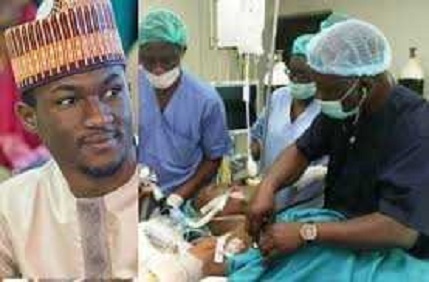
It is eight months after Yusuf, the son of President Muhammadu Buhari, survived a power bike accident he had in Abuja which prompted his airlift. In this investigative analysis, Odimegwu Onwumere writes on the imperatives to put Nigeria’s health care into shape
He could not be airlifted immediately and hurried to St. Josefs Hospital in Wiesbaden, Germany, for further medical treatment. But he needed to, he needed to be alive, the country already had many internal problems besetting it and did not want his death.
Due to the rigorousness of damage in his brain and one of his limbs that was broken, he remained fundamentally expressionless to treatment at the Cedarcrest Hospital Abuja where he was rushed to. This was the reason for the delayed airlift. He needed to regain consciousness.
There was scarce assurance at this hospital that his life could be saved, a hospital regarded as one of the best in the country.
The presidential aides ran helter-skelter in making sure that his life was saved. His bewildered mother spent supplementary time in the hospital with him. She literally relocated to the hospital to attend to her only son.
She could not afford to lose him; she could not afford to be mocked by their political detractors who always said that their presidency ruled the populace with the horsewhip in a democracy. She could not afford.
His mother, his sister, Mrs. Halima Sheriff; the personal physician to the mother, Dr. Kamal Mohammed and three other aides were expected to accompany him to Germany. But the presidency on December 30, 2017 said that it was not under any anxiety to fly him abroad for emergency treatment. At least, there was hope he could respond to treatment at a private orthopedic surgeon in Abuja, thereafter.
How It Started
The presidency had no premonition that Yusuf Buhari, the son of Nigeria’s President, would go out that night, let alone, involving in a drag-racing motorbike accident at Gwarinpa District, in the Bwari Local Government Area.
Nigeria stood dead as newsflash on that Tuesday, December 26, 2017, was, “Buhari’s son in a drag-racing motorbike accident.” The corresponding tension that generated had no measure.
The awestruck President Muhammadu Buhari was seriously angry, asking why security in the presidency allowed his only son for the biking journey. The aides were jumpy that heads would role just as they feared many would be relieved of their jobs. The worst they thought was what their fate would be should Yusuf who was yet to respond to treatment two days after died.
The incident did not go down well with President Buhari. Some officials of the Department of State Security (DSS) were sacked over the careless undertaking that Yusuf was supposed to take responsibility, over the issue that they did not send Yusuf to drag-racing motorbike.
Even if they sent him, it was not supposed to be in the night when he left the presidency for his power bike that cost him fortune to purchase in a country where many had died as a result of hunger, where many were malnourished.
Cost Of Power Bike
Yusuf was unconscious when fillers emerged in January 2018 that he acquired two BMW power-bikes to the tendency of $157, 000, each, from Germany. And they were acquired surreptitiously in June, 2017 at the demand of his friend, Bashir Gwandu.
It was at Gwandu’s place situated in Gwarinpa District that the two bikes were kept. So, the security operatives in the presidency could not have known that Yusuf was out for a power bike race. They could not have known.
Even though they knew, they could not also have stopped him from going out since he was an adult who should take charge of where he should go to or not. But then as the president’s son, he lost his liberty on May 29 2015, the day his father was sworn into office to superintend the affairs of Nigeria. Till the incident, Yusuf was assigned with three operatives of the DSS who guarded him. Sadly, on that fateful day, a deal was struck between them and he was allowed to go out that night for the disastrous journey.
Prayer For Yusuf
Politicians hijacked the opportunity to pay their solidarity that was always a facial-expression. As Yusuf battled between life and death, they organised prayers for him and wanted all Nigerians to be involved.
It was the Buhari Youth Organisation (BYO) that organised the special prayer session, conducted at the Good Tidings Church in Utako and the Abuja National Mosque, Abuja. It was held around 9am for Christians, while Muslims held theirs by 1pm.
They were the two dominant religious sects in Nigeria that often caused social disturbances than any civil organisations. Before now, hardly did anyone call for prayers that less than forty per cent of Nigerian women had access to healthcare and that this had led to some maternal and mortality deaths.
No one had called for prayers that Nigeria lacked research funds, basic amenities, had too many poor policy implantation, was corrupt and had political instability, insufficient medical experts, lacked modern medical facilities and amongst many woes that had bedeviled the healthcare system in the country. No one.
Nigerians Die Due To Hunger
Just like the presidency was edgy to airlift Yusuf to overseas due to the inadequate trust it had for the Nigerian medical system, laughable healthcare in Nigeria had drove hundreds of thousands of citizens to seek for quality medical care abroad, especially those who could afford it, thereby the impoverished citizens were left to their fate, to putrefy in hospitals in the country known for their obsolete equipment.
While they called for prayers for Yusuf, the United Nations (UN) had on May 24, 2017, warned, “Hundreds of thousands of Nigerians could starve to death in the famine-threatened North-East due to lack of aid funds.”
The World Food Programme (WFP) had exclaimed that over 5.2 million people were expected to be seriously affected by malnutrition by August in 2016, from the 4.7 million the WFP said were affected in North-East.
The United Nations International Children’s Emergency Funds (UNICEF) had in an estimation of 2016, cried out that the South-East geo-political zone of Nigeria had a number of 34, 889 malnourished children, while 6, 700 deaths were recorded.
The body said the same was pertinent to the South-South zone, with a total of 86, 304 malnourished children, and 16, 700 deaths; while in the South-West, there were 84, 417 cases of malnourished children and 16, 300 deaths.
The source went further to reveal that the North-West zone had 1,594, 462 bags of the ugly omen and 308, 000 deaths. The North-Central had 43,635 toll of malnourished children with 8,400 deaths; and North-East had 695,998 cases and 134, 000 deaths.
Experts at Working to Improve Nutrition in Northern Nigeria (WINNN) had exclaimed, “As a result of malnutrition, 58 per cent of children under five in Katsina, Kebbi, Jigawa, Yobe, and Zamfara States, suffer from stunting, meaning their physical and mental development have been impaired.”
Laughable Healthcare
Worried by the extreme shortage and allotment of healthcare professionals in Nigeria, which had seen to different health challenges especially maternal and mortality deaths (where 36% of Nigerian women had access to health care system) due to dearth of feasible primary healthcare centres in the country, experts had assembled in Abuja, the country’s seat of power, on a three-day workshop, which commenced on July 18 2017, to look into the circumstances.
The presidency wanted to airlift Yusuf to overseas due to the derisory healthcare which had generated some significant reports of some of the citizens with minor illnesses that ended up in the morgue, because of lack of life-saving and modern technologies in the Nigerian hospitals.
This was no longer news. Connoisseurs opinion was that hardly could one find such modern equipments as “Heart Defibrillators, Holter monitor, and Bronchoscope, which was used to perform Bronchoscopy” and many others in the hospitals across Nigeria.
Some added that apart from lack of modern equipments, “unrestricted and unethical practices” thrived among doctors that practiced in the country. Those in this line of thought believed that in rational countries of the world, doctors were not allowed to practice after one year of internship after medical school as it obtained in Nigeria; they were allowed to practice after 3 years of residency (after medical school).
They added that in those countries, (people went to medical school after graduating first from the university). But in Nigeria, the case was different. “This results in the roll out of too many half-baked or unqualified doctors that are not well groomed to practice in Nigeria.”
While these minds talked to some newspapers editors, they added, “Government laissez-faire attitude towards healthcare, ignorance, socio-cultural issues, fake drugs, affordability, incessant strikes by healthcare workers for non-payment and so on, are fad in Nigeria.”
They continued, “It can be observed that the staffers at the Federal Ministry of Health seem to have more interest in spending time and energy with public sector shenanigans than in demonstrating medical expertise that they have been trained for. Therefore, attention and concern of the health of Nigerians had been replaced by selfish interests of those who run the Ministry of Health at the Federal level.”
The raging debate however suggested that the healthcare woes in Nigeria were due to decades of unsuitable measures taken by the successive governments to arrest the situation.
Shortage And Allotment Of Healthcare Professionals
While the presidency wanted Yusuf airlifted, according to Nigeria Demographic Health Survey 2004, maternal mortality was increasingly high in Nigeria and the country had one of the maternal and child health indices in the world with maternal 800-3000 deaths per 100,000 live births, life time risk of dying from pregnancy related complications of 1:8 compared to 1:10 in developing countries.
A media data, March 16, 2016, lectured that there’s a population of N182 million Nigerians in 36 States of the country. “These populations share just 20 Federal Teaching Hospitals and 23 Federal and State Medical Centres. Some States like Lagos host more than one.”
Adding, the source asked, “43 Federal and State Medical Facilities for a population of 182million? That’s an average of about 4.2m people per hospital. Apparently these facilities are too small to cater for Nigeria’s population.”
Universal Health Coverage Failed
In a three-day summit that was tagged Human Resources for Health Summit and was organised by the Federal Ministry of Health in partnership with global health cohorts, the keynote was dubbed “Strengthening Human Resources for Health Towards Revitalization of Functional Primary Healthcare Centres in Nigeria.”
Factors hindering service delivery, to health workforce challenges, to attaining the nationwide objectives, such as that of Sustainable Development Goals (SDGs), to achieving Universal Health Coverage, characterised the discourse.
The Minister of State for Health, Osagie Ehanire spoke at the conference, and harangued the need for the authorities to enliven the comatose healthcare system in the country.
Ehanire said, “All the initiatives to achieve Universal Health Coverage will be appropriate if the right numbers of people with the right skills are in the right place at the right time with the right attitude to provide the right service at the right cost.”
Investigations nonetheless revealed that unfavourable environment had led to many health professionals from Nigeria to migrate to Organisation for Economic Co-operation and Development (OECD) countries in search for greener pastures. A representative of the World Health Organisation (WHO), Ibadat Dhillion frowned at this, and said that Nigeria had lost much of her health workforce to OECD countries.
Dhillion said, “Nigeria’s health centres have been in shortage of manpower, whereas a country like Jamaica enjoys medical personnel in her health workforce who are Nigerians in the indices of 25 percent. Nigerian migrant health personnel to OECD are in the ratio of 60 percent.”
N1500 On Nigerian’s Healthcare Per Year
In sound climes, just like the Germany where Yusuf was suggested to be hurried to, health benefits were seen as a fundamental human right that must not be deprived the individual. For instance, pundits said that elections in countries like the USA and UK were won or lost “on the debate of Health from NHS to the Affordable Care Act.”
But this was not the same with Nigeria.
Nigeria was a country without National Health Act implemented. This, if implemented, was supposed to help in bettering healthcare delivery in the country. With the huge mineral resources sales that went to its coffers, authorities said that the Federal Government (FG) spent about N1500 (about 4 USD) per Nigerian’s health care a year.
That might sound hilarious. Conversely, Nigeria’s Minister of Health, Isaac Adewole literally wept concerning this, at the Maiden Edition of Health Communication Conference organised by Association of Nigeria Health Journalists, ANHEJ in Abuja, July 13 2017.
In Adewole’s words, “Nigeria is still far below the Abuja Declaration, a commitment by the African Union Heads of Governments to ensure that at least 15 per cent of National Budgets are allocated to the health sector.
“In 2017, the Health Budget (Nigeria’s) is only around 4 per cent of the National Budget. Though, this represents a slight improvement from around 3.73 per cent in the 2016 budget, the numbers are worrisome. This would mean that only about N1, 500 (One Thousand and Five Hundred Naira only) is being spent on the health of every Nigerian per year.”
Lack Of Spirit Of Funding
Adewole was worried that unless the country imbibed the spirit of funding major part of its health programmes, Nigeria might not get out of the health conundrum, at least, soon. Buttressing his views, he gave instances where approximately 70 per cent of the resources to contain HIV came from foreign donors.
On June 29, 2017, there were reports of 260 children who tested positive for HIV in Niger State. These children were between the ages of 0-14. Approximately 12% of the children had no entrée to antiretroviral drugs, enthused Mrs. Mary Jalingo, Niger State chairperson of the Society for the Elimination of HIV, at the introductory assembly of the league of Civil Society Organisations for the brawl against the multiplication of HIV/AIDS.
According to Mrs. Jalingo, “The number of facilities providing prevention of mother-to-child transmission of HIV in the state is also low; there is also the need to encourage women to come forward to prevent their babies from being born with HIV.”
For the Zonal Coordinator of SEHAC, Dr. Ismailia Garba in his observation, “Many children had died at very tender ages because they were born with the HIV virus… if there was enough sensitisation the infected mothers would have known how to protect their unborn babies from the virus.”
Journalists Alliance for the Prevention of Mother-To-Child Transmission of HIV/AIDS in Nigeria (JAPIN) listened with apt attention during a three-day communication evaluation gathering early July 2017, as the National Coordinator, National AIDS and STIs Control Programme (NASCP), Ministry of Health, Dr Sunday Aboje said in Calabar that Nigeria had mapped out stringent measures in making sure that Mother to Child Transmission of HIV was pummeled by 2020.
The participants were worried, “No fewer than 1.7million women and 380,00 children under the age of 15, are currently living with HIV/AIDS in Nigeria, as according to the 2015 data by the National AIDS & STIs Control Program (NASCP) of the Federal Ministry of Health (FMOH). They added that only 53,677 HIV positive pregnant women out of about 75,855 that test positive in the same year received anti-retroviral drugs.”
Taiwo Olakunle, who represented Dr. Aboje at the public presentation said, “As a result of this, many babies have been exposed to HIV/AIDS through Mother-To-Child Transmission (EMTCT). Currently, Nigeria has the largest number of paediatric HIV cases in the world.”
UNICEF HIV specialist, Abiola Davies recently whispered at an event in Abuja, “Nigeria is among countries with slow mother-to-child transmission decline. This is responsible for the country accounting for one third of the new HIV infections among children worldwide.”
According to Adeowle, “99 per cent of the commodities were paid for by outsiders, so we must put our money. When we look at family planning, the large part of the money is from outside. Immunisation, the vaccines all come from outside. This country must wake up; we must put our money in health and create a positive way for the health of this nation.”
Upon Billions Of Dollars Launched
Just as Adewole said that Nigeria depended on donors to curb her healthcare challenges, research showed that the donors had spent trillions of naira to boost Nigeria’s healthcare system and fight diseases such as malaria, diarrhoea, measles, cholera, hepatitis, polio, and so many others; yet Nigeria was thus far to solve her health unresponsiveness.
This issue got some Nigerians cracked. One of them who claimed anonymity, said, “The deplorable state of the Nigerian healthcare system is sad; the healthcare system in Nigeria by every indication is third world standard.
“In spite of the large budget and funds from donor countries and organisations, there is nothing to be proud of as most of the resources are flagrantly embezzled by certain group of people, who run the affairs of the Ministry as personal property.”
Unaccounted Billion Dollars
On February 16 2017, N40 billion (70 million Euros) to improve healthcare in Nigeria was launched by European Union (EU) of which the Federal Ministry of Health, in collaboration with the Ministry of Budget and National Planning and the National Primary Health Care Development Agency (NPHCDA), were running round for implementation.
“50 million Euros of the grant disbursed through the United Nations Children Fund (UNICEF), aim to ensure that by 2020, 80 per cent of the wards in Adamawa, Bauchi and Kebbi States will have a functional primary health care centre, providing round-the-clock services to three million children under the age of five, as well as almost a million pregnant women and lactating mothers,” as according to official data.
“Also, 20 million Euros disbursed through the World Health Organisation (WHO), will support the strengthening of health care systems towards achieving universal health coverage in Anambra and Sokoto States.”
The EU Ambassador to Nigeria and ECOWAS, Michel Arrion, while speaking at the event, said, “The focus is especially on providing services to poor, marginalised, rural women and children, saving the lives of mothers and children and improving their health and nutrition through a sustainable primary healthcare delivery system.”
For UNICEF Nigeria Representative, Mohamed Fall, “This will help Nigeria on the road to achieving the Sustainable Development Goals agreed at the United Nations in 2015 by all the world’s nations, including Nigeria.”
Buhari Thanking Nigerians
The Senior Special Assistant to the President on Media and Publicity, Garba Shehu confirmed to Nigerians that Yusuf had undergone a successful surgery and was in a stable state. But how Yusuf was healed remained a surprise to Nigerians, because the presidency had incessantly denied airlifting him earlier when this matter was on the cover pages of the newspapers.
Professor Adewole was happy that the medical team that attended to Yusuf he chaired wasn’t a failure. Aisha disclosed a “thank you” message on her verified Instagram page, aishambuhari, which read “On behalf of my family, I will like to thank well-meaning Nigerians for their prayers in the past week.” Yet, the healthcare system in Nigeria was beyond the drag-racing motorbike and airlifting of Yusuf.
Odimegwu Onwumere is a multiple awards-winning journalist and publisher of ooreporters.com based in Rivers State. Tel: +2348032552855. Email: apoet_25@yahoo.com
The management of Bank of Agriculture (BOA) in Nigeria, has debunked allegations of wrongful termination of appointments of 325 employees, categorised as those from the non-core sector of the organisation
The Managing Director/CEO of BOA, Kabir Mohammed Adamu disclosed this to newsmen on Wednesday while reacting to the allegations by the disengaged employees.
The workers ,he explained, were disengaged in line with the practice in the industry and were duly settled to the tune of N1.1 billion as severance Allowances.
Mr. Adamu who spoke through the Bank’s Acting Head of Corporate Communication, Mr. James Wayo, explained that the said affected employees of the bank comprising of drivers, secretaries and auxiliaries were from the non-core sector of the organisation.
The disengagement, according to BOA Chief Executive Officer, was based on old age, length of service, decline in productivity, disciplinary cases and in accordance with due process and Collective Agreement in line with the practice in the industry.
He emphasised that the former employees were duly paid all their entitlements in accordance with the salary structure as approved by the National Income Salaries and Wages Commission, (NISWC) and the Employee Handbook.
To buttress his point and in view of this, documents showing payments to the said 325 disengaged staff including 70 that were re engaged following the review of the exercise as directed by the National Assembly, were tendered before newsmen for clarity.
According to the Managing Director/CEO, of the N1.1billion paid to the disengaged staff as severance allowance, N520,644,339.14 to Junior staff; while N624,969,884.29 was paid to Senior staff of the bank.
Speaking on the allegations of recruitment of relations by top Management of the Bank, he said it was not correct and should be disregarded. According to him, all recruitment exercises in the Bank were carried out in accordance with due process, the principles of Federal Character and the approval of the Federal Character Commission.
“On receipt of the resolution of the NASS requesting the Bank to review their case and give them first right of refusal in case of vacancies for which they are qualified, the Bank carried out a review, reengaged about 70 of them as Drivers and Secretaries.
“The Clerk of the NASS, the Permanent Secretary and Hon. Minister, Federal Ministry of Agriculture and Rural Development, Complaint Commission and Legal Aid Council Kaduna were appropriately informed.
‘The Bank appeared before the House Committee on Legislative Compliance in December, 2016 on the matter where the committee confirmed that the Bank had complied with the resolution of the House.
“The Bank further appeared before the House Committee on Legislative compliance to show evidence of payment of their entitlements. Details of the Bank’s submission on compliance with the resolution of NASS and evidence of payment were made available to their representatives (solicitors) by the committee.
” The current Management Team of the Bank came into office March, 2017, and although management is continuous, but it is not part of these allegations we are talking about,” he added.
The disengaged staff had alleged at a news conference in Kaduna recently, that their appointments were wrongly terminated by the Bank without settlement of their entitlements.
They also spoke of alleged recruitment of relations by top management of the Bank.
The Kano state government, Northwest Nigeria has launched a 60-day emergency period to enable residents who have not registered for the Permanent Voters Card, PVC, and the National Identity Card to do so.
At the launch on Tuesday, Governor Umar Abdullahi Ganduje tasked residents across the 44 Local Government Areas to take advantage of the exercise to enrol in order to have a legitimate means of identification and avoid disenfranchisement in the forth coming general coming elections.
According to him, the importance of having a National ID card number cannot be overemphasised as it can easily be used to confirm legibility by institutions, help in eliminating fraud, provide identity for every transaction, and help government in its planning as well as the provision of infrastructures and social amenities among other benefits.
Governor Ganduje further pointed out that, government has provided the registration bodies with solar facilities, internet services to facilitate and make the exercise a success, especially in remote areas where access to power is a challenge.
He added that a circular has also been issued to civil servants to utilise the opportunity to register while the government in its sensitisation efforts, would embark on awareness programs such as radio programs and jingles to sensitise the public.
In a remark, the Director General of the National Identity Card Commission, Aliyu Aziz Abubakar, lamented the low response of ID cards collection by the public, saying many who took their time to go and enrol, have found it difficult to collect their cards.
He called on them to check at their various offices across the country where they registered for their ID cards.
The DG also thanked the Kano state government for providing the enabling environment for the exercise saying the state have one of the highest numbers of enrolment.
With the launching of the exercise, the state government intends to boost enrolment of both the PVCs and National Identity Cards to about 25,000 from 12,000 weekly across the state.
It would be recalled that Governor Ganduje had promised President Buhari five million votes from Kano state in the 2019 general elections. In 2015, the state delivered about 1.9 million votes to the President.
Nigerian Union of Local Government Employees (NULGE), has advised members of the union in Kaduna State, North West Nigeria to take full advantage of the ICT training programme introduced by the State government.
Acting President of the union in the State, Comrade Rayyanu Isyaku Turunku gave the advice during a statewide sensitisation tour on the importance of the ongoing ICT computer training for local government workers which he described as laudable innovation.
The union leader however appealed to the Government to address some shortcomings identified by the beneficiaries in the conduct of the training to achieve the desired objective..
Comrade Rayyanu, who described the initiative as one of the laudable programmes of Governor El Rufai led administration , also stressed the need for the government to provide the local government staff with laptops at heavily subsidised rates .
The State NULGE President also expressed satisfaction with the smooth conduct of the ongoing promotion exercise in various centres across the local government areas of the State.
On the achievements of the Caretaker Committee of the Union, Commerade Rayyanu said with the support of the National President of the Union, Comrade Ibrahim Khaleed, the Committee has recorded giant strides in regaining the confidence of its members..
He praised the State government for its genuine effort to make local governments in the State service delivery oriented but stressed the need for synergy between the government and the leadership of the Union for proper coordination and efficient implementation of Programmes.
Drop in income in the third-quarter of 2017 is still impacting reinsurers in Africa notwithstanding growth in written premiums recorded by a firm like African Reinsurance Corporation in the first quarter of 2018. Many of the firms were yet to update their websites concerning their written premiums of the first quarter of 2018, a sign that all is not well. This affirms experts’ worry that Africa’s $6.8bn reinsurance market will decline this year, given that many insurance firms’ net income in the first three months of 2017, waned by 73.61 per cent to N604.56 million in contrast with N2.29 billion that was the case in March 2016. Again, by December 2017, their net income dropped by 20.57 percent to N2.47 billion as against N3.11 billion in 2016, writes Odimegwu Onwumere, winner of the 2018 Continental Re’s Pan African Journalist of the Year award
Despite the growth in written premium recorded by few reinsurance firms in Africa in the first quarter of 2018, the predictions by professionals that insurance markets in Africa would be defectively punched by rising reinsurance cost this year, holds water.
While a firm like the African Re said it recorded a gross written premium of 26.31%, from US$ 167.13 million in March 2017 to US$ 211.10 million in 2018, the record does not represent what reinsurance firms on the continent are going through.
The inspiring performance made by Africa Re revealed the flourishing 1 January renewals in most of its markets – the South African reinsurance market had some difficulties.
Opinion leaders stated that in spite the increase in premium made by African Re, unfavourable claims occurrence with numerous huge and misfortune losses, piloted to an approximately break-even underwriting outcome.
The trade tariff disagreement between China and the US, joined with an increase in the US Federal Reserve interest rates, saw to more problems in the international financial markets in the first quarter of 2018.
According to a statement by Corneille Karekezi, Africa Re’s GMD/CEO, many of the financial markets endured a modification during the period under review. Hence, Africa Re’s investment earnings dropped to US$ 3.34million from US$ 13.97 million which was gained in the first quarter of 2017.
Notwithstanding, the corporation didn’t sleep on its oars but exhibited hardiness not minding the key losses it testified in 2017 and impacting 2018.
Natural and economic catastrophe
The battle-to-survive in business among the reinsurance firms on the continent was due to natural and economic catastrophe in many parts of the world last year.
As at May 2018, Continental Reinsurance Plc, an amalgamated reinsurer, writing business in more than 50 countries across the African continent had not updated its Q3 2018 record, a habit showcasing that all might not be well with its written premiums for the year.
The 19 March, 2018 press release by Continental Re revealed its full year results for the year ending 31 December 2017. In that statement, the firm said: “Throughout 2017, the African insurance market continued to experience the residual effects of prior years’ business turbulence stemming from the sharp slowdown of key economies impacted by the widespread foreign exchange crunch arising from low commodity prices.”
The fall in premiums was applicable to some other firms. Explaining, the group managing director of Continental Re, Dr. Femi Oyetunji said, “2017 represents yet another year characterized by headwinds emanating from the challenging economic environment.”
“Localized volatility and periodic downturns are inherent features of doing business in Africa,” he added.
Prediction of 2017
The maintenance of reinsurers’ outlook was at negative in 2017, whereas they had hoped that the overall market circumstances recover somewhat over the near term.
They did this because of the significant vagueness surrounding the level and continuity of any enhancement in the reinsurance market’s environment.
African insurers, but especially Nigerian insurers, operated in a depleted business environment and there was poor turnout of business in the third-quarter of 2017.
Conversely, reinsurers on the continent hoped that Africa’s $6.8bn reinsurance market would recover in 2018, yet experts in the industry anticipated a rough market.
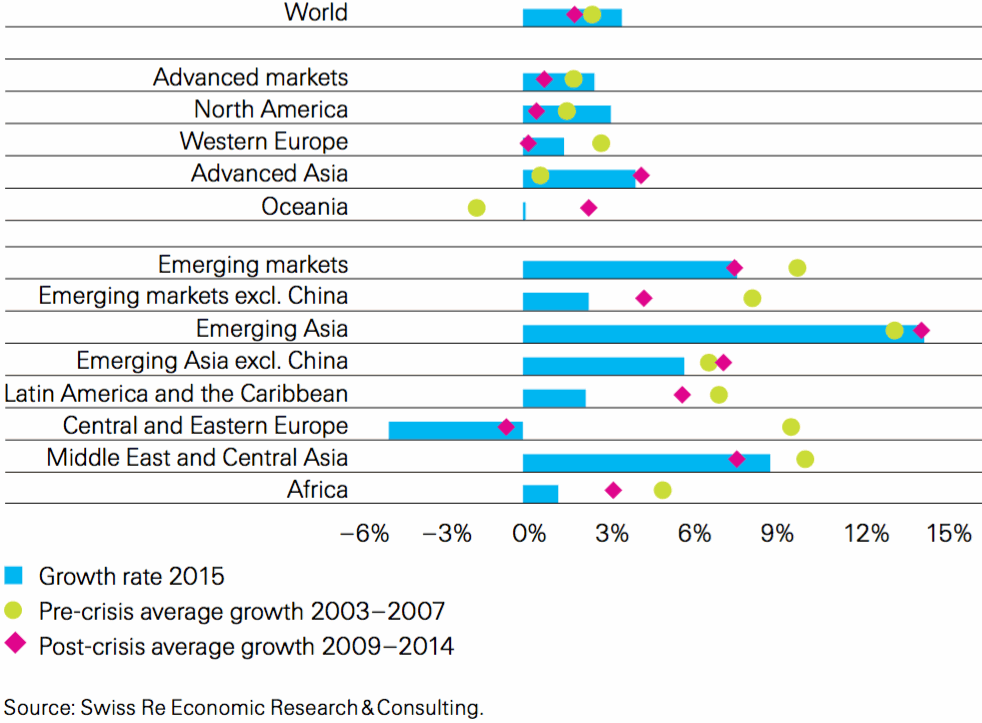
The prediction of 2017 saying that the 2018 would be a rough ride for reinsurers on the continent was based by specialists on the drop to 1.8% in GDP growth, below the global average of 2.5%.
They talked about insurance premiums that dropped by 5.3% translating to US$ 61 billion in 2017.
They gasped over the reduction, which experts said was chiefly because of decrease of some key African currencies against the US dollar.
They knew that the insurance sector couldn’t help Africa to both address energy poverty and to give shelter to its population without gains in insurance premiums.
Private sector financing
Insurance sector not being able to help Africa to both address energy poverty and to give shelter to its population, was contrary to what reinsurers discussed at the UN Financing for Development Conference in Addis Ababa, when experts met to discuss development issues in Africa and the role of private sector financing.
They wanted to carve a niche and help the more than 620 million sub-Saharan Africans who lack basic access to electricity, but unfortunately, premiums declined.
The reinsurers believed it would be powerful to help the sub-Saharan Africa in this era of climate change, but they started to experience decline in premiums.
Declining net premium
At the 22nd African Reinsurance Forum in Mauritius last October, Africa’s reinsurance executives were hopeful about the predictions of their markets in 2018.
But many of the insurance firms’ net income in the first three months of 2017, waned by 73.61 per cent to N604.56 million in contrast to N2.29 billion that was the case in March 2016.
Experts bemoaned that spiky slump “at the top-lines (profit)” was because there was 1016.61 per cent deterioration in reinsurance everyday expenditure to N911.70 million and an 82.63 per cent diminution in unjustified income to N2.56 billion in-spite-of an “uptick in written gross premium.”
Buttressing this, data has it that analysis of the financial declaration of NEM Insurance Plc, Nigeria, demonstrated gross premium written (GPW) augmented by 29.17 per cent to N5.18 billion in March 2017, whereas net premium income bowl-shaped by 32.41 per cent to N1.71 billion.
Investigation revealed that like other re/insurance firms experienced, NEM paid a total of N439.90 million in March 2017, which signified a 66.60 per cent drop in premiums from last year’s numeral of N1.31 billion the preceding year.
The data explained that the Nigerian insurer underwriting everyday-expenditure was 43.15 per cent to N885.63 million in the time under assessment from N618.66 million as at March 2016.
What reinsurance faced
Some of the continent’s reinsurance expenses (as a portion of written gross premium) climbed to 49.23 per cent in March 2017 from 34.91 per cent as at March 2016.
But a firm like NEM, its underwriting profit dropped by 51.85 per cent to N1.56 billion in the time under review as opposed to N3.24 billion as at March 2016.
It was noted that reinsurance firms in Africa were faced with rising inflation, weak money and an economic recession.
There were under-performance and lack of market piercing products, weak regulatory strategy, shallow enlightenment and public lackadaisical approach towards insurance.
These, experts said were the reasons stock price in a country like Nigeria hadn’t moved beyond 2Naira in five years preceding 2017. They added that this incessantly undermined growth.
Shortage of foreign exchange
Reinsurers on the continent but especially in Nigeria were forced to retain risks emanating from the local market higher than their capacity due to shortage of foreign exchange (FX) needed to transact international businesses that happened.
It started in 2016 and analysts had opined, “Insurance industry is sitting on a gun powder waiting to explode, as inflation adjusted claims are huge and coming in their numbers, and this is capable of weighing down the industry.”
The managing director/CEO, Risk Analysts Insurance Brokers, Funmi Babington-Ashaye, who confirmed the impact of shortage of FX policy on the industry, said insurance companies could not get FX to repatriate for reinsurance and so have resulted in keeping some of the risks locally.
Devaluation of the currency
Re/insurers in a country like Nigeria had not predicted that there would be a drop in foreign exchange unlike in the mid 2016 when the devaluation of the currency by the Central Bank of Nigeria (CBN), was a huge blessing to them and boosted their profit that year.
Despite that targeted underwriting actions by Continental Re yielded fruits with flooding of 211.59 percent to N1.29 billion as at December 2017, many believed that reinsurers spent more on claims than they gained in premiums.
Juxtaposing to this, those who know better stated that Nigeria’s GDP had a drift of 0.52 per cent sliding in 2016. As according to data from the National Bureau of Statistics (NBS), this shift was Nigeria’s first recession in 25 years.
When the going was good – an example
It was ‘Hosanna in the Highest’ back in 2016 for the Continental Reinsurance Plc (being one of the two licensed reinsurance firms operating in Nigeria; the other is Nigeria Reinsurance Corporation (Nig Re).
Continental Re made 16% growth in gross premium income of N17.5billion in its Q3 2016, as against N15.1 billion in 2015. And as at December 31, 2016, the company told the world through its (audited financial statements for the year ended December 31, 2016 submitted for investors at the Nigerian Stock Exchange (NSE), that total unclaimed dividends it made was N334.032million as against 2015 level of N173.784million, an increase of about 92.2percent within one year.
The records showed “The total amount in the account as at December 31st, 2016 was N385.489million (Interest income from 2011 to date: N128.285million).”
Looking at Continental Reinsurance Plc, its consolidated statement of profit or loss and other all-inclusive income for the year ended December 31, 2016, its gross premium written rose to N22.406billion from N19.738billion in 2015.
Its underwriting expenses increased to N10.498billion from N7.386billion in 2015. Underwriting profit stood lower at N414.549million in 2016, from a record high of N2.055billion in 2015.
Continental Re’s interest income enlarged to N1.5billion from N1.120billion in 2015. Foreign exchange (FX) gain was N4.067billion, an extraordinary rise from N467.981million in 2015.
Then-again, profit before income tax moved to N4.651billion from N2.915billion in 2015.
Continental Re accounted earnings for the year in review stood at N3.118billion from N2.142billion in 2015. Proceeds per share Basic and Diluted (kobo) increased to 28kobo from 19kobo in 2015.
By December 2017, the “Hosanna in the Highest” changed: Continental Re’s net income dropped by 20.57 percent to N2.47 billion as against N3.11 billion in 2016.
Analysts cried out that the decline in foreign exchange was the culprit responsible for the bowl-shape in the Continental Re’s loss.
The wane in foreign exchange was given at 71.92 percent demur (in foreign exchange gains) to N1.14 billion in the cycle under evaluation.
According to opinion leaders, “While Continental Re has an efficient underwriting capacity amid a tough and unpredictable macroeconomic environment; its N0.50 share price is lower than the N1.92 share price of small and midsized lender, Diamond Bank.”
This was around December 2017 and “investors are becoming increasingly worried about the continued stagnation of insurance stocks on the floor of the ‘bourse’ as they have called on regulators to find a way to formulate policies that would invigorate these firms”.
Odimegwu Onwumere is a multiple awards-winning journalist based in Rivers State. Tel: +2348032552855. Email: apoet_25@yahoo.com