The Nigerian community in South Africa has condemned the killing of 28-year-old Okolie Olileanyi Paul from Awgu Local Government Area of Enugu State, South East Nigeria by a fellow Nigerian in that country.
The Nigeria Union, South Africa, made the condemnation in a statement signed by its National Publicity Secretary, Chief Iyke Odefa, and made available to the News Agency of Nigeria (NAN) in Abuja on Wednesday.
Odefa stated that the deceased was allegedly stabbed to death by a fellow Nigerian and housemate, Mr Donald Mordi from Ika Northeast Local Government Area of Delta State.
“He was stabbed during an argument that resulted into physical combat.
“The sad event took place in Roodenport West Rand on Aug. 17 in the wee hours, when an argument ensued between the duo. Subsequently, a physical fight resulted and the assailant stabbed the deceased to death with several deep cuts.
“Mordi has been on the run since the gruesome murder. The police has been informed and a case file has since been opened.
“The legal desk of the Nigeria Union, South Africa, is already on the case.
“We appeal to the law enforcement agencies to leave no stone unturned until the culprit is apprehended and brought to justice.
“We convey our sincere condolences to the family of the deceased,” he said.
Recently, a 42-year-old Nigerian, Chibuzor Nwankwo, was shot by Lawrence Nwarienne, another Nigerian operating a bar in South Africa, in the early hours of July 27, 2018, in Kempton Park, Johannesburg.
Nwarienne was reported to have shot the deceased at his bar for reasons not very clear.
Police immediately arrested him and had since commenced investigation into the case.
Chairman, Kogi Council of Nigeria Union of Journalists (NUJ) Adeiza Momoh- Jimoh on Wednesday, appealed to Gov. Yahaya Bello to urgently pay salary arrears of late Nathaniel Drisu, a Chief Correspondent with Kogi-owned Graphic Newspaper.
Momoh-Jimoh who made the appeal at the burial ceremony of the deceased journalist at Odu-Ofomu in Dekina Local Government of the state said that the payment would ameliorate the hardships experienced by the immediate family.
The late Drisu born on Sept. 24, 1963 and was a graduate of Literature, Ahmad Bello University, Zaria.
He died on Aug. 10, survived by an aged mother, wife and three children.
Momoh-Jimoh said that the appeal for payment of the salary arrears and consolidated benefits to the deceased journalist’s family had become necessary.
“My appeal today, is that Kogi State Government should, as a matter of urgency, pay the accumulated salaries owed Mr Drisu to the immediate family to cushion the effects of this sudden and painful death’’, he said.
The chairman advised working journalists in the state and friends of the deceased not to abandon the family but accord the family necessary support as a demonstration of love for the fallen colleague.
Momoh-Jimoh described Drisu’s death as a big blow to the journalism profession in the state, saying that the deceased was gentle, trustworthy and unassuming professional who brought his wealth of experience to bear on his profession.
Earlier in his homily, Rev. Fr Michael Osannaiye, Assistant Parish Priest, St. Michael, Raphael and Gabriel Catholic Church, Gadumo-Lokoja, reminded Christians on the need to always be prepared for death to meet with their creator through righteous living.
Osannaiye explained that no one knew when death would strike but emphasised that Jesus Christ remained the hope of all believers.
He described the world as a marketplace, stressing that every flesh shall return to the dust and enjoined the congregation to be constantly aware that death is inevitable.
Osannaiye described the late journalist as one whose commitment in the church would be greatly missed and urged his family to lend a helping hand in bringing up the children he left behind.
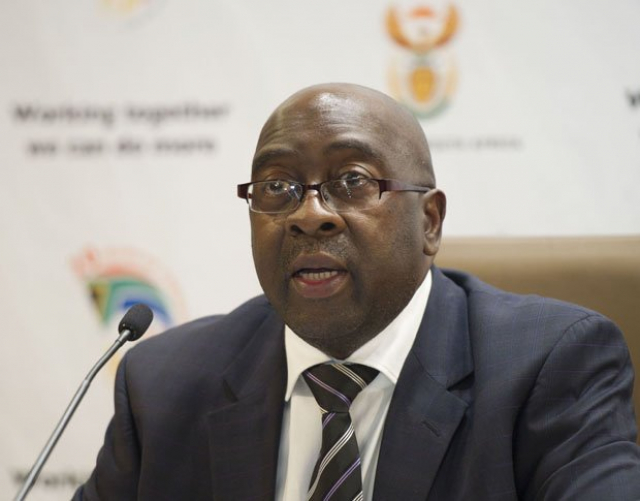
Finance Minister Nhlanhla Nene has announced a set of measures aimed at strengthening State-owned companies.
Addressing the National Council of Provinces (NCOP) on Tuesday, the Minister said given the dire situation in which some of these state-owned companies are in, capable and morally upright men and women are needed to stabilise them.
Drawing on recommendations made by the Presidential Review Committee on State-owned companies, Nene told the NCOP that several measures will be implemented.
These measures which seek to address challenges faced by the entities. Among the challenges identified by the Presidential Review Committee include governance failings and policy and mandate misalignments, among others.
Namely the measures which seek to address the challenges identified are:
The Private Sector Participation (PSP) Framework;
Costing the developmental mandates of SOCs;
The framework for the appointment of members to Boards of SOCs and remuneration of Executives of SOCs.
The PSP framework
The framework which was approved by government in 2016 provides for alternative financing strategies to enable infrastructure investment and highlights considerations for SOCs to partner with private sector companies to enable a faster, more efficient delivery of goods, services and economic infrastructure to support South Africa’s higher economic growth aspirations and economic transformation goals.
“The PSP framework is therefore aimed at accelerating the delivery of infrastructure projects that are key for enabling economic growth through leveraged financing from the private sector,” said the Minister.
The framework proposes the key principles for determining where PSP projects should be undertaken. These are:
The possible PSP structures that could be employed depending on the nature of the infrastructure project; and
a governance framework for government to oversee the implementation of PSPs.
The proposed PSP projects must be a by-product of the filtering process based on sector performance and market structure analysis with a key focus on economic development.
Key principles of the framework include consideration that PSP project are feasible and demonstrate that they will yield socio-economic benefits for the country.
Currently, all SOCs are required to give effect to the implementation of the PSP framework in their respective Corporate Plans.
To give effect to this framework, government is currently working towards several objectives including higher levels of investment in economic infrastructure in both the public and the private sectors for South Africa to achieve its economic growth rate aspiration of 5% as outlined in the National Development Plan (NDP).
Costing the developmental mandates of SOCs
Government has also committed to a mechanism for the costing of the developmental mandates of SOCs, with the financial implications set out more clearly in Shareholder Compacts. The proposed mechanisms include identifying existing and future developmental activities.
Once costs have been quantified a funding mechanism then needs to be decided upon.
Nene said SOCs contribute to the development of the country through their commercial and non-commercial developmental activities. Many of the poorly performing SOCs claim that developmental activities have contributed to their poor financial performance.
“In this regard, it has become important that the costs associated with the developmental activities be clearly specified and that these generate external benefits without compromising the financial sustainability of the entity,” said the Minister.
Framework for the appointment of members to the Boards of SOCs and the Remuneration of SOC Executives
Under the guidance of the Minister for Public Service and Administration, government has developed a framework for the appointment of members to SOC Boards and the SOC Executives.
It comprises several elements including a review of the requirements of minimum qualifications for potential candidates and a review of the methodology for processing of board appointments and their submission to Cabinet.
“It is also important that the Framework for the appointment of members to the Boards of SOCs should be aligned to the remunerations Framework (both guaranteed packages and short-term incentives) for the boards and executive management in order to standardise the determination of compensation and also close the huge gaps between compensation of boards and executive management of the different SOCs.”
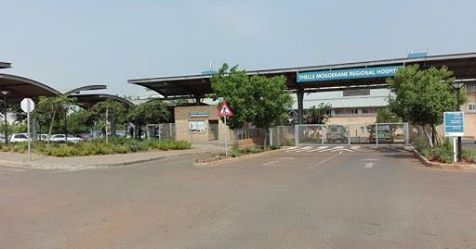
The Gauteng Department of Health has confirmed the outbreak of Klebsiella Pneumonia at the Thelle Mogoerane Regional Hospital, in Vosloorus.
On Wednesday morning, the Head of Department (HOD), Professor Mkhululi Lukhele, paid a visit to the hospital to assess the situation following the outbreak and a recent protest by employees of the facility.
During the visit, Lukhele confirmed that the hospital’s neonatal unit identified seven cases of Klebsiella pneumonia outbreak in July 2018, which sadly resulted in the deaths of two babies.
“Contrary to what has been reported in the media, there were five babies that were being treated and out of the five, one of the baby’s results was negative,” said Lukhele.
Samples were taken and have been sent to the laboratory to establish the source of the outbreak.
The hospital has since taken proactive measures by strengthening its infection, prevention and control unit and closely monitoring it.
“All babies that were admitted in the ward were screened to prevent further infections. Furthermore, the district specialist and head office were called in for support.
“The department is planning to form a provincial task team, led by a neonatologist, to continuously look at the measures to prevent possible future infections in all our facilities,” said Lukhele.
With the increasing demand for services, Lukhele said the hospital is looking at improving the hospital infrastructure. The 61-bedded neonatal unit often admits close to 90 patients.
“Patient care and delivery of quality health care service remain our key priority. To this end, we are working closely with all stakeholders in ensuring that this facility indeed serves the community,” said the HOD.
Meanwhile, Lukhele said the department noted allegations made against its hospital staff.
“All complaints and concerns brought to us are thoroughly followed through. I have also noted the allegations levelled against some of the facility management team.
“I would like to assure the workers and members of the public that the management team will be subjected to the department’s labour policies and procedures. No stone will be left unturned in our investigations,” said Lukhele.
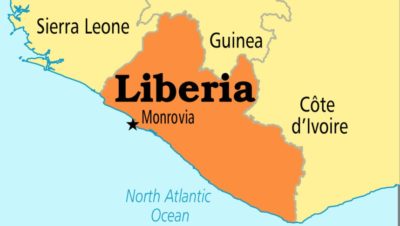
The blue field in the flag of Liberia is supposedly the representation of the dark continent of Africa. Although we argue that why should blue represent a dark continent instead of black—that it was a misjudgment on the part of the creators of the flag. Years later, currently, the blue field in the flag of Liberia doesn’t represent the dark continent of Africa, but the dark and backward country of Liberia.
Now, the sudden dialectical shift of the meaning of the blue field is not a product of abstraction or a figment of our imagination, but its change of meaning finds striking and deep expression in the egregious malady which has engulfed the country since the ascent of George M. Weah as the president of the republic.
Also, in the National Anthem of Liberia, it says ‘we’ll shout the freedom of our race benighted,’ even though our race is still benighted, it is important to state that an alteration must be made to the effect that we are a benighted people whose country is in the state of decadence and decay.
Liberia dances in ruins and it is a strange domain of wretched reactionary trend that represents a dying civilization. The current crisis in the country is one of the crisis of conscience and an eloquent case of a civilization which cannot solve its problem, hasn’t found a direction, refuses to use the scientific method in addressing social discards, but relies on jingoism, fanaticism, symbol, and incoherent phrase-mongering as a short-cut to address social ills.
History teaches us that each time a particular civilization refuses to solve its problems, keeps postponing them by opening different frontiers, it is essentially planting the seed for its demise. When it reaches a dead end, the most scandalous of its member will rise on center stage through the people calling or voting for said person. As was the case when the Germans called for their Hitler, the Americans called for their Trump, the Liberians called for their Weah, and we dare say their own nightmares.
Currently, there is a striking alienation in the country akin to that of the schism between wage labor and capital, feudal lord and serf, worker and capitalist, materialism and idealism. The Liberian stripe of alienation is found in the fact that the masses of the people elected a president who they thought could deliver them from social backwardness, but this leader who they created through their vote has come to suppress and exploit them. It is an alienation because what they created has turned on them and is engaged in howling exploitation of them. In this matrix of things, the wretched existence of the people will then lead to a change in their consciousness. Hence the intensification of the class struggle between the masses of the people and that of the ruling clique.
Similarly, Liberia may not have emerged from colonialism in the truest sense of the word, but from the political gospel preached by the CDC one can draw a striking parallel between the two. Here it is fair to argue that Weah preached about the liberation of the homeland, but such was a pretext and use of high-sounding jingoistic phrases to hoodwink the people, as he himself is a blood relative of corruption and the country has thus transformed into a carnival of avarice, balkanization and wholesale theft.
This era in the nation’s history represents the confluence of two reactionary trends. On one hand, it indicates Liberians never miss an opportunity to miss an opportunity, and on the other hand, the country is a dancing flame in a bonfire. It goes without saying that the homeland is a contradiction on three legs: crass opportunism, ingrained sycophancy and scandalous degeneracy. These anti-people trends alienate the people and provide opportunity for economic parasites and robber bureaucrats to milk the homeland with reckless abandon.
President George M. Weah has not only exposed the rotten edifice of the Liberian political system, but also unveiled himself as the most grotesque fraud which has ever hit the nation, stultified by the most pernicious of disorders: leadership deficit. Truth be told, the country sucks and it holds the dubious distinction as the model for mediocrity and misrule.
Eight months in his tenure, the self-styled emancipator of the masses has shown center finger and granite attitude to them and is yet to take a nationwide tour in the country as a simple courtesy of thanking the people for electing him—that is if we are to blind our eyes to the irregularity and rigging of the election. In such a visit, he would have a first-hand interaction with the people and they would outline the social plagues affecting them, which would influence the policy choice and priority of the regime.
Up to this point, he has neither toyed with such idea nor said anything about embarking on such trajectory, which is a clear expression of the lack of appreciation of the sufferings and sacrifices the ordinary people went through to elect him. By any measure, Weah’s action is an act of contempt for the people. A classic testimony of bankruptcy and an indication that he is clueless.
While Weah shows utter neglect for the people and seems to be totally unconcerned about them, he organizes a so-called meeting with opposition figures which in true was nothing but a meeting of the elite Monrovia boys club with nothing substantive to talk about other than engaging in bandy, singing his praises, and adoring the chief patron of corruption and the Liberian variant of leadership at nadir in him.
Inspired by their misconception that the people are beholden to the regime, intoxicated with power and its residue of private property, getting wealthy through wholesale swindling of the people’s resources, with slavish minions at their disposal and thus ready to insult decent compatriots who dare to question the criminality of the regime, the nation perishes in poverty and bloody exploitation, but the CDC-led government sits above the people and exercises authority through lies and deception.
What is thus obtaining in the homeland is the thingification of the masses of the people by the Weah regime. Their action can be analyzed in the context that they think the people are not worthy of living a dignified life, take them as objects to be used, fooled, and rot on the margins of society.
The Weah regime is caught in a deep-seated, all-round and intractable crisis. Side by side such crisis, there is a growing wave of revolutionary ferment among the people as they pose serious questions about the trajectory of the homeland. Even though the regime would limp on this crisis it is a far gone conclusion that its democratic termination by the people is on the horizon.
Its inability to salvage the economic crisis and garner the gravitas to awaken its social base is being laid bare by the growing antagonistic contradictions. Even some of the masses who supported this regime are struggling to put up a coherent defense for it. While some of them have jumped to commend the popular forces for being steadfast in exposing the hollowness of the political farce, others have pander to sycophancy to defend the malady which is amok in the country, trading insults—an expression of the inability to engage in a civil debate about the Liberian situation.
As contradictions are being repeated on a colossal scale in the homeland so we keep writing to expose the excesses of the regime until the people move in history and make the social overturn. The people have been duped and tricked by this political farce which has no productive capacity. Therefore, our task is to keep exposing these elements so the revolutionary ferment which is taking root in the country can spread across its nook and cranny.
One can wager that in the not too distant future the anger which is building in the mass of the people against this establishment will reach the critical point, and that is when they would stampede in history like the Italian partisans ‘stormed heaven’ in the small village of Giulino di Mezzegra to lynch Benito Mussolini and his girlfriend Claretta Petacci on August 28, 1945.
In true, the CDC-led government plies its trade in lie, deceit and obfuscation. The regime practices zogo capitalism as its economic model, trashycracy as its form of government, and black fascism as its official ideology. These three reactionary trends explain why the country is in the doldrums and thus emphasizes why wages have been destroyed by inflation, unemployment has hit ear-piercing crescendo, and the exchange rate is at an all-time high.
Trashycracy— is a form of government which showcases bourgeois democracy in senile decay. In this form of government, professionals are overlooked for trashy lowlifes, standards are disregarded, the function of the civil services is compromised and usurped, and there is a disregard for the rule of law and thus the government is personified in a bankrupt president.
Zogo capitalism— is the Liberian variant of gangster capitalism, in which the nation metamorphosis into a gambling casino. In this system, there is a great stampede for private property and the official normalization of corruption. The state turns into a mafia corporation and joint criminal enterprise where loan sharks, black money dealers are pursued for funds against every parity of reasoning.
Black fascism—this ideology is based on no social category but relies on the use of crude violence and brute force. Its application begins with threat, peddling of insults, and concludes with serious violence. In this realm, healthy debates are substituted for verbal insult, fist fight, and the infliction of pain.
Here there is a unity and struggle of opposites of two trends, in the form of the center and periphery. The elements in the government represent the center while the masses of the people represent the periphery. In such an asymmetrical relations, the elements in the center plunder the resources of the country with the speed of light, in primitive accumulation. While the masses of the people in the periphery live on the margins of the society, crushed by systemic poverty, inequality and diseases. In this matrix, social mobility is predominantly driven by one’s readiness to trade in deceit, deception and theatrics. Others who dare to remain virtuous suffer from the pangs of vilification.
Against this background, a revolutionary party must be formed to educate the mass of people and workers to remain internally vigilant to expose the government, conduct propaganda work among the people and explain how their suffering is tied into the logic of the neo-colonial capitalist system which only strives on exploitation and oppression of the people, while using the rotten ruling clique in the third world countries, and in this case Liberia, to frustrate the people and to ensure they remain in the economic wilderness.
Kiadii studies Political Science with emphasis in Public Administration at the University of Liberia. He is the Secretary General of the Movement for Social Democratic Alternative (MOSODA). You can reach him through bokiadii@gmail.com.
Brent oil rose to approximately 74 dollars a barrel on Wednesday as an industry report showing a drop in U.S. crude inventories and U.S. sanctions on OPEC producer, Iran, pointed to tighter supplies.
The American Petroleum Institute reported U.S. crude stocks fell last week by 5.2 million barrels, more than three times the drop analysts expected.
“The API inventory data published after the close of trading yesterday are lending buoyancy to prices,” Commerzbank analyst, Carsten Fritsch, said.
Brent crude, the international benchmark, rose to approximately 70 dollars a barrel by 1006 GMT.
U.S. crude rose to 66.62 dollars.
Oil also found support from a weak dollar which has slipped this week in response to U.S. President Donald Trump’s comment that he was “not thrilled” by the Federal Reserve’s interest rate increases.
A weaker dollar makes oil less expensive for buyers using other currencies.
The prospect of a drop in oil exports from Iran, the third-largest producer in the Organization of the Petroleum Exporting Countries, in response to new U.S. sanctions is also supporting the market.
European oil companies have started to cut back on Iranian purchases, although Chinese buyers are shifting their cargoes to Iranian-owned vessels to keep supplies flowing.
“The Iran issue continues to occupy traders’ minds,” said Greg McKenna, chief market strategist at futures brokerage AxiTrader.
OPEC has started to boost supplies following a deal with Russia and other allies in June, although producers have been cautious so far.
Saudi Arabia told OPEC it cut supply in July, rather than increasing output as expected.
Signs of tighter supply countered concern about slowing oil demand stemming partly from the trade dispute between the United States and China, the world’s two largest economies.
U.S. and Chinese officials were set to resume talks on Wednesday, but Trump has predicted there will be no real progress.
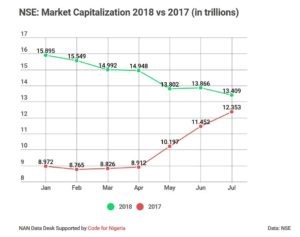
Investors on the Nigerian Stock Exchange (NSE) lost N2.49 trillion or 15.64 per cent between January and July, a development experts attribute to the political uncertainty in the country.
The financial experts who spoke to the News Agency of Nigeria (NAN) said the political uncertainty had taken its toll on the bourse.
Data obtained by NAN from the exchange showed that the market capitalisation which closed at N15.895 trillion in January declined to N13.409 trillion in July.
Similarly, the All-Share Index lost 7,325.87 points or 16.52 per cent during the period under review, closing at 37,017.78 in July compared with 44,343.65 in January.
Prof. Uche Uwaleke, Head of Banking and Finance Department, Nasarawa State University Keffi, told NAN that the performance of the market was dismal and eroded the growth recorded in January.
Uwaleke said the market had remained bearish despite the oil price recovery, stable exchange rate, retreating inflation and even improved company fundamentals.
He, however, attributed the development to heightening political tension, insecurity from herdsmen and economic uncertainties from the delay in budget implementation.
Uwaleke added that the spike in interest rates in the United States of America and to some extent the US-China trade war combined to swing the attention of foreign investors to US markets.
Prof. Sheriffdeen Tella, Professor of Economics, Olabisi Onabanjo University Ago-Iwoye, Ogun, said the bearish trend was caused by movements of interest rates in the United States which resulted in withdrawal of money from the market by foreign investors.
“The seeming sustainability of the downward trend is caused by fear of local investors that they might be losing large amounts of money if they don’t sell off their securities now,” Tella said.
Mazi Okechukwu Unegbu, former President, Institute of Bankers of Nigeria (CIBN), said security issues and the social environment were responsible for the negative sentiments in the capital market.
Unegbu said foreign investors had pulled out their funds from the nation’s market, especially portfolio investors.
He said the real investment that impact positively on the economy was foreign direct investment in the productive sector not ‘hot money investment’ in the stock market.
Unegbu said government must encourage local investors to invest in the market by creating an enabling environment.
He added that politicians should stop their daily political altercations in the media, which he said was fuelling fears among investors.
Malam Garba Kurfi, the Managing Director, APT Securities and Funds Ltd., said the performance of the capital market had remained negative from February to date.
Kurfi said the initial gains of January of about 17 per cent had been completed eroded by July.
He said the market for about seven weeks now had experienced a loss of one per cent per a week or even more.
Kurfi attributed the trend to the exit of foreign investors and the institutional investors, and that the market witnessed a lot of sell pressure.
He also said the Pension Funds Administration failed to invest due to political risks.
“We hope to see revised trends probably after primary elections when the foreign investors are likely to review the prospective candidates and take decision,” Kurfi said.
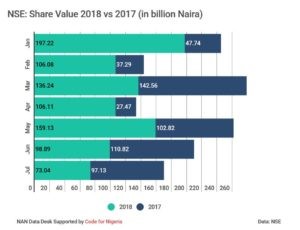
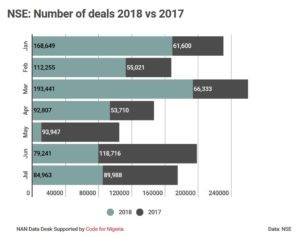
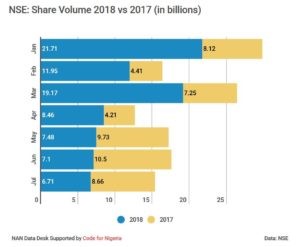
However, NAN reports that volume of shares traded between January and July rose by 56.16 per cent with an exchange of 82.58 billion shares valued at N871.71 billion in 742,014 deals.
This was in contrast with a turnover of 52.88 billion shares worth N565.83 billion transacted in 539,315 in the comparative period of 2017. (NAN)
The National Leader of All Progressives Congress (APC), Asiwaju Bola Tinubu, says the Administration of President Muhammadu Buhari is the foundation for re-engineering and reinvigorating Nigeria’s economy for a better future.
Tinubu made the remark in Lagos on Wednesday during the Eid-el-Kabir celebration, saying a strong foundation mattered in nation building.
He said that building such foundation required patience, perseverance and commitment as it often presented difficulties for the people.
”Economic development and the future of the youth are crucial in the growth of any nation and we are taking care of that.
”You have to re-grow the economy, re-engineer it from bottom-up, during that process, it is always very difficult for ordinary people.
“They bear the brunt of the economic difficulties because they are in the lower cadre of the society.
”You can only use and depend on what you have and if you manage to use resources carefully, yes, you end up enjoying a multiple development in the country and that is why I always emphasise that foundation matters.
”Foundation is crucially important. I have listened to the people. I have been in contact with them at the grassroots.
”Even this house is not spared too, from demands from the poor and the needy, but without re-growing the economy, re-tooling, re-engineering the economy, we will not have anything.
”We ate the seed of growth for breakfast. Therefore, there is nothing for lunch or dinner. Nothing to harvest, that is what we talk about looters.
”But it will not take a magical touch to bring it to reality, It takes patience and perseverance. Three years is not enough time to for retouching, redevelopment and re-engineering the country.
”There is a lot of hope, there is a lot of expectation, but when the treasury was empty, when the salaries were outstanding, when the quality of life is low, what will you do?
”We have oil, they didn’t save money and we have not diversified the economy. We have eaten our dinner for breakfast, nothing in the kitchen.
“There is no magic about it. It takes dedication, commitment and perseverance.
“Yes, we might not be communicating effectively with the people but we are working to make things better, ” he said.
Tinubu said the country need a focused and determined leader like Buhari to gradually re-engineer the economy for the benefit of all.
”Nigerians adopted democracy, we are going to live through this democratic government.
”We need a President Buhari, to retool and re-engineer, that is what he is doing in the economy and he is doing it gradually, otherwise we don’t want it to fall apart again.
”Continuity, perseverance, and endurance, those are what we need. Our determination is progress for the country and for the people. We can’t go back.
”I am very proud of what I have done in Lagos to be where it is. We were meticulous, dedicated and focused and we lifted the spirits of our people and that is why it is important for Nigerians to be focused now, ” he said.
Tinubu urged Nigerians to make sacrifices, endure, tolerate and forgive one another in the spirit of Eid-el-Kabir celebration.
”When you pray for forgiveness, you must be able to give forgiveness if you think you deserve forgiveness.
”Can you ask God to give you what you cannot give to another fellow human being? That is simple,“ Tinubu said.