By Joseph Edegbo


By Joseph Edegbo

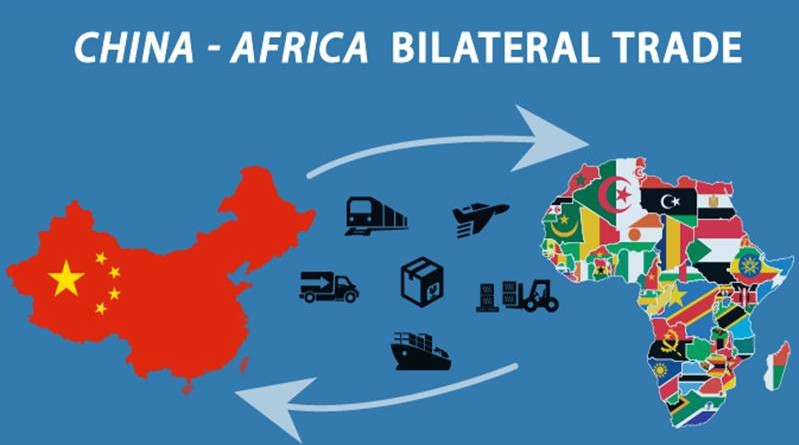
The Chairman, Nigeria’s Senate Committee on Local and Foreign Debts, Sen. Shehu Sani, has cautioned against emphasis on loan in the relationship between China and African countries.
Sani, gave this warning when he chaired a roundtable organised by the Centre for China Studies in Abuja on Thursday.
The roundtable has the theme,” The Outcomes of 2018 Beijing Summit of Forum on China-Africa Cooperation (FOCAC).”
The roundtable was aimed at working out ways to synergise outcomes of the summit with the Economic Recovery and Growth Plan of the Federal Government, to drive sustainable and inclusive development in Nigeria.
Sani, who warned that debt was a form of colonialism, advised that the relationship between China and African countries should be mutual and not on a “creditor and debtor basis.”
According to him, many African countries have frosty relationship with their creditors, for their inability to service their loans accessed from such countries.
“China, Africa relationship should not be simply about loans. We must be careful and ensure there is no strong emphasis on loan.
“Loan is sweet but payment is bitter and it will be in the interest of both countries that other areas are explored.
“Debt from our experience is a new form of colonialism. I am of the opinion that as you borrow in bits it becomes a mountain.
“We should explore all other areas, from security cooperation, to China doing everything possible to support Africa to have a permanent representation at the United Nations Security Council.
“The relationship between Africa and China should not be about the creditor and debtor.
“It should be about mutual engagement and the need for China to invest in Africa, so that we can also rise to their level,” he said.
The lawmaker urged African countries to borrow a leaf from China’s developmental strategies, which were devoid of loans.
According to him, China rose from being a third world country to becoming the second largest economy in the world.
“We are here today to follow up that historic forum that brought together leaders from Africa to China, to discuss and deliberate on what has been achieved and the way forward.
“There is no doubt that there is no nation outside of Africa that is deeply involved in developmental and economic activities in Africa than China and this relationship becomes easy because of the historical similarities between the continent and China.
“China moved from a third world nation to the second biggest and largest economy.
“That should be an inspiration to African nations to look up to themselves for their political liberation and economic progress.
“China today is a dominant economic power, a force to reckon with and one that is viewed globally as a power militarily and economically and an inspiration to us.
“They did so without putting their knees on the ground begging other countries to come and develop China. That should also be the inspiration of Africans.”
Sani, while appreciating China’s role in Africa’s liberation struggle, called for mutual relationship that would see African countries providing value rather than looking up to what China had to offer.
In his remarks, former Director-General, Institute for Peace, Conflict Resolution, Prof. Joseph Golwa, said while there was nothing wrong with accessing loans, workable strategies ought to be put in place to make judicious use of such loans.
According to him, emphasis should be laid on having a coordinating body on loan implementation.
He also said attention should be paid to research and human capacity development to maximise the potentials in the country and continent at large.
“In this country and most African countries, we do not encourage research and that is why we are not growing at the pace we ought to.
“Why should we be bringing in Chinese and other people to build our refineries.
“In our relationship under FOCAC, we should be able to build on the technology we obtain here as well as using our own people so that we build our own refineries and other things.
“We have the human resources to achieve this feat and we must take it seriously.”
The News Agency of Nigeria (NAN) reports that President Muhammadu Buhari led a delegation to Beijing, China, to attend the 7th Summit of the Forum on China-Africa Cooperation (FOCAC), which held between Sept. 3 and 4.
Heads of Government and delegations from 52 African countries, including Nigeria and the People’s, Republic of China met in Beijing, under the auspices of the Forum on China and Africa Cooperation (FOCAC).
The tri-annual summit was held with the theme: “China and Africa: Towards an Even Stronger Community with a Shared Future through Win-Win Cooperation.”

By Mohammed Munirat Nasir
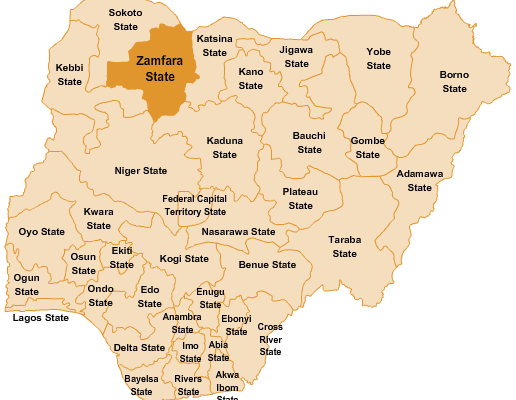
Police in Zamfara have confirmed Killings of six persons, while several others were Injured by dreaded bandits in Badarawa village of Shinkafi local government area of Zamfara state, Northwest of the country.
The Command Spokesman, SP Mohammed Shehu who confirmed this to AFRICA PRIME NEWS put the figure of those Injured at twelve.
He said on receiving a distress call, the Command mobilised its men to the area forcing the bandits to flee, but were still being trailed by the police.
However, an eye witness and resident of Badarawa village, who claimed to have escaped, Usman Sani, said, the bandits in their dozens stormed the village and began shooting sporadically, which resulted in the death of about 20 people, while several others were seriously injured.
A health worker in Shinkafi town, the local government headquarters, who prefers anonymity also said that many dead bodies were brought to the hospital in Shinkafi town from the village where the attack took place..
He added that at least 12 people, some of whom were seriously injured were referred to Gusau the state capital for proper medical care in view of the severity of their injuries.
The latest killing is coming barely three days after a special Town Hall Meeting on security organised by the federal government was held in Gusau, the State capital.
By Amos Tauna
Determined to ensure peaceful and harmonious relationship among the citizenry, an international organization which promotes interreligious and cultural coexistence globally , KAICIID, Dialogue Centre has organized a one day sensitization programme.
The programme brought together religious and traditional leaders, political parties, youth and women in Chikun Local Government Area of Kaduna State, Northwest Nigeria to fashion out a common ground of understanding.
It had resource persons chosen from both the Christian and Islamic scholars to educate participants on the teachings from the two Holy books and for enhanced interreligious and cultural coexistence in the various communities.
The convener, Samaila Yahaya, said as a member who had been trained by the KAICIID Dialogue Centre for the promotion of peace among diverse nationalities ,the programme was to pass the message of peace, love and unity to the people in the local government towards ensuring peaceful coexistence among the people.
He noted that though the 2015 general elections was peaceful, there was still the need to further educate the people not to allow politicians use them for their selfish desires to kill and destroy in the name of politics.
Yahaya stated that peace and unity is the only weapon that could fight enemies of progress that have nothing to offer the people but to devise their selfish means of actualising their evil schemes.
Earlier, an Imam, Dr. Muhammad Nurayn Ashafa, co-Executive Director interfaith mediation centre enjoined the people to be aware of politicians that have nothing to offer but come in the name of religion to cause disaffection among the electorates.
He explained that Nigeria is the most religious nation, but the most corrupt country in the world, stressing that there was no practical adherence to the Holy books.
“We will continue to deceive ourselves with all that we are doing until we come to our senses of the reality of life. In every street in Nigeria, you find Churches and Mosques with people calling unto God but yet our attitudes to one another does not portray what we are learning in our various places of worship,” he wondered.
“Until such time that we practically apply what the Holy books demand from us, we will continue having problems as a people in all spheres of life because we lack knowledge and understanding of the Holy books.”
On his part, Rev. Bitrus Dangiwa, who spoke on the role of dialogue in the electioneering process, noted that the only way for Nigerians to get it right, is through dialogue with one another, adding that until we come to a round table in accordance with the Holy scripture, there would be no better understanding and way forward for peaceful coexistence among Nigerians.
Imam Sani Isah Mohammed who spoke on dialogue , emphasises on respect and understanding for one another irrespective of religion, tribe or political affiliations as the only panacea for peaceful coexistence among Nigerians.
Other speakers enjoined Nigerians to always be mindful of politicians have nothing to offer the people and advised that the electorate should always vote people of integrity that could be held accountable.

By Peter Usman
The family of Arazim Shaibu from Kadijin village in Gujba Local Government Area of Borno State, Nigeria’s North East Region, has solicited the assistance of the Federal Government to facilitate the release and repatriation of their son, Arazim, said to have been detained since 1999 by the Authorities of the Niger Republic.
Speaking to AFRICA PRIME NEWS in Abuja, a close relation to the family, Mrs. Ummy Zahraha ShaibuDeen, stated that all efforts put in place to bring back home Arazim Shaibu since he left home for his dear life after his father, mother, brothers and sisters were killed, proved abortive.
Mrs. Ummy explained that Shaibu’s sudden disappearance from his home town at the age of 16 since 1999 to unknown destination was as a result of family persecution, which she said later led to the death of 5 members of the family.
She explained further that after searching for the where about of the young man for years, it was discovered that he travelled to Niger Republic where he was arrested and charged as an illegal alien.
According to her, “The sudden disappearance of Arazim Shaibu from his family’s home in 1999, to unknown destination as at the time the activities of Boko Haram started newly in Borno state was as a result of family persecution.
“He accommodates and assists people, both Christians and Muslims, but little did he know that his kind gesture in helping humanity had generated hatred and envy against him by the Kanuri tribe.
“Ahmad and his wife, Abdullahi and Nancy, who are both brother and sister to Arazim were killed by the Kanuri people when the issue of Boko Haram started newly in Borno state.
“Mr. Ahmad was born to the family of Shaibu in Kadijin village in Gujba Local Government Area of Borno State. Ahmad, a Kanuri by tribe was married to Zuwera and gave birth to Nancy, Abdullahi and Arazim. They were both Muslims and Mr. Ahmad don’t discriminate religiously.
“Shaibu was assisting Christian to escape and as such, he was targeted by the Kanuri people of Borno and later, he was killed with the wife, Arazim and other two siblings.
“Arazin however ran away for his life and since then, the closed family relations have not set their eyes on him until recently somebody told us he is Niger Republic.
“Recently, according to Mr. Wakilu Adimo, a close friend of the family revealed to us that he sighted Arazim at Agades, somewhere in Niger republic” she narrated.

President Muhammadu Buhari of Nigeria has appealed to members of the All Progressives Congress(APC) not to be complacent but to prepare, strategise and win 2019 elections, to prevent the Peoples Democratic Party from taking Nigeria backwards.
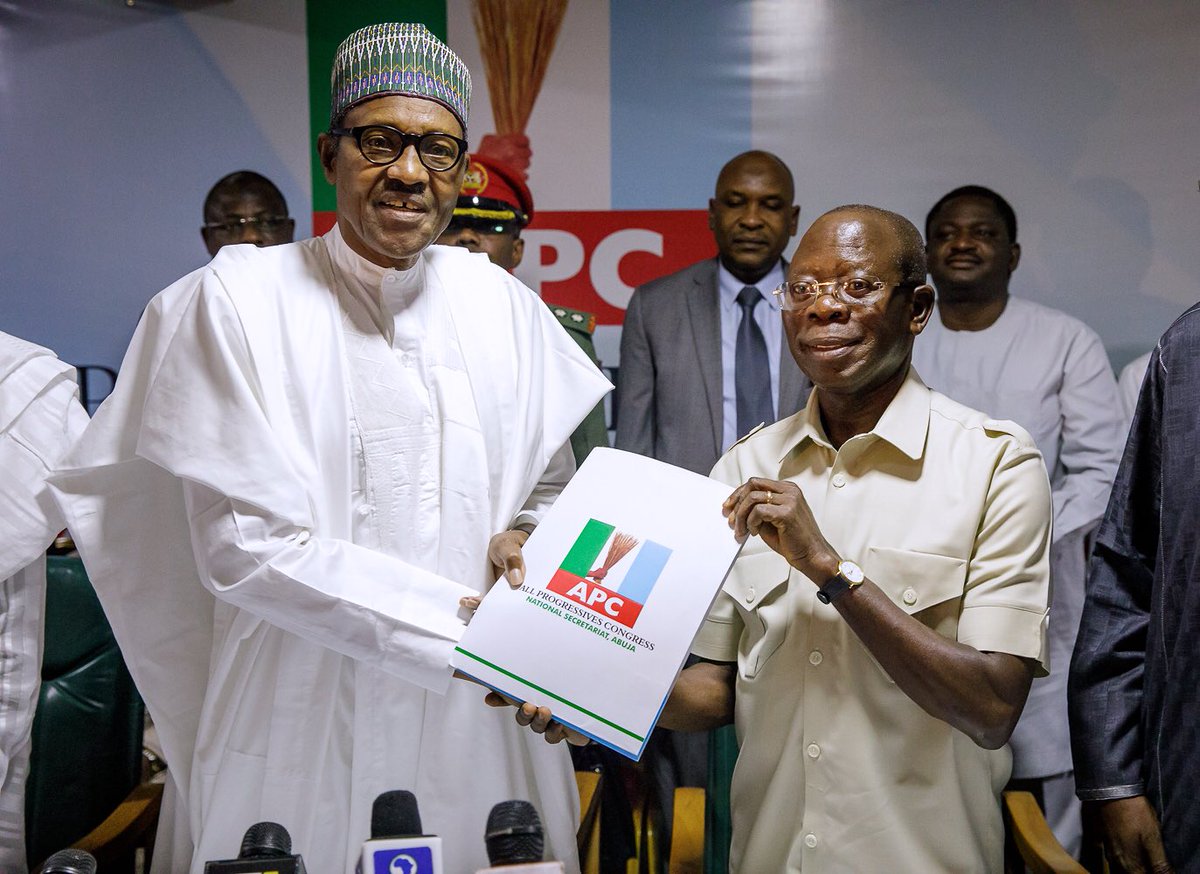
He made the appeal at the APC national Secretariat Wednesday in Abuja while submitting his Expression of Interest and Nomination forms to contest the presidency in 2019.
Although Buhari did not mention PDP in his short speech, the reference was unmistakable as he referred to those who ruled Nigeria between 1999 and 2015.
The News Agency of Nigeria (NAN) reports that the forms were purchased for the president by the Nigeria Consolidation Ambassadors’ Network on Sept. 6th at the cost of 45 million.
Buhari had in April declared his intention to seek re-election at the APC National Executive Committee (NEC).
President Buhari while submitting the forms, said; “I m here in person among friends and colleagues to put my name forward to my party, the APC, seeking nomination to contest the presidential election in 2019.
“I am taking this step with all humility, sense of responsibility and unquestionable desire to serve and protect the interest of all Nigerians.
“Let me today, appeal to party members not to be complacent but to pre,strategize and win 2019 elections.
“We must not allow those who brought the country to its kneels from 1999 to 2015 to come and take us back”.
National Co-coordinator Nigeria Consolidation Ambassadors’ Network, Sunnsi Musa, said the group paid for the forms because the President is not a multi-millionaire cash wise.
“But he has millions of supporters who are always ready to come together to pay for his nomination form.
He said the group embarked on the project based on the recognition that the President has started laying a foundation for a better Nigeria and deserves a second term in office.
He expressed gratitude to those who contributed towards the purchase of the forms.
He assured them and Nigerians generally that if nominated, and re-elected in 2019, hr would continue to serve the people to the best of his abilities.
Mr Adams Oshiomhole, the APC National Chairman used the opportunity to present to President Buhari his new party membership card.
He also told the president that the APC under his leadership, took advantage of modern technology to come up with a new membership data base, saying that the party currently has 15.6 million registered members.
“Today to talk about the size of our party, the largest party in the world and in Africa, we need to have evidence that can be verified by a third party or by members.
“We have taken advantage of technology to produce what I believed is the best or the first in Nigeria.
“We now have as at last week when they started printing of membership register, about 15.6 million registered APC members across the country “he said.
The APC national chairman added that the party membership data base was designed to ensure that the membership status of anyone could easily be verified at the touch of a bottom.
Oshiomhole further added that with the development, the party had credible and verifiable persons to conduct direct primaries on the basis of its membership register.
However, he said the party would not in any way nullify or change the decisions of its National Executive Committee (NEC) at its sixth meeting, which allowed for indirect primaries, for logistics reasons
He said the APC will strive to give practical expression to its decision as transparently as possible.
This, he added, would ensure that the APC would not only be the largest, but the smartest, most democratic and most cohesive party in the country.

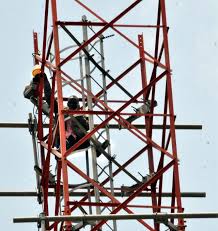
A 28-year-old man, Mr Nurudeen Lliyasu, has climbed a telecommunication mast in Abuja, to protest the poor economy in the country.
The News Agency of Nigeria (NAN) reports that the man was seen on top of the mast at about noon on Wednesday at AYA, Abuja , the nation’s capital.
NAN also reports that posters with different inscriptions were seen along the AYA road and at the foot of the mast, which read: `Another hope betrayed battered, mutilated with collapsed economy.
Others include, ‘inflation and hunger is killing Nigerians’, ‘unemployment continues unabated’, and ‘Nigeria is on the precipice of collapse’ among others.
Lliyasu said he would remain on the mast for the next seven days, adding that he was ready to sacrifice his life for the progress of the country.
“I am on hunger strike to protest and register my grievances on the condition of the country; I will remain here for the next seven days and I do not mind if I die here.
“If my dying on this mast will change the economy of this country, then I choose to die for others to live a good life.
“ I have not eaten for days and also other Nigerians, if I die on this mast I am not worried, no roads in the states only in the city of Abuja you can see good roads.
‘’The doctors have said that a man can survive only on water without food for some days, I believe I can and if I cannot I will die.”
Lliyasu said that there was nothing working in the country, adding that the education, health system, infrastructure are all in bad shape.
He said that he was into transport business and other businesses.
Mr Ayuba Luka, the security man in the area, told NAN that Lliyasu approached him that he wants to climb the mast he warned him against it.
“He came to me I warned him not to climb that mast, but when I left the site he sneaked in and climbed it.
“I was shocked when I came back and saw him on the topmost part of the mast, I have called my supervisor to come and take necessary action’’.

Frank talk. Optimism. Pragmatism.
These are the buzz words African states will have to embrace if the continent is to make tangible strides in eradicating alarming poverty rates and propel stubborn economic growth.
Until then, the continent might be seen as navigating a landmine blindfolded, while wobbling in high heels. A grim chef’s certified recipe for disaster.
This much has been conceded by leaders of the 52 African states attending the recent Forum on China-Africa Cooperation (FOCAC) in the bustling Beijing metropolis.
In the 48 hours that the first citizens of each country huddled to chart a new path, Chinese President Xi Jinping was able to thrash out eight major initiatives to be pursued by the world’s second largest economy. These initiatives, ranging from industrial promotion, infrastructure connectivity, trade facilitation and green development, will see China increasing African imports over the next three years.
President Xi pledged $60 billion to Africa in loans, export credits and aid. Of this amount, $15 billion is interest-free.
And, a further boon would be a planned economic and trade expo on China-Africa, to be held in China, with Chinese companies urged to invest in Africa to enhance industrial promotion.
In addition, China will carry out over 50 agricultural assistance programs to provide emergency humanitarian food aid amounting to 1 billion yuan (147 million US dollars) to African countries affected by natural disasters.
China and the African Union, President Xi said, would also work together to formulate an infrastructure cooperation plan. This will see Chinese companies participate in Africa’s infrastructure development for investment-construction-operation models.
“China will buy more goods, especially non-resource products, from Africa, and will continue its free-trade negotiations with African countries that wish to do so,” the President reportedly said.
Over the years, the China-Africa bromance has seen China squash billions of yuan in debt owed to it by 31 African countries, while hordes of trade and bilateral agreements and memoranda of understanding aimed at strengthening flailing economies were entered into.
FOCAC on its website defines the collective as a “consultation mechanism” advancing “equal consultation, enhancing understanding, expanding consensus, strengthening friendship and promotion”.
South African President Cyril says the relationship between Africa and China forged through FOCAC “was premised on the fundamental and inalienable right of the African people to determine their own future”.
“It is premised on the African Union’s Agenda 2063, a vision that has been crafted in Africa, by Africans,” the President contends.
The grouping has, however, been met with much scepticism, as was the case wherever China latched its tentacles. Think BRICS.
Professor André Thomashausen, a member of the European Academy of Sciences, Academia Europaea, leans on the side that says there’s empirical evidence to prove that FOCAC had been beneficial to Africa.
“There’s been definite benefits for Africa that are measurable,” he emphatically states. “Every African city today has a new airport which was built through the FOCAC. Every African [city] has a new Convention Centre and at least one five-star hotel that is as a result of this cooperation.”
Telecommunications and technology has over the past 20 years vastly advanced, he adds. “Every village in Africa today has some sort of mobile connectivity that is changing our politics because people can use the internet, especially the youth. That is all being done with Chinese technology. Huawei and ZTE are the two backbones throughout Africa. It has changed the continent. We used to talk a lot about it in the 2000s and now it’s a reality – people have connectivity.
But “there’s no free lunch,” argues a less optimistic Bonke Dumisa, a KwaZulu-Natal-based economist, stopping short of describing China’s goodwill as a poisoned chalice of debt.
“So what’s the catch?” he asks.
In his assessment, the only tangible benefit from the recent meeting was that parts of the loans pledged by China were interest-free.
“Not to be negative about China, but when China says it will invest, they come with their own conditions and most of those conditions relate to them using their own labour. Whatever money they ‘invest’ in your country ends up going back to their own people. They leave a lot to be desired, just like the United States and the West. We must be happy with China being in our corner but there’s a lot of apprehension about how they do their business,” he said.
Thomashausen says there is a grain of truth in this assertion but “in reality, nothing is for free”.
“Why should anyone give anything away to get nothing in return? As Africa, the question is: ‘where do you get the best deal?’ Loans in Europe and America have always been very expensive. South Africa today pays up to one third of the national income on loans because we’ve been borrowing money from the western banking system. We are paying eight to nine percent interest, it’s not very sustainable in the long term,” he argues.
“The Chinese have accepted the risk of investing in Africa,” he says.
“They have already invested a total of over $200 billion in the continent over the last 20 years. That’s actually three times the amount we had originally budgeted in the Thabo Mbeki era when it was said $70 billion was required to fix the infrastructure. Out of that $200 billion, $100 billion is in loans that have to be paid back. That is projection for reasonable growth and… all African economies are working from very low bases so it shouldn’t be difficult to get six to seven percent economic growth a year.”
Earlier this year, the World Economic Forum argued that Africa needed to embrace sustainable intra-trade in order to harvest a significant slice of global economic growth.
According to World Bank figures, intra-African trade was at a paltry 11 percent between 2007 and 2011. This improved by a measly five percent four years later, the 2017 African Economic Outlook found last year. In 2015, despite potential trading measuring at about trillions of dollars, statistics for that year reveal that intra-Africa trade was a mere $170 million in that year. Not a very pretty sight.
According to Dumisa, intra-Africa trade was not thriving, due to hostilities, such as in the example of the recent “aggression” South African telecommunication giant MTN experienced in Nigeria. A further example was that of local food chain Shoprite Checkers considering scaling down operations in the same country. If Africa is to prosper, acquaintances such as China would have to be embraced, as much as there were murmurs of suspicion. The 18-year-old FOCAC relationship has already produced irrefutable results, with infrastructure development gradually picking up steam. A lack of infrastructure has long been seen as an impediment to the continent’s advancement.
Aggressive, yet calculated, risks can only benefit the millions of hunger ravaged citizens languishing in Africa’s natural resource-rich backwaters.
The politicians have talked a big game, it’s time to implement. This year is merely seven years to 2025, the African Union’s target of eliminating hunger in the world’s second most populated continent. Can this be achieved? Only time will tell.
SAnews.gov.za