The World Bank has said that it approved 62 micro projects for Kogi communities under the State Community and Social Development Agency (KSCSDA) for execution across the state in 2018.
Dauda Momoh, General Manager of the agency, disclosed this in an interview with the News Agency of Nigeria (NAN) on Saturday in Lokoja.
He said that the 62 micro projects were part of the Community Development Projects (CDPs) approved by the World Bank for execution in the state this year.
He said each CDP has an envelope of about N10 million for a minimum of two micro projects, adding that 10 micro projects were ongoing in the state before the further approval of 52 for this year.
He stated that the projects cut across areas like education, health, access roads, electricity and viewing centres in various communities based on their needs.
“CSDA is all about touching lives. It’s all about giving the poor a hope to live. That is what the project is all about.”
He said that it was in view of the importance and urgency to kick-start the projects after almost a year of inactivity that the agency held a stakeholders’ training during the week.
The training, according to him, was aimed at sensitising the stakeholders on how we operate because most people don’t know how we operate.
Momoh, however, pointed out that from 2019, the CSDA would intervene only in approved focal Local Government Areas against the former practice of covering all areas at once.
“Before, we used to intervene in all the local government areas but a new dimension has been introduced by the World Bank and in this case, we will intervene in seven focal LGAs to be approved by the state government at a time.
He said that Gov. Yahaya Bello had approved seven LGAs selected from the three senatorial districts for intervention from 2019, but the sensitisation had to start immediately.
The seven LGAs for 2019 interventions including Ajaokuta, Ibaji, Okehi, Okene, Ijumu, Kogi, and Olamaboro and they were selected using the state poverty map, adding that another set of seven LGAs would be approved for 2020.
He noted that the number of micro projects for 2019 would be above 92 as against 62 for this year.
Momoh reiterated that efforts would be made to exploit the Additional Financing window for more interventions as it is expected to expire in 2020.
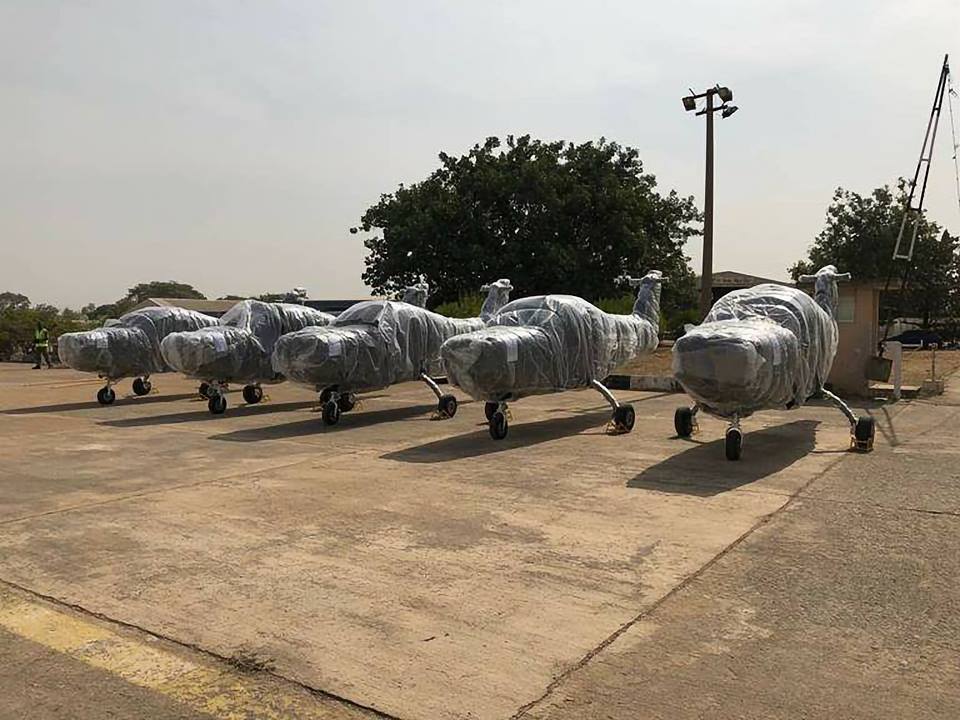
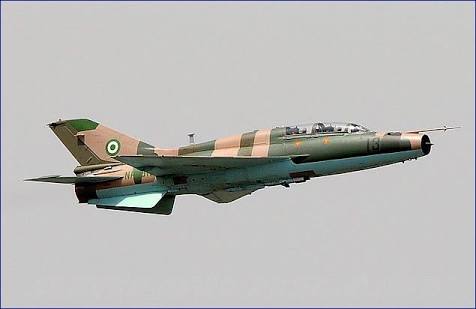
5 of the 10 Super Mushshak aircraft procured by Nigeria from Pakistan to fight insurgency in the country
5 of the 10 Super Mushshak aircraft procured by Nigeria from Pakistan to fight insurgency in the country
The Chief of Air Staff, Air Marshal Sadiq Abubakar said the Nigerian Air Force acquired 30 aircraft and activated 13 grounded ones in the last three years.
Abubakar disclosed this on Saturday at the inauguration of the new Headquarters of Air Training Command, and the Sports complex at the Air Force Comprehensive School in Kaduna.
He said professionalism was about providing serviceable equipment and making case to the Federal Government to provide equipment required.
“I am very happy in the last three years, we were able to acquire 18 aircraft, similarly the Federal Government have paid for additional 12 aircraft, if put together is 30,” Abubakar said.
“Professionalism is also ensuring that we activate what currently we have; hence we embarked on renovation of our grounded aircraft.
“So far, we have activated 13 aircraft and working on the 14 to15 ones both in Port Harcourt in Rivers State,’’ Abubakar said.
According to him, professionalism is having the right structure, hence the decision to unbundle the former Training Command to Air Training Command and Ground Training Command.
He disclosed that the NAF increased its manpower from 1,000 a year to 1,500 minimum annually.
“We also recognised the need to have required numbers of officers, in addition to the one coming from Nigerian Defence Academy (NDA) and that is why we enlisted 400 Direct Short Service Commission Officers’’ he said.
The CAS also pledged to improve the welfare of personnel hence it embarked on construction of accommodation and renovation of existing ones including office accommodation.
He said that the NAF was able to make the achievements through the support of President Muhammadu Buhari.
Earlier, the Air Officer Commanding (AOC) Air Training Command, AVM Muhammad Idris, commended Abubakar for his visionary and well thought leadership.
He said the construction of the air training command headquarters was completed in eight months.
The All Progressives Congress (APC) has described the Speaker of House of Representatives, Mr Yakubu Dogara, as“a political paperweight in Bauchi,” saying he is not on the ground in his home state.
The APC National Publicity Secretary, Mr Yekini Nabena, said this in a statement on Thursday in Abuja, while reacting to Dogara’s defection to the Peoples Democratic Party (PDP).
“We have received several media requests for a reaction to the purported defection of Dogara from the APC to one of the opposition political parties, as reported in the media.
“In reacting, I want to quote a recent comment by President Muhammadu Buhari, aptly sums up Dogara’s reported defection: “the weakest people whose senses of expectation do not align with our vision have exited our party.
“Indeed, all politics is local; as a party, we empathise with Dogara on his despair over his political future given the fact that he is not on ground and a political paperweight in his home Bauchi State.
“In his emergence as Speaker, Dogara was merely used by his political master to achieve their selfish political ends at the time, they have since moved on to pursue their individual political aspirations and left Dogara in the cold,” he said.
The APC spokesman, however, advised Dogara against his decision to re-contest his House of Representatives seat under the opposition party he was linked with because, according to him, a crushing and humiliating defeat awaits him.
He said as a party, the APC remained united and committed to its progressive ideology, urging APC faithful to consolidate on the party’s strengths and collectively go into the 2019 general elections as a united and strong political fighting force.
This resolve, Nabena said, was critical to sustenance of the change agenda that the party is implementing for the benefit of ordinary Nigerians.
He said Dogara’s reported defection, however, did not come to the APC leadership as a surprise, judging by his anti-party antics in the National Assembly.
He accused the speaker and President of the Senate, Dr Bukola Saraki, of exploiting “all available avenues to sabotage and undermine the APC-led executive”.
He further noted that Dogara’s anti-party stance, which allegedly enabled one of the opposition party’s sole victory in Bogoro Local Government Area (Dogara’s council) during the recent Bauchi South Senatorial by-election won by the APC, was another pointer, among several others.
President Muhammadu Buhari has approved the appointment of Yusuf Magaji Bichi, as new Director-General of the Department of State Service (DSS).
Malam Garba Shehu, the President’s Senior Special Assistant on Media and Publicity, who confirmed this in a statement issued in Abuja on Thursday, said the appointment is with immediate effect.
According to him, the appointee is a core Secret Service operative.
He attended Danbatta Secondary School, the Kano State College of Advanced Studies and the Ahmadu Bello University, Zaria where he graduated with a degree in Political Science.
The new Director-General began his career in the security division of the Cabinet Office in Kano, from where he joined the defunct Nigerian Security Organization (NSO), the precursor of the present DSS.
He said Bichi had undergone training in intelligence processing analysis, agent handling recruitment and intelligence processing in the UK, as well as strategic training at the National Defence College.
“The new DSS boss comes to the job with skills in intelligence gathering, research analysis, conflict management, general investigation, risk and vulnerability operations, counter intelligence and protective operation and human resources management.
In the course of his career, Mr. Bichi has worked as the State Director of Security in Jigawa, Niger, Sokoto and Abia States,” he added.
He was at various times the Director, National Assembly Liaison, (National War College), Director at National Headquarters in the Directorate of Security Enforcement, Directorate of Operations, Directorate of Intelligence, Directorate of Inspection and Directorate of Administration and Finance.
Bichi also served as Director at State Service Academy.
Nigerian Government has described Labour’s 14-day ultimatum as “a subtle blackmail” to stampede the Tripartite Committee on the new National Minimum Wage.
Minister of Labour and Employment, Chris Ngige, stated this at a news conference on Thursday in Abuja, noting that the ultimatum was uncalled for.
The organised labour has accused the Federal Government of stalling the negotiation by failing to mention a figure as a new minimum wage for the Nigerian workers.
The organised labour also issued the Federal Government 14 days, insisting that the Tripartite Committee on the new National Minimum Wage concluded its work within the stipulated time frame.
According to Ngige, it is not true that the Federal Government is trying to stall negotiations.
“The following facts speak in that direction, if the Federal Government is not interested why did Mr President inaugurate the Presidential Committee on the new National Minimum Wage.
“If it is not interested, Mr President would have asked me to do an inter-ministerial meeting, but Mr President took interest and set up a presidential committee. “This Presidential Committee, he monitors it and I also brief him from time to time, both written and verbally.
“As a matter of fact, before the meeting adjourned last week, I have told the committee that the Economic Management Team could not hold.
This is due to the fact that most people in the team travelled with Mr President to China.
“Also if the Federal Government is not interested, why will l brief the entire tripartite committee and tell them that work is in progress, “he said.
The minister also noted that he had requested for two weeks from the committee to enable the Federal Government delegation consult with state government delegation.
“That means that the meeting can be called at any time, in one day or within three days which is still stipulated within the month of September.
“So it is very surprising to know that labour gave ultimatum of 14 days to the Federal Government, this is uncalled for and a subtle blackmail to the Federal Government.
He also said that the chairperson of Tripartite Committee on the new National Minimum Wage would lead a delegation on Friday to brief Mr President on the negotiations so far.
Ngige further assured Nigerians workers that there was no cause for alarm, adding that Federal Government was working assiduously to ensure the implementation of the minimum wage, soonest.
“We were unable to fix a figure because of many factors that have occurred.
“For example, the components in review, organised labour finds easy to give a figure.
“They have brought a figure which is N56, 000 and later change it to N65,000 and it is within their ambit to do so.
“The organised private sector also brought a figure, initially they brought N42, 000, and by last week before the Committee on National Minimum Wage adjourned they brought their own figure down to N25, 000.
“The organised private sector also took into account the economic situation in the country, the ability to pay and the ability to enhance and create new jobs in the country.
“So it is important for us to look at all those things because one of the cardinal principles of the International Labour Organisation is the minimum wage fixing, which is the ability to pay.”
He also said that the Federal Government had requested that the state governors give a tentative figure, noting that they had not yet been able to make available.
The minister further said that the Federal Government delegation had written, as a committee, to the state governments and had also followed it up with visits and is still awaiting their response.
Ngige said that the Nigeria Governors Forum (NGF) had further requested for time to do more work on what their delegation in the committee had proposed and requested for an extension of time.
The Charge d’ Affaires of China Embassy in Nigeria, Mr Lin Jing, says China is not a Father Christmas, but rather, looking for a win-win partnership with Africa and Nigeria.
Jing made this declaration on Thursday in Abuja at a roundtable on the Review Dialogue on the just concluded 2018 Beijing Summit of the Forum on China-Africa Cooperation (FOCAC).
At the roundtable organised by the Centre for China Studies, Jing shed light on the cooperation between China and Africa, particularly Nigeria with regards to free interest loan from China to the continent.
“China has never been a ‘Father Christmas’as you can see from the theme of the just concluded FOCAC, which is “China and Africa: Toward An Even Stronger Community with a Shared Future through Win-Win Cooperation”.
“It is win-win cooperation and to join hands to build a closer and stronger community with a better future between China and Africa. So, our cooperation is mutually beneficial.
“Sometimes, China gives loan and takes later. Sometimes we give and ask in return,” he said.
Jing said that China-Africa relations were gaining global attention as their practical cooperation has brought about dramatic changes in the economic landscape across Africa and real benefits to both people.
While allaying the fear of another debt trap in Africa, he explained that China was ready to work closely with each African country to ensure that debt trap was avoided in Africa-China relations.
“Through consultation and dialogue, we have been able to solve problem in our cooperation including the debt payment; and we are ready to closely work with African countries,” he said.
The envoy further explained that China loans only accounts for 8.5 per cent of Nigeria’s foreign debt profile.
He said that China was committed to the development of FOCAC and to deepening China-Africa comprehensive strategy and cooperative partnership.
Jing said the success of FOCAC had fully demonstrated that the relationship between China and Africa has solid foundation, adding, “China Africa cooperation is strong and it is ongoing and never ending”.
Speaking, Amb. Usman Sarki, a former Deputy Permanent Representative of Nigeria to the UN, called for better understanding of the relationship between China and Nigeria.
Sarki said that there was need to focus on how to explore the benefits of the relationship, especially the outcome of FOCAC and maximise it for the development of the country.
“We should have structural and administrative framework for implementing decision taken at level of heads of state and government in FOCAC.
“It very important to have parliamentary input toward setting up of mechanism at the national level to handle trade investment and other matters related to China –Nigeria relations.
“Financing and access to technology should be very critical consideration by Nigeria without it we cannot develop and attain the level of development that we are all yearning to attain,” he said.
Sarki said that the line of investments coming from China within the framework of FOCAC must target key pillars of development of Nigeria mainly infrastructure, agriculture, food security and human development.
He stressed that focus should be, especially in the area of education, health, healthcare, poverty alleviation, among others, noting that emphasis should also be on women empowerment in Africa.
According to him, in China today, women are aggressively coming to the forefront in terms of development, entrepreneurship even commercial activities, that women are targeted across the continent,
“We also attract and develop strategies for accessing the amount that has been granted by China to Africa.
“In 2015 at the Johannesburg, China pledged 250 billion dollars; in the last three years, we do not know how much of it has been accessed.
“There must be very clear framework and mechanism for accessing these funds; determining how far they have been used toward the intended purposes by which they were created,” he said.
The Nigerian Air Force says the the Air Task Force (ATF) of Operation LAFIYA DOLE has destroyed a Boko Haram vehicle and neutralised scores of the insurgents at Tumbun Rego on the fringes of Lake Chad in Borno.
Air Commodore Ibikunle Daramola, NAF Director of Public Relations and Information, who disclosed this in a statement on Thursday in Abuja, said that the operation was carried out on Wednesday.
“As Operation THUNDER STRIKE 2 entered the tenth day, Sept. 12, the Air Task Force (ATF) of Operation LAFIYA DOLE has recorded significant successes against Boko Haram Terrorists (BHT) in air raids conducted at Tumbun Rego on the fringes of Lake Chad in Borno State.
” The attacks were conducted in successive waves, involving Nigerian Air Force (NAF) F-7Ni and Alpha Jet combat aircraft.
” As well as Mi-35M Helicopter Gunships supported by Intelligence Surveillance and Reconnaissance (ISR) platforms.resulting in the destruction of a BHT vehicle and neutralization of scores of insurgents.
” Characteristic of the insurgents’ tactics, the BHT fighters were initially well camouflaged under foliage and inside abandoned buildings within the settlement.
” However, timely intelligence enabled the ISR platforms to track and locate one of the BHT vehicles as it was entering the settlement,” he said.
Daramola said that the vehicle was engaged and destroyed by the attack aircraft.
” Subsequent waves of attack targeted the scores of insurgents that emerged from their hiding places after the attack on the vehicle. These were engaged in turns by the attack aircraft and neutralised,” he said.
In another development, Daramola said the ATF conducted several ISR and Close Air Support missions throughout the night of 12 and early morning of Sept.13, in support of troops of the 145 Nigerian Army Battalion, ensuring that the BHTs’ attack at Damasak was thwarted.
He said the Chief of the Air Staff, Air Marshal Sadique Abubakar, was in Maiduguri Sept.13 to again assess progress of the operation as well as boost the morale of the frontline troops.
The NAF spokesman said Abubakar seized the opportunity to commend the Command and personnel of the ATF for their efforts.
He said the CAS also urged them to sustain the momentum of operations with a view to locating and destroying all remnants of the insurgents within the fringes of Lake Chad and other areas in Northern Borno.
Warnings to other African countries over debt burden
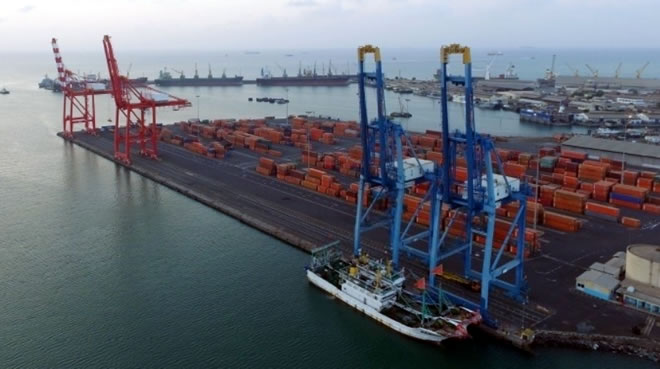
Port of Djibouti (photo: intelligence briefs)
Beijing’s cumulative loans to Africa since 2000 amounted to $124-billion by 2016, according to figures compiled by the China-Africa Research Initiative (CARI).
Djibouti is projected to take on public debt worth around 88 percent of the country’s overall $1.72 billion GDP, with China owning the lion’s share of it.
On March 2018, Djibouti signed a partnership agreement with a Singaporean company that works with China Merchants Port Holdings Co. or CMPort—the same state-owned corporation that gained control of the Hambantota port in Sri Lanka—to build the Doraleh Multipurpose Port.
In recent years, China has emerged as a key investor and a generous, ready and easy lender to African countries.
Beijing’s cumulative loans to Africa since 2000 amounted to $124-billion by 2016, according to figures compiled by the China-Africa Research Initiative (CARI) at Johns Hopkins University School of Advanced International Studies in the United States.
Angola, Ethiopia, Sudan, Kenya and the Democratic Republic of Congo respectively, were the top beneficiaries of these loans. Angola’s oil-related loans worth $21.2 billion since 2000 total roughly a quarter of cumulative Chinese loans to the entire continent.
“Half of those loans were given in the past four years,” Janet Eom, an associate researcher at CARI, told DW. “So Africa’s debt to China is becoming more of a concern moving forward.”
While African Presidents are at least this time round somehow exempted from the indignity of being talked down while clutching their begging bowls at western capitals before a few notes is thrown into their bowls, the readily available Chinese loans are not entirely risk free.
Economists and other international financial institutions are becoming increasingly worried that the East Asian giant under a careful disguised “debt trap” diplomacy is burying many developing and poor countries in massive debt and then forcing the highly indebted countries to hand over some of their key infrastructures’ such as the case of Sri Lanka.
One such African country that is exhibiting all the red flag signals of going Sri Lankan and now Zambian way is Djibouti.
Djibouti lies more than 2,500 miles from Sri Lanka but the East African country faces a predicament similar to what its peer across the sea confronted in 2017, after borrowing more money from China than it could pay back.
In both countries, the money went to infrastructure projects under the aegis of China’s Belt and Road Initiative.
Sri Lanka racked up more than $8 billion worth of debt to Chinese sovereign-backed banks at interest rates as high as 7 percent reaching a level too high to service. With nearly all its revenue going toward debt repayment, in 2017 after being pushed to the wall, Sri Lanka threw in the towel and handed over the Chinese-built port at Hambantota under a 99-year lease with China having a 70 percent stake.
Djibouti is projected to take on public debt worth around 88 percent of the country’s overall $1.72 billion GDP, with China owning the lion’s share of it, according to a report published in March by the Center for Global Development.
At the end of 2016 China owned 82% of Djibouti’s external debt.
On March 2018, Djibouti signed a partnership agreement with a Singaporean company that works with China Merchants Port Holdings Co. or CMPort—the same state-owned corporation that gained control of the Hambantota port in Sri Lanka—to build the Doraleh Multipurpose Port.
That project was completed in May 2017.
The port is significant not only because it sits next to China’s only overseas military base but also because it is the main access point for American, French, Italian and Japanese bases in Djibouti and is used — because of its strategic location — by parts of the U.S. military that operate in Africa, the Middle East and beyond.
One concern is that the Djibouti government, facing mounting debt and increasing dependence on extracting rents, would be pressured to hand over control of Camp Lemonnier to China.
In a letter to National Security Advisor John Bolton in May, Sen. James Inhofe (R-Okla.) and Sen. Martin Heinrich (D-N.M.), two members of the Senate Armed Service Committee, wrote that Djibouti’s President Guelleh seems willing to “sell his country to the highest bidder,” undermining U.S. military interests.
“Djibouti’s now identified as one of those countries that are at high risk of debt distress. So, that should be sending off all sorts of alarm bells for Djiboutians as well as for the countries that really rely on Djibouti, such as the United States,” said Joshua Meservey, a senior policy analyst at the Heritage Foundation.
And that’s not all, China is not done yet with Djibouti, Beijing has been earmarked the country as one of 68 countries set to be involved in its ambitious One Belt and One Road Initiative (OBOR).
Problem is eight of the 68 countries involved in the Belt and Road Initiative currently face unsustainable debt levels, according the Center for Global Development’s report.
The eight nations are Djibouti, Kyrgyzstan, Laos, the Maldives, Mongolia, Montenegro, Pakistan, and Tajikistan.
As past experiences have shown the eight nations will certainly be enticed to chew more than they can swallow and by the end of it end up being even poorer than they are now.
As the cradle of mankind continues to sink deeper into debt condemning future generations to economic slavery, the late Whitney Houston feat Deborah Cox classic ‘Same Script, Different Cast’ has never rang truer.