At least: forty-five women and girls, aged between 16 and 55 drawn from the two main religions, Islam and Christianity have been trained on peacebuilding, mediation and community dialogue in Kasuwan Magani, Kajuru Local Government Area of Kaduna State, North West Nigeria.
The one-day training was organised by Interfaith Women Kasuwan Magani, with support from the Interfaith Mediation Centre (IMC), Kaduna, as part of efforts to strengthen the role of women in preventing violence and promoting peaceful coexistence in communities affected by inter-communal conflict.
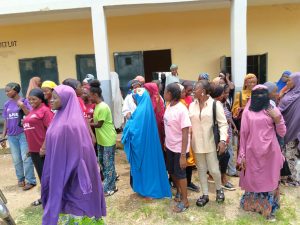 Speaking during the programme, Mr. Jonathan Peter, the organiser of the event, said the training was designed to educate women on practical ways of promoting peace, resolving disputes and strengthening community dialogue.
He explained that women have an important role to play in identifying tensions at the grassroots and preventing disagreements from developing into violent conflicts.
The initiative was particularly designed to respond to Kasuwan Magani’s history of inter-communal tensions, as well as climate-related pressures on livelihoods and natural resources. It brought together women and girls, including widows, young people and survivors of conflict, with the aim of helping them move from being victims of violence to becoming active peacebuilders and first responders within their communities.
The training covered Alternative Dispute Resolution (ADR), mediation techniques, women’s and girls’ rights, Gender-Based Violence (GBV) prevention and survivor support, community-based Early Warning and Early Response (EWER) mechanisms, as well as the relationship between climate change, competition over resources and conflict.
Participants took part in interactive lectures, role-playing exercises and practical simulations designed to strengthen their ability to respond to disputes and emerging threats within their communities.
According to the organisers, assessments conducted before and after the training indicated an 85 percent improvement in participants’ mediation knowledge and performance in mock conflict-resolution exercises.
A major outcome of the programme was the formal establishment of the Kasuwan Magani Women Peace Ambassadors Network, bringing together the 45 participants as a community-based network capable of helping to manage rumours, mediate disputes, identify early signs of conflict and support survivors through appropriate GBV referral pathways.
One participant said the training had changed the way many women viewed their role in conflict prevention.
She noted that women who previously waited for men to intervene in community disputes now felt better equipped to mediate neighbourhood disagreements and take early action to prevent violence from escalating.
The organisers said empowering women with peacebuilding skills could strengthen community resilience because women are often among the first to witness tensions within families and neighbourhoods.
To sustain the impact of the initiative, the project leaders recommended regular follow-up mentoring for the Women Peace Ambassadors Network, stronger links with security agencies and the Kajuru Local Government Peace Committee, and the expansion of similar training programmes to neighbouring conflict-prone communities.
The organisers also stressed the need for continued collaboration among women leaders, religious institutions, traditional authorities, civil society organisations and government agencies to ensure that women remain actively involved in peacebuilding, early warning and community dialogue.
The initiative demonstrates how investing in women’s leadership and practical peacebuilding skills can contribute to preventing violence and building more resilient and peaceful communities in conflict-affected areas.

