Kaduna (Nigeria) – The 2015 Nigerian States Budget Transparency Survey Index has revealed that only three states in Nigeria scored above 50 percent in providing opportunities for citizens’ involvement throughout budget process and making it available to the public, while 21 states score below 25 percent.
The top three states are Ekiti, Cross River, and Lagos while from the bottom is Oyo, Katsina and Kwara state.
In view of this, Budget Transparency Stakeholders present at the North-West Zonal Launch Of the 2015 Nigerian States Budget Transparency Survey Results advocated For ‘Citizens’ Budget’, a simplified form of budget, which will encourage general public participation in the budget process where it will be available and accessible.
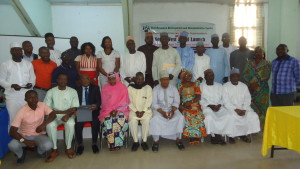
The launch was organized by Civil Resource Development and Documentation Centre (CIRDDOC) in collaboration with the Department for International Development (DFID) and International Budget Partnership (IBP) in Kaduna on Thursday.
Speaking during the launch, Executive Director of CIRDDOC, Oby Nwankwo explained that budgets which are usually voluminous and highly technical when summarize into few pages as well as local languages, will help citizens understand and participate in its process – they are able to improve the decisions made about what to spend public money on and the quality of how the money is actually spent; as such it will help in fighting corruption by enhancing openness and transparency.
The Executive Director who was Represented by Ralph Ndigwe noted that, when the citizens are not knowledgeable, no matter the number of town hall or stakeholders meetings government holds, “it is completely irrelevant and unproductive”; adding that, it is productive only if the number of people attending the meetings understands and are able to make inputs as well as follow up when necessary.
“The essence of openness and transparency is that, it makes people in government accountable – citizens can make probes if any contract given is not executed; by that, lives are improved upon and it also helps government to govern better.
According to Ndigwe, the developed survey is the first independent assessment investigating transparency and public participation in the budgeting and procurement processes in Nigerian states; noting also that the report compares the performance in all the 36 states of the country where it identifies best practices and recommends how state budgeting and procurement systems can be open and participatory.
“The project is intended to contribute to enhancement of government accountability through transparency in budget planning and implementation. It entails collecting, collating and analyzing data, and scoring and ranking the performance of the 36 states.”
The North-west CIRDDOC Zonal Coordinator, Abel Adejor said in the North-west geopolitical zone, there is the non-production of the citizens’ budget and most of the states don’t make their budget available to the public. He gave the overall State Transparency Budget Index as; “Jigawa scores the highest with 54 percent, followed by Sokoto with 34 percent, Kebbi – 23 percent, Kano – 18 percent, Zamfara – 13 percent, Kaduna – 7 percent and Katsina state having the least with 6 percent.
The Kaduna State Minority whip cum Chairman, House Committee on Public Account, Samuel Tanko said with the new government, the state will top the 2016 index survey as the state will make judicious use of the state media to get grassroots participation so as to carry everyone along.
The launch has in attendance independent researcher and directors from all the north-west states, where the directors promised to take the necessary approach towards improving their state’s index.
Liberia’s Central bank has on Thursday confirmed the appointment of President Ellen Johnson Sirleaf’s son, Charles Sirleaf as interim governor of the bank despite his previous suspension from the institution for failing to properly declare his assets.
Charles Sirleaf was deputy governor of the bank until his promotion to interim governor on Wednesday, but in 2012 was temporarily suspended on his mother’s orders for breaching declaration rules.
The bank confirmed the appointment to AFP on Thursday but would not comment further.
It was unclear how long he was expected to remain in the interim governor post or when a permanent replacement would be named.
His appointment has raised fresh allegations of nepotism against Sirleaf following the short-lived appointment of another son, Robert Sirleaf, to the National Oil Company of Liberia.
Robert Sirleaf was forced to resign in 2013 after attracting heavy criticism, and went on unsuccessfully contest a Senate seat in 2014.
The outgoing governor of the central Bank of Liberia, Mill Jones, resigned his post two weeks ago to enable him to stand for the presidential elections due to take place in 2017.
Jefferson Knight, head of human rights monitoring at the influential United Methodist church in Liberia, told AFP he believed Charles Sirleaf was appointed primarily due to his name.
“There are so many Liberians who are qualified for that post, why it is only he who will be elected? This is nepotism,” he said.
“I am sure the president is testing the water and I hope she will do the right thing by appointing another person. Though we don’t know for how long her son will remain as interim head, this does not smell good,” Knight added.
“Liberians spoke against it until Robert resigned. That will also be the case with Charles Sirleaf’s appointment.”
Ordinary Liberians were also quick to express their anger Thursday.
“This is the same nepotism Leymah Gbowee was referring to when she resigned her post from the government,” said Patrick Tokpah, an educator.
Gbowee, a Nobel Laureate like Sirleaf, resigned as head of Liberia’s reconciliation commission in 2012 accusing President Sirleaf of failing to fight graft.
In a 2013 Transparency International survey, 96 percent of respondents said they felt that Liberia’s lawmakers were corrupt or extremely corrupt, and 77 percent reported paying a police bribe in the last year.
Kaduna (Nigeria) – Nigeria’s Minister of Labour and Employment, Chris Ngige has urged the International Organization for Migration (IOM), to support the Federal Government’s vocational skills acquisition program as well as promote trade test certificate issued by the ministry for skills export.
A statement by the ministry’s director of press, Samuel Olowookere noted that the Minister sought for the partnership recently when he received on courtesy visit the Chief of Mission, International Organization for Migration, Ms Enira Krdzalic.
While calling on IOM to do more in the area of advocacy, publicity and sensitization through the newly established Migrant Resource Centre under the 10thEuropean Union Development Project, the minister observed that many skilled youths took the part of irregular migration which is dangerous due to lack of information.
According to him “irregular migration is one of the worst problems we have. Some of these migrants have skills and vocations that can actually put them on the part of regular migration, but because they lack the information and knowledge, they veer off and undertake the part of irregular migration which has caused them a lot of hazard.”
Ngige added that, the ministry’s partnership with IOM will afford skilled Nigerians the opportunity to work abroad as regular migrant with relevant documents thereby reducing the spate of irregular migration and the dangers it posed to the youths.
Earlier in her remarks, the Chief of Mission for IOM, Ms Enira Krdzalic said her organization is partnering with the Ministry to promote gainful employment opportunities as government alone cannot generate all the needed jobs.
She said, IOM has assisted the ministry in upgrading the National Electronic Labour Exchange Portal (NELEX), including establishment of six job centers in Lagos, Asaba, Awka, Bauchi, Kaduna and Abuja; as well as the establishment of Migrant Resource Centre for easy dissemination of information to intending migrants.
Kaduna (Nigeria) – Governor Nasir El-Rufai of Kaduna State, northwest Nigeria, Tuesday resumed demolition exercise of houses in Kaduna, focusing on the New Millennium city layout.
Eyewitnesses told AFRICA PRIME NEWS that a team of workers from Kaduna State Urban Property Development Authority (KASUPDA) stormed Hayin Dan Bushiya area of the New Millennium city accompanied by Seven hilux vans of ‘Operation Yaki’, the joint military-police security outfit in Kaduna State, heavily armed.
Our reporter who visited the area saw a bulldozer working at pulling down between three to five houses.
The media was prevented from going close to the point by the heavily armed security men, and people of the area stood and watched helplessly.
El-Rufai however said the printers village was demolished without his consent, leading to the suspension of Kaduna North Local Government Chairman, Ahmed Kurfi, who ordered the exercise.
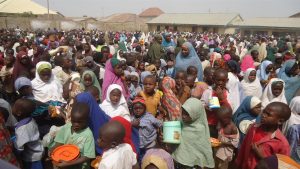
Rigasa primary school pupils in Kaduna state, collecting food under govt's school feeding programme
By Longtong Ibrahim
Kaduna (Nigeria) – Governor Nasiru El-Rufai of Kaduna State, northwest Nigeria, declared a state of emergency in the education sector soon he came into office, by introducing free and compulsory basic education, as well as announcing free feeding of pupils and distributions of uniforms to all secondary students in public schools across the state.
He also made the sector one of the priorities of his administration, where he stressed, ‘no child of school age should be seen on the streets hawking during school hours’.
No doubt, education is the cornerstone for the development of every nation, so, investing in it will create an avenue for the advancement of any given society and securing its future.
Reports by Consortium for Research on Educational Access, Transitions and Equity, (CREATE), notes that over 60 million children of primary school age are not in school, mostly in sub Saharan Africa and South Asia.
According to UNESCO, 40 percent of children aged 6-11 in Nigeria do not attend any primary school, with the northern region recording the lowest school attendance rate; it added that, despite a significant enrollment in recent years, it is estimated that about 4.7 million children are still not in school.
In an attempt to fight illiteracy and extend basic education to all children in the country, Nigerian government introduced the universal basic education scheme, by passing into law the compulsory, free universal basic education (UBE) Act in 2004.
Pronouncement by governments in the country on provision of free basic education and even free feeding in some states Kano, Osun, Lagos, etc, has led to increase in enrolment rates. These are laudable policies which will not only boost school enrolment and attendance, but also ensure education for all and create a better future for them and the country.
However, poor learning environment has remained one greatest challenge in the educational system in the country.
The challenges range from inadequate or unavailability of school facilities like classrooms, weak infrastructure, as well as teachers, to handle the high number of school children, hence the expected result becomes less effective.
In Kaduna for instance, Governor El-Rufai during the flag-off ceremony of the free feeding programme noted that, the feeding intervention was necessary to boost nutrition, health of the children, and also encourage school attendance; stating further that the free feeding program will expand access to education and ensure that every child have nine years of free, decent basic education, no matter the income level of their parent.
This development has attracted lots of commendations from various stakeholders within the state and country at large. It has also attracted lots of pupils and students’ enrolment, which is now affecting the quality of access and the effectiveness of the program.
A visit by AFRICA PRIME NEWS to some of the public primary schools within communities of the state shows that the free feeding program has begun in earnest and has attracted great influx of pupils’ enrolment; it was also noticed that most of the schools have stopped offering admission to children, because government has already stopped capturing pupils in the school feeding programme.
Inadequate infrastructure and other facilities like chairs, desks, classroom buildings, toilets, as well as teaching aids were also noted in schools visited.
In UBE primary school, Layin Biliya, Rigasa, a ward in Igabi Local government Area – the number of pupils has sharply risen up from 2,234 to 19, 954 – this has drawn the attention of the aid organisations and more than 20 other community volunteers to help in crowd control during food distribution.
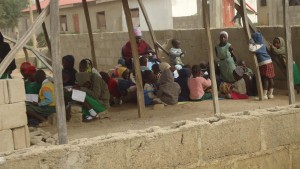
AFRICA PRIME NEWS observed that the school has only eight classrooms for its over twenty thousand pupils; most of the pupils are seated on the floor inside their classes; those who do not have the opportunity to be inside the class were seen seated on the ground in the open field of the school compound.
The school also has limited teachers; no toilets facilities, and the walls of the school fence were used as chalk board by some teachers who were conducting class outside.
More than 80 percent of the pupils were not wearing the Kaduna adopted green and white uniforms – they were expecting the State Government to provide them with school uniforms [the state government however only promised secondary students uniform].
Most pupils roaming were seen carrying plates for collecting food, instead of books and other writing materials.
AFRICA PRIME NEWS also observed that when it was break time (feeding time), some street beggars in the area were pushing their way into the school to get some share of the food.
Food distribution took more than the 30-minute break time, and immediately the pupils collected their meal, majority of them left for home – it was difficult for the authorities to control the over twenty thousand pupils divided into morning and afternoon session.
The population of pupils made the food sharing process difficult – the children struggle, they get out of control – the little ones were trampled upon, many of them sustaining various degree of injuries in the process.
School Unit Coordinator of Red Cross of Igabi Local Government Area, Safiliyu Adamu Bawa, who has been providing support in crowd control said by the end of week two of the school feeding programme, the organisation has recorded more than 260 casualties, comprising of the wounded and those who fainted.
Headmaster of the school, Joseph Audu while commending the state government’s feeding program said, “to reduce the pressure of population, the pupils had been shared into morning and afternoon school session.”
He admitted that pupil population does not make the environment hygienic for feeding, noting that, the school needed more classrooms, as well as renovation of existing facilities to make the environment conducive for learning.
“Even before now there is a need; in my office the table is 3 legged, not to even talk of desk and chairs in the classes,” he added.
Chairman of the School Based Management Committee (SBMC) Idris Sheriff called on Kaduna state government to post more teachers to the School.
Noting however that there is no space for expansion, he advised the government to purchase a building close to the school where the owner have agreed to sell the property for the school expansion.
Sheriff also called on parents to provide their wards with uniforms and books, and not to wait on government for such.
Amina Halilu, a concerned parent, urged El-Rufai, to as a matter of urgency stop the feeding programme, even if it is for three months and provide classrooms for the pupils, emphasising that children cannot learn anything in the present condition.
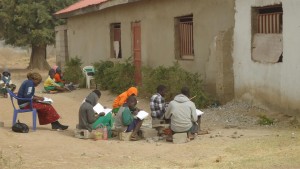
At another primary school in Ungwan Maigero, a community in Chikun Local Government, pupils population was about 170; all pupils were receiving their teachings in an open field, under the trees – ceiling board was used as blackboard.
AFRICA PRIME NEWS gathered that parents have asked their children not to eat the food provided by vendors under the scheme on grounds of hygiene.
This stemmed from government’s failure to honour its promise of engaging food vendors from the community, as obtained in other areas. [the Commissioner for Education had in a media briefing promised to address such cases within two weeks, but as at the time of filing this report, it was still being reported in a number of other schools].
A member of the Maigero community, who declined from giving his name, decried the state of their school saying, several calls on the state universal education board to come and erect school structure yielded no results.
He appealed to the Kaduna government to convert money meant for feeding of pupils in their community to capital votes and raise structures to enhance learning for their children.
He said, “for example we have about 170 pupils and if the N50 for food can be converted to building of classes, at least in a month we will have almost N170, 000 and in three months we may get more than a 500,000 – that will go a long way in helping us have structures for this children.”
He added that a structure which was started some time ago was brought down by rain, during the last rainy season, and since then, the pupils were been taught in an open field, exposed to the harsh weather.
Cases of decayed infrastructure and inadequate facilities were observed in a number of public primary schools visited, including Narayi LGEA primary school in Chikun Local Government Area and Tudun Wada LEA Primary School on polytechnic Road, in Kaduna South Local Government Area, where most pupils were seen seated either on bare floor or on broken chairs taking lessons.
Kaduna (Nigeria) – The Internally Displaced Persons (IDPs) who recently returned from Cameroon Republic camping in Gamboru Ngala of Borno State, North-east Nigeria have received succor from the National Commission for Refugees (NCR).
The relief materials brought and distributed to them include mobile clinic, foodstuff, building materials, and school materials; others are household items like bedding materials, plastic buckets, bowls, leather mats, clothing for children and toiletries among others.
Presenting the relief materials to the Caretaker Chairman of Ngala Local Government Council, Abdulrahman Abdulkarim, for onward distribution, the Federal Commissioner of the Refugees’ Commission, Hadiza Kangiwa said the items were meant for the returnees who fled their homes following the Boko Haram insurgency to the neighboring country for safety. She noted that, they are essential materials to start a home.
While calling on national and international partners for support, she said the commission would not relent in giving assistance the group.
Abdulrahman Abdulkarim, while distributing the items to the refugees urged the beneficiaries to be steadfast in their prayers for peace to return in the area and state at large.
Meanwhile, the Nigeria Security and Civil Defence Corps (NSCDC) has arrested a suspect, Bukar Ladan, 50 in Mairi area of Maiduguri for allegedly defrauding 9,000 IDPs of N27 million under the guise of supplying foods stuffs.
NSCDC Commandant of Borno State command, Abdullahi Ibrahim said the suspect allegedly collected N300 from each of the 9, 000 IDPs who are currently taking refuge in different camps in the state capital, Maiduguri
He noted, “Our men found out that some of the women in the IDPs camp were grumbling that they have paid for food supply without being delivered.
“It is very unfortunate that some people will go to this length and defraud this people who had suffered great trauma in the hands of Boko Haram insurgency.
“After going to the man’s house, we discovered that he did not have anything worth N10, 000. We don’t know what they are using the money for, but we are still investigating him”, the Commandant added.
He however cautioned the IDPs to be vigilant and wary of people around them.
Pagak/Juba – The military command of the Sudan People’s Liberation Army-In Opposition (SPLA-IO) has accused and condemned government forces for carrying out what it described as senseless killing of children in Bhari area West of Mundiri.
Colonel William Gatjiath Deng, the spokesperson for the SPLA-IO released a statement, saying Juba-backed troops carried out multiple attacks against rebel forces and civilians who live in Kediba and Lui Payams, saying the attacks resulted in the killing of seven innocent children and wounded several others.
“South Sudan army SPLA/Juba faction this morning [Sunday] attacked cantonment site of SPLA-IO, killing 7 children and wounded several others around Katiba village in Bhari land, 20 Miles far West from Mundiri County,” Col. William said.
The senior rebel army officer added that heavily armed government forces are constantly shieling SPLA-IO positions in and around Western Equatoria state, adding that government forces are also carrying out random killings, looting, and burning down civilian homes.
The SPLA-IO’s spokesman states that government troops have for the last four days been intensifying their attacks against the SPLA-IO forces in Western and Eastern Equatoria States.
The military command of the armed opposition further accused South Sudan’s government of sending reinforcements from Yei and Maridi in an attempt to “terrorize” civilians.
Col. William reveals in the statement that a huge number of government forces are marching toward areas largely inhabited by civilians and asserts that the SPLA-IO will not tolerate what he described as “unethical behaviors and aggression against the civil populations.”
William also warned of peace collapse if government keeps attacking rebel-held territories.
South Sudan’s rival forces have been trading accusations over ceasefire violations, despite the IGAD-Plus brokered power-sharing deal.
Nigerian Government on Monday relieved the heads of its six media – related parastatals from duties.
Minister of Information and Culture, Lai Mohammed, announced the disengagement at a meeting with the Chief Executives of the affected organisations, i.e Nigerian Television Authority (NTA), Federal Radio Corporation of Nigeria (FRCN), Voice of Nigeria (VON), News Agency of Nigeria (NAN), Nigerian Broadcasting Commission (NBC) and the National Orientation Agency (NOA) on Monday.
Mr. Lai directed the disengaged persons to hand over affairs of the agencies to the most senior officials in their various establishments.
He thanked them for their service to the nation and wished them the best of luck in their future endeavours.
The affected Chief Executives are the Directors-General of NTA, Mr. Sola Omole, FRCN (Mr. Ladan Salihu), VON (Mr Sam Worlu), NOA (Mr. Mike Omeri), NBC (Mr. Emeka Mba) and the Managing Director of NAN (Mr. Ima Niboro).